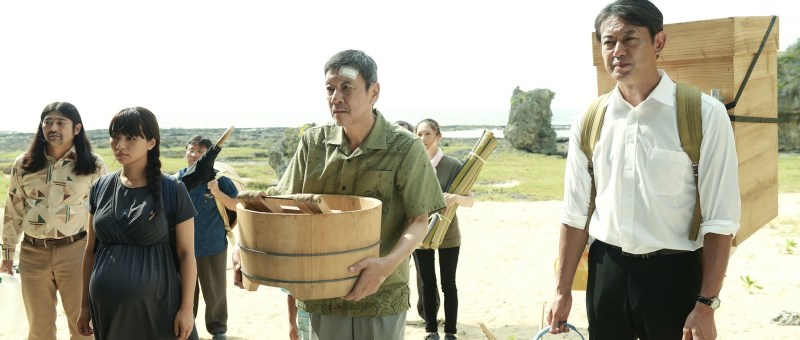
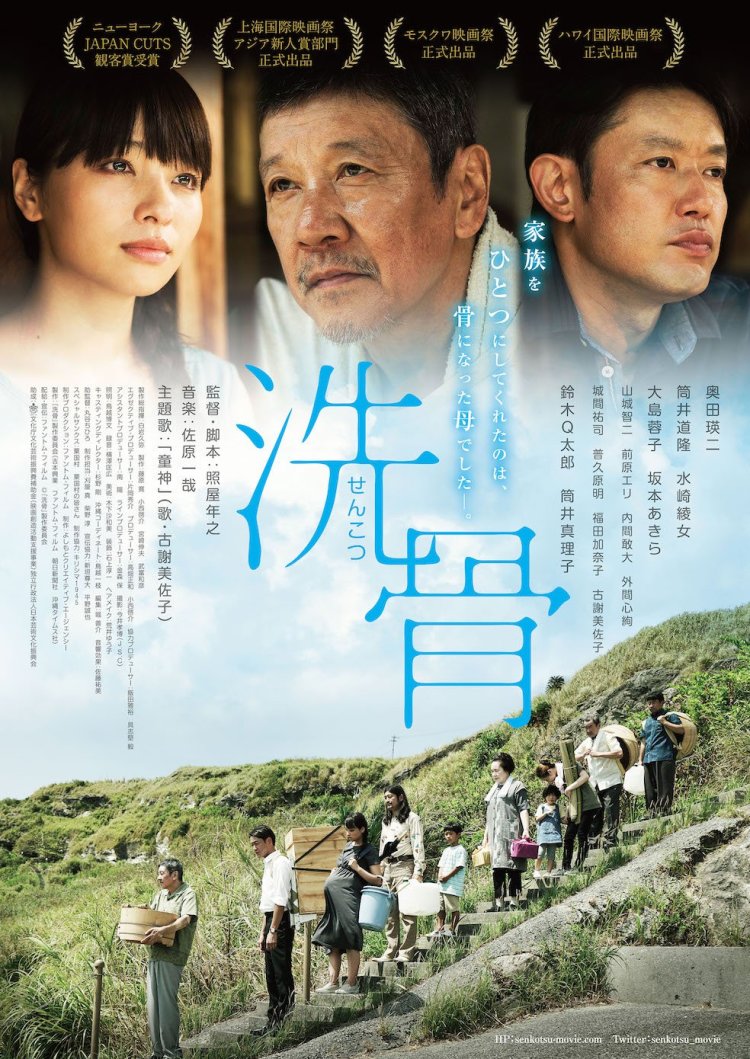
 “Is this really Japan?!” asks the bemused boyfriend of the protagonist of Born Bone Born (洗骨, Senkotsu), only to be met with the reply “on paper, at least”. Comedian Toshiyuki Teruya, better known as Gori, returns to his native Okinawa for his second feature but to an island culture of which he was completely unaware. Aguni is one of the last on which the ancient ritual of “Senkotsu” or “bone washing” still takes place.
Beloved matriarch Emiko (Mariko Tsutsui) died four years ago. Now the time for her “senkotsu” is approaching. Daughter Yuko (Ayame Misaki) has come home, but with a secret. She is heavily pregnant and as yet unmarried, a fact she knows will scandalise the still conservative island community. Meanwhile, her her father Nobutsuna (Eiji Okuda) has retreated into drunken reverie, unable to accept his wife’s death or the many disappointments of his life. Yuko is waiting for her brother, Tsuyoshi (Michitaka Tsutsui), to arrive before explaining any further about the baby, but he even he is much less supportive than she hoped he might be and seems to be dealing with some troubles of his own which might explain why his wife and daughter have not accompanied him on this very difficult family occasion.
The island of Aguni practices open air burial, which is to say the bodies are enclosed in a wooden coffin and entombed in cave. Four years later the relatives return, retrieve the body and wash the bones before re-enclosing them in a smaller casket which will then be interred on the island’s “other world”. It is, of course, a difficult and frightening prospect to consider seeing one’s loved ones in such an altered state – so much so that many cannot bear to do it without getting roaring drunk which at least ameliorates the solemnity of the occasion. The human terror is in a sense the point as an exercise not only in memento mori but in acceptance of total loss and the finality of the physical.
Before all that, however, you still have to live and the Shinjos are having a fairly hard time of it. A small island somewhat trapped in the past, Aguni is intensely conservative and so the local old ladies can’t get their heads around Yuko’s unwed pregnancy. Yuko of course knew this would be the case but could hardly refuse to come and has braced herself for the worst of it. However, after the initial shock has worn off, she finds an unexpected ally in her stern aunt Nobuko (Yoko Ohshima) who assures her that if she finds it hard to raise the child on her own she can always come back to the island where she and Nobuko’s daughter will help if needed. Her father Nobutsuna, in boozy fog as he is, is also broadly supportive even if her brother shows little sign of coming round, engaging in unexpected small town conservatism as he accuses his little sister not only of shaming the family but of becoming a burden on it too.
In a motif that will be repeated, it’s the men who struggle to cope with loss while the women get on with life with stoicism and fortitude. Nobutsuna has remained unable to come to terms with Emiko’s death, drinking himself into oblivion while blaming himself for placing undue strain on her after their family business went bust. Nevertheless he is a good hearted man who wants the best for everyone even if his mild-mannered deference has Tsuyoshi sniping at the sidelines for his supposed fecklessness. He too blames his father for his mother’s death, but is also struggling with the elders’ expectation that he will return home to the island to take over as head of the family while there is evidently something else going on in his life which has left him irritable and judgemental.
If nothing else the Senkotsu ritual forces each of them to accept the fact of Emiko’s death, but also of her life and their own place within a great chain of humanity stretching both forward and back. In a sense, as Tsuyoshi puts it, it’s their own bones they’re washing in honour of the undying part of Emiko that exists in all of them and something of her kindly spirit certainly seems to be present on the beach that day as the family slowly repairs itself, emerging from their deep seated grief back to the friendly island solidarity as they resolve to treasure what they have in acknowledgement of what is to come.
Born Bone Born was screened as part of the 2019 Japan Foundation Touring Film Programme.
Original trailer (no subtitles)
 Making a coming of age film when you’re only 14 is, in many ways, quite a strange idea but this debut feature from Ryugo Nakamura was indeed directed by a 14 year old boy. Focussing on a protagonist not much younger than himself and set in his native Okinawa, Catcher on the Shore (やぎの冒険, Yagi no Boken) is the familiar tale of a city boy at odds with his rural roots and the somewhat cosy, romantic relationship people from the town often have with matters of the countryside.
 Windows on Worlds