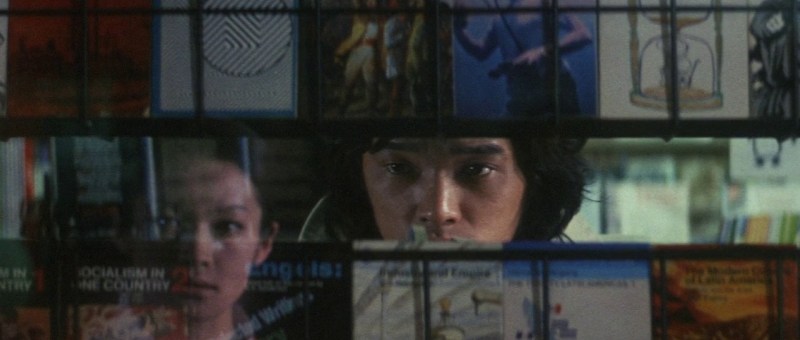
The Petrified Forest (化石の森, Masahiro Shinoda, 1973)

An angst-ridden medical student wrestles with truth and responsibility while drawn into a toxic relationship with a childhood friend and trying to avoid the estranged mother he resents in Masahiro Shinoda’s dread-laden melodrama The Petrified Forest (化石の森, Kaseki no Mori). Based on a novel by Shintaro Ishihara who later became a very conservative mayor of Tokyo and made his name with a series of “Sun Tribe” novels centring on the nihilistic hedonism of wealthy post-war youth, Shinoda’s noirish drama paints contemporary Tokyo as a duplicitous place in which hate is the only possible emotion and self-delusion the only path out of existential loneliness. 

Haruo’s (Kenichi Hagiwara) first conflict, however, is with the medical profession. He objects to the old-fashioned methods of his professor, Miyaji (Torahiko Hamada), who adopts the position of the physician as god only giving his patients the information he thinks they should have rather than the truth. A young boy, Kazuhiko (Masami Horiuchi ), is brought in with an aggressive brain tumour. Given how how quickly it regrows, there is a possibility that the boy cannot be cured while operating will likely mean he will lose his hearing. Though Miyaji knows all of this, he continues to give false reassurance to the boy’s mother, Kikue (Masako Yagi), even after making a snap decision on the table to excise the tumour knowing it will leave him deaf telling her that her son’s hearing might come back in time. Pressed for an answer, Haruo gives her the more honest prognosis that it “might”, “if he’s lucky”, but resents himself for “lying” knowing that Kazuhiko will be deaf all his life and the tumour may still recur. One of the reasons he wants Miyaji to tell the truth is so that the family can accept the situation and start working on the best ways to help Kazuhiko adjust, but Miyaji refuses to explain and in fact threatens to fire him if he won’t do as he’s told.

This resistance to a male authority figure might explain why he identifies so closely with childhood friend Eiko (Sayoko Ninomiya) now in Tokyo working at a barber’s offering male beauty treatments. Eiko is being sexually harassed by her middle-aged boss who is jealous and possessive. At one point she claims that he beat her and locked her up in a cupboard for two days after she told him she had slept with Haruo. The pair agree that he boss needs to die, rebelling against his corrupt and patriarchal authority. ”When you hate you must hate all the way” Haruo insists, explaining that the human race is “petrified”. They can only hate and loathe and lie to themselves in order to bear it. Haruo suggests they’ll eventually come to hate each other, but Eiko is certain that he’s her one exception though as will be revealed hate is eventually where they will end up. 

Fascinated by a high tech pesticide supposedly discovered by the Germans while they were testing poisonous gases but perfected by Japan Pharma, Haruo decides to use it poison to Eiko’s boss suggesting she put it in nail varnish and offer him a manicure. But once the deed is done he finds himself conflicted, unable to live with himself as a murderer which he now is seeing as he was present and applied the gauze soaked in the poison to the boss’ face while “treating” him after he had been “taken ill”. He distances himself from Eiko who irritates him by bringing over her hoover, somehow confused by her intention to move in now that they are married not least by their crime. Eiko, however, allies herself with his estranged mother Tatsuko (Haruko Sugimura) who is desperate to live with Haruo as it turns out by any means possible. 

There is an undeniable whiff of misogyny in the depiction of the two women, Eiko less damsel in distress than wilful manipulator and Tatsuko a classic overbearing mother though one apparently indifferent to her other two children including an apparently doting younger son. Haruo is caught between the two while otherwise drawn to Kikue in part because of her relationship with her son laying bare the apparent mother complex which defines his life as Eiko eventually points out calling him a coward who secretly craves his mother’s approval. Haruo’s resentment towards Tatsuko stems from having caught her with another man, his reaction both sexual jealously and puritanism unable to forgive for the transgression of adultery. Yet history later repeats itself, Kazuhiko who is at that point deaf walking in on Haruo and his mother. Haruo hugs him and covers his eyes only for the boy to later lose his sight and Kikue to go out of her mind wailing that she has destroyed her son through her sexual transgressions. 

Kikue had taken Haruo to a strange cult where she hoped Kazuhiko would be cured though he wouldn’t enter the church and later got into a conversation with the monk who is a former doctor but now believes medicine is a con because it cannot offer you salvation tacitly agreeing with Haruo’s assertion that doctors too are dishonest. This tendency to hate has rendered everyone lonely, Tatsuko’s daughter reminding her that she is lonely too even with her husband and children while Tatsuko later cruelly uses Eiko’s loneliness against her as a tool of manipulation. “Eiko trusted me too much” she explains, her attempt at female solidarity and forging a bond through their shared desire to possess Haruo obviously failing to overcome Tatsuko’s matriarchal machinations. The eerie blue colour of the poison vial, mirrored in the nebuliser forever used by Tatsuko, seems to loom behind them as a reminder of human loathing while mother and son are frequently caught in multiple mirrors in an echo of their duplicity yet in the end as Tatsuko says they share the same sin and it seems Haruo will never really be able to escape the matriarchal net.


The Inugami Family (犬神家の一族, Kon Ichikawa, 1976)

the inugami family 1976 posterUnlike many of his contemporaries, Kon Ichikawa was able to go on working through the turbulent ‘70s and ‘80s because he was willing to take on purely commercial projects. The phenomenal and hugely unexpected success of 1976’s The Inugami Family (犬神家の一族, Inugami-ke no Ichizoku) set him in good stead for the rest of the decade during which he followed up with another four movies starring Koji Ishizaka as the eccentric detective Kosuke Kindaichi as featured in the novels of Seishi Yokomizo each of which was a bonafide box office success partially thanks to the effect of Haruki Kadokawa’s intensive multimedia marketing strategy then still in its infancy. In fact, Ichikawa would return to the sordid world of the Inugamis for his final picture in which he dared to remake his “greatest hit” with a now much older Koji Ishizaka reprising his role exactly 30 years later. Ichikawa might have been making “commercial” movies, but he never lost his experimental spirit.

Old Sahei Inugami (Rentaro Mikuni) finally drops dead in 1947 after a lifetime of seemingly doing exactly as he pleased. As a 17-year-old orphan he was taken in by a kindly priest and thereafter founded one of the biggest pharmaceuticals companies in Japan which is to say he leaves behind him a vast estate and desirable name. Unfortunately, he also leaves a messy family situation. Sahei was never legally married, but fathered three daughters with three different women who each have a son. In his 50s, he also fathered a son with his maid who would be about the same age as the grandchildren if anyone knew where he was. Sahei’s will, which in dramatic fashion can only be read with everyone present, leaves everything to a young woman, Tamayo (Yoko Shimada), who isn’t even part of the family but was doted on all the same by the elderly patriarch. In order to inherit, Tamayo must consent to marry one of the three grandsons – Suketake (Takeo Chii), Suketomo (Hisashi Kawaguchi), or Sukekiyo (Teruhiko Aoi) with whom she seems to have shared a past attachment. The will stresses that she is free to choose though if she decides to marry someone else entirely, the fortune will be divided in five with one part each to the grandsons and the rest to the maid’s son. As one can imagine, the daughters are furious.

Kindaichi is called in by a clerk (Hajime Nishio) at the solicitor’s office who has seen the will and finds it all decidedly strange (plus he’s in love with Tamayo so it’s very bad news for him). The clerk gets murdered before he can spill the beans, but the solicitor himself, Furudate (Eitaro Ozawa), decides to enlist Kindaichi’s help in figuring all of this out before it claims any more lives. Unfortunately, claim more lives it will.

Greed, as ever, is at the root of all evil but like the other entries in the Kindaichi series the crimes are largely a result of the world which surrounds them. Old Sahei made his money in some dubious ways. Ingratiating himself with the rich and powerful, later becoming a militarist for what seems like opportunistic reasons, he got himself special dispensation to grow poppies for their medicinal properties. Which is to say, he got rich selling opium to the masses. Inugami pharmaceuticals profited hugely from suffering incurred in wars spanning the century – with Russia, with China, through the first world war and the second. There was Inugami, ready to fuel the fire by numbing the pain.

Yet it’s his own unresolved emotional suffering that seems to have sent him such a dark and amoral path. Later we discover that a strange and emotionally difficult set of circumstances involving a quasi-incestuous, bisexual love triangle seem to have left him craving something to numb his own pain but only succeeding in passing it on to those around him. Firstly through the women he kept around to satisfy his carnal desires and then sent away, keeping the children with him but in a loveless, austere home. The sisters – Matsuko (Mieko Takamine), Takeko (Miki Sanjo), and Umeko (Mitsuko Kusabue) share an uneasy sort of camaraderie but are quick to turn on each other when it becomes clear that only one of them will inherit the family fortune and that they are now each rivals for the hand of Tamayo.

Like their grandfather, the Inugami boys are not an especially good catch. Two of them eventually attempt to rape Tamayo in an attempt to force her into marriage through shame (despite the fact that one has already fathered a child with his cousin), while she also has her doubts that Sukekiyo, with whom she has always felt a connection, is really who he says he is. Having gone away to the war, Sukekiyo did not return home after being demobbed because of intense survivor’s guilt. He also sustained severe burns to his face which require him to wear a latex mask over his entire head making positive identification difficult seeing as his voice, which he rarely uses, is also changed.

Rather than submit himself to the necessarily pokerfaced approach common to prestige murder mysteries from across the globe, Ichikawa uses the saleability of the property as an excuse to go all out. His tone varies wildly, almost to the point of parody in his frequent cuts to Kindaichi causing another of his famous anxiety induced dandruff avalanches. The blood eventually flies as do severed heads while upended corpses do handstands in lakes. The story of the Inugami family is a strange one filled with moments of bizarre whimsy but somehow it all works. As in many a Japanese mystery, the past refuses to die and the guilty eventually realise how misguided their enterprise has been, but there is hope for those left behind if they can free themselves from the cycle of guilt and suffering on which the Inugami name was built.


Original trailer (no subtitles)