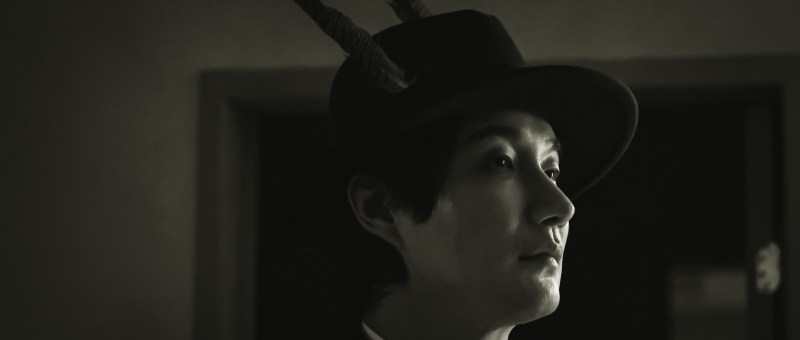
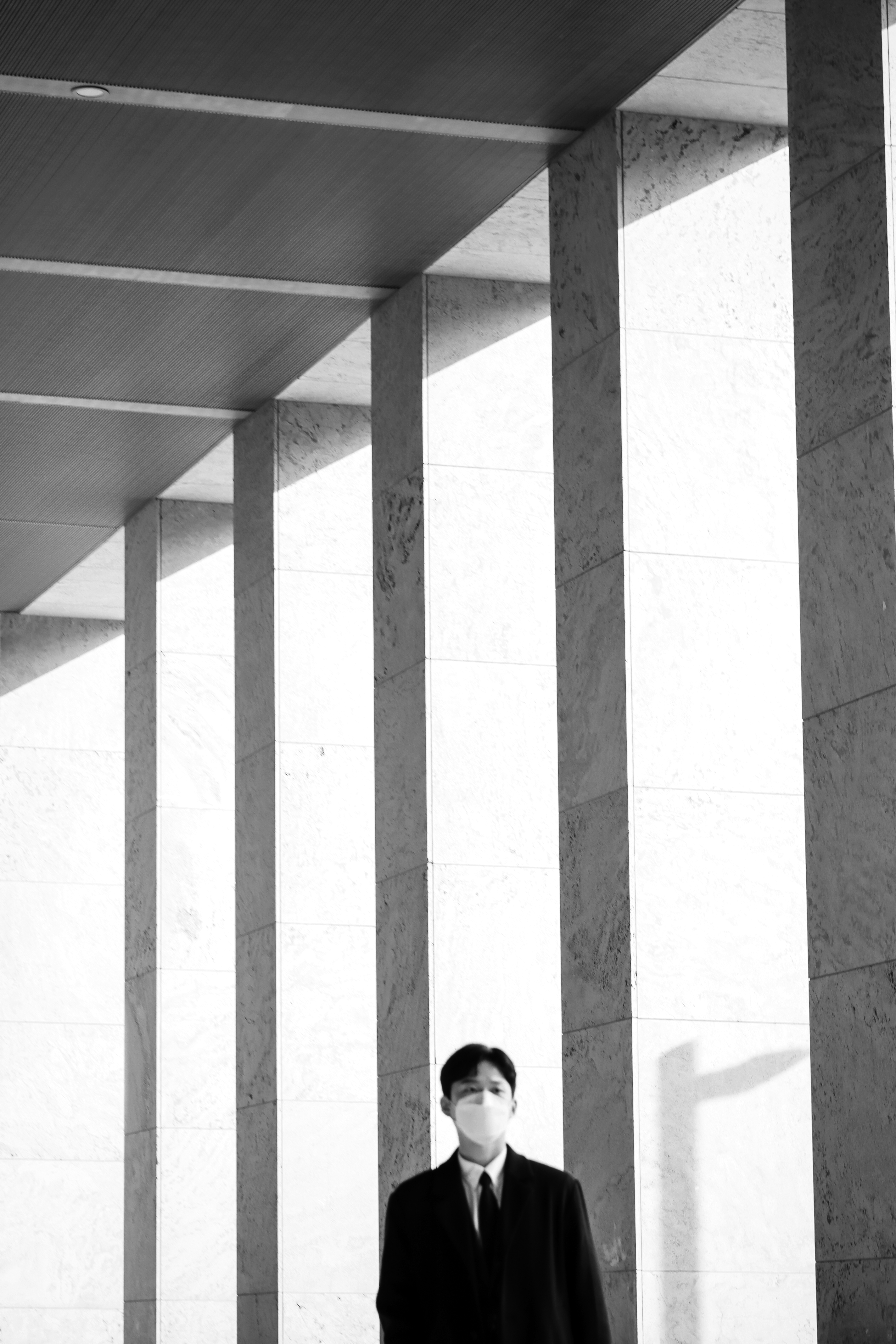
“Think carefully. Think about why you can’t leave here, and what keeps you from leaving,” runs the opening and closing dialogue of Yoon Eun-gyeong’s elegantly lensed monochromatic dystopian drama The Tenants (세입자, Seibja) in which the citizens appear to be trapped in an abusive relationship with a toxic city that offers what it claims are attempts to help the struggling get back on their feet but which are really constraints to prevent them from leaving.
At least that’s what Shin-dong (Kim Dae-gun), a hard-working if apparently average officer worker, discovers when his landlord, who appears to be a child who has taken over this role from his still living mother, informs him that he wants to remodel the building to attract higher quality tenants and effectively bamboozles him into the idea of moving. Only, in this near future society, moving isn’t an easy thing to do and Shin-dong is struggling to pay his rent already for an apartment he barely occupies considering all the unpaid overtime he does just to show willing in the hope of career advancement. His friend in a similar position informs him of a loophole, that ironically enough as other kinds of tenants have rights, if he sublets part of his apartment his landlord won’t be able to kick him out.
Only the pair of lodgers he acquires are strange in the extreme. A very tall man in an alpine hat with two feathers that looks like bunny ears arrives with a decidedly childlike wife who appears not to speak much Korean and just smiles creepily while standing behind him. To make matters stranger they insist on living in the bathroom, because the wife has bowel issues, which also means Shin-dong has to start using communal facilities which turn out to be much busier than expected with similarly troubled office workers. Meanwhile, he starts to feel like someone is watching him and wakes to find one of the pair staring at him in his sleep.
Understandably, he regrets the arrangement but ironically he’s now in place of a landlord himself and feels awkward about asking the couple to leave while forced to acknowledge that they also have rights as tenants which include those to sublet the part of Shin-dong’s apartment he sublet to them. In this way, his space is literally shrinking but it’s also as if the city is further encroaching on his life. He explains that he’s a solitary person and much prefers to live alone but is prevented from doing so by the socio-economic conditions which surround him. His colleague calls him a hardworking loser who just makes trouble for everyone else with his constant overtime while he has invested in making closer ties with the boss in the hope of getting a promotion that way.
But it appears the only way out of this toxic city which is literally choking Shin-dong with its low quality air is to get a transfer to the new utopia of Sphere 2, an idyllic future settlement with a purified air system advertised in both Korean and Chinese on his morning commute. The fact that Shin-dong works for a friendly corporate entity titled “Happy Meat” which apparently manufacturers ethical, cultivated meat products adds to the sense of unreality in which everything is somehow fake or a little less than you might have been expecting while things are that marketed as positive attempts at kindness are also in themselves a little bit toxic as Shin-dong works himself harder than the most earnest donkey and gets nothing back in return save the ability to think of himself as someone with the status of “officer worker” which at least confers a degree of respect.
That might be one reason he’s disgusted by the idea of the attic dweller underclass who are, he’s warned, a little bit dangerous having been driven out of their minds by their dismal circumstances and prone to sometimes violent delusions. A less than helpful medical professional advises him to “reduce his thoughts”, which doesn’t seem like a very good long term solution even in this “zombie-like” city though even when he’s been given a chance to escape Shin-dong is told he’ll have to cancel his lease first, which means getting his tenants to stamp a form agreeing to end their tenancy and also get a form from the the person they’ve sublet to to do the same. It’s tenants all the way down. Shin-dong finds himself staring into the photo of a beach in the eventual hope of escaping to some kind of paradise, but otherwise seems to be trapped inside this hellish yet grey, lifeless dystopia in which it seems the only salvation may lie in madness.
The Tenants screened as part of this year’s New York Asian Film Festival.
Original trailer (English subtitles)
 Windows on Worlds