Lost Land (Harà Watan, Akio Fujimoto, 2025)

The world’s largest group of stateless people, the Rohingya have been persecuted under several authoritarian regimes in Myanmar and forced continually on the move throughout the region. Having previously explored the lives of Burmese migrants in Japan, and those of Vietnamese workers caught in exploitative training contracts, in Lost Land (Harà Watan), Fujimoto follows a community of Rohingya refugees as they embark on a perilous journey across South East Asia to reach Malaysia.

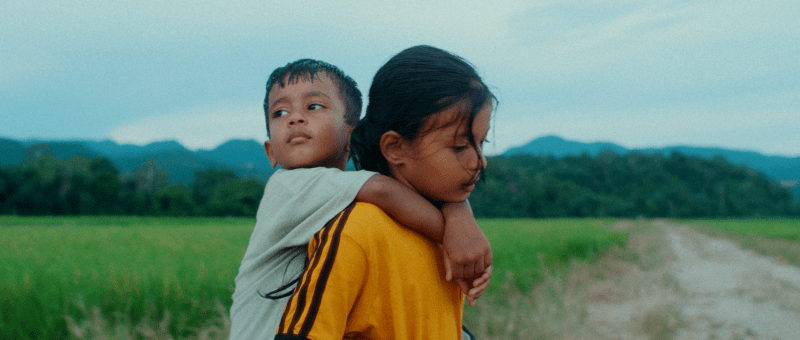
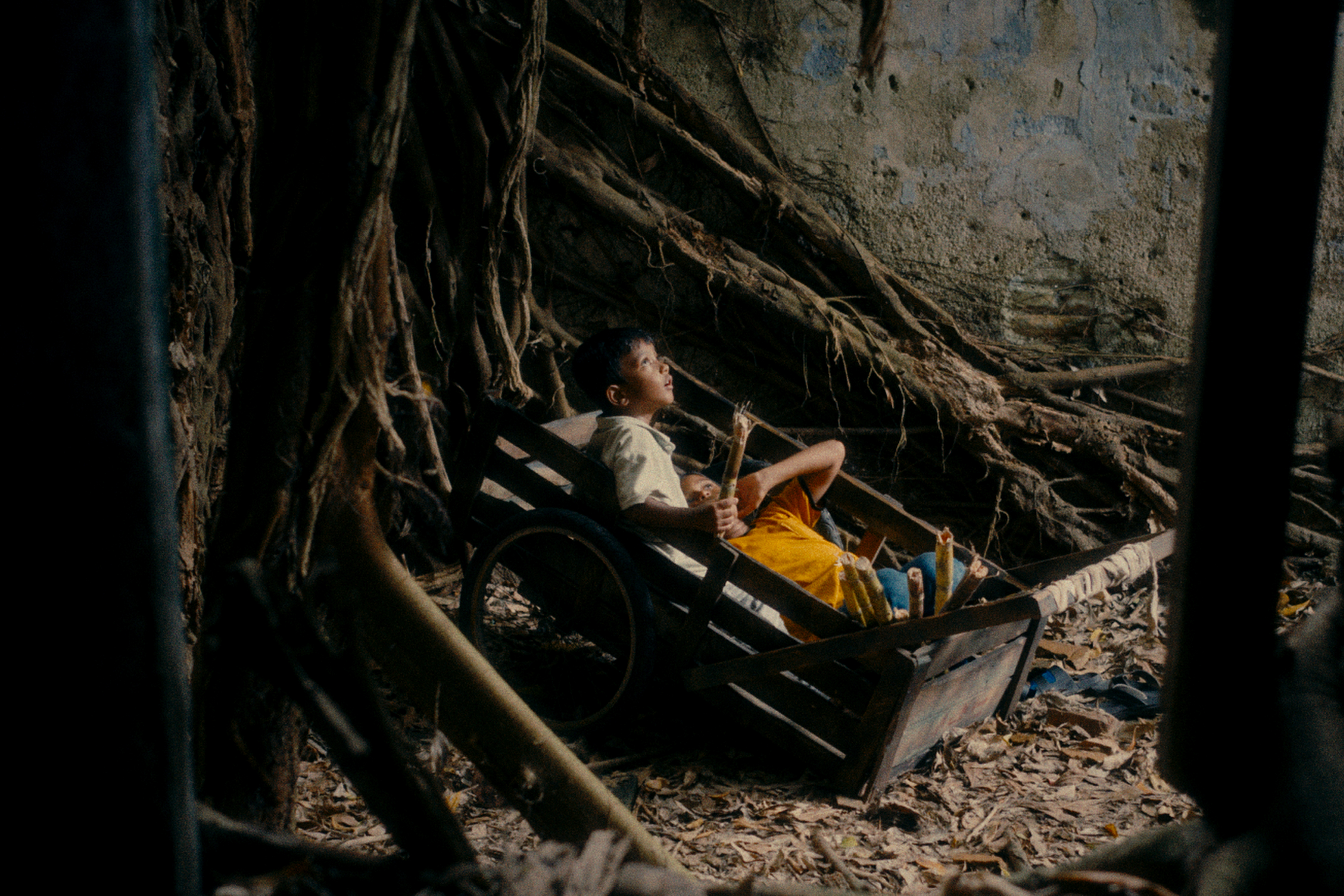
Somira and her brother Shafi don’t know much about this. They’ve been told that they have an uncle living there, but they don’t know his name or his phone number. Shafi keeps asking when they’re going “home”, but in reality they don’t quite have one. Their mother tells them stories about her childhood in Myanmar and a large mango tree that to her seems to embody the idea, but it’s an abstract concept that occupies a space of fairytale or mythical origin story. Later, Shafi will tell a kind young man looking after him that his uncle lives near a big mango tree, mixing up the stories he’s been told in his internal search for a home. He wanders off and finds a tall tree for himself in the middle of the city, looking up at it plaintively and playing hide and seek on his own knowing that no one’s coming to look for him. 

The siblings continue to play like children, but their games take on a darker quality when they become separated from their community and must try to look after themselves. They steal sugarcane to suck on, and beg local women for water, while planning to walk to Malaysia on their own despite not knowing the way. Eventually, they’re taken in by another fleeing Rohingya community who find themselves conflicted about what they should do with them. Though they may want to help these lone children for humanitarian reasons, they also know that they make their own passage more difficult and that the brokers will demand extra money they don’t have when they get to the next check point. 

By this time, it’s already been a couple of weeks since the children left their previous “home”. Their journey began by walking through the night to a dinghy that took them to a small ship where they encountered a storm, blew off course, and began to run out of food. One of their community died in the liminal space of the boat and was buried at sea. They frequently have to leave people behind because they couldn’t keep up or the authorities got them. This community too walk in the through the night clipping metal fences and then are forced to run for their lives. A horrifying moment finality demonstrates what it costs to look back or to try to help others while bullets fly indiscriminately in the darkness. 

Then again, there are moments of joy as a mother is reunited with her son after ten years even if he tells her that his workplace was raided and many of his friends were arrested. He was spared because he wasn’t working that day but ended up losing his job and will now struggle to find a new one while making sure to not blow his cover or be caught by the authorities. His mother’s faith remains strong as she insists that God wouldn’t let him suffer and is sure to find him a new job, despite all the fear and horror she’s been through on her journey towards him. She and her son are good people who look after Shafi even though they don’t have to because it’s the right thing to do. Though the siblings encounter good people like the Thai man who wanted to help them because he saw once Rohingya being taken away but couldn’t do anything about it, the world is otherwise heartless traffickers who’ll kill those who talk back to them or aren’t able to pay the extra money they’re sure to ask for. Wherever they go, the children aren’t welcome but are pushed on somewhere else, forced on more perilous journeys towards a distant homeland in an endless game of hide-and-seek. The first film ever produced in the Rohingya language, Fujimoto’s hard-hitting drama is a quiet plea for a little more compassion for those who are only in search of a home.


Los Land had its World Premiere at the 2025 Venice International Film Festival in the Orrizonti Section.

Evil Does Not Exist (悪は存在しない, Ryusuke Hamaguchi, 2023)

Whatever happens upstream affects those further down according to the headman of a small village faced with incursion from city dwellers hoping to turn their peaceful idyll into a tourist hotspot in Ryusuke Hamaguchi’s eco drama Evil Does Not Exist (悪は存在しない, Aku wa Sonzai Shinai). He reminds them that those at the top have a responsibility to those below, and it’s only because of this sense of mutual consideration that life is possible here. It’s an obvious metaphor for the contemporary society in which those with money and power have largely forgotten about those without, but then the film’s title also asks us a question. What is “evil”, does it exist or not, or is it merely in inextricable part of nature human and otherwise that balances out the good?

After a long tracking shot along the trees shot from below, Hamaguchi focuses on the figure of Takumi, a man at home in nature patiently sawing and cutting logs. He teams up with another man, Kazuo, to harvest water from a local stream we later realise is being used by an udon restaurant for a superior taste. Takumi shows him wild wasabi and explains how the locals use it, suggesting that Kazuo consider adding some to his dishes. Like him, Takumi’s daughter also seems to be at home in the forest, wandering off to walk home alone when Takumi inevitably forgets to pick her up from school.

Takumi describes himself as a “jack of all trades” or more to the point a local odd job man, but seems in many ways he’s one who keeps the balance. The problem they have now, is that a company from Tokyo has bought some land and is intent on stetting up a “glamping” resort in the village. A pair of agents turn up from the city to give a kind of question and answer session, but as one of the attendees later suggests it’s mainly to make themselves look good. Unable to answer most of the villagers’ quite reasonable questions all they can do is state they’ll take their opinions into account while offering flawed promises of financial gain and insistence that people from Tokyo will visit as if that were some kind of honour. It doesn’t seem to occur to them that the villagers maybe happy as they are and aren’t interested in further material gain while understandably wary of the effects of the resort on the local area from increased traffic and pollution. The agents encounter unexpected resistance centring on the septic tank which has been penciled in for an area which would lead to the contamination of wells and groundwater while it’s also clear that the company are determined to cost cut with the agents blithely telling them that a little bit of sewage in your drinking water never harmed anyone and in any case it’s within the permitted amount. 

Others ask questions about fire risk and understaffing with the agents later asking Takumi to become the resort’s caretaker, insulting him with the implication that he’s some kind of layabout easily bought with a fat paycheque. He corrects them that he has a job and doesn’t need the money, though they persist with asking him to be a kind of advisor. Takahashi, a jaded manager, is soon captivated by the area and in particular Takumi’s manliness in his log splitting and mysterious demeanour but there’s something inevitably harsh and unforgiving about nature even if it’s man that has corrupted it. Gunshots are heard over the horizon, men hunting deer. Takumi and Hana walk past the carcass of one who bled out from a bullet wound and was presumably just left there dying for no real reason. Takumi tells the agents that their site is on a deer path, so they’d need high fences which might put the customers off but reflecting that wild deer aren’t usually “dangerous” unless they’re sick or have been shot. Takumi asks where the deer are supposed to go but gets only a shrug of the shoulders and “somewhere else” from Takahashi, but there are only so many other places, what if this is the last one? If you continue to displace things, there won’t be anywhere left for anyone.

Still, as Takumi says it’s not that villagers have already decided to resist the glamping project, only that they want their fair complaints to be addressed and are willing to engage with the process if only the agents would treat them with a little more respect. But that’s something thin on the ground from the execs in Tokyo who think they’re all a load of bumpkins easily bought off with promises of a better economic future. To Takumi it is really a matter of balance, something that should be maintained for one’s protection as much as anything else. The ominous score which frequently cuts out abruptly adds to an edge of unease and supernatural dread in the ancientness of the natural world even if as Takumi points out this isn’t their ancestral land. It’s a new village that originated in the immediate post-war era when returning soldiers were given land to farm. They are all to some degree outsiders, as perhaps are humans in this inhuman place, but also ones who’ve found a way to live in it that’s as much about respect for the land and others as it is about survival.


Evil Does Not Exist opens in UK cinemas of 5th April courtesy of Modern Films.

UK trailer (English subtitles)

Heaven is Still Far Away (天国はまだ遠い, Ryusuke Hamaguchi, 2016)

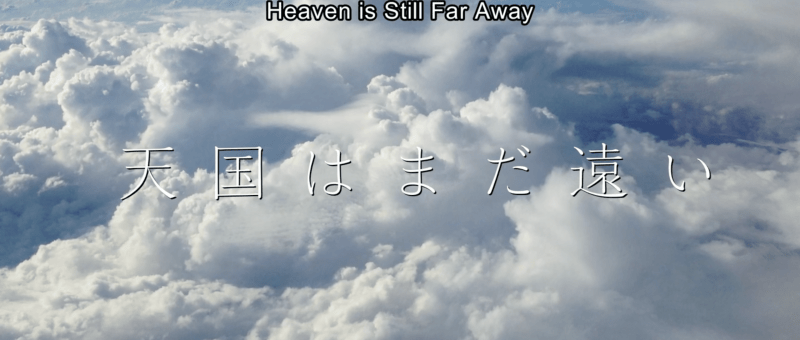
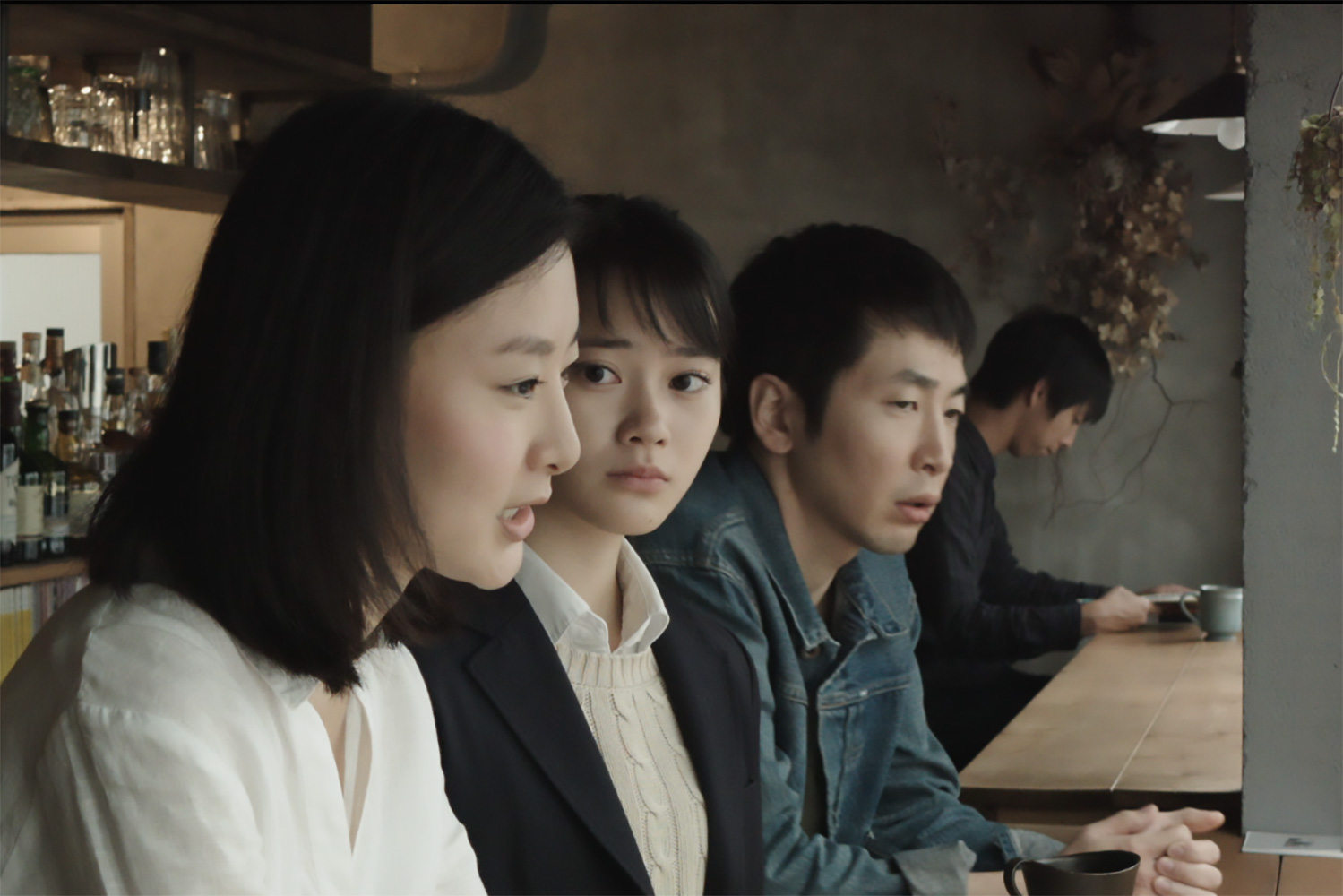
Heaven is still far away still 1Ryusuke Hamaguchi returns to the theme of objects in motion with his haunting short Heaven is Still Far Away (天国はまだ遠い, Tengoku wa Mada Toi). When one thing ends, conventional wisdom insists that something else must begin but real life shows us that that isn’t always the case. For three people attempting to deal with the legacy of an unsolved serial murder case, forward motion has been impeded, or perhaps refracted, and not least for the victim herself who remains a still point in an otherwise turning world.

Mitsuki (Anne Ogawa) tells us that her mother explained to her when she was a child that when you die you go to “heaven”, which is a place beyond the clouds. For Mitsuki, however, heaven still seems so very far off – after all, there are still so many things to experience here on Earth. At present, Mitsuki lives with Yuzo (Nao Okabe) – a strange and blunt young man who has the rather skeevy job of adding mosaics to pornographic videos. One day Yuzo gets a phone call from another young woman, Satsuki (Hyunri), who wants to interview him for a documentary she is making as a graduation project which will focus on her older sister who was murdered 17 years previously. Yuzo didn’t really know Satsuki’s sister but something he did after she died has captured her imagination and Satsuki would like to explore why he did it.

What ensues is a series of odd, concentric conversations as Satsuki tries to articulate her artistic intentions to the grumpy Yuzo who is either a quite a tactless person or one who likes to appear so for various unexplained reasons. Satsuki’s main hope, it seems, is a kind of exercise in emotional excavation. Confused by the way some things can carry on when others end, she wants to wants to mark out the shape her sister cut into the world by finding out how her presence and absence has affected the lives of those around her. For reasons which aren’t immediately clear, she wants to start with Yuzo because, through an accident of fate, he finds himself at the exact intersection of both of these points.

Satsuki asks if Yuzo bears a grudge towards her seeing as his life too has been derailed thanks to his connection with her sister’s life and death. Yuzo replies that he doesn’t – he bears the responsibility for the way his life has turned out, even if it might have been impacted by external events. Satsuki wrestles with trajectories, accepting that her family may have fallen apart on its own but always wondering what might have happened if she had died in her sister’s place, why her sister had to die rather than someone else’s, why parts of her life have also stopped in the wake of her sister’s absence. If Satsuki has “lost” something, did Yuzo “gain” it or did he “lose” too in gaining an additional burden? The only truth is that Mitsuki has become a point of refraction in each of their lives, looking on from the periphery unseen but making her presence felt even in her absence.

Hamaguchi once again makes the everyday seem strange as the past continues to haunt our protagonists, in ways both literal and metaphorical. An eery sense of sadness pervades, yet endings are refused in favour of dualistic circularity. Objects in motion must remain in motion, even if they appear to have stalled. One life refracts another, and absence defines presence. Heaven may still be far away, but it’s there all the same and its presence is felt, even if unseen.


Available to stream worldwide via Le CiNéMa Club until 24th May.

Joy of Man’s Desiring (人の望みの喜びよ, Masakazu Sugita, 2014)

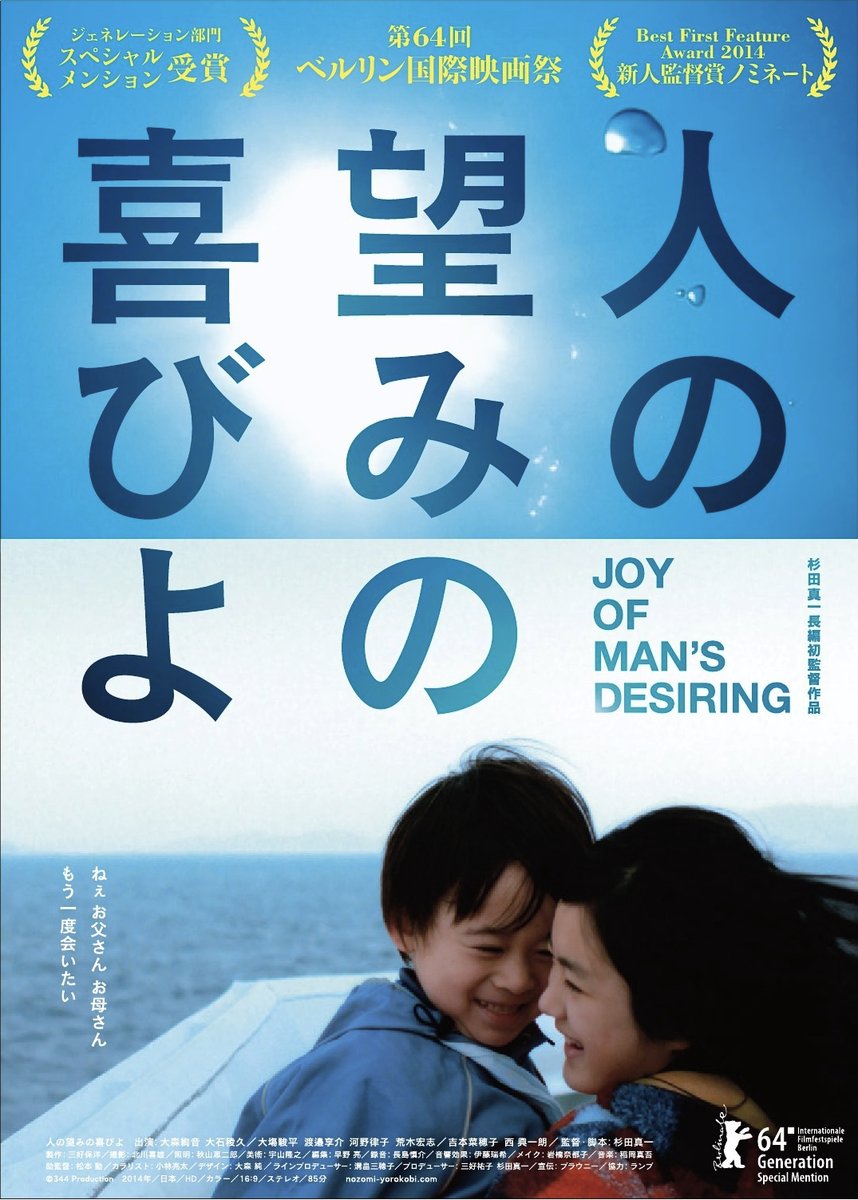
Joy of Man's Desiring posterWhen disaster strikes false cheerfulness takes hold as those left behind attempt to push each other forward and away from the wreckage of their old lives, but refusing to deal with the reality causes more problems than it solves. This is doubly true when it comes to children who find themselves all alone when robbed of everything they’ve known by forces beyond their control. First time feature director Masakazu Sugita, himself a survivor of the 1995 Hanshin Earthquake which struck when he was just 14 years old, was led to the realisation of a long gestating project after the devastating earthquake and tsunami which struck Japan in March 2011 leaving many facing loss and bereavement. Though the children at the centre of Joy of Man’s Desiring (人の望みの喜びよ, Hito no Nozomi no Yorokobi yo) are lucky enough to have surviving relatives prepared to take them in and raise them with love and care, their lives are far from easy as they attempt to come to terms with the aftershocks of disaster.

12 year old Haruna (Ayane Ohmori) tugs at roof tiles now lying on the floor with no house underneath them. Her nightdress is covered in blood stains and dust and she has deep cuts on her heels, hands, and face. Finally someone drags her away from her broken home and towards a makeshift settlement with a oil drum fire where a relative later finds her. Though she and her brother Shota (five, still in the hospital) survive, both her parents have been killed. The relatives who’ve been looking after her don’t want to make it a long term arrangement and suggest sending the siblings to an orphanage all with Haruna lying awake listening in the next room. Her other aunt won’t hear of it and so Haruna and Shota (Riku Ohishi) are packed off to live in a quiet coastal town with their mother’s sister (Naoko Yoshimoto) and her family which includes their slightly older and very sulky cousin Katsutoshi (Shumpei Oba) as well as their uncle (Koichiro Nishi) and his father who is all too happy to have another two grandchildren to spoil.

The quiet coastal town with its natural beauty, wide open roads and winding streets dotted with pleasant looking houses should be the ideal place for the children to settle down in peace and they are indeed lucky in their aunt’s willingness to take them in as full members of the family (especially given the initial ugliness which exposed the relative lack of compassion from others) but moving to a completely new town to live with near strangers is a difficult prospect at the best of times, especially for young children, even if they aren’t also trying to process the loss of their parents. Whether because they didn’t have the heart, or they thought he wouldn’t understand, or perhaps just because they were waiting for his physical health to fully recover, no one has explained to little Shota that his parents will not be coming back. He can’t understand why they haven’t come to fetch him and has taken to hanging around the ferry terminal all day watching the figures coming off the boat in case they should eventually arrive.

Shota is lively and boisterous, adapting much more quickly to his new life than his older sister who remains quiet and withdrawn, sitting alone at school and staying in her room at home. Everyone is so caught up in the need to be cheerful and get on with life that no one has stopped think about the various effects the new living situation is having on all involved. The community is small and so new kids moving in is a rare event, making Haruna a mild novelty at her new school whether she likes it or not. People keep telling her to “hang in there” and they mean well, but all they really do is remind her that she’s been bereaved, that she’s “different” from the other children, and that she doesn’t quite belong in their world.

Meanwhile, they also discourage her from talking to them about her feelings of grief and guilt, but talking’s not something generally done by people making a great effort to get on with things as demonstrated by a final frustrated outburst by Haruna’s aunt who has been trying to care for the children while her own son turns his resentment back on her, her husband leaves everything to his wife, and Haruna offers some unkind words at just the wrong time. Katsutoshi is perhaps justified in his petulant resentment of his new siblings, fearing (as one unkind school friend indelicately puts it) that his parents don’t want him anymore, and that he’s unwittingly become associated with the mild whiff of intrigue surrounding the newcomers, but it’s his inability to voice any of his concerns in a more normal way that provokes the eventual family crisis which sees Shota and Haruna finally set out on a course of reconciliation with their past.

Haruna thinks she has to be strong for Shota, keeping the secret of their parents death to avoid causing him pain but also leaving her with no one to talk about them with. Shota, however, is equally devoted to his sister, gently patting her futon while she’s ill and arriving with a pretty daisy he’s picked to cheer her up in the film’s poignant final scenes. Sugita keeps things natural but enlivens the drama with interesting composition and a shift into the expressionist for the traumatic scenes of destruction which mark the film’s opening. A repeated motif of the sun shining through water serves an apt metaphor of the grief process as a kind of drowning, but like the daisy at the film’s closing it also offers hope in the possibility of life after disaster but only once the waters have receded.


 Screened as part of the Japan Foundation Touring Film Programme 2018.

Screening again at:

  • Queen’s Film Theatre – 11 February 2018
  • Firstsite – 18 February 2018
  • Depot – 21 February 2018
  • Filmhouse – 4 March 2018
  • Broadway – 19 March 2018

Original trailer (English subtitles)