A Muse Never Drowns (ミューズは溺れない, Nozomi Asao, 2022)

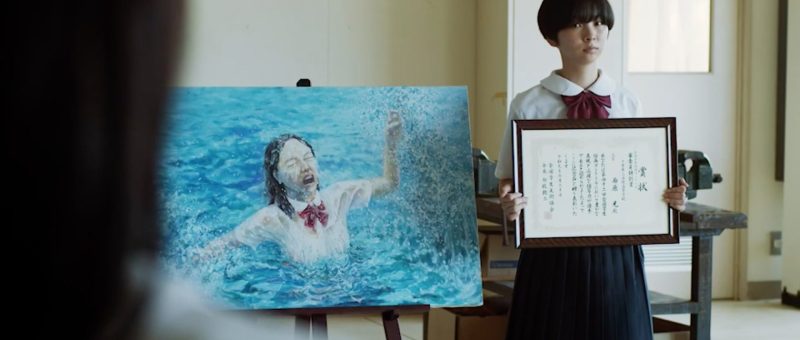
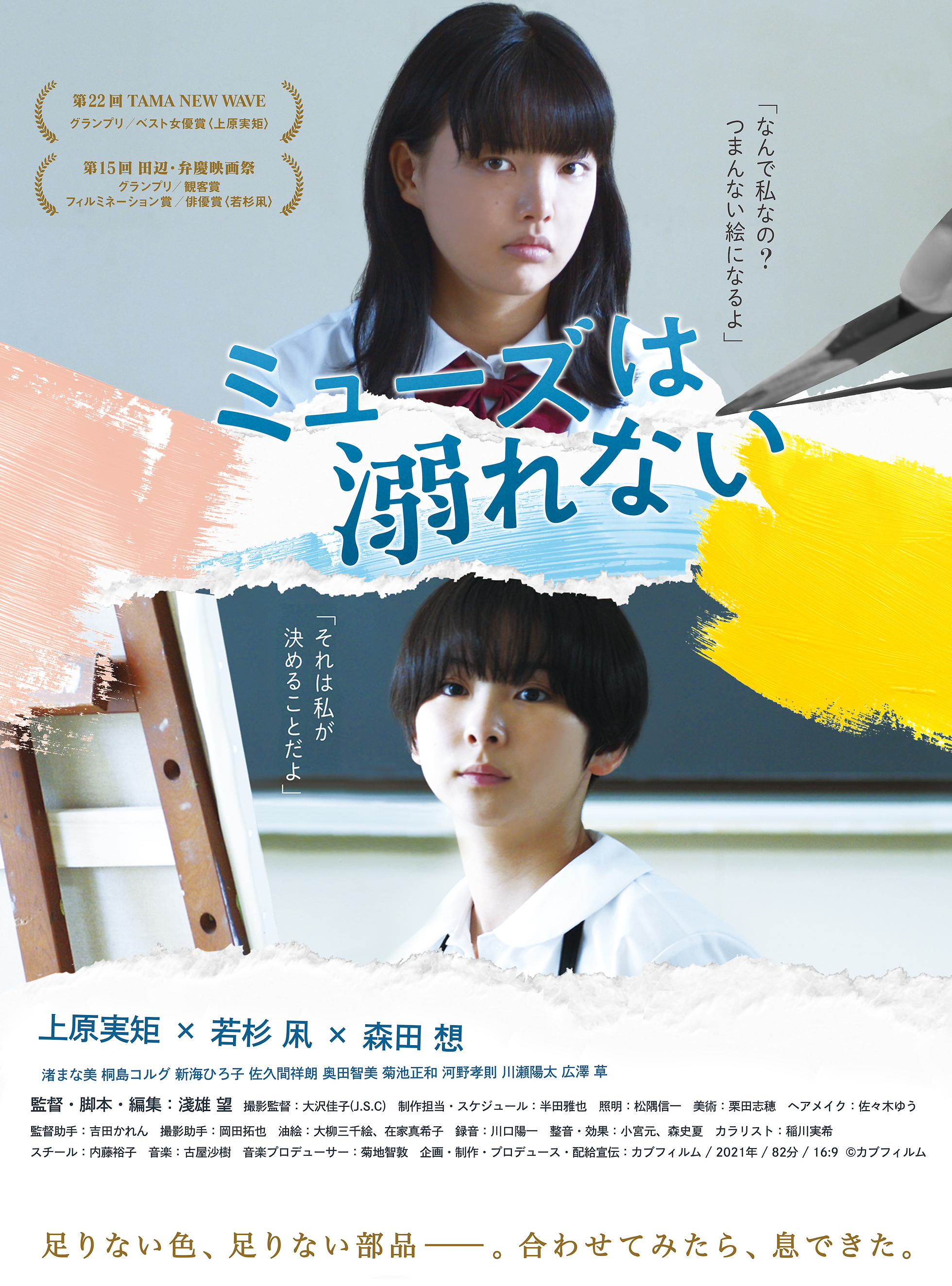
A teenage girl flounders amid a series of changes in her life while questioning her future and identity in Nozomi Asao’s empathetic coming-of-age film, A Muse Never Drowns (ミューズは溺れない, Muse wa Oborenai). Saku (Miku Uehara) is however drowning, a fact brought home to her by the relentlessly aloof Saibara (Mimori Wakasugi) who captures a sense of her panic and despair in a painting of her falling into the local harbour. Yet through their rather tumultuous friendship the pair eventually discover that they aren’t so different after all.

Saibara’s perfectly executed painting destabilises Saku on more than only level, firstly in her discomfort in having been seen and secondly in the insecurity it causes her in her own talent as an artist. Saku had wanted to go to art college, but a teacher harshly corrects her drawing style as if trying to push her towards a more authentic form of expression that’s less worried about getting it right than capturing a sense of what she sees and feels. Lacking confidence that she’ll get in, Saku is thinking about quitting the club in embarrassment but is persuaded to try making something else for the cultural festival while simultaneously receiving an unexpected entreaty from Saibara who wants her to pose for her next painting.

Most of the other students seem to resent Saibara for what they see as her superiority complex, believing she is aloof because she thinks she’s better than them. Because of her blunt manner, Saku too had thought her to be ultra confident and is surprised to realise that Saibara too is filled with doubts and anxieties even if she makes a point of pushing through them. Echoing her teacher’s words, Saibara admits that the lines don’t always come out the way she wants them either but all she can do is try to connect the dots. The reason for her aloofness is a vicious circle of deep-seated loneliness that convinces her she will ultimately be rejected, mirroring Saku’s conviction that she is a “boring” person, and therefore it is easier to remain alone from the start. 

Part of Saibara’s self-rejection is borne of internalised homophobia uncertain if others will accept her sexuality while harbouring a crush on Saku she doesn’t know how to articulate other than through her art while Saku too struggles with her feelings and is confused by the attention she receives from Saibara. Saku’s feelings of insecurity are informed by a sense of embarrassment that she has never experienced a romantic crush like her friend Emi (Kokoro Morita) who likes baseball player Endo despite knowing that likes he Saku, though Emi has also picked up on the way she looks at Saibara and is drawing conclusions about her lack interest in boys. Emi tells her that she accepts her whatever her sexuality is, but is hurt and confused when Saku remains silent and declines the opportunity to open up to her though perhaps partly because she does not really know the answer herself. 

Other than Saibara, Saku is the only one who hasn’t yet returned her careers survey still uncertain of the future direction of her life. Her father has recently remarried and he and her step mother Satomi (So Hirosawa) are expecting a baby all of which has Saku feeling somewhat adrift, displaced within her family and soon to lose her home which has been bought out for a new development project meaning they’ll soon be moving to a new house shorn of the memories of her birth mother and primed for her father’s new start. 

Yet through all her experiences, slowly bonding with Saibara and repairing her friendship with Emi, Saku begins to discover a path towards a more authentic art born of the desire to take things apart and put them back together again while quite literally feeling her way forward with her hands. Coming to terms with her new family circumstances, she builds herself a boat and is no longer drowning but drawing strength from her new found friendships with a renowned sense of possibility for the future while her friends do much the same in the knowledge that they are all scared and uncertain but doing their best to join the dots towards a happier future. 


Trailer (English subtitles)

A Far Shore (遠いところ, Masaaki Kudo, 2022)

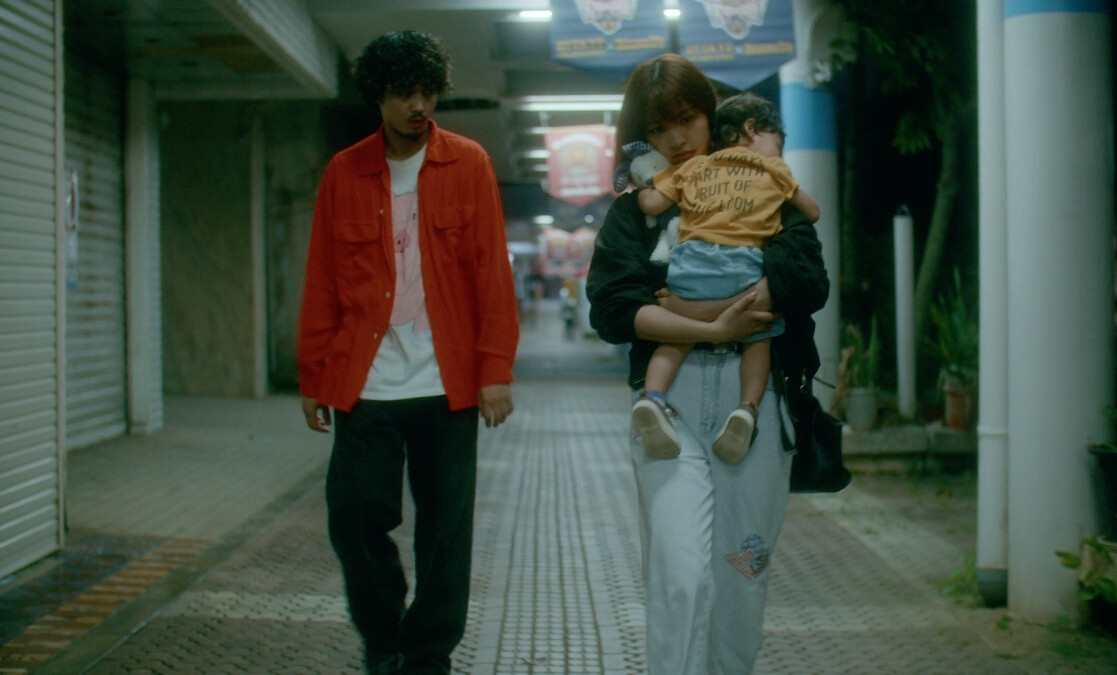
A young mother struggles to find a way through a legacy of parental abandonment and exploitation in Masaaki Kudo’s Okinawan drama, A Far Shore (遠いところ, Tooi Tokoro). As the title implies, the heroine does indeed long to go somewhere far away but finds herself hemmed in by the nature of the island on which she lives while facing rejection from all sides. She tries to do everything right, working to support herself and her son, but is finally left with no place to turn in a fiercely patriarchal and judgemental society. 

At 17 (Kotone Hanase), Aoi makes her living as a bar hostess leaving her two-year-old son Kengo (Tsuki Hasegawa) with her grandmother. Her husband, Masaya (Yoshiro Sakuma), is a drunken lout who can’t, and doesn’t want to, hold down a job. She hides the money she earns in various stashes around their apartment including in the bathroom bin fearful that Masaya will take it and they’ll be left short on the rent again. Though he refuses to work, Masaya resents being kept by his wife and often turns violent, viciously beating Aoi if he suspects her of hiding money from him or otherwise feels in some way belittled. 

On the one had, she isn’t supposed to be working in the clubs because she’s a minor but realistically they are the only place where she can find the kind of employment that will pay enough to support herself and her son. The clubs know they make more money off underage girls so they are keen to employ them, a gaggle of men from Tokyo obviously taken with the transgressive thrill of buying cocktails for a girl who technically isn’t old enough to drink, but cut them loose when the police come knocking as Aoi discovers when she is picked up by a patrol who take her in for questioning and ask insensitive questions such as how a woman who does what she does can love her son while making her the criminal rather than prosecuting the bar which employed her. In any case when Masaya beats her so badly she is forced to take on even more debt paying for hospital treatment she can no longer do bar work because men won’t want to drink with a woman whose face is bruised. In another irony, it’s the inability to work in bars, which only requires sitting and talking with men, that finally leaves her with little option other than sex work in which her clients are also often violent. 

Her plight in a sense echoes a legacy of abandonment in the Okinawan islands, her own parents having seemingly disowned her with her mother apparently in prison on the mainland and her father remarried with other children. When she asks him for help he just tells her that it’s easy for a woman to find work when men will struggle all their lives in Okinawa’s difficult employment environment, brushing off grandma’s reminder of the lucrative subsidy she assumed he had as a fisherman. Meanwhile Grandma also takes against her, believing she’ll end up wayward like her mother but seemingly accepting little responsibility for either of the women while suggesting that part of her problem lies in not having given enough respect to her local Okinawan heritage neither speaking the language nor obeying the customs. Grandma’s last straw is seeing Aoi take back Masaya after he abandoned her and ran off with all her savings, while he echoes his refusal to work by insisting they move in with his mother who can’t do anything with him either because he’s been indulged by a fiercely patriarchal social culture that encourages him to think he owes women no basic respect or decency. To add insult to injury he ends up landing Aoi with even more debt when he’s arrested after a bar fight and tells the police that his wife will pay the compensation money he owes to the other guy for throwing the first punch.

Eventually Aoi is brought to the attention of social services who do actually seem a little more sympathetic than might be expected but still largely fail to accept that she may be a mother but she’s also a child in need of care. She tries get to a respectable job in a cafe but encounters only further exploitation with extreme low wages, a shift pattern that doesn’t suit a working mother, and a one month probationary period during which she wouldn’t be paid which is obviously impossible for her to manage with no other means to support herself while everywhere she goes people just look down on her. A bleak portrait of life in contemporary Okinawa, Kudo’s icy drama suggests the hope of a distant place is all women like Aoi have to keep them going but in the end it may not be enough. 


A Far Shore made its World Premiere at this year’s Karlovy Vary International Film Festival.