Black Night Parade (ブラックナイトパレード, Yuichi Fukuda, 2022)

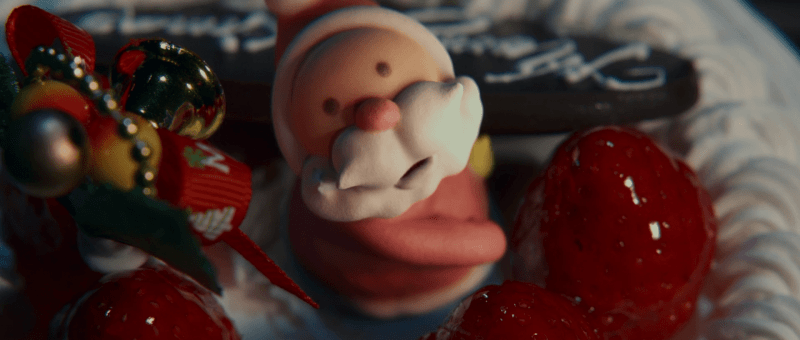
According to the opening voiceover of Yuichi Fukuda’s seasonal comedy Black Night Parade (ブラックナイトパレード), we’ve all got Christmas wrong. It’s not completely true that Santa only gives presents to the nice kids for there are in fact two Santas, the other one, the anti-Santa, making sure that bad children have a very unhappy Christmas receiving gifts ranging from the traditional lump of coal to offal. The Santa dressed in black is described as being a little more egalitarian, but does indeed pedal in disappointment and the opposite of the holiday spirit though in another way perhaps he’s just an embodiment of a sense of resentment towards to the unfairness of the contemporary society. 

Miharu (Ryo Yoshizawa) is very definitely grown up and a good example of someone who regards themselves as earnest but is becoming fed up with seeing those he regards as acting inconsiderately prosper. Still working part-time at a convenience store having repeatedly failed to get into university or find a full-time job, he’s irritated by his loudmouth slacker colleague Kaiser (Taishi Nakagawa) who just seems to constantly fall up in life while Miharu ends up being the responsible one doing most of his work for him. When Kaiser asks him to cover his shift Christmas Eve so he can go on a date with his pretty girlfriend seconds after telling him he’s actually had a full-time job offer, it obviously stings more than a little. But when Miharu takes a leaf out of his book and tries to take home one of the expired Christmas cakes, he’s immediately caught and threatened by his boss not to mention being deemed a bad boy by the Santa in black. 

Though in his case, it results in an ironic job officer to become one of Santa’s helpers at a gloomy Santa centre where they run a virtual surveillance state to figure out whether the kids that send in letters to Santa have really been as good as they claim to have been. Surveillance queen Shino (Kanna Hashimoto) decides one little lad hasn’t on catching him cheating on a test despite having emphasised how hard he’d been studying in his letter. Cheating on a test is obviously not “good”, but perhaps it’s not innards in your stocking bad either and Miharu’s moral compass is going haywire trying to understand the strange world he finds himself in while participating in a contest to join the elite Reindeer division of Christmas shock troops. Meanwhile, he’s also confronted by a conspiracy in which the red Santa has already been murdered by rats controlled by a mysterious group who hate Christmas and are trying to eradicate it. If they don’t find a new red Santa soon, the magic will be broken forever.

Despite the zaniness of the concept, the humour is a little less grating than the broad variety style generally employed by Fukuda in his other films even if several of the performances are on the larger side. Rather than rediscovering the true meaning of Christmas or coming to an accommodation with the unfairness of the contemporary society, Miharu is guided towards dealing with his own unresolved childhood trauma which repurposes the empty consumerism of a contrived holiday tradition as a means of signalling of a lack of something or the roots of unhappiness. Even if most most kids are asking for the latest toys it may be because they want others to play with with them, while some just want company because their parents have to work long hours and they’re lonely at home. 

Despite making the astute observation that the best way to disappoint a naughty child is to get them what they asked for but not quite right, Miharu eventually discovers a calling in making sure no child is left empty-handed on Christmas Day spreading the spirit of the season wherever he goes even while being chased by packs of evil rats out to destroy the joy of Christmas forever. Then again, there is some mildly satirical humour in the likening of Santa Claus House to a “black company” ruthlessly exploiting its employees while engaging in some very dubious corporate shenanigans in its use of customer data and clear invasion of privacy in its all-seeing surveillance network. In any case, it does appear that Christmas is safe from the rat race for the moment and children good or bad will wake up to a surprise equally so on Christmas morning for years to come.


Original trailer (no subtitles)

From Today, It’s My Turn!! (今日から俺は!! 劇場版, Yuichi Fukuda, 2020)

The high school fighting manga has long been a genre mainstay but perhaps hit peak popularity in terms of the big and small screen during the Bubble era with such well known hits as Sukeban Deka and Beb-Bop High School. More recent treatments have frequently bought into the genre’s inherent absurdity such as the contemplative and melancholy Blue Spring, or the anarchic Crows Zero series helmed by Takashi Miike to which Blue Spring’s Toshiaki Toyoda later added a sequel. Which is all to say, that a genre so deliberately puffed up and obsessed with macho posturing is near impossible to parody. Leave it Yuichi Fukuda to try with the retro nostalgia fest From Today, It’s My Turn!! (今日から俺は!! 劇場版, Kyo kara ore wa! Gekijoban), a theatrical sequel to the TV drama series adapted from the manga by Hiroyuki Nishimori. 

Set in the genre’s heyday of the 1980s, the action takes place in a small town in Chiba with an improbably large number of high schools. Nerdy high schooler Satoru (Yuki Izumisawa) floats the idea of transferring somewhere else, fed up with all the delinquents at his school disrupting his studies with their constant violence but then it seems like everywhere else is the same. The big problem is that their two top guys have recently been deposed during a conflict with rival school Nanyo leaving a power vacuum while their school is temporarily merging with Hokunei from the next town over seeing as they’ve already burnt their school building down. 

While many high school fighting manga focus on the hierarchy within one particular institution, From Today, It’s My Turn!! is much more concerned with the battle between rival schools even if some of the more antagonistic fighters are in fact secretly friends. The first fight that breaks out is between bleach blond Mitsuhashi (Kento Kaku) and blue-suited Imai (Taiga Nakano) over a juice carton he bought for Mitsuhashi’s aikido-trained girlfriend Riko (Nana Seino) which Mitsuhashi sees as an affront to his masculinity, though in truth the two guys seem to get along well enough in the long run. Most of this fighting is in essence performative posturing, something made plain by the unexpected cowardice of supposed top guy Mitsuhashi who it turns out frequently runs away when challenged even relying on Riko to get him out of trouble. 

Though there are female gangs and female lone fighters, this is largely a male affair as the women, excepting Satoru’s cousin Ryoko (Maika Yamamoto), are expected to perform their femininity as the boys perform their masculinity through fighting. The supposedly evil head of the girl gang from Seiran High, Kyoko (Kanna Hashimoto), turns into a walking embodiment of kawaii when encountering crush Ito (Kentaro Ito) who begins acting in an equally lovey-dovey fashion, but breaks right back into her delinquent tough girl persona as soon as he’s off the scene. Aikido expert Riko meanwhile is largely reduced to trying to keep Mitsuhashi out of trouble while adopting an air of nice girl refinement. Only Ryoko who determines to take revenge on behalf of the bullied Satoru with the aid of a bamboo sword is allowed to stay firmly within the confines of the sukeban

Nevertheless, despite their treatment of each other most of the gang members can’t abide bullying which is why they eventually turn on Hokunei realising that they’re the sort of guys that befriend vulnerable people only to betray them later. Yet like Mitsuhashi, Hokunei boss Yanagi (Yuya Yagira) is also an under-confident coward so insecure in his fighting prowess that he has to cheat by taping throwing knives to the inside of his blazer. Legitimate authority is it seems largely absent, parents either unseen or oblivious while the teachers are unable to offer much in the way of help, wandering round the town with a toy police car and a loudspeaker trying to fool the guys into dispersing. 

Fukuda’s brand of humour is nothing if not idiosyncratic and largely inspired by TV variety show sketch comedy which explains the random nature of many of the gags along with the absurdist manga to the max production design. He further amps up the incongruity by casting prominent actors clearly far too old for high school and then saddling them with ridiculous costumes to the extent that Taiga Nakano looks oddly like Frankenstein’s monster with his too broad shoulders and overly bouffant quiff. While action choreography leaves much to be desired, fans of Fukuda’s previous work will most likely have a ball though others it has to be said may struggle. 


From Today, It’s My Turn!! streamed as part of this year’s New York Asian Film Festival.

Original trailer (no subtitles)