
A former concert pianist begins to see the world from a different angle after taking a job cleaning houses in Takayuki Kayano’s humanistic dramedy, Hoader on the Border (断捨離パラダイス, Danshari Paradaisu). Ritsuki (Ryo Shinoda) describes the path that took him to his new line of work as mere coincidence, but there is something satisfying to him in helping people get rid of all the rubbish in their lives both literal and metaphorical and doing so in a broadly sympathetic way that encourages the customer to think hard about what it really is they want and don’t want cluttering their existences.
Ritsuki doesn’t seem to have that much literal clutter, only it also appears that he is more than a little conflicted with his way of life. Seemingly coming from a rather upper middle class family, Ritsuki had trained since childhood to become a concert pianist only to give up a promising future due to a hand tremor which may be psychosomatic. It may be no coincidence that in contrast to the upbeat dance music his boss plays while cleaning, Ritsuki prefers jazz rather than classical and may be looking for something with a little more freedom than the life of a concert pianist.
Even so he quickly discovers how many of his relationships were based on his status as classical musician. His girlfriend of 11 years abruptly breaks up with him apparently no longer interested now that he is a mere piano teacher with a sideline as a house cleaner. His experiences place him well to empathise with some of his clients who are each in someway overwhelmed to the extent that it has prevented them getting rid of literal rubbish from their lives which continues to clog up their homes only further deepening their sense of internalised shame. Then again, one of his first clients, Asuka (Yumiko Nakamura), is in her own way “shameless”, unembarrassed when Rituski discovers a box of DVDs she describes as “precious” featuring herself in her previous career as a porn star.
The film doesn’t go into what led to her home becoming a “trash house”, but perhaps does suggest there is a degree of shame involved in the proposed solution of welcoming more visitors to encourage her to keep the place presentable. The reason she needed it cleaned is that her son’s teacher has become fed up with her attempts to dodge a home visit while his usual behaviour has them thinking there may be something wrong in his family circumstances. As is later revealed, the teacher, Mariko (Tomu Muto), also lives in a trash home for unclear reasons but that seem to reflect her generalised anxiety in her inability to make decisions or take care of the rubbish in her life. She’s recently become engaged to a man who seems a little domineering but is also becoming suspicious of her reluctance to let him into her flat worried that it’s because she lives with another man while also hurt and confused by her rejection of intimacy.
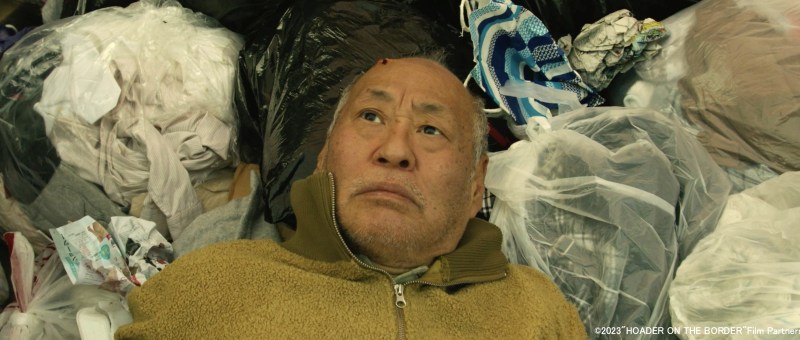
Similarly, a care worker preparing to move back to the Philippines (Mac Sekioka) found himself living in a trash home after falling into depression following the death of his mother. The thing he didn’t want to get rid of was a Tupperware container containing a stew his mother had made for him he’d been keeping in the freezer for the last eight years and eventually shares with Ritsuki as a final ritual before moving on. Another old man meanwhile needs a little more persuading with the situation complicated seeing as the main reason his son wants them to intervene is that he suspects there may be valuable antiques trapped under all that trash. What led to Shigeo becoming a local pariah remains obscure save that he too seems to be suffering with guilt and grief, haunted by the figure of a tiny woman who claims he threw her away. In some cases, it seems like at some point it all became too much and what each of the clients needed was a helping hand to get them started, Ritsuki and his eccentric boss gradually freeing them of the burdens of their lives while restoring both peace and order as he too learns to move forward bonding with his new work family no longer quite so constrained but living in the freedom and happiness of an uncluttered existence.
Hoarder On The Border screened as part of this year’s Nippon Connection.
Original trailer (no subtitles)


 Windows on Worlds