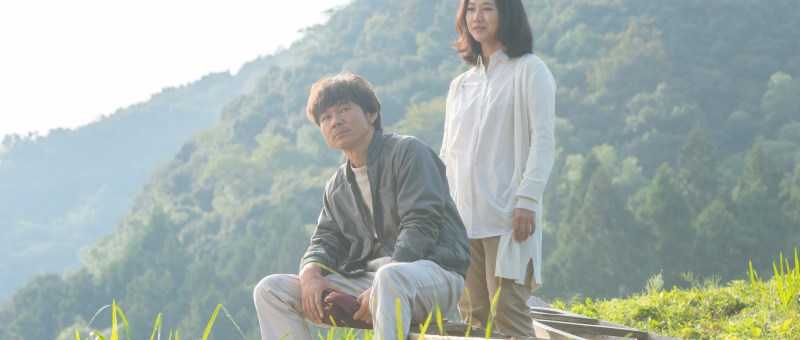
The Takatsu River (高津川, Yoshinari Nishikori, 2019)

What price modernity? Post-war migration saw a rapid turn towards urbanisation with the young forsaking their countryside hometowns to chase the salaryman dream in the cities. Though there has in recent years been a mild reversal to the prevailing trend as economic fluctuation and technological innovation have a generation of anxious youngsters looking for a simpler life, the effects of rural depopulation have only become starker in light of Japan’s ageing society leaving the elderly isolated in inaccessible communities with few family members or facilities to support them. This push and pull of the traditional and the modern is at the heart of Yoshinari Nishikori’s The Takatsu River (高津川, Takatsugawa), in many ways an elegy for a vanishing Japan but also an ode to the furusato spirit and to continuity in the face of change. 

Set in a small town on the Takatsu River in Japan’s Shimane prefecture on the South West coast of Honshu, the central drama revolves around the middle-aged Manabu (Masahiro Komoto), a widower with a teenage son and a daughter recently returned from university in Osaka. His problem is that his son Tatsuya (Ishikawa Raizo) has been skipping out on rehearsals for the Kagura dance society, something which is obviously close to his father’s heart. About to graduate high school Tatsuya is perhaps at a crossroads, like many of his age trying to decide if his future lies in his hometown staying to take over the family farm, or in the cities as a regular salaryman. 

“Everyone thinks of leaving once” Manabu philosophically laments to the lady at the post office though like most of the other parents he does not try to influence his son’s decision even if he’s additionally grumpy about his lack of commitment to Kagura dance. The dance troupe is not just a precious artefact of traditional culture or a means of entertainment but a social hub for the small community in which the generations mix freely and are equally represented. One older man affectionately known as “Pops” (Choei Takahashi) is over 80 years old but refuses to give up the art of Kagura dancing, not only because he loves to perform but because he enjoys being part of the society especially as he lost his eldest son to a flood in childhood and the other, Makoto (Hiromasa Taguchi), has become a lawyer in the city who rarely visits his hometown claiming that his wife has a dislike of “bugs”. 

Acting as a surrogate son to the old man, Manabu’s other quest is to convince Makoto to visit a little more often, touting the idea of a reunion for some of their old elementary school friends a few of whom are, like Manabu, still living in the village. Unfortunately, however, Makoto’s time in the city has fully converted him into a heartless ultra-capitalist who struggles to understand a more traditional way of thinking. Meeting up to celebrate the successful graduation of another friend’s apprentice as a sushi chef, the guys lament the case of their friend Yoko (Naho Toda) who never married, apparently calling off an engagement to look after her elderly mother who has dementia while acutely feeling the responsibility of taking on her family’s 300-year-old traditional sweet shop. Confused, Makoto wonders why you wouldn’t just stick the parents in a home and get married, much to the consternation of his friends. Similarly, when Manabu asks him for some legal advice about how to stop a resort being built up river he reveals himself to be fully on the side of corporate power. After all, he points out, a resort will bring jobs and foot traffic to the area encouraging modernisation and better transport links which will also draw young people back towards the village. If you want to save the community, perhaps it’s the best and only way. 

Yet as Manabu points out, the Takatsu is the last clean river in Japan. His daughter Nanami (Ito Ono) came back after uni because she missed the taste of sweet fish that you just can’t find anywhere else. If the river is polluted by construction, the fish will disappear and perhaps there’ll be nothing left to “save”. With the local school set to close now there are only a handful of pupils, Manabu and his friends are minded to pick their battles and protect what it is that’s most important, eventually reacquainting Makoto with his furusato spirit by confronting him with the traumatic past which had kept him away. Bar repeated references to the double-edged sword of the Takatsu in the potential for lethal flooding, Nishikori’s gentle drama perhaps provides an overly utopian view of country living which sidesteps the hardships that can often accompany it, but also celebrates community spirit and an atmosphere of mutual support, qualities which have convinced city-raised farmhand Kana (Yurie Midori) that the rural life is the one for her. A gentle elegy for a disappearing way of life, The Takatsu River is ultimately hopeful that something at least will survive as long as the clear stream flows on.


The Takatsu River streams in Poland 25th November to 6th December as part of the 14th Five Flavours Film Festival.

Original trailer (English subtitles)

A Beautiful Star (美しい星, Daihachi Yoshida, 2017)

A Beautiful Star poster 1Given life’s anxieties, it can sometimes be hard to remember that the world is a beautiful place. If only we humans could learn to stop and smell the flowers every so often, we wouldn’t be so eager to destroy the place that gave us life. Loosely adapting a novel by Yukio Mishima, Daihachi Yoshida’s A Beautiful Star (美しい星, Utsukushii Hoshi) swaps Cold War nuclear paranoia for climate change anxiety as a collection of extra-terrestrials consider differing strategies to save the Earth, the most radical of them being the eradication of the human race.

Yoshida opens with the Osugi family, minus son Kazuo (Kazuya Kamenashi), “enjoying” a birthday dinner at an Italian restaurant. The tension between them is obvious as patriarch Juichiro (Lily Franky) bad mouths his absent son, daughter Akiko (Ai Hashimoto) sits sullenly not touching her food, and mum Iyoko (Tomoko Nakajima) tries to keep the peace. Juichiro, as we later realise, is a minor celebrity – a much loved TV weatherman whose predictions are not terribly good but he does have a very personable manner. Unfortunately, he’s not so nice offscreen and has been cheating on his wife with a much younger woman who is after his job. After a tryst at a love hotel, the pair get into some kind of bizarre car accident and Juichiro wakes up on his own in a field feeling not quite right. After a colleague suggests he might have been abducted by aliens, he develops an interest in UFOs and, after being moved to tears on air, comes to the conclusion that he is a Martian emissary from the League of Solar Planets come to enlighten the Earth to the dangers of global warming before it’s too late.

In fact, Juichiro is not the only member of the Osugis to believe he is not of this Earth. Except for mum Iyoko, everyone eventually realises they are actually from another planet but their feelings of “alienation” are perfectly Earthbound and born of extremely normal anxieties the like of which can cause discord in any family. Complaining about his son’s lateness to the birthday dinner, Juichiro runs down Kazuo’s lack of full-time employment and writes him off as “just an errand boy”. Kazuo, resentful of his father, feels an intense insecurity about his failure to forge a successful life for himself – something that is thrown into stark relief when he meets an old college buddy now a salaryman who seems to take pleasure in the fact that the captain of the basketball team has made a mess of things where he is now on the road to career success. So when Kazuo meets shady fixer Kuroki (Kuranosuke Sasaki), currently running the campaign for conservative politician and climate change denier Takamori (Jyunichi Haruta), and finds out he is actually from Mercury, it restores his sense of purpose even if it pushes him towards becoming a slightly dangerous right-wing manipulator.

His sister, meanwhile, is a lonely, depressed university student with a complex about her appearance. Approached by a creepy guy running some kind of campus beauty pageant, she can’t get away fast enough but is captivated by the song of a street busker who eventually tells her she likes his music because it’s inspired by their shared roots as Venusians and that the reason she “despises” her own beauty is that Venusians used to set the beauty standards on Earth but now they’ve been usurped. Feeling not quite so alone and more confident in her skin, Akiko decides to enter the pageant to “correct” the perception of beauty in human society.

“Beauty” seems to be the key. Iyoko finds herself sucked into a pyramid scheme selling “beautiful” water mostly out of a sense of lonely purposelessness. Apparently from power spot deep within the Earth, the water is supposed to be its rejuvenating life blood but like so much else, humanity has misused and commodified it. Juichiro’s Martians have a conventional solution to the present problem in that they want humanity to wake up and slow down. The Mercurians, however, have more radical ideas. Seeing as humanity is toxic to this planet that we all love, the obvious answer is simply to eliminate it, engineer a reset in which the Earth could heal itself after which point a new, more responsible humanity could be permitted to return. The problem, they say, is that humans do not think of themselves as a part of nature or realise that extinction is a perfectly natural part of the ecological life cycle. If they did, they might not be in this mess, but now they need to accept their responsibility and agree to a mass cull to save the planet.

Each of the Osugis has their insecurities wielded against them, and in the end each of them is in some way deceived. Kazuo’s resentful ambition is exposed by Kuroki, but he eventually realises he’s not much more than a patsy, while Akiko has to face up to the possibility that she’s been spun a yarn by an unscrupulous man who was only after the usual thing from a naive and vulnerable young woman. Iyoko’s deception is of the more usual kind as she figures out that “beautiful water” is an obvious scam she only bought into because of the false sense of belonging and achievement it afforded her, and Juichiro has to wonder if his Martian “delusion” has a medical explanation, but through their various deceptions the family is eventually forced back together again springing into action as a unit. The Mercurians dismissed humanity as unable to see the world’s beauty, remaining wilfully ignorant of the gift they had been given. The Osugis have at least been awakened to a kind of beauty in the world and in themselves as they face their alien qualities and integrate them with those of others. Yoshida may not have a clear answer for the problems of climate change (who does?), but he is at least clear on one thing – you lose that which you take for granted. Smell the flowers while the flowers last.


International trailer (English subtitles)