
 Written by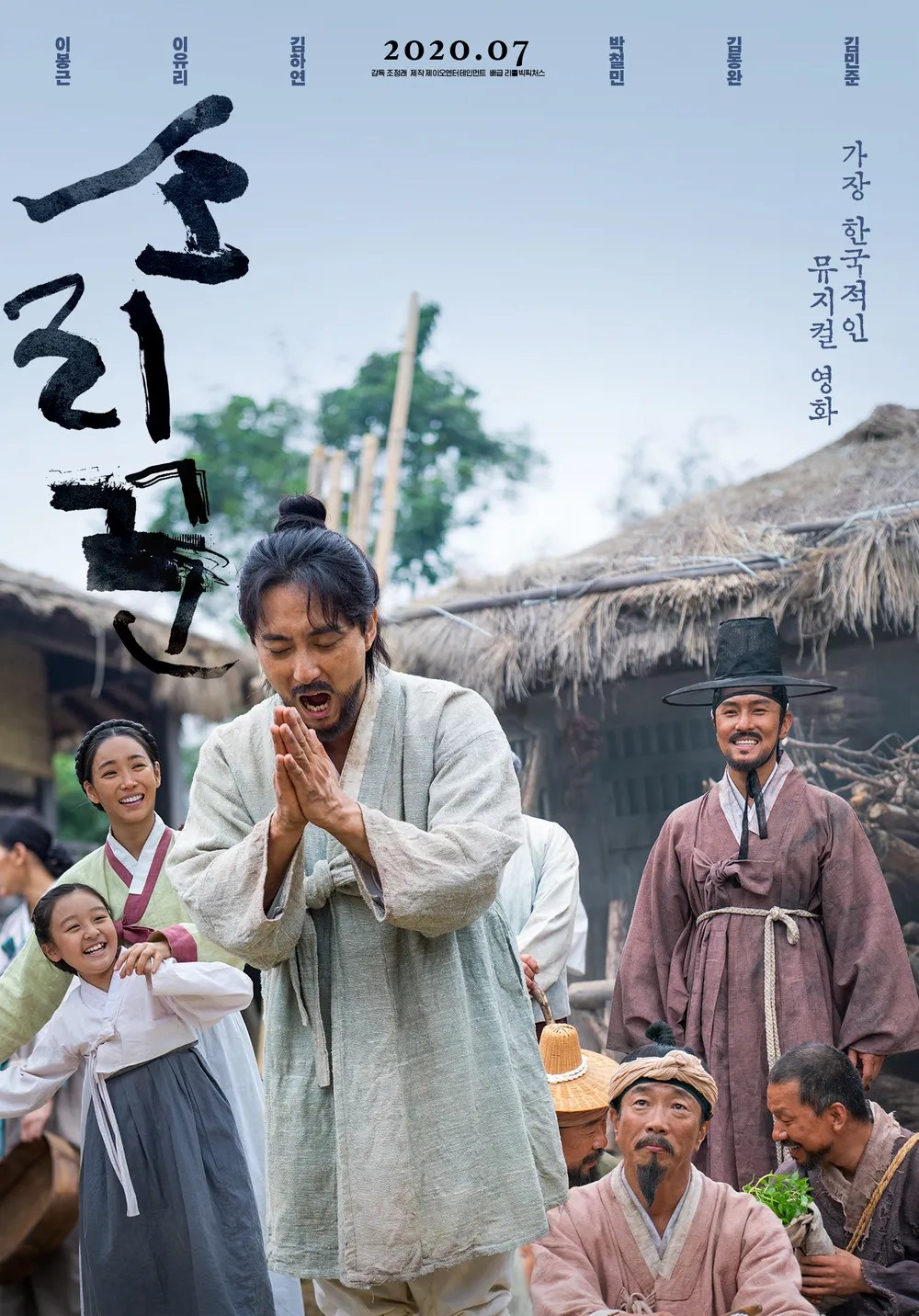
A Pansori singer shames the world into giving him his miracle in Cho Jung-lae’s musical fable, The Singer (소리꾼, Sorikkun). If there’s one thing you can bank on in old Joseon it’s that there is intrigue in the court, yet the rot seems to have penetrated even more deeply into the fabric of society as the hero discovers while looking for his kidnapped wife only later realising that the people who are supposed to protect you from violent criminals are in fact violent criminals themselves.
Set in 1734, the 10th year of King Yeongjo’s reign, the film opens with a cheerful scene as singer Hak-gyu (Lee Bong-geun) performs in the marketplace while his wife Gan-nan (Lee Yu-ri) and daughter Cheong (Kim Ha-yeon) watch from the sidelines. As the opening voiceover reveals, however, this is also a time of increasing chaos in which the accepted social order has broken down following successive incursions from China and Japan. The King has appointed a special courtier, Kim Tae-hyo, to investigate the so-called “Ja-mae gang” suspected of running a human trafficking ring while in collusion with corrupt lords. Of course, the king doesn’t know that Tae-hyo is one of the corrupt lords, but then there are so many of them to choose from. In any case, disaster strikes when Hak-gyu is late home after being accosted by a fan while returning some of the clothes Gan-nan had been mending to a nobleman and discovers his wife and child missing when he gets back. Gan-nan and Cheong have been kidnapped by the gang along with several others from the area. Cheong manages to escape thanks to her mother’s quick thinking but is badly injured and in a coma for some time eventually waking up to realise she has lost her sight. Hak-gyu along with his drummer friend Dae-bong (Park Chul-min) decides to take his daughter and search for his wife all over Korea if necessary.
As the opening and closing titles remind us, Pansori gained popularity precisely because it told the stories of the common people and was often transgressively frank in its attacks on the class system, social inequality, and even the monarchy. Belonging to the lowest class of entertainers, Hak-gyu’s “lowborn” status is often used against him, the gang deliberately targeting those from the lower orders to enslave because they do not really think of them human, yet it is also in a sense his salvation in his innate ability to connect with ordinary people as he retells his life as fable gathering large crowds around him as he anxiously asks if anyone has seen his wife. He is joined in his travels by a “corrupt monk” he saves from drowning in a river, along with bumbling lower aristocrat supposedly bumming around too afraid to go home and tell his father he’s failed the civil service exam (again), providing an accidental microcosm of the current society.
Yet what Hak-gyu didn’t know was that the gang is merely an extension of government oppression, corrupt lords flexing all of their muscles to fully exploit their subjects. Tae-hyo’s mentor reminds him that “politics is all about money” as the pair of them try to game the king pretending to hunt the gang that they are themselves running. A skilled seamstress, Gan-nan is firstly placed in the home of a local dignitary but later moved on to the mines for making too much trouble. She tells everyone she meets that she’s been kidnapped, but the nobles are all in on it and everyone else is too frightened to resist. Meanwhile, Tae-hyo and his fellow conspirators are also it seems in collaboration with the Japanese, buying up smuggled rifles to use in a potential insurrection.
Drawing inspiration from his own life story, Hak-gyu re-imagines the gang as Chinese pirates and his daughter as a displaced princess determined to do whatever it takes to save her blind father, always leaving his audience wanting more with his cruelly positioned cliffhangers. He finds himself in an odd kind of trial by combat, given the opportunity to win back his life and his wife if only he make the heartless lords laugh or cry eventually saved only by his ability to move the hearts of others through the power of his sincerity. A Pansori fable in and of itself, Cho’s meta musical drama is fitting tribute to power of art to speak truth to power revealing its own truths in falsehoods and by it handing back the means to the people to demand justice and freedom.
Original trailer (English subtitles)
 Windows on Worlds