 Written by
“This play will never end,” says one of a pair of actors, in love with the same woman near the conclusion of Nobuo Nakagawa’s haunting final feature, The Living Koheiji (怪異談 生きてゐる小平次, Kaiidan: Ikiteiru Koheiji). Based on a 1924 play by Senzaburo Suzuki which had not originally been a kaidan or ghost story, what originally seems seems to be a conventional love triangle drama develops into something darker and stranger as its trio of protagonists find themselves trapped in an escapable loop of obsession, violence, love and misogyny.
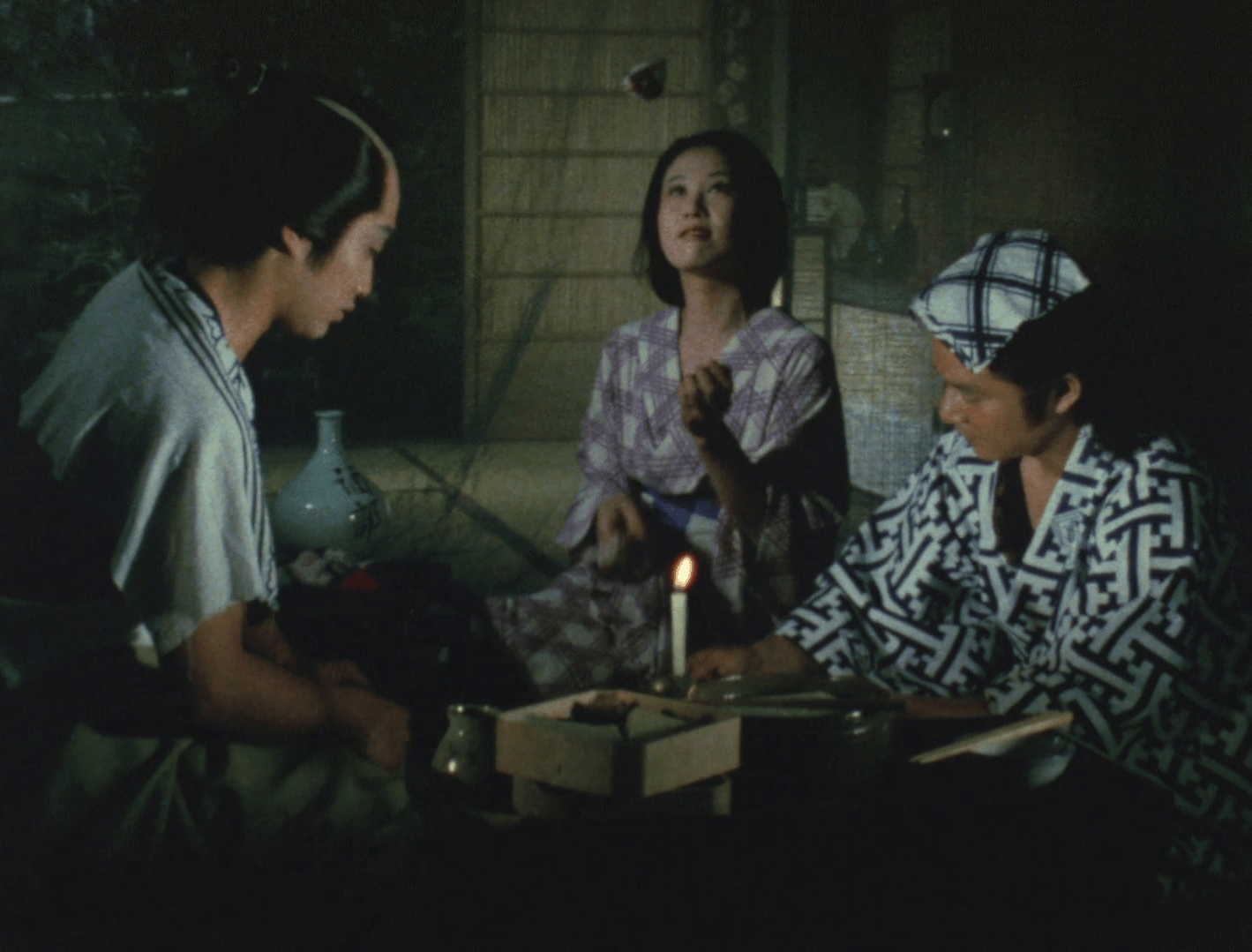
At heart, this is a story of a woman trapped between two men, an abusive husband she cannot leave and a childhood friend who says he loves her she may want not want either. We’re told that Ochika (Junko Miyashita) was once the daughter of a wealthy landlord and entered into an arranged marriage with wealthy man but was eventually sent back and married Taku (Shoji Ishibashi), the son of a teacher the landlord may otherwise have regarded as beneath them. A childhood friend of each of them, Koheiji (Fumihiko Fujima) was the son of an itinerant actor and loved Ochika too but bit his tongue. However, he can do so no longer. At breaking point, he must make his feelings known. Ochika does not accept them, but neither does she fully reject him. At an impasse, Koheiji states that he will kill Taku so that Ochika will then be free to marry him. On a fishing trip with Taku he directly asks him to surrender Ochika, but he refuses and becomes angry. Knocking him into the water and hitting him with an oar, Taku believes he has killed Koheiji, dissolves the acting troupe to which they all belong, and returns home. Koheiji soon turns up there but relief turns to rage when he repeats his request for Ochika’s hand and Taku kills him again.
We can never really be sure if “the living Koheiji” as he takes to calling himself is alive or dead, an actual ghost or a man with a talent for surviving living only for his obsessive love. He continues to haunt the couple, or more directly Taku whose guilt he may be manifesting. From what we can tell of Taku, he is a monstrously insecure figure who attempts to assert dominance through violence. Of the three, he is the only one outwardly frustrated by his lowly socio-economic position as an itinerant actor and only the troupe’s drum player at that. He has been writing his own play, a love suicide drama, in an attempt to bump himself up to the intellectual position of playwright but the manager rejects his work or else Taku lacks the economic power to bribe him.
It’s possible in one sense that what we’re watching is the love suicide drama that Taku is writing. He does indeed later invite Chika to die with him while haunted by the living Koheiji. The dialogue between the three is ostensibly theatrical and delivered in the rhythms of kabuki theatre as if they were constantly rehearsing a play, yet Koheiji in particular often slips into a rhythm that mimics that of the Akita Ondo, a bawdy folk chant that is part nonsense song and part improvised diatribe against the state of the nation. Koheiji may also have been professionally frustrated in his desires to become another Danjuro, his lack of success another barrier to romantic fulfilment, but ultimately feels that Ochika should be his and Taku should consent to give her up.
He points out that Taku is violent towards her. When Ochika asks him about his play, she says that women shouldn’t pry into men’s work and beats her. She asks him for a divorce which he refuses to grant, but later tells Koheiji that his violence is only a sign of his love for her though it’s clearly an expression of his wounded masculinity. In many ways, Ochika is a woman haunted by two men neither of whom she can fully escape. We can’t even be sure she isn’t dead too, or else a figment of Taku’s fevered imagination furiously writing out this love tragedy in real time. In any case, she continues to follow him and is continually disillusioned. On discovering that she engineered a miscarriage, he questions the parentage of the child and is resentful that she chose not to tell him about the pregnancy because it trapped her in an abusive relationship from which she wanted escape. She may have been willing to use Koheiji to help her, but does not appear to return his feelings and is in any case denied any agency. Just as she was traded away by her father, Koheiji simply demands her of Taku as if she had no right to refuse.
The living Koheiji becomes more grotesque each time he resurrects himself, eventually disguised as a leper and as pale as a ghost whether or not he actually is one. Wracked with guilt, Taku begins to experience ghostly nightmares featuring scenes from classic tales of horror such as Koheiji tied to a board and floating in a lake much as Oiwa and the servant in Nakagawa’s own Yotsuya Kaidan. A master of the genre, the eeriness that Nakagawa conjures here is of a different order. An ancient, unending haunting that as Koheiji says will never end destined to be repeated by the trio in an eternal and irresolvable cycle of suffering. The final scene takes place at Sai-no-kawara, the shore of the river of life and death to which the souls of deceased children go to be watched over by the crowds of jizo at the cave, echoing the faces of the dolls that once watched Taku and Ochika. What happens there may represent escape or merely damnation, Ochika perhaps freed or only to repeat this cycle for all eternity.
Trailer (English subtitles)
 Windows on Worlds