
 Written by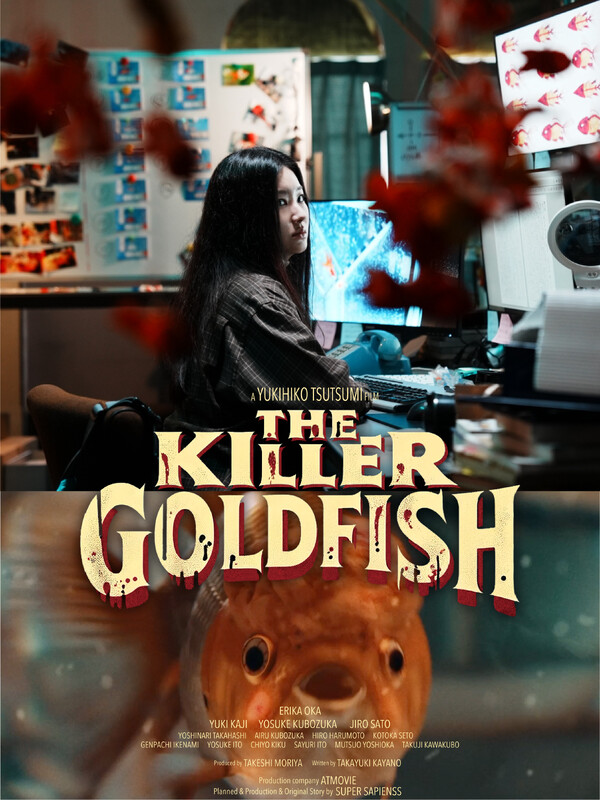
“Did the goldfish have a grudge against your husband?” It is a very strange question, but the policeman admits he has to ask it because he knows his contact at Public Security’s Extraordinary Unit will ask him if he asked. Goldfish aren’t something you’d ordinarily think of as dangerous, but perhaps they’re sick of being cooped up in tiny bowls, denied the whole ocean, so they’ve decided to fight back against humanity? Either that or, as Public Security agent Erika (Eriko Oka) suspects, someone is using them to exact a very particular kind of revenge.
Helmed by one of the premier directors of mainstream contemporary Japanese film, Yukihiko Tsutusmi’s The Killer Goldfish is not the schlockfest its name may suggest but a hark back to the anarchic conspiracy thrillers of the 90s. In fact, it’s produced by a director collective, Super Sapienss, of which Tsutsumi is a member alongside Katsuyuki Motohiro, best known for the Bayside Shakedown series, and Yuichi Sato (Kisaragi) which aims to shake off the inertia of the contemporary Japanese film industry by taking charge of the entire process so they can make the kind of films they want.
You have to admit, it might be difficult to get a production committee to sign off on a such an outlandish series of events that only begins with murderous goldfish and eventually spins off into a far reaching conspiracy involving superhumans, psychic powers, neanderthal migration, missing high school students, a young woman who is somehow connected psychically with goldfishkind, and long-haired jizo that can stir up human appetites to the point of mass destruction. Erika has a feeling all of this is connected, but she doesn’t quite yet know how save that this world is apparently full of strange crimes to the extent that the powers that be are well aware of them but they prefer to keep quiet and let the Extraordinary Unit handle them.
In any case, the action proceeds X-Files style as Erika teams up with sceptical cop Yukine to try to solve the mystery and avoid any more fishy crimes in the future. This conspiracy is it seems located at the nexus of the primaeval and sophisticated, neanderthal rage delivered into the contemporary society in the opening scenes via our ubiquitous technology with a secret symbol broadcasting into the minds of those born to receive it. A professor digs up evidence that suggests early man arrived in Japan earlier than previously thought and is invited on a daytime talk show only to cause consternation with the obscene quality of his find, while further clues are bizarrely delivered through a love island-style reality dating show and its caddish heartthrob contestant. Making contact with the suspect eventually entails solving a riddle, messaging them on social media, and then completing an online questionnaire.
Nevertheless, these superhumans are apparently so because of their primaeval genetic makeup that places them outside of contemporary notions of civility. Their atavistic qualities render them, like the goldfish, constrained by the limitations of contemporary society from which they long to break free. Even so, their sensibilities seem to align with a problematic seem of historical nationalism that lends them an edge of danger aside from their potential connection to the unexplained goldfish murders which in themselves may indicate a rebellion against entrenched patriarchy given that they seem to target only middle-aged men.
These ideas may be fleshed out more fully in the accompanying manga, also produced by Super Sapienss, or explained in the Chapter Two alluded to in the title card following the post-credit sequence but otherwise have an unconstrained, freewheeling quality rocketing between the primaeval past and the ultra modernity of reality television and social media conspiracy. The film makes frequent use of animation to express transformation or transportation between these worlds along with another that may exist in a less visible dimension, and has an unexpected freshness that belies Tsutsumi’s long career in the industry. The script by Hoarder on the Border director Takayuki Kayano similarly has an anarchic sensibility which is both retro and ultra-contemporary blending buddy cop procedural with zany horror comedy and an unfolding sense of unease in modern society. It’s fair to say that with The Killer Goldfish Super Sapienss has made good on its mission statement to disrupt the status quo of mainstream Japanese cinema with hopefully more to come in Chapter 2.
THE KILLER GOLDFISH screens 26th November as part of this year’s London International Fantastic Film Festival (LIFFF)
Original trailer (English subtitles)
 Windows on Worlds