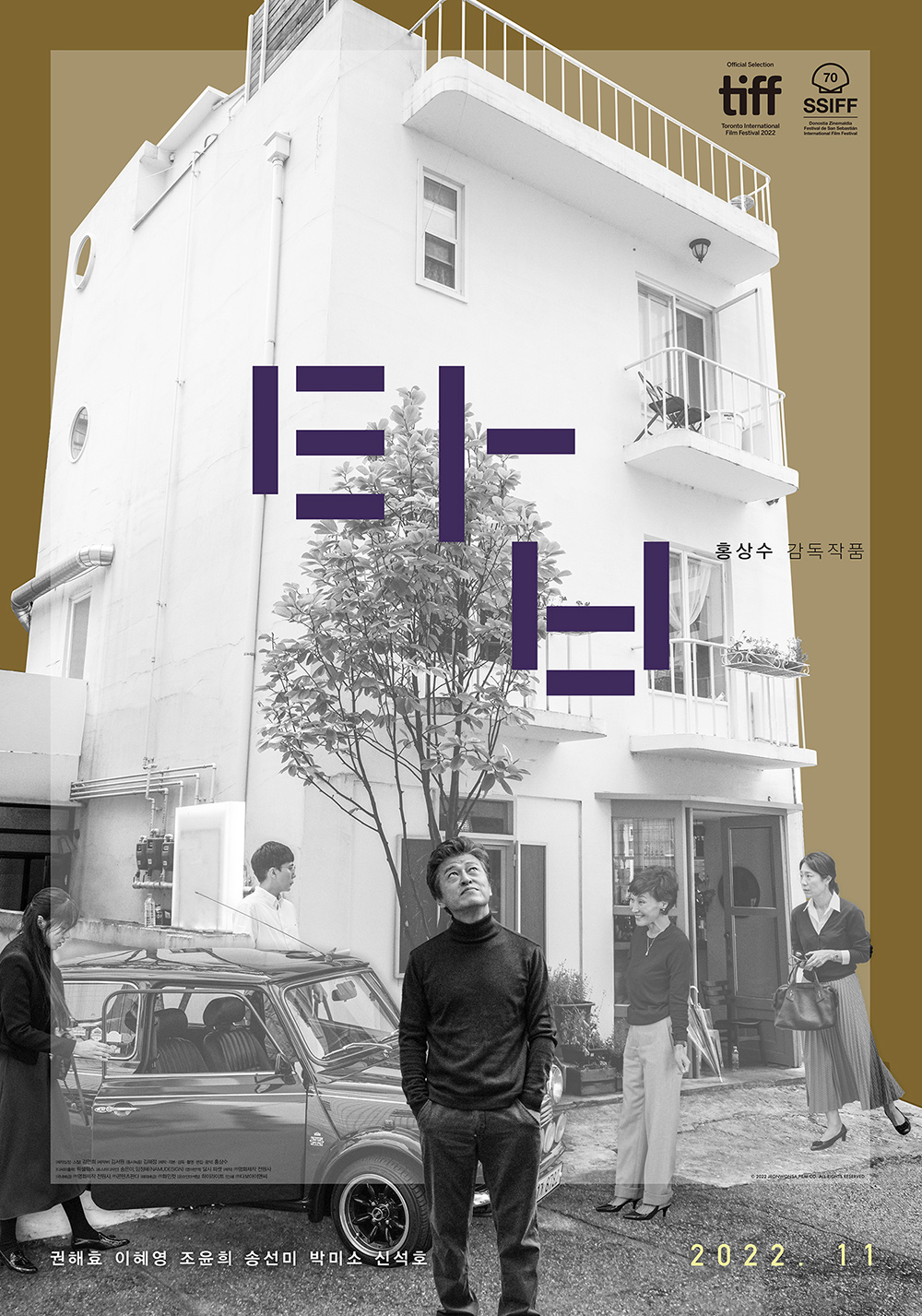
Walk Up (탑, Hong Sang-soo, 2022)

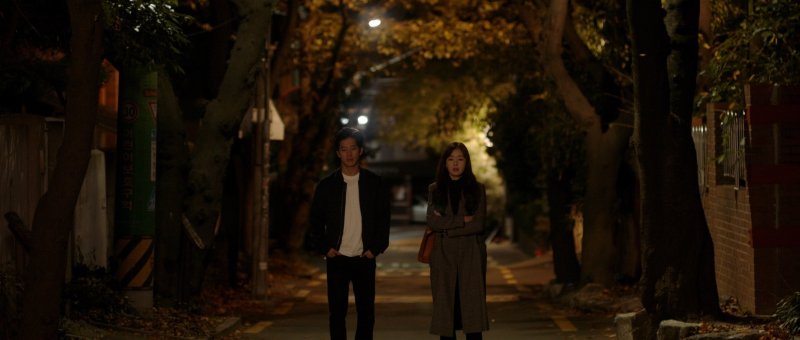
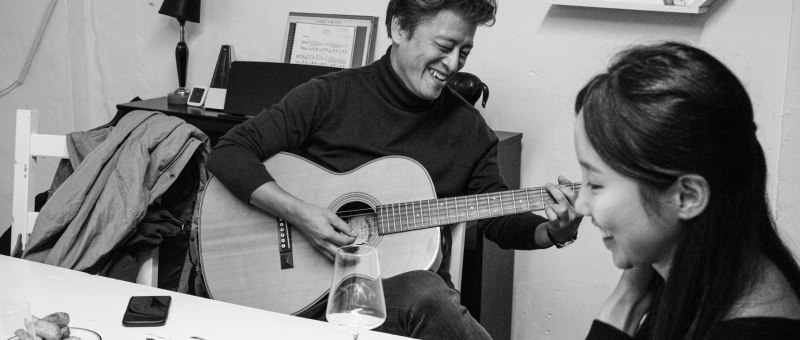
“Really all of us are like that. We’re different when we go out” an older woman tries to console, ”you want to believe that the person you see at home is the real him”. The second remark may come out more cuttingly than she means it, unsubtly suggesting that really you never know anyone and the intimacy you might believe exists within a family is just a performance. The director at the centre of Hong Sang-soo’s Walk Up (탑, tab) is indeed several different people with several different women across multiple floors of a small building owned by an old friend, Mrs Kim (Lee Hye-young), with whom he repeatedly checks in across the space of several years. 

Distance does seem to define Byungsoo’s (Kwon Hae-hyo) existence. When he turns up at Mrs Kim’s the first time, it’s with his daughter, Jung-soo (Park Mi-so), whom he later reveals he had not seen for five years. Jung-soo is there trying to make a connection, hoping Mrs Kim will take her on as an apprentice interior designer having experienced a moment of crisis on leaving art school and discovering that “art has nothing to do with money”. That’s also a problem that repeatedly plagues Byungsoo. During their conversation he’s called away to a meeting with a film producer, and later reveals that a project has fallen through after the funding was pulled at the last minute. Byungsoo embarks on a small rant about the commercialisation of the film industry in which artistic decisions are overruled by investors and no one really cares anymore about whether the film is any good only if it’s going to make money. 

Jungsoo had described her father as “feminine” and “domesticated” during her early childhood before her parents’ divorce, explaining that he seemed to change after his film career took off. Where once he’d been content to spend time a home, suddenly he was out all the time partying with actresses. Jungsoo seems to regard this personality shift as a kind of betrayal, hurt by Mrs Kim’s suggestion that Byungsoo may have been repressing himself at home and the “real” Byungsoo was the one who liked to go out on the town. Then again, people can be many things at once and perhaps there’s no one “real” Byungsoo so much as there’s the Byungsoo of the moment. Sunhee (Song Seon-mi), another failed painter who now runs a restaurant on the second floor, panders to his wounded ego repeatedly telling him how much she likes his films, though mostly for the things they’re not, and that she hopes that he will go on making films for many years to come. 

But it’s obvious that Byungsoo is deeply insecure, eventually drifting into an affair with Sunhee and living with her in the second floor apartment having taken a break from filmmaking due to ill health. He bristles when she tells him she’s going to visit a friend who slighted him on a previous occasion and tries to guilt her into not going, repeatedly texting her while she’s out to a degree that seems uncomfortably possessive and controlling. Yet he eventually ends up hugging his pillow and admitting to himself that perhaps he’s no good at relationships and deep down gets along better on his own. Even so, he later ends up with a third woman, an estate agent, who brings him wild ginseng to help with his health worries while he moves up to the studenty top floor flat which while barely big enough to turn around in comes with a spacious roofgarden. By this point his relationship with Mrs Kim, who basically begged him to move in when he first visited with Jungsoo, has clearly become strained, she perhaps also a little hurt in appearing to have carried a torch for him while hinting at feeling trapped in an unsatisfying marriage as the building itself continues on a course of disrepair. 

Mrs Kim too appears to have differing personas as she shuffles between the floors of the building she owns while each of the episodes replays with only slight differences and subject to the consequences of the last. Failed artists moving to Jeju to start again becomes a repeated theme, though it’s as if Byungsoo is resisting the pattern, talking of buying a dog with Sunhee when they relocate but then putting it off for another three years while they save money. By the time he’s made it to the top floor it’s like he’s hit rock bottom, raving about a vision from God telling him to move to Jeju and make 12 films while still ostensibly on an extended break from filmmaking. Shooting once again in a crisp black and white, Hong finally brings us back to where we came in leading us to wonder how much of what we’ve just seen really happened and how much was just a kind of thought experiment created by a bored and insecure director feeling maudlin and trying to figure himself out while his career collapses around his ears. Maybe you have to go up so you can come back down, but it doesn’t seem to leave you any less lonely as the melancholy Byungsoo discovers smoking a solitary cigarette looking up at the house from outside as if trying to decide where exactly he belongs. 


Walk Up screens at Ultrastar Mission Valley on Nov. 9 as part of this year’s San Diego Asian Film Festival.

Trailer
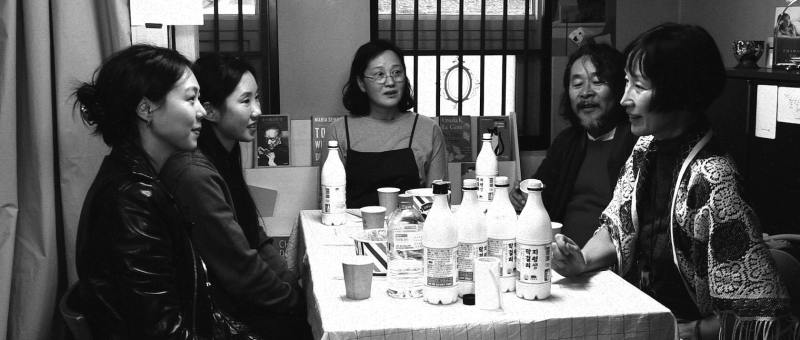
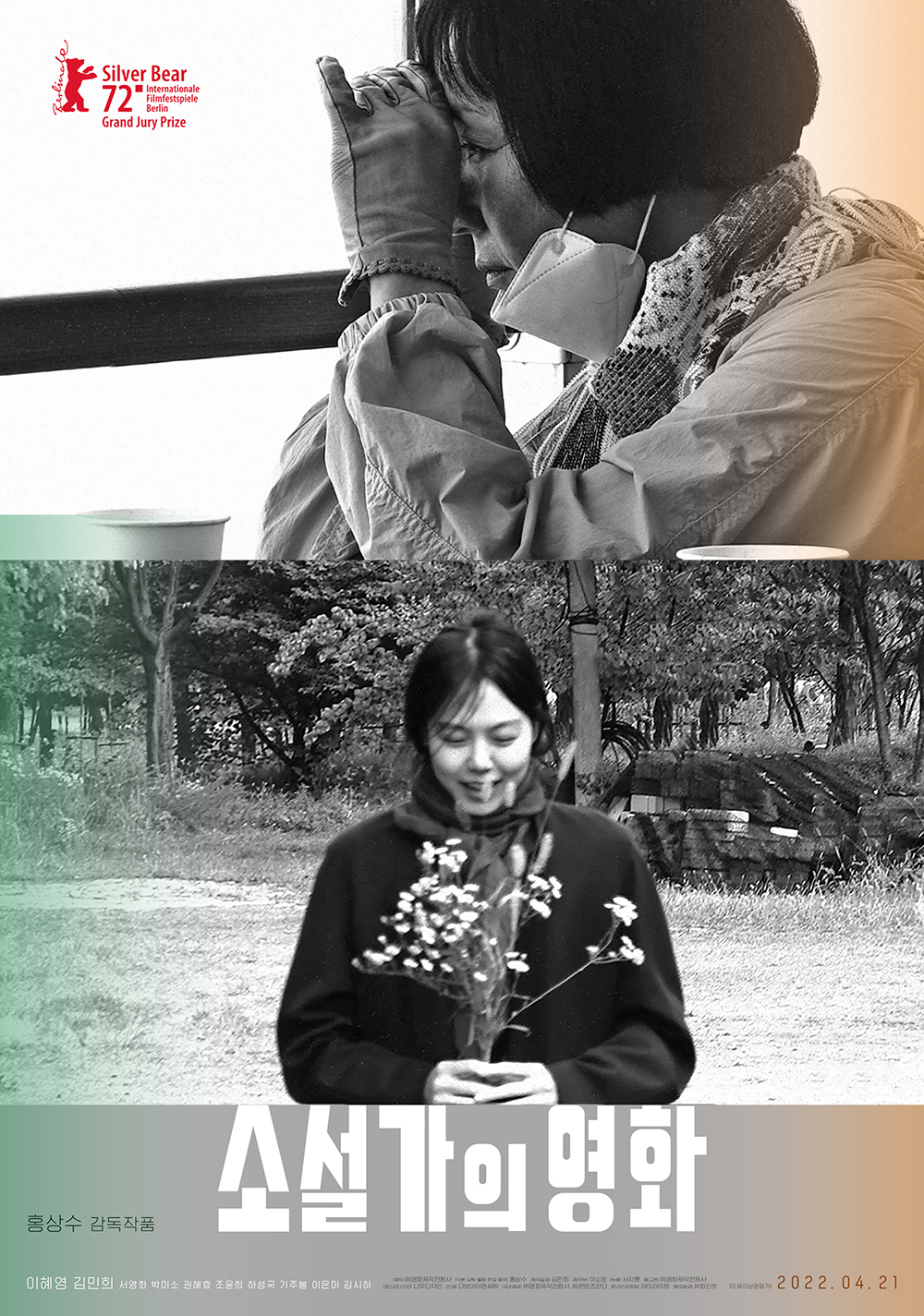
The Novelist’s Film (소설가의 영화, Hong Sang-soo, 2022)

Once again in a meta mood, Hong Sang-soo’s The Novelist’s Film (소설가의 영화, Soseolgaui Yeonghwa) seems to be peopled by those who’ve already given up. The heroine’s friend has given up her writing career to run a small-town bookshop while she herself is struggling with writer’s block, her friend’s assistant has given up acting to learn sign language, and a movie star she later meets has apparently retired because she doesn’t feel the desire to act anymore. In similar fashion a director declares that some have perceived a shift in his career that leads him to concede that he just doesn’t feel the sense of “compulsion” that used to drive him and his work may have become freer and more authentic as a result. 

As usual, Hong may partly be taking about himself, about his relationship to filmmaking and to his muse Kim Min-hee who is herself given a meta moment when berated by the director, Park (Kwon Hae-hyo), who tells her that her decision to retire is a “waste” of her talent only to be shouted at by blocked novelist Junhee (Lee Hye-young) who is hoping to make a film in order to rejuvenate her creative mojo. Junhee tells Park in no uncertain terms that Kilsoo is not a child and if this is the choice she’s made he ought to respect it, circling back to the offensiveness of the word “waste” and its various implications. The situation is so awkward that it leads Park’s wife to leave it all together, but it’s true enough that after this outburst Junhee seems to find a more comfortable relationship with Kilsoo than with any of her old acquaintances as they bond in mutual admiration and shared creative endeavour. 

It’s with a sense of tension that the film opens, Junhee venturing into the bookshop run by an old friend (Seo Young-hwa) only overhear a heated argument between her friend and a younger assistant, Hyunwoo. As so often with Hong the nature of the relationship is unclear, the argument intimate in quality not really the kind one has with an employee or casual acquaintance and so awkward that Junhee decides to wait outside until it’s over. In any case, Junhee’s manner even with the friend she’s deliberately tracked down and come to see is somewhat accusatory and passive aggressive as if hurt by her friend’s decision to abruptly drop out of contact apparently having given up writing and intending to cut herself off from her city life in its entirety.

Her encounter with the director is similar in that she seems clearly annoyed with him, firstly pretending not to recognise his wife then accusing of them of deliberately hiding from her at a popular tourist attraction. Picking up on the vibes, he asks her if she’s still upset with him over a project to adapt one of her novels that fell through. She says she isn’t but is obviously annoyed about something while his wife elaborates on his creative process and the ways she thinks he and it have changed. Then again the wife is also a little strange, introducing herself to Kilsoo, whom they’ve randomly bumped into in a park, as someone who lives with director Park rather than as his wife answering Kilsoo’s question of how long she’s lived with him with a very matter of fact 30 years. Junhee is similarly vague about the extent of her relationship with an ageing poet and former drinking buddy (Gi Ju-bong) with whom she had herself lost touch or perhaps partially ghosted when his interest turned romantic. We hear brief snippets about Kilsoo’s personal life, an allusion to scandal and drinking problem but never see her offscreen husband, only his filmmaker nephew (Ha Seong-guk). 

Yet the the serendipitous connection between Kilsoo and Junhee allows each of them to reignite their creative spark while generating an unexpected friendship. The film novelist envisions is scripted but intended to capture something of Kilsoo as she is while ostensibly playing a character, exposing the reality of the vague relationships by cutting through artifice to the truth. In another series of meta comments, the poet reminds her she needs a hook to draw the audience in but she simply tells him she’ll figure that bit out later because the story is in its way irrelevant. “He writes what he lives” she later says of him, a little dismissively. In any case, the film she makes takes on another meta quality, Hong himself perhaps behind a camera as Kim Min-hee and another woman gather flowers eventually ending with a mutual declaration of love and a sudden burst of colour in what has been a static and monochrome affair which hints at the sense of freedom and comfort Hong like the director may have found in new artistic connection. 


The Novelist’s Film screens at Ultrastar Mission Valley on Nov. 4/7 as part of this year’s San Diego Asian Film Festival.

US release trailer (English subtitles)

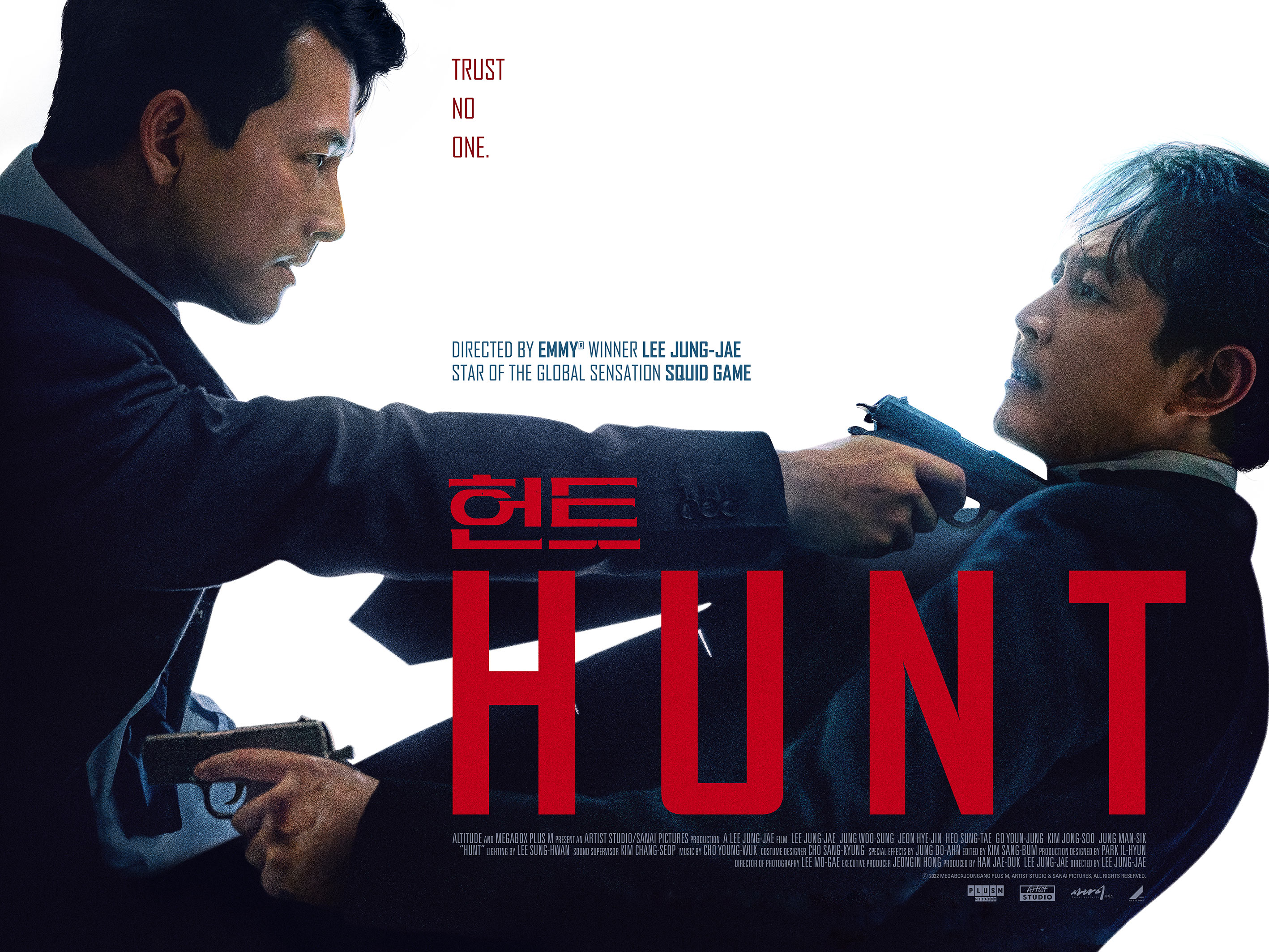
Hunt (헌트, Lee Jung-jae, 2022)

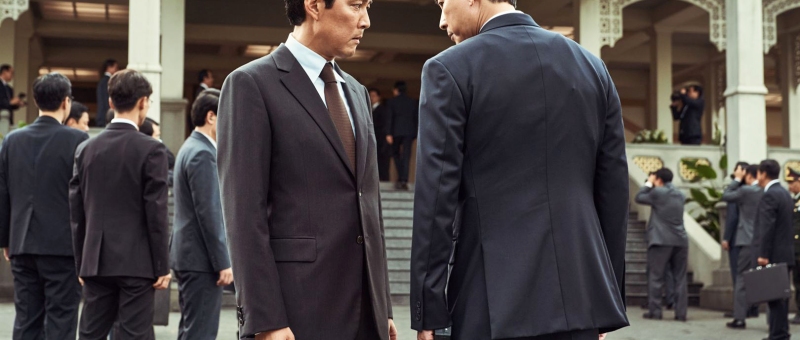
“How long can you fight violence with violence?” one accidental ally asks another towards the conclusion of actor and star Lee Jung-jae’s 80s-set directorial debut, Hunt (헌트). As the title implies, this is a story of two men stalking each other but also each ironic representatives of an ideological divide both seeking a better future while torn between violent overthrow and peaceful revolution in the dying days of a Cold War in what could be termed its ground zero. 

As the film opens, the South Korean president, a stand-in for an unnamed Chun Doo-hwan, faces mass protest from local Korean-American democracy activists on return to his hotel while on a diplomatic visit to Washington. His security team is itself somewhat compromised in that it is a joint operation between foreign and domestic intelligence teams neither of which have must trust in the other. When it’s discovered that a plot is underway to assassinate the president, foreign intelligence chief Park (Lee Jung-jae) is taken hostage but insists on capturing the suspect only for domestic chief Kim (Jung Woo-sung) to abruptly shoot him, leading Park to wonder if Kim did it to keep him quiet rather than simply to neutralise an immediate threat. Assuming North Korea is most likely behind the plot, each begins to suspect the other is a mysterious double agent known as Donglim. 

What soon becomes apparent is that the two men, the domestic and the foreign, are being pitted against each other by the questionable authority that is the Chun regime. Recently promoted from the military, Kim had in fact instigated Park’s torture in the immediate aftermath of the assassination of the previous president, also a military dictator, Park Chung-hee. Both men appear to be conflicted in their association with an authoritarian government in the wake of widespread state violence including the brutal suppression of the Gwangju Uprising in May 1980. Nevertheless, both are party to acts of torture many of them enacted on teenage democracy activists they routinely smear as communists. 

In short, no one could really blame anyone who wanted to overthrow this brutal regime but as oppressive as it is, it’s also backed by the Americans who would rather keep Chun in power than risk the students’ wishes that the American military pull out of Korea coming to fruition lest it lead to a similar situation in Okinawa, which had only returned to Japanese sovereignty a decade earlier, undermining their ongoing foreign policy goals in Asia. If there is one clear villain, aside from Chun, it’s the shady the international order that is content to watch authoritarian leaders enact violence on their people when it supports their own interests. Nevertheless, it’s also true that Park and Kim’s personal vendetta sparks major diplomatic incidents in two sovereign nations which in any other case would seem primed to turn this cold war hot.

What emerges is a cat and mouse game in which each attempts to unmask the other while on increasingly unstable ground unable even to rely on support from their superiors who in any case answer directly to Chun. It seems there are several factions who would like to unseat him even if they do not necessarily object to authoritarian rule only to persistent state violence against citizens who are more often than not mere children. The differences between Park and Kim are ideological in more ways than one, torn between the belief that only violence can free them from violence and the desire to seek a better solution but each agreeing that assassination is the only viable path to deposing Chun and ushering in a better future despite the failure of the assassination of the previous president to do the same . 

Anchored by strong performances from veteran actors Lee Jung-jae and Jung Woo-sung, the film also features a host of cameos from some of the nation’s top stars including Hwang Jung-min as a manic North Korean airforce defector and Lee Sung-min in a small but pivotal role as a Korean-Japanese asset. With notably high production values and truly astonishing action sequences, Lee excels in capturing the paranoid atmosphere of the conspiracy thriller and an almost unbearable tension between its twin protagonists who will later discover that they are quite literally on the same bus even if they have very different destinations in mind. 


Hunt screened as the opening night gala of this year’s London East Asian Film Festival and arrives in UK cinemas/digital on 4th November courtesy of Altitude Films.

UK release trailer (English subtitles)

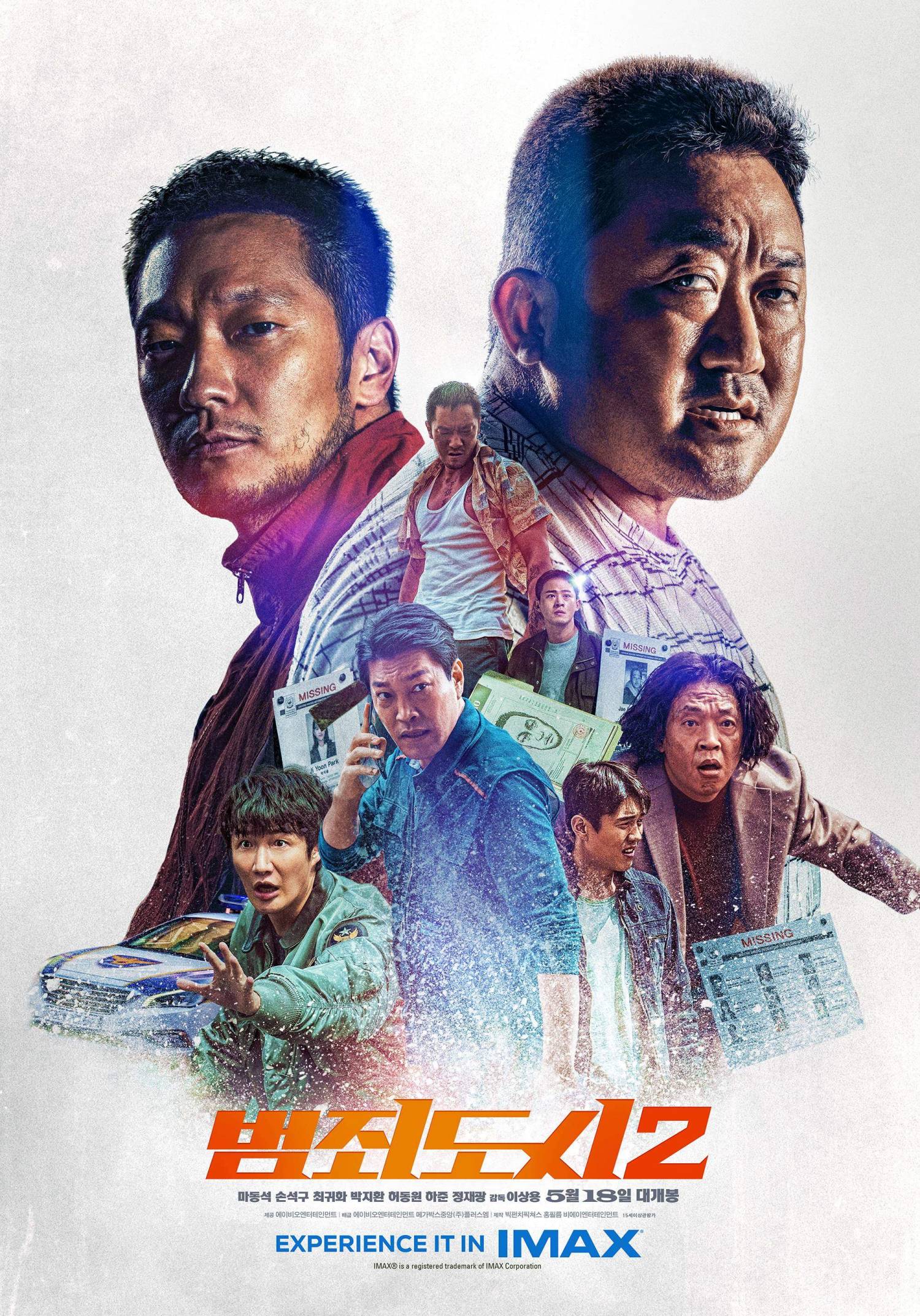
The Roundup (범죄도시 2, Lee Sang-yong, 2022)

Force of justice Ma Seok-do returns five years after The Outlaws to right more wrongs in jet-setting action comedy, The Roundup (범죄도시 2, Beomjoidosi 2). By this stage in his career, actor Ma Dong-seok has succeeded in creating a persona for himself as a loveable bruiser whose violence is just a way of being and always in service of a greater good. These are qualities very much in play as Seok-do (Ma Dong-seok) finds himself defending the interests of Korean citizens abroad against crooks the cops failed to catch at home.

Seok-do is however in the dog house for being accused of using excessive force in the papers after neutralising a hostage incident in a convenience store. To keep him off the front pages, the higher ups decide to send him on a mini mission abroad bringing home a Korean fugitive who has apparently turned himself in to the Vietnamese authorities. Given that this is quite an odd thing to do and the criminal’s explanation that he was suddenly overcome with guilt and wanted to repay his debt to society doesn’t ring true, Seok-do smells a rat. As he discovers, it all points back to the kidnapping and murder of a rich man’s son by vicious gangster Hae-sang (Son Seok-koo) who preys on unsuspecting tourists. Rather than get the police involved, the boy’s father has decided to hire a bunch of mercenaries to take revenge further destabilising the local underworld in Ho Chi Min City. 

It has to be said that there is something a little uncomfortable in the quasi-nationalist posturing of the film’s central premise. Korea has effectively been exporting crime by allowing dangerous criminals to flee abroad where the law can’t touch them. Korean crooks then make trouble for Korean tourists even if not quite to the extent of Hae-sang, all of which ignores the effects on the local Vietnamese population in concentrating on Korean on Korean crime. At the end of the film it’s even suggested that Korean police officers might be dispatched to other areas of Asia to look after Korean tourists which shows a certain lack of respect for national sovereignties while more or less letting the same police officers off the hook for failing to catch criminals in Korea or address the issues which led to them entering lives of crime. A maverick cop, Seok-do does rather throw his weight around in a foreign country, caring little for protocol and threatening to spark a diplomatic incident every few seconds. 

Then again he is just particularly keen on shutting down Hae-sang and exposing him for his heinous acts, cleaning up a mess that has ended up spilling over abroad. Ironically enough, the bereaved father, Choi (Nam Moon-cheol), maybe a powerful CEO but he made his money loansharking and is pretty much a petty gangster himself so of course he wants personal vengeance once again uncomfortably hiring mercenaries from China. Meanwhile, Seok-do ends up enlisting the help of a formerly undocumented migrant when Choi ends up getting kidnapped himself by a cornered Hae-sang.

In any case, Seok-do more than holds his own against the bloodthirsty villains in a series of well choreographed action sequences culminating in a one-on-one showdown on a bus. Much of Ma’s appeal lies in his effortless ability to take down bad guys which he does a plenty, even dispatching one via escalator to his waiting teammates below. Even so, he knows not to take himself too seriously and is keen to cede screen time to the ensemble allowing a gentle camaraderie to appear among his squad members despite their separation while Seok-do and the Captain are in Vietnam trying to have a covert holiday and the rest of the team are left behind to do regular admin work in the office. Though it may present some rather uncomfortable ideas in a kind of Korean exceptionalism that implies a degree of superiority over and disregard towards other Asian nations, the film is nevertheless a charming retro action comedy and perfect showcase for the charismatic star as his no-nonsense policeman makes a point of slapping down bad guys and fighting international crime while generally living his best life hanging out with similarly justice-orientated buddies. 


The Roundup screens in Amsterdam on 27th October & 4th November as part of this year’s Imagine Fantastic Film Festival.

International trailer (English subtitles)

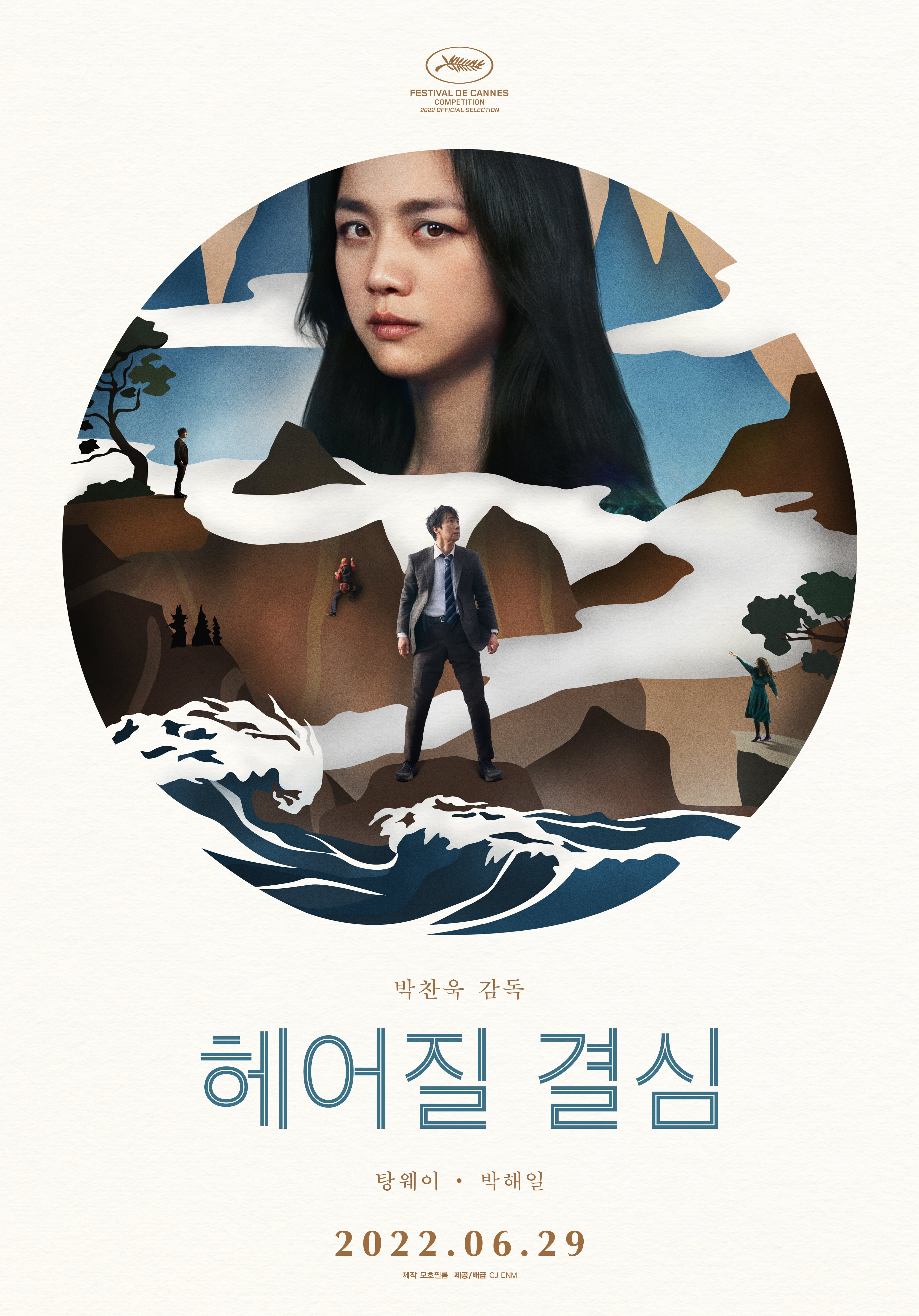
Decision to Leave (헤어질 결심, Park Chan-wook, 2022)

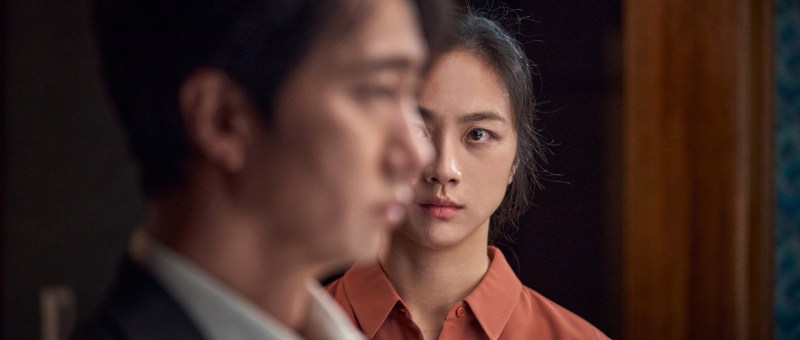
“I went through hell for you but without you my life would be empty” a fugitive murderer asks an insomniac detective to tell the woman he loves, making his own Decision to Leave (헤어질 결심, Heojil kyolshim) which will in fact be one of many in Park Chan-wook’s achingly romantic noir. Tinged with fatalism, the pursuit of love is also one of death and leads inevitably to a kind of haunting from which there is no real escape though you wouldn’t really want one anyway. 

In any case, the detective Park Hae-joon’s (Park Hae-il) sense of reality is already fracturing under the strain of his incurable insomnia. As he tells his partner, it’s not that he can’t sleep because of his obsessive stakeouts, it’s that he goes on stakeouts because he cannot sleep. Unfortunately for him, there have been relatively few murders lately. He wonders if it’s because of the nice weather, as if homicidal rage were being held in check by the gentle art of picnicking which it has to be said has a strange logic to it. Living apart from his wife who is a nuclear engineer in provincial Ipo, Hae-joon prides himself on being a good policeman and is preoccupied by his failure to catch two suspects currently on the run for a vicious murder. When he’s called to the scene of a dead body lying below a cliff, most are ready to rule it a tragic accident or perhaps a suicide but Hae-joon isn’t so sure especially given the unusual behaviour of the man’s much younger widow, Seo-rae (Tang Wei), who appears almost indifferent to her husband’s death and giggles to herself during an interrogation a habit she later claims is born of nervousness and a lack of confidence in her ability to speak Korean having migrated from China. 

Seo-rae’s Korean is perhaps a little better than she makes out, but still we see her repeating lines from romantic dramas on television, lines she later repeats to Hae-joon, while he wonders if her taste for historical romance has lent her Korean its archaic quality. They are each in a way out of time, she remarking that he strikes her as “dignified” to a degree she didn’t expect in a “modern” man while he ironically tells her that he was drawn to her because like him she liked to look at things directly. Yet there’s nothing at all direct about the mysterious Seo-rae whom he suspects of murdering her husband, and though there might be something unspoken directly understood between them their attempts at communication are always frustrated. Not only is there an ever shifting language barrier, but a mediation through text message and voice note or else through the act of being observed at a distance. As they grow closer, Hae-joon allows Seo-rae to listen to his surveillance tapes recorded as he voyeuristically watched her apartment from the rooftop opposite. She immediately deletes them but later does something similar herself, and is finally undone by her inability to delete a potentially incriminating recording because it has come to mean too much to her. 

The pair are in a sense perfectly matched. Hae-joon’s melancholy wife finally exclaims that he needs murder and violence in order to be happy, while Seo-rae admits that she ends up with terrible men like husband because it would take something extreme such as a murder for a good man like Hae-joon to take notice of her. As the couple dance around each other, Park colours their non-romance with shades of the gothic in the repeated motif of the crow feathers each of them find as they work their way towards the apotheosis of their love. As they say every love story is a ghost story and what is love if not an unsolvable mystery? Hae-joon’s sense of reality is forever in flux, Park playfully dressing Hae-joon’s new team and his old team in similar outfits as he segues between fantasy, reality, and memory while trying to parse out an objective truth. Hae-joon’s tragedy may be that he discovers more than he ought to know but not enough to solve the mystery, destined to be haunted by his unresolved cases and the elusive silhouette of lost love lingering silently in the mists of memory. 


Decision to Leave screened as part of this year’s BFI London Film Festival and is now on general release in US & UK cinemas courtesy of MUBI.

International trailer (English subtitles)

Angae (Mist) by Jung Hoon-hee (1967) which is also the title song for Kim Soo-yong’s 1967 film of the same name.

I am More (모어, Lee Il-ha, 2021)

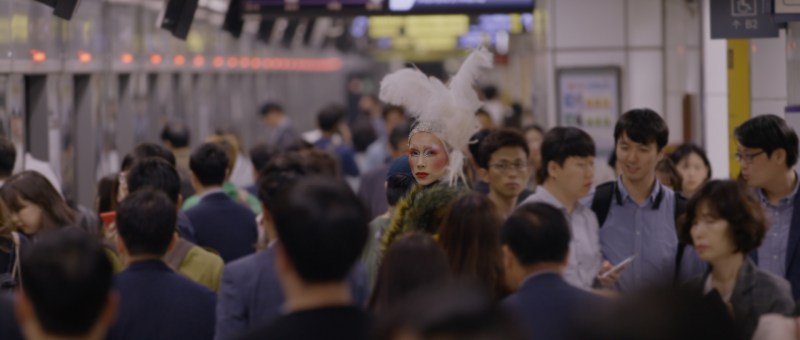
I am More (모어, More) is as much a mission statement as it is a simple piece of biographical information in Lee Il-ha’s musical documentary following transgender drag artist More. Born in Korea but based in Japan since 2000, Lee’s previous documentaries focused on the position of Zainichi Koreans but with I am More he explores the position of minorities within Korea itself while providing a platform for More to express herself fluently through music and performance art. 

More describes herself as having a love hate relationship with drag which she has been performing for over 20 years in the bars and clubs of Itaewon. She relates that she still has a gun in her heart and that going to perform is like going on duty while throwing shade on the Western customers at her bar and their $1 tips. Even so, drag was a liberating experience for her on arriving in the city in which attitudes towards gender norms were much stricter than they had been in the small town where she grew up even if they had not exactly been much warmer there. Embarking on her studies at Seoul University of the Arts, a fellow student punched her in the face and told her to lose her feminity while when forced to do military service she was briefly placed in a mental hospital. 

More’s warmhearted and completely accepting mother claims that there was no bullying during More’s childhood and that nobody thought much of her atypical gender presentation, but More also reveals that she once tried to take her own life during high school but survived and in fact went straight to an exam to avoid getting in trouble for missing classes. Her teacher also recalls another student whom he describes as “effeminate” and apologises for the way they were treated by their classmates while More seems to have developed a friendship with one of the bullies who tormented her but also showed her kindness. He reflects on the various ways their perspective was “limited” by their small-town upbringing remembering how small he felt on going to the city and realising he was no longer at the top of the social hierarchy. 

The situation may be very different than it was during More’s childhood, but the LGBTQ+ community still faces prejudice and discrimination from religious groups who are seen protesting pride events and harassing attendees while a patriotic song from the era of dictatorship singing of “our Korea” ironically plays in the background. More is in a longterm relationship with a Russian man, Zhenya, whose immigration status is precarious as he is stuck on a job seeker’s visa. Same sex marriage is not recognised in Korea meaning that he is unable to apply as a spouse and is in the midst of trying to gain Korean citizenship. Meanwhile despite having a PhD in chemistry he is currently unemployed and losing himself in the comparatively tranquil world of Pokémon Go where he says the monsters are kinder than people. Though they have been together a long time, some of it on and off as Zhenya later implies, Lee follows More as she introduces Zhenya to her parents who welcome him with open arms and make sure to invite him to all the major celebrations as More’s partner seeing as he obviously has no other family in Korea to spend them with. 

Meanwhile, Lee spends much of the documentary focussing on More’s rehearsals for a show in New York celebrating the 50th anniversary of Stonewall during which she develops a friendship with Hedwig and the Angry Inch star John Cameron Mitchell who later travels to Korea and remarks on how difficult it can be to be yourself in a conformist society where individuality can sometimes be read as selfishness. Hedwig in a sense brings things full circle with a reference back to More’s own Wig in a Box moment discovering drag in Itaewon while Lee is careful to give her her own space to express herself as she lip syncs to iconic pop songs and performs poetry and performance art in elaborate outfits at Seoul landmarks as if beckoning towards a new and more inclusive culture. A vibrant portrait of a queer artist who is absolutely herself I am More more than lives up to its name in its electric advocation for a world of love and joy. 


I am More screened as part of this year’s New York Asian Film Festival. It will also be screening in London on 13th November as part of this year’s London Korean Film Festival.

Festival trailer (dialogue free)

Though the film’s subtitles refer to More as “he”, she has confirmed with festival organisers that she prefers feminine pronouns.

Images: ⓒ2021 EXPOSED FILM, All Rights Reserved

The Woman in the White Car (하얀 차를 탄 여자, Christine Ko, 2022)

A small-town policewoman unfairly held back by a traumatic past is embroiled in a complicated case of distorted realities in Christine Ko’s twisty, B-movie thriller, The Woman in the White Car (하얀 차를 탄 여자, Hayan Chaleul Tan Yeoja). Alluding to a novel which is mentioned in the film and both clue and red herring simultaneously, the title may actually be a minor spoiler but is also neatly allusive in its sense of mystery which at the same time proves mildly reductive even as we ask ourselves who such a woman may be. 

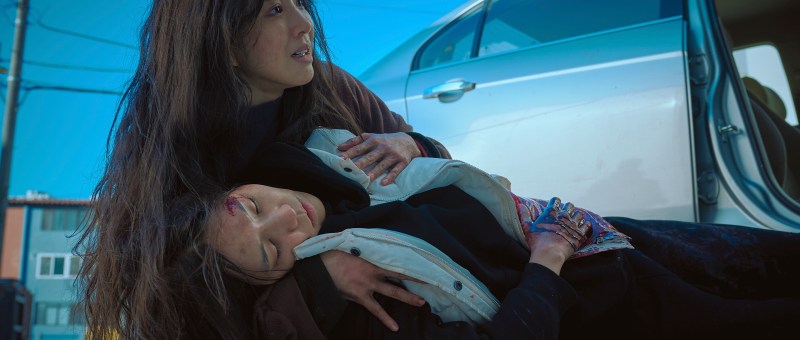
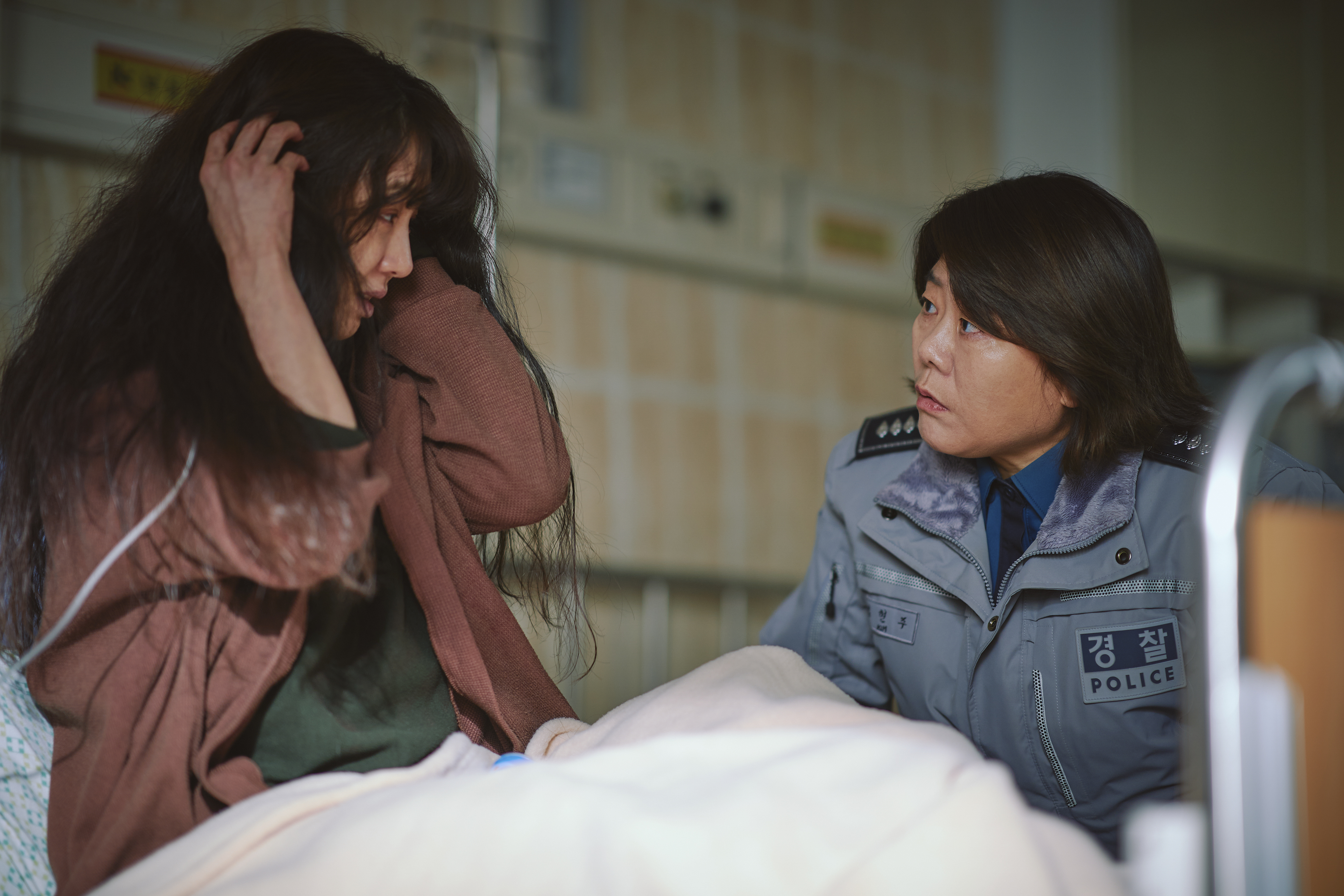
The film opens, however, with a silver car which has a large dent to its front bumper arriving at speed at a hospital where the driver, Do-kyung (Jung Ryeo-won), pulls another woman she calls sister out of the passenger seat while trying to get the attention of medical staff explaining that the woman has been stabbed by an abusive partner, Jung-man. All of that is obviously very distressing but when policewoman Hyun-ju (Lee Jung-eun) arrives on the scene she is immediately alerted to what seem to be inconsistencies in Do-kyung’s story some of which could possibly be chalked up to shock along with the revelation that Do-kyung has been diagnosed with schizophrenia and her recollections of events may be unreliable. 

Then again as Hyun-ju says, just because Do-kyung has schizophrenia it does not mean there is no truth in her testimony, just as it does not mean that anyone else with no such condition is necessarily telling the truth. Identifying with her on some level, Hyun-ju tries to tease out the hidden meaning behind Do-kyung’s words to unlock an objective reality but is also mindful of the possibility that Do-kyung may actually be completely lucid and playing them all for fools. The plot thickens when it is realised that the woman in the silver car is not Do-kyung’s sister Min-kyung as she had claimed, but an otherwise unidentified passenger whose origins they do not know further casting doubt on Do-kyung’s version of events along with the existence or not of prime suspect Jung-man. 

As she had received the call about the incident, Hyun-ju had been having a meal with her naive assistant Young-jae who had complained how boring their lives were as small-town police officers while Hyun-ju had even insisted on finishing her dinner before leaving for the hospital believing it couldn’t really be that urgent. On witnessing her talent for investigating, he asks her why she didn’t leave to pursue a more fulfilling career elsewhere only for her to explain that she stayed to look after a father we later learn to be abusive whose cutting criticism eroded her confidence in seeking a better life. All the women are in fact similarly constrained, but eventually fighting back against those who are preventing them from taking full control over their lives and in some cases creating a narrative that allows them to do so while claiming their freedom. 

Ko piles twist onto twist through a series of unreliable narrators each giving contradictory versions of events but each in their own small way hinting at greater truths which eventually present themselves to Hyun-ju leaving her with a dilemma in solving a mystery but wondering if it’s better to let it rest and each of the women, herself included, go free. Switching aspect ratios and colour grading to present different versions of reality through flashback and thought experiment, Ko places material clues in each of the stories to act as tiny anchors while setting the tale at a creepy mountain lodge in the middle of nowhere filled with gothic uncertainty and almost chilling loneliness. Accompanied by an overtly B-movie score, the film certainly indulges, with pleasure, in a series of genre cliches from mental illness to unreliable narrators, blood in the snow, and dangerous mountain curves but is finally anchored in a more certain reality unlocked by a detective’s unexpected empathy even if that same empathy leaves her vulnerable to a more literal kind of deceit. “I was just saving myself” one of the women admits, speaking for all taking their destiny into their own hands and reclaiming their freedom in the knowledge that only they can do so.


The Woman in the White Car screens 7th/8th October as part of this year’s BFI London Film Festival.

Original trailer (English subtitles)

My Perfect Roommate (룸 쉐어링, Lee Soon-sung, 2022)

In recent years, an ingenious idea has seen older people living alone paired with youngsters struggling to find affordable housing in the hope of combating loneliness and isolation among the elderly to allow them to continue living independently in their own homes for longer. Some more cynically minded people might say it’s merely the government attempting to shift its own responsibilities onto the community, but it can’t be denied that it’s an interesting solution to the problems of an ageing society that, if it works out, can be enriching for both parties though as the grumpy granny and kindhearted student at the centre of Lee Soon-sung’s My Perfect Roommate (룸 쉐어링, Room Sharing) discover it’s always going to be a difficult adjustment. 

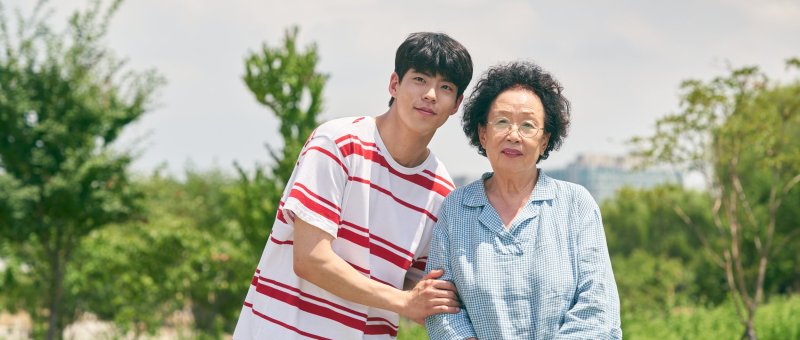
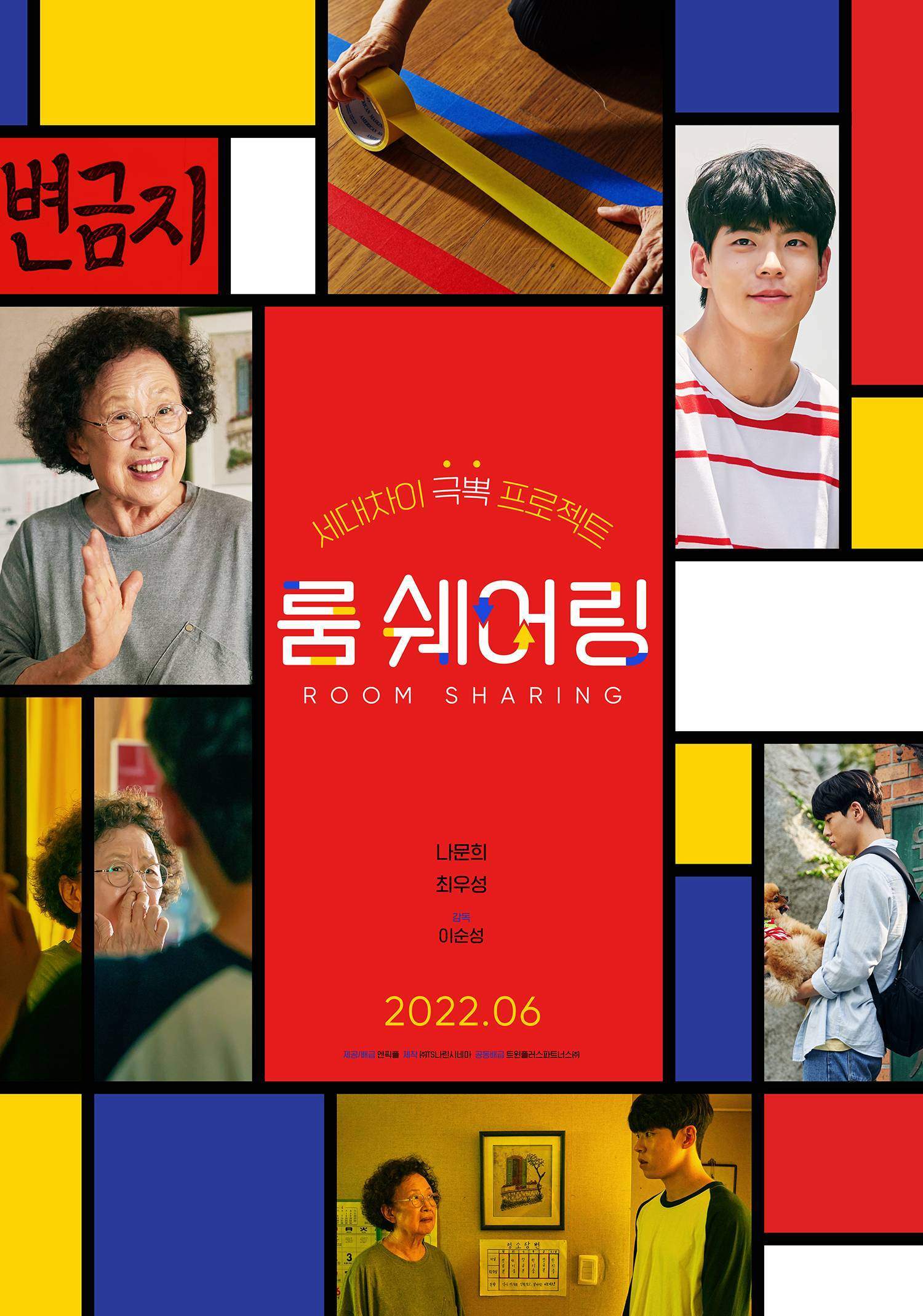
That’s in part because Gum Bun (Na Moon-hee) is an elderly lady very set in her ways who appears to be not entirely happy with the idea of having a young man come to live with her in the first place. Before Ji Woong (Choi Woo-sung), a student on a tight budget, arrives she patterns her home with duct tape to mark out which areas he’s allowed to go into and even goes so far as to forbid him from using her bathroom to do a number two because she just can’t bear the thought of sharing her toilet with a man after all these years living alone. For his part, Ji Woong doesn’t complain and does his best to abide by Gum Bun’s wishes even though at times the arrangement seems exploitative as she makes a point of ordering him to do her housework and even begins cooking him meals so she can charge him for them. 

Yet as Ji Woong’s boss at his part time job clearing houses after someone has died points out, loneliness can come at any age and both Gum Bun and Ji Woong are lonely each in a sense excluded from mainstream society because they do not have families of their own. Gum Bun never married and has only one friend (Choi Sun-ja), a neighbour of the same age who married and had children but feels disconnected from her son who rarely calls or visits. She has also elected to take part in the home sharing programme and enjoys spending time with the young student who lives with her as if he were really her grandson. But Gum Bun struggles to bond with Ji Woong in part because she has had disappointment in her life that has left her embittered and resentful while he is also reserved as he is afraid to disclose that he has no family because of a societal stigma towards orphans.

For these reasons there are trust issues on each side, but also an eventual common ground that allows the pair to generate a kind of familial bond and Gum Bun to open herself up to the world again no longer so afraid of abandonment. As Ji Woong had said about a little dog he agreed to look after for a few days much to Gum Bun’s consternation, if you give something love it will eventually come back to you. “We must help each other in this society” Ji Woong had earnestly said only for Gum Bun to counter that helping other people only leaves you miserable, but even she learns to remember her community spirit helping local children living in poverty while collecting prescriptions for other elderly people along with offering a little medical advice as a former nurse. 

Lee’s warmhearted drama directly tackles a series of societal problems from the ageing population to the difficulties young people face trying to get their start in life, but is also clear that prejudice often contributes to the crushing loneliness that can make life seem not worth living. Gum Bun is written off as a “grumpy granny”, excluded from mainstream society because she never married, while Ji Woong is constantly faced with a degree of suspicion solely because he has no family, embarrassed when friends asks what his father does or when a job application unnecessarily asks for his parents’ names. Ji Woong is over the age of majority, but he’s still pressed by a policeman to call his mum and dad while the guy he got into a fight with protecting Gum Bun calls him an “orphan punk” and gestures to the policeman that he is obviously in the wrong assuming the policeman will immediately agree with him. Both he and Gum Bun are in a sense orphans, left alone to fend for themselves in an often hostile society but eventually discovering an unexpected solidarity and sense of familial warmth that allow them to begin moving forward with their lives.


My Perfect Roommate screens in Chicago on Oct. 1 as part of the 15th season of Asian Pop-Up Cinema.

International trailer (English subtitles)

Director’s Intention (영화의 거리, Kim Min-geun, 2021)

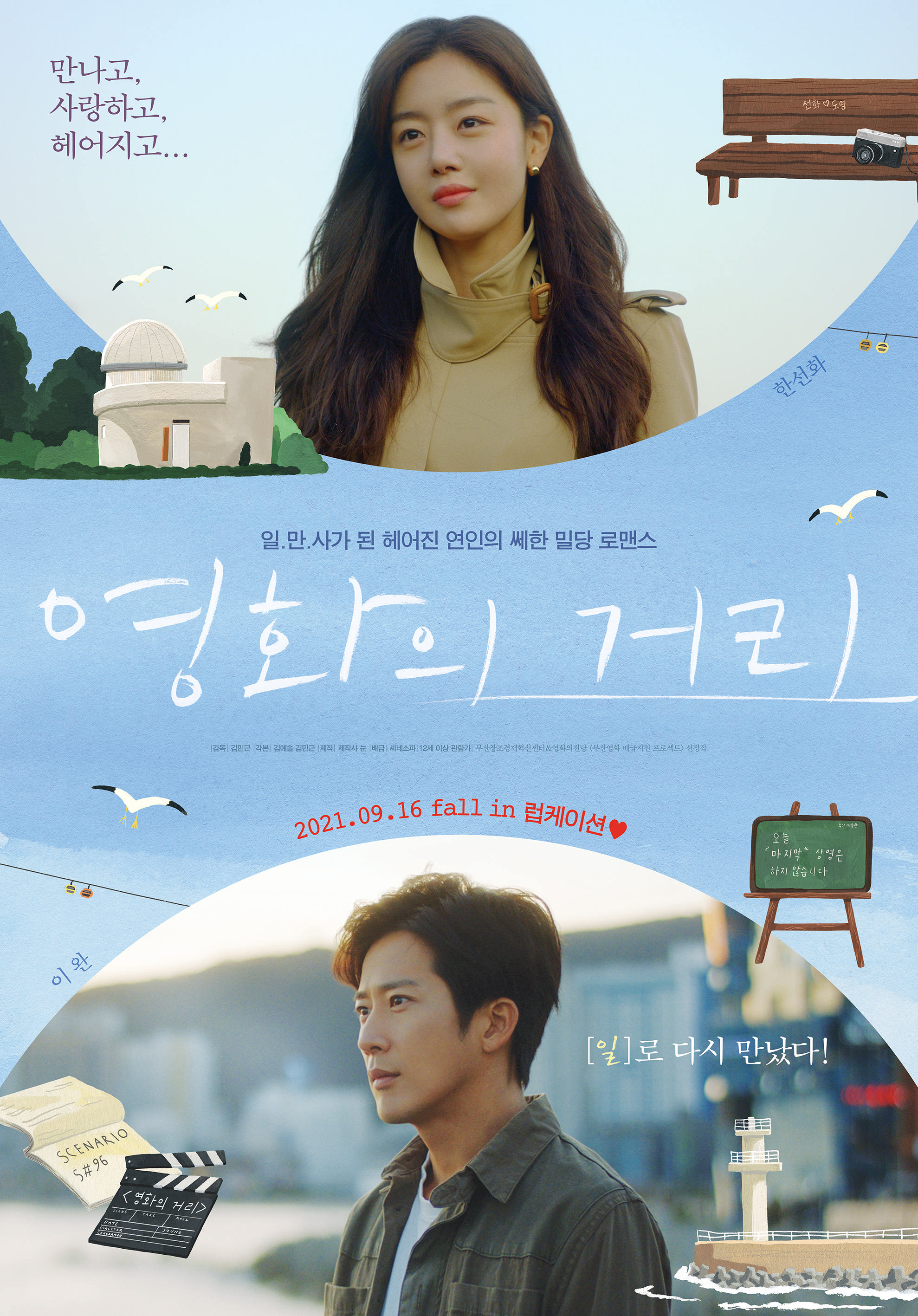
A location scout struggles with memory and landscape when reuniting with a former love in Kim Min-geun’s indie drama, Director’s Intention (영화의 거리, yeonghwaui geoli). The director’s intention is something she’s trying to tease out in trying to find the places that best reflect his feelings, but in doing so she’s also forced to confront herself, her regrets about the past, and her true feelings about her city and her place within it. 

Longtime movie-obsessive Sun-hwa (Lee Sun-hwa) has been working as a location scout in her home city of Busan for quite some time and while moderately successful has not yet hit the big time. Her boss is excited to call her back to the city for a big new job he thinks could even lead to some Hollywood connections, but Sun-hwa isn’t sure she wants to take it because the director, Do-young (Lee Wan), turns out to be an old flame who broke her heart by leaving her behind to chase movie success in Seoul. 

It’s Sun-hwa’s firm opinion that Busan is as good as anywhere else and that filmmaking shouldn’t be limited to a small elite in the capital. She couldn’t understand why Do-young was so keen to leave and was determined to stay making films with those she loves in a place she loves. She accuses him of selfishness, but it is perhaps on another level simply afraid to leave the security of the familiar for the promise of the new, while he is too quick to abandon the old insisting that there are better opportunities to be had elsewhere. At the end of the day what they have is contradictory perspectives that cause each of them a crisis of faith in the relationship, he because she won’t leave with him and she because he won’t stay. “He cared more about his dreams, I cared more about my life” Sun-hwa later explains, justifying her desire to stay and build something on firmer foundations rather than take a gamble on an unlikely success. 

Sun-hwa prides herself on being able to match the emotions from the scene she’s given to a particular place to help the director express his feelings onscreen, but Do-young seems to reject each of her choices simply walking away from each location as in someway unsuitable. She offers him only barbed comments which seem to confuse the other members of the film crew who presumably have no clue what’s going on or of the couple’s former relationship while he says barely anything leaving the question open as to whether he’s here to rekindle an old romance or simply to memorialise it in film. Sun-hwa meanwhile needles him by deliberately selecting painful places filled with their shared memories sure to provoke something if not necessarily the effect Do-young was hoping for. Then again, his key criteria for a pivotal, unwritten scene is that it should look nice but feel empty. 

In any case, as Sun-hwa says there are no places you only see in the movies. Every location has its own story to tell, but can also play host to the stories of others. In the opening scenes, Sun-hwa holds a notebook and surveys a river ominously containing abandoned boots and clothing. She is mistaken for a detective by a panicked local who has in a sense created his own story from what he sees only to be relieved on discovering it to be an illusion. No horrific crime has disrupted the tranquility of this peaceful, rural scene. The only thing that matters is that it’s the right place for the right director and perhaps at the right time. Wander around and you might just find what you’re looking for while in having a firm destination you might ending up missing the perfect spot and never reach what you thought you were searching for. Then again, even if a place no longer exists the feelings surrounding it survive and can perhaps be salvaged even if not quite the same as they once were as Sun-hwa discovers in revisiting her past to scout locations that will either bring an old story to an end or begin it anew.


Director’s Intention in Chicago on Sept. 25 as part of the 15th season of Asian Pop-Up Cinema.

International trailer (English subtitles)

Mother’s Place (엄마의 자리, Ryu Hee-jung, 2022) 

Outdated patriarchal social codes conspire against the emotional bonds of family in Ryu Hee-jung’s touching family drama, Mother’s Place (엄마의 자리, eomma-ui jali). While adult siblings keep secrets from each other to avoid personal embarrassment and fail to resist the demands of otherwise estranged relatives, a teenage girl is forced to mourn the loss of her parents alone feeling as if her place in the family unit was never guaranteed and that she has been abandoned by those closest to her simply because her mother’s was a second marriage. 

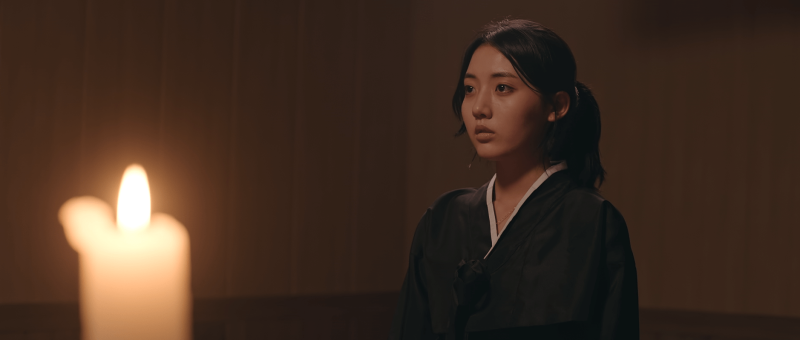
High school girl Yuna is called to the hospital by her oldest sister, Jungsun, who is desperately trying to hold it together but receiving little support, to be told that her parents have been involved in a car accident and are in critical condition. Jungsun rings her other sister, Jungwon, to ask her to pick up her children while waiting for her husband to get off work but Jungwon is also busy with her job as a lawyer and ignores her first few calls. Meanwhile, the oldest brother, Junghan, rudely tells her he’s too busy to talk and makes no attempt to travel to the hospital which the other siblings partly understand because they believe him to be in Japan only as it turns out that is not quite the case. After the parents sadly pass away, Jungsun and her sister organise the funeral but are immediately overruled by a grumpy and extremely conservative uncle who happens to be a prominent politician and is outraged that they are holding a joint memorial considering it was a second marriage. Apparently from a somewhat prestigious family, the other relatives intend to bury the father in the family plot and think it would be improper to inter the mother alongside him because his first wife and the mother of the eldest three children already rests there. 

“Things won’t change even if you insist” Yuna is told by her siblings who are minded to simply go along with the uncle’s instructions even though they too were shocked and hurt by the suggestion that a joint funeral is improper, reminding the uncle that she may have been a stepmother but she was their mother too. Orphaned at such a young age, Yuna is then left to deal with her mother’s death all alone while simultaneously prevented from being able to attend her father’s funeral. Her outsider status is already signalled by her name, all of her siblings share the first syllable “Jung” while she obviously does not and while they always acted like a family now it’s like they’re disowning her while disrespecting her mother’s memory in suggesting there was something sordid about her relationship with her father that prevents her being buried next to him in her rightful place as his wife. 

She can’t understand why they would just go along with something so obviously wrong, totally unable to reject the uncle’s intrusion into what should be a matter for the immediate family. When he first arrives, the uncle immediately takes issue with the fact that Jungsun is acting as the chief mourner, insisting her husband (who might otherwise not be considered a member of her father’s family) take over until Junghan arrives because a woman occupying such a role is to him in his extremely conservative thinking inappropriate. A tearful Jungsun just lets it go if internally hurt and irritated given that she’s the one doing all the work of making these arrangements that have so casually been overturned. When Junghan finally shows up with a bruised face, the uncle immediately commandeers him and reveals that he’s invited some professors from a local university along with the intention of getting him a “proper” job though there can be few people who would otherwise think a funeral is an appropriate place for a job interview or professional networking. 

Junghan does however mimic his uncle’s conservative views in his constant digs at Jungwon for not yet being married at a comparatively late age. As will be discovered, Jungwon may have her reasons and they’re ones which she may not have felt comfortable sharing with her family members given the quality of the relationship that exists between them. They are all already holding secrets from each other because of the toxic performativity of their familial roles which leaves them embarrassed and fearful of failing to conform to a societal ideal as seen through the conservative eyes of their uncle and those like him. The older siblings only begin to realise their mistake on witnessing Yuna’s rebellion and fearing for her safety while reflecting on their own emotional bond with her mother and the various ways they are now being forced to deny their love and affection for her. 

Oddly, it’s the surprise appearance of the first wife’s ultra-glamorous sister that gives them permission to question the patriarchal norms expressed by the uncle and begin to re-establish the bonds they share as siblings brokered by an emotional connection and founded in shared memories rather than a simple blood relation. With truths aired and a little more emotional honesty in play, the family is free to remake itself along healthier lines of mutual support and compassion free of the constraints placed on them by outdated social codes. In searching for her mother’s place, Yuna begins to find her own outside of the cold and austere conservatism imposed by those like her uncle. 


Mother’s Place in Chicago on Sept. 24 as part of the 15th season of Asian Pop-Up Cinema.