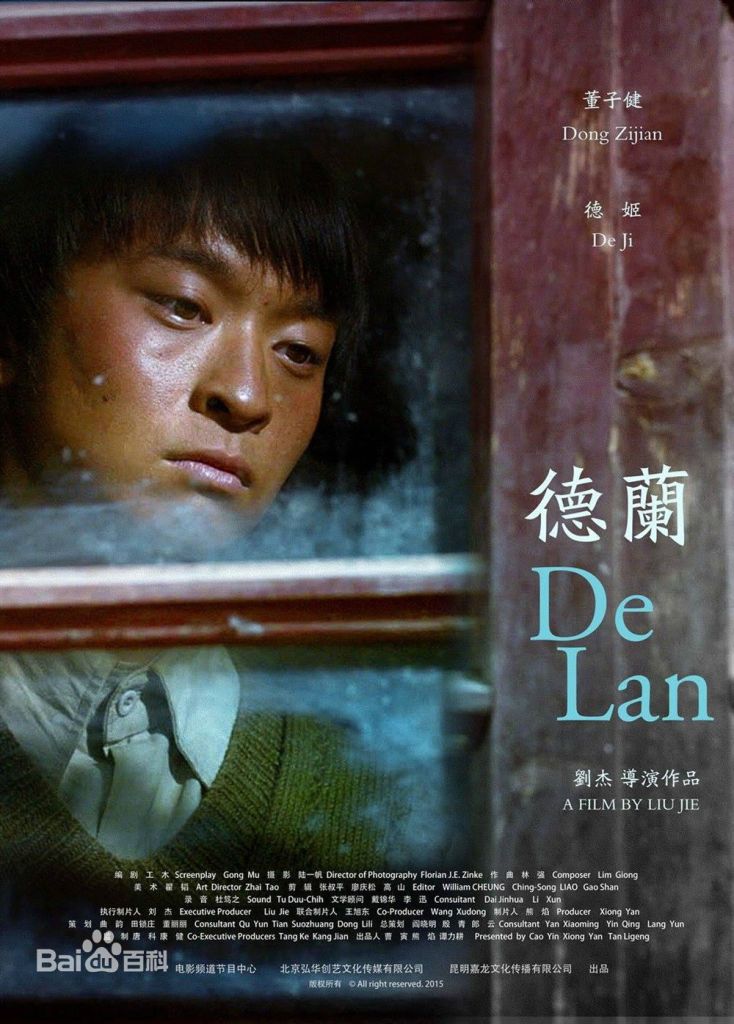
De Lan (德蘭, Liu Jie, 2015)

Set in 1984 in a rural Chinese backwater, De Lan (德蘭) is named not for its central character, but for his first love – a mountain woman far from home in search of a missing relative. Tasked with following De Lan (De Ji), Wang (Dong Zijian) finds himself entering a strange new world which he is incapable of fully understanding, not least because he doesn’t speak the language. A wordless love story between the tragic De Lan and the adolescent Wang is destined to end unhappily, but will affect both of them in quite profound ways.

Wang’s father has been missing for three months, and what’s worse is that around 2000 yuan went missing with him. Mr. Wang had been the loans officer for the local party office in this dreary mountain town and now the best idea anyone has come up with is for Wang to take over the position and pay back the missing money with deductions from his wages (this should take around ten years). Hardly fair, but what can you do? Wang’s first assignment is to take an audit of a mountain town where the residents have a lot of outstanding payments. Seeing as they’re heading to the same place, Wang is to accompany a mountain woman, De Lan, who had been travelling around local towns looking for a missing person but has now run out of money and must go home alone.

Wang is told to trust De Lan when it comes to the terrain, but that he should keep control of the food supplies in case she tries to run off. All things considered, the people at the foot of the mountains, aren’t very well disposed to those at the top. Wang is young and unused to walking such long distances, frustrating De Lan with his inability to keep up and frequent needs to rest. Nevertheless a kind of mutual affection seems to build up between them but largely goes unspoken and unacknowledged. Finding himself installed in De Lan’s home, Wang begins to feel very awkward indeed, unable to work out the strange family dynamic between the gruff man with the lame leg, ancient blind old woman, and the feisty De Lan.

Wang has, after all, been sent to the town to collect on loans – an entirely pointless enterprise as no one here has any money. Wang’s father was a much loved presence, mostly because he always came with cash and never pressed them on repayments. His son, with a father’s debt around his neck, is not quite so nonchalant. Calling a village meeting with no notice, Wang makes it clear he won’t be following his father’s lax approach and will not be issuing any new loans, rather he will be calling in the old ones. This does not make him popular in the village.

Eventually he changes his mind and decides to flash some cash but his worst assumptions are confirmed when the villagers, far from using the money they claimed to so desperately need to survive to invest in their businesses, club together to buy all the booze in the surrounding area and have a giant party. Originally put out by their trickery and De Lan’s ongoing unavailability, Wang suddenly finds himself trying some of their liquor and joining in with a dance around the fire. Perhaps learning to adjust to the Earthy, less ordered way of life, Wang has embraced the new found freedom of the place, but he will also discover that it only runs so deep.

De Lan’s life has undoubtedly been a difficult one which she faces with stoic resignation. Shared between two men and longing only for a child, De Lan has very little say in anything that happens to her yet she was able to set off all alone to look for her missing person. During the trip, De Lan is dismayed when a teenage boy in a home they spend a night in makes a vulgar comment about her body, leading her to try to leave as soon as possible only for Wang to pledge his protection. De Lan is aware of the dangers of the road, as well as the constraints placed on her life, whereas as Wang is still naive enough to think his physical strength and government position would be enough to keep De Lan any safer than she would be alone.

As Wang’s feelings for De Lan grow he fantasises about saving her from this strange, cold household though he barely stops to ask himself if saving is really what she wants. Unable to speak the local dialect, Wang necessarily needs to rely on look and gesture which is largely how he and De Lan have come to communicate – a pure kind of dialogue without need of words. Wang’s love for De Lan is destined to cost him dearly both in financial and emotional terms. A beautifully sad tale of frustrated first love set against the picturesque Chinese countryside and inside it’s much less pretty political system, De Lan is the story of one man’s transition from adolescence to manhood through heartbreak, filled with quiet, yet intense, emotion.


Reviewed at the 2016 London East Asia Film Festival.

Trailer (English subtitles)

https://www.youtube.com/watch?v=AIqY-zUEzww

What’s in the Darkness (黑处有什么, Wang Yichun, 2015)

whats-in-the-darknessFirst time writer/director Wang Yichun draws on her own experiences for What’s in the Darkness (黑处有什么, Hei chu you shenme), a beautifully shot coming of age piece with serial killer intrigue running in the background. Seen through the eyes of its protagonist, What’s in the Darkness neatly matches the heroine’s journey into adolescence with the changing nature of Chinese society.

In May 1991 a series of horrific killings rock a small, rural town. Schoolgirl Qu Jing (Su Xiaotong) learns of the first murder of young and popular girl from the village when her policeman father Zhicheng (Guo Xiao) is called to investigate. A crowd has gathered around the crime scene where local women gossip and speculate, assuming the poor girl must have been raped and then murdered to prevent her going to the authorities.

Unaccustomed to such violent crimes, the police get busy but predictably lack the expertise to properly investigate. Zhicheng is unusual among his peers as he has a university degree and is keen on deduction, but his colleagues think his efforts are just going to make trouble for everyone and quickly decide on a suspect to beat a confession out of so that they will be seen to have done something. This plan goes haywire when a second murder occurs whilst the accused is in custody leaving the police with no option other than to allow him to “escape”. When one of Jing’s friends, whose estranged father is also a policeman, goes missing the stakes are raised but the possibility of successfully solving the crime seems increasingly remote.

Many things were changing in 1991, even in small rural towns. Jing is a wide eyed, naive and innocent girl with an intense curiosity and an ethereal nature which sets her apart from her more ordinary schoolmates. Her best friend, Zhang Xue (Lu Qiwei), is a slightly older, more mature girl ostracised by her peers who have decided that she is, in some way, immoral. Living within an extremely repressed society, Jing has very little concrete knowledge about sex or relationships – she even had to look up the word “rape” in a dictionary after hearing it at the crime scene because she’d never heard it before. Her only other information comes from pamphlets about pregnancy (with which she seems to be strangely fascinated) and her attempts to get more information out of the supposedly more experienced Xue backfire when she realises they’re both as clueless as each other.

Jing’s big hobby involves heading out to a disused factory area and singing pop songs to an imaginary crowd (and a boy who’s secretly watching her from the shadows). When she and Xue visit a hair salon there are pictures of movie stars all over the walls and the TV shows the fluffy pop entertainment of the day rather the propaganda films Jing’s parents might be more used to. Having lived through the Cultural Revolution, Jing’s mother and father have experienced far more hardship than she could ever know. Jing can’t understand their preoccupation with food, but to those who’ve experienced the threat of starvation, the presence of a full rice bowl makes almost anything endurable. Trained to keep their heads down and make sure they eat, the villagers of Jing’s parents’ generation are determined to maintain the status quo, even if it means continuing to reinforce the old values in order to avoid reprisal.

The trappings of communism are everywhere from the school room where the kids rehearse patriotic songs under banners of Marx, Engels, Lenin, Stalin, and of course Mao, to the security forces lurking in the background. Representing the state, the police force is staffed by a collection of lazy, corrupt petty officials content to throw their weight around in the absence of any real crime to deal with. Zhicheng refuses to engage in the same level of corruption as his comrades, but his honesty and steadfastness only arise resentment. Jing finds herself experiencing the same phenomenon when the headmaster finds out about her volunteering at the old people’s home and decides to give her an award thereby singling her out in front of her friends and irritating her harsh and grumpy teacher.

It’s at the old people’s home that Jing encounters her first randy old man when one of the residents she’s been asked to read to suddenly swaps out the book she’s been assigned for a probably banned erotic classical text with the only saving grace that Jing, even if she can read all the characters, does not quite understand what she’s reading.

Through Wang’s camera every man in town begins to look suspicious from the ice lolly seller eying up the behinds of the school girls as they walk away from him with their frozen treats, to an odd looking man with physical ailments who is often seen lurking in the background behind Jing. Visiting a friend’s house, Jing is unceremoniously dumped into a backroom when the older brother turns up with a porn film only for the house to be raided and everyone arrested. In a quest to finally find out what all of this is about, Jing buys a ticket for an adult movie from a man positively overjoyed at the idea of sending an underage girl into a room full of sweaty guys who all instantly turn away from the onscreen action to stare at the anomaly of Jing as she openly weeps at what she sees.

One of the benefits that communism claimed to bring was equality between the sexes. Women may hold up half the sky, but they still have to conform to an arcane set of social mores whilst they do so. Zhicheng forces Jing to ride sidesaddle on his bicycle rather than sit with her legs open and when she complains to him about the guy watching her sing, he tells her it’s all her fault for dressing in too alluring a manner. The murdered women are posthumously berated for their decision to be out on their own despite the fact that at least one of the killings must have occurred in broad daylight and when one of Jing’s schoolmates is feared to be the latest victim, their teacher reminds them that this is the kind of thing that happens when you fall in with a bad crowd. The police avoid serious investigation not only because they are lazy and corrupt, but because this kind of state sanctioned sexism is a tool they themselves (even if unwittingly) use to keep their womenfolk where they want them.

The identity of the murderer becomes irrelevant, this world is killing young women and it’s getting away with it because nobody cares. The women who die are written off as tainted, a lesson in failed femininity and evidence of what can happen if you don’t play by the rules. Little attention is paid to the perpetrator of the crimes who may also be a victim of this repressive environment as his desires are refused any other outlet than violence.

Although beginning in the vein of a serial killer movie, What’s in the Darkness is, at heart, a coming of age tale and social issue film. The era has shifted as the fear and austerity of the Cultural Revolution gives way to rising consumerism, placing a wedge between Jing’s generation and that of her parents. Wang rejects the classic procedural ending, leaving only questions in place of answers. As Jing stands alone with a little dog in her arms in the film’s final scene, she looks almost like Dorothy before the Emerald city as she plunges deeper into the reeds in search of answers, most definitely not in Kansas anymore. Jing’s eyes have been opened, her curiosity remains intact and unsated, as she alone remains unafraid to look at what’s really waiting for her out in the dark.


Reviewed at the BFI London Film Festival 2016

Original trailer (Chinese subtitles only)

https://www.youtube.com/watch?v=_69Pj-jB_rM

The Vanished Murderer (消失的凶手, Law Chi-leung, 2015)

vanished-murderWhen The Bullet Vanishes was first released back in 2012, the film received unfair criticism in some quarters due to its enormous debt to Guy Richie’s then popular Sherlock Holmes. Derivative or not, The Bullet Vanishes remains an innovative and intricately plotted cerebral thriller, primed to launch the return of its central detective, former prison warden, Inspector Song (Sean Lau). Only slightly late, Song is finally back to address another series of baffling deaths and conspiracies in 1930s China only this time he’s landed in a pulpy LA noir rather than the cowboy-tinged action of the previous film.

The Murderer Vanishes (消失的凶手, Xiāoshī de Xiōngshōu) revolves around Song’s Irene Adler figure, Fu Yuan (Jiang Yiyan), whom we saw Song making frequent prison visits to in The Bullet Vanishes. Song is called to the prison because Fu Yuan has mysteriously disappeared from her cell leaving only a Shawshank Redemption inspired red herring behind her. The strange bond between Song and Fu Yuan in which they chastely dance around each other in the ultimate long distance romance, dictates that Fu Yuan send him a letter to tell him exactly where she is so he can come and arrest her all over again.

After a hot date at the cemetery, Fu Yuan takes Song to a philosophy lecture in which the speaker, Professor Hua (Gordon Lam), muses on a thought experiment in which he discusses the ethical problem of making an active choice to sacrifice one life in order to save multiple lives and whether making such a choice is any different from committing a murder – i.e. pushing another person in front of a moving train to stop it hitting a crowd further up the track. The experiment is eerily echoed when a body falls out of the sky just as Song is about to re-arrest Fu Yuan, allowing her to once again slip away.

Song investigates and is arrested only to be recruited to solve the mystery of why so many of the workers at evil corporate boss Gao Minxiong’s (Guo Xiaodong) string of factories are suddenly leaping to their deaths whilst wearing shirts bearing slogans which decry him as a slave driver.  Song is assisted by the girl he jilted at the alter eight years ago with whom he was improbably reunited on the train, Chang Sheng (Li Xiaolu), and a local policeman, Mao Jin (Rhydian Vaughan), as well as the philosophy professor but somehow this must all be linked to Fu Yuan’s mysteriously timed prison escape.

The biggest departure The Vanished Murderer has to deal with is the absence of co-star Nicholas Tse. Rather than give Song a new partner or attempt to ditch the buddy format altogether, Tse’s role has been awkwardly split into four with Song surrounded by his cohorts of varying stripes but never achieving the same kind of bond that made The Bullet Vanishes so satisfying. Many of the first film’s plot elements are also ported over wholesale, rehashing the same political subplots and betrayals but without the subtlety.

One again we have an exploited work force of factory workers suffering at the hands of a heartless capitalistic sociopath. Gao Minxiong is seen early on collaborating with a British businessman who warns him about the effects of the depression only for Gao to explain the “measures” he’s taken which include burning harvests to increase demand and therefore drive prices up, as well as closing factories to increase competition for jobs and therefore drive wages down. Gao also has a private militia he uses for strike breaking and indiscriminate massacre. The people suffer while the elites prosper, it’s an old story.

The Bullet Vanishes may have had one foot in the Old West, but The Vanished Murderer has stayed in the same geographical area whilst jumping fifty years into the future in terms of tone. Gone are the lawless, dingy back alleys and saloons – The Murderer Vanishes takes place under bright sunlight, in an airy city surrounded by green country estates. Song has even switched up his zany bowler hat from the first film for a wide brimmed fedora and the musical score also pulls in some Spanish guitar to ram home that West coast style. This is a land of flappers and jazz babies, filled with art deco elegance and international flair.

For all that it’s a pulp world too and as such exempts itself from the need to make any kind of real sense. The central mystery is nowhere near as compelling as that of The Bullet Vanishes and resolves in a less than satisfactory manner. In the great pulp tradition action set pieces become increasingly ridiculous until the point Song and Fu Yuan attempt to escape by riding a horse through a building. The film’s finale takes place entirely on a train and does at least make good use of its CGI budget even if it’s a disappointingly simple way to conclude.

A slight misstep after the well plotted charm of The Bullet Vanishes, The Vanished Murderer can’t live up to the promise of the first film. The relationship between Song and Fu Yuan ought to take centre stage but the pair spend too much time apart to make it work and the film kills off a promising ongoing plot strand for the sake of cheap melodrama in the closing moments. Still, The Vanished Murderer provides enough thrills of its own even if lighter in tone and with a weaker central mystery to make the continuing adventures of Inspector Song worth investigating.


Original trailer (Mandarin with English subtitles)

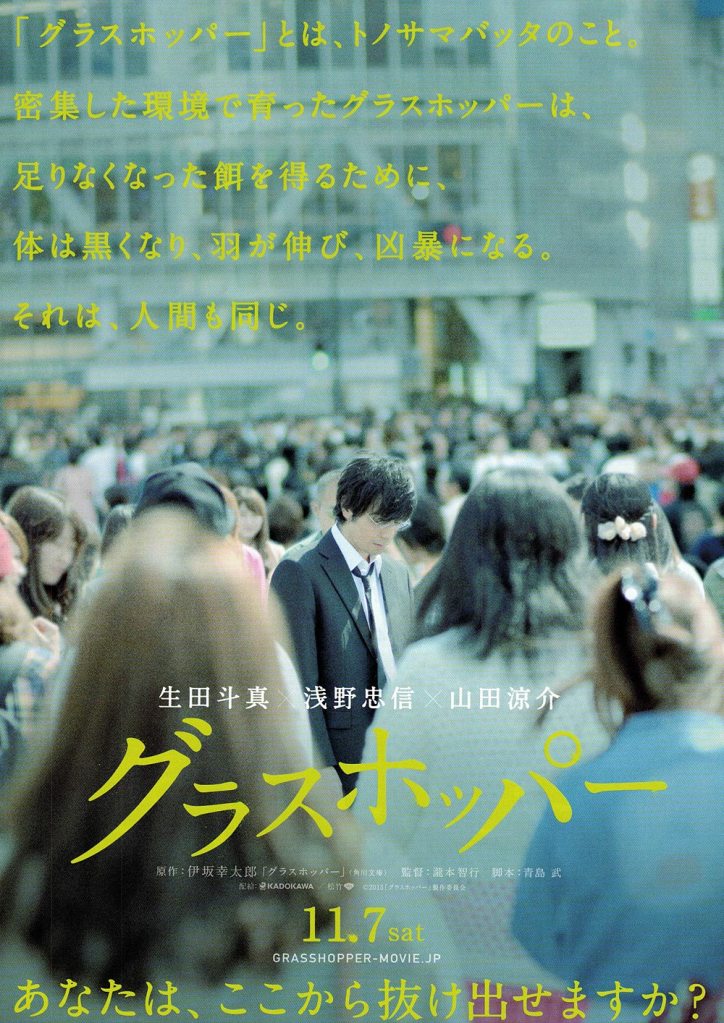
Grasshopper (グラスホッパー, Tomoyuki Takimoto, 2015)

grasshopperThe best revenge is living well, but the three damaged individuals at the centre of Tomoyuki Takimoto’s Grasshopper (グラスホッパー) might need some space before they can figure that out. Reuniting with Brain Man star Toma Ikuta, Takimoto moves away from the more overtly sci-fi elements but maintains a level of everyday strangeness that adds weight to this standard B-movie affair. A revenge thriller in which revenge itself is shown to be a fallacy, Grasshopper manages to mix its grimy grind house violence aesthetic with an oddly hopeful view of human nature.

One tragedy connects three very different people. Halloween, Shibuya – a crazed man at the wheel of a 4×4 receives a phone call instructing him to “crush all those bugs”, because he’s “the saviour”. The man obeys and plows into the holiday revellers crushing them like insects under his wheels. One victim, Yuriko (Haru), who died pushing a child out of harm’s way happened to be the fiancée of middle school science teacher, Suzuki (Toma Ikuta). Revisiting the spot where she fell, Suzuki unexpectedly receives a letter informing him that the events which occurred at Halloween were not as straightforward as the media asserts and he should set about investigating the father and son working at “Fraulein”. His mind burning with thoughts of vengeance, Suzuki abandons his old life and launches himself headlong into the criminal underworld in search of answers.

Meanwhile, the evil kingpins at the centre of things have sent their ace hitman with a difference, Kujira (Tadanobu Asano), to silence a troublesome reporter. Kujira’s unusual assassination method involves a kind of hypnosis in which he forces his victims to acknowledge their darkest sins and eventually commit suicide. Though this sounds like the ideal plan for evading detection, the gangsters are nervous that Kujira has learned to much through his near death conversations with his targets and send a duo of slightly less competent killers on his trail. This leads us to our third strand – sociopathic blade wielding killer, Semi (Ryosuke Yamada), and his stray cat rescuing handler, Iwanishi (Jun Murakami).

Suzuki finds himself out of his depth in the murky, crime ridden underworld. Talking to yet another hitman he crosses paths with, Suzuki is offered the grasshopper analogy which lies at the centre of the film. Pusher (Hidetaka Yoshioka) tells him that unlike regular migratory locusts which are generally green, there is a mutant breed which undergoes a “swarm phase” in which their wings grown darker and longer, becoming ever more destructive in the quest to feed themselves in a crowded environment. People, Pusher claims, are no different. The film is filled with these mutant insects, crushing their fellow humans like roaches under boots, yet there’s something to be said for the migratory guys who keep moving and oppose the mutant breed through stealth and cunning.

Each of the three men is looking for a kind of revenge even if it’s ultimately self inflicted. Unusual hitman Kujira has hit the assassin’s version of angel wings in that he can see the faces of all the men and women he has killed, quite literally haunting his every move and offering a running commentary on his life. Setting out for vengeance against the men who’ve ordered his death, Kujira knows he’s nearing the end of his path yet before he gets there he will have to face off against Semi with whom he has no particular quarrel despite having just given Semi a reason to seek vengeance against him. Semi’s quest for revenge is pointed at Kujira but their mutual need for satisfaction will destroy each of them whilst also bringing them together as equals.

Everything prior to the fateful Halloween is bathed in golden light where warm colours predominate in Suzuki’s fond memories of his fiancée, but everything after is dark, reds and blacks tinged with insect green as grasshoppers swarm like harbingers of a great evil. Revenge itself is constantly frustrated and ultimately swept away from each party by shadowy forces secretly working against the darkness. Nothing is quite as it seems, no one is quite telling the truth. Yet as deep as the original conspiracy goes, the counter conspiracy consistently exceeds it.

Filled with impressive action sequences from Semi’s well choreographed balletic knife displays to large scale crowd scenes and good old fashioned fist fights, Grasshopper owns its down and dirty origins but reinvigorates them with a degree of modern sophistication. Yuriko, a soup chef, insists that the true secret ingredient in her cooking is genuine emotion – that this is what’s left behind when everything else is gone. Suzuki could choose to dive inside his cocoon of unresolved vengeance for the rest of his life but that would not have been what Yuriko wanted for him. In this anti-revenge drama, vengeance is the fallacy that detracts from the truth – that the ultimate form of revenge is learning to live with the past rather than wasting time settling scores.


Original trailer (no subtitles)

Revivre (화장, Im Kwon-taek, 2015)

revivreThe 102nd film from veteran Korean film director Im Kwon-taek may appear close to the bone in its depictions death, suffering, and the long look back on a life filled with the quiet kind of love but Revivre (화장, Hwajang) is anything but afraid to ask the questions most would not want to hear as the light dwindles. The inner journey is just too hazy, as one man puts it, unknowingly commenting on the human condition, yet Im does manage bring us nicely into focus, if only for a moment.

Oh (Ahn Sung-ki), a successful salaryman working in marketing for a cosmetics company, finds himself slightly adrift as the brain tumour his wife, Jin-kyung (Kim Ho-Jung), had previously suffered from resurfaces. The treatment this time is apparently not as successful leading to prolonged hospitals stays as Jin-kyung’s condition deteriorates and she begins to require a greater level of medical care. While all of this is going on, Oh is still very much dedicated to his work but has also begun to indulge in an old man’s folly, fantasising about the pretty new girl at the office.

Much of Revivre is concerned with Oh’s inner life, the things he does not say (which are many because Oh is a quiet sort of man). Ahn Sung-ki captures this quality well in playing Oh with a kind of blankness that could be the numbing sensation of grief or an extension of his ordinarily reserved nature. This makes his impromptu verbal attack on the figure of his fixation, Choo Eun-joo (Kim Gyu-ri), all the more unexpected though his remorse over having acted in such an out of character way may actually help to generate a kind of relationship between the pair albeit more of a paternal than romantic one.

Oh’s continuing fixation on Eun-joo, the woman who becomes the accidental focus of his world even though his wife lying dies in a hospital, is intended to be a fantasy and nothing more. An early dream sequence sees Oh participating in an elaborate traditional funeral taking place in a desert in which all of the mourners are dressed in black, except, of course, for Eun-joo – the only fixed point of reference, clothed in vibrant purple and smiling back at him in contrast to the solemn faces of the other guests, each staring at the floor. In the real world time slows down for him as Eun-joo dances youthfully in a nightclub and as he leaves the party early, her’s is the lone still face, haunting him as he looks back at the other revellers still enjoying themselves heartily even outside the club.

Indeed, “looking back” with all of its various advantages and disadvantages becomes another central theme as Oh becomes a kind of Orpheus descending into his own personal hell in the hope of dragging back his departed Eurydice – an idea neatly recreated in one of the film’s few outright fantasy sequences in which Oh dreams himself into an avant-garde dance show. Like Orpheus, Oh cannot help but look back though he risks losing all in the process. What Eun-joo represents for him is perhaps not the woman herself but an image of his own youth and a desire to live again as he once lived before. The present and the past begin to overlap for him, Eun-joo becomes the future he cannot touch as well as the returning spectre of a past he cannot return to.

Oh’s daughter asks him at one point if he ever really loved her mother. His reaction to losing his wife is, it has to be said, restrained, practical. Yet this question is answered with an immediate cut to Oh helping his wife to the bathroom, performing the most intimate of tasks with unwavering devotion. As his wife fades, Oh’s fantasies become a shield against the growing fears of his own mortality as his body also begins to fail him. The melancholy sense of loss and loneliness coupled with the inevitability of the passage of time pervade as each of Oh’s points of reference slips away from him at exactly the same time.

Im opts for a non-linear approach beginning with Jin-kyung’s passing and thereafter moving freely, reflecting Oh’s fleeting memories and interior confusion as he deals with such a traumatic, life altering event. Neatly framing Oh’s dilemma within his work in which he faces a choice of sticking with the current marketing strategy or striking out in a bold new direction, Im plays with the eternal theme of transient beauty in a society which prizes bodily perfection above all else. The film’s Korean title plays on a pun involving a homonym which means both “cremation” and “makeup” perhaps harking back to the central theme that you dig a grave for yourself if you attach the wrong sort of importance to the impermanent, but is in a sense ironic as one represents a final acceptance and the other an attempt to hold off the inevitable. Poetic and intensely moving, Revivre is another characteristically multilayered effort from Im, still at his full strength even in this late career effort.


International trailer (English subtitles/captions)

Flying Colors (ビリギャル, Nobuhiro Doi, 2015)

flying-colorsBelow average student buckles down and makes it into a top university? You’ve heard this story before and Nobuhiro Doi’s Flying Colors (ビリギャル, Biri Gyaru) doesn’t offer a new spin on the idea or additional angles on educational policy but it does have heart. Heart, it argues is what you need to get ahead (if you’ll forgive the multilevel punning) as the highest barriers to academic success are the ones which are self imposed. Arguing for a more inclusive, tailor made approach to education which doesn’t instil false hope but does help young people develop self confidence alongside standardised skills, Flying Colors is the story of one popular girl’s journey from anti-intellectual teenage snobbery to the very top of the academic tree whilst healing her divided family in the process.

Little Sayaka Kudo (Kasumi Arimura) got off to a bad start in her academic life, bullied and friendless at primary school. After the teachers refuse to help, Sayaka’s doting mother, Akari (Yo Yoshida), manages to get her into a more exclusive middle school which is affiliated with both a high school and a university which means that Sayaka’s academic destiny is fairly secure. However, though she does manage to make friends at her new school, she falls in with the “popular” crowd and begins dying her hair, rolling her skirt up, and wearing an inadvisable amount of makeup. Knowing that their entrance to high school and university is assured, the girls slack off completely and are at the very bottom of the class.

However, it all comes crashing down when Sayaka is caught smoking and threatened with expulsion. Bravely refusing to give up her friends and have them suffer the same fate, Sayaka is the only one who gets suspended but still risks missing graduation and losing her secured place at university. One of the few people to really believe in her, her mother Akari, arranges for Sayaka to attend an unconventional cram school where the well meaning teacher, Tsubota (Atsushi Ito), encourages her to have a goal, and it’s a lofty one – Keio University, one of the most prestigious institutions of higher education in Japan.

Despite her dismal academic prognosis, Sayaka is not lacking in ability, just the will and belief to see it through. After being so unhappy in primary school, Sayaka values her friendships and status as one of the popular girls and maintaining that side of her life is much more important than getting good grades. Written off by her teachers, no one is prepared to give her the permission to succeed and so she assumes she’s as dim as everyone says she is.

The situation isn’t helped by her home life in which her embittered father (Tetsushi Tanaka) ignores his two daughters in favour of devoting all his attention to his son, Ryuta (Yuhei Ouchida), whom he wants to become a professional baseball player. Vicariously thrusting his own dream on his unsuspecting son, Sayaka’s father is unprepared for the moment Ryuta realises he’s been denied the right to choose for himself and rebels against him as all young men are apt to do. In fact, many of the cram school students are there because of a grudge against an unfeeling father who has had quite an adverse affect on his child’s sense of self worth.

Tsubota is the first person other than her mother to show faith in Sayaka’s abilities and is able to convince her that she might be able to achieve something if she started to apply herself. Speaking to her in terms she can understand, Tsubota hunts down different kinds of study materials to help her along the way gradually raising her scores as she builds belief in her ability to reach her goal. Tsubota is the only teacher at the school and is able to take the time to get to know each of his pupils individually so he can tailor the course to bring out the potential in each of his charges. While the kids are studying to pass exams, Tsubota is studying pop culture so that he can talk to them on their own level and find out the best ways to keep them motivated.

As much as it’s the story of a persistent underdog finally discovering a well of self belief that will sustain them on a difficult path, Flying Colors is also an indictment on the modern educational system which only caters for the group rather than the individual and is so concentrated around rote learning and standardised tests that it fails to teach young people the critical thinking skills they need to succeed in life. Flying Colors probably is not going to influence public educational policy but it does offer an amiable and inspirational story that might give hope to those struggling under its often unreasonable demands.


Original trailer (English subtitles)

Behemoth (悲兮魔兽, Zhao Liang, 2015)

behemothEvil, so a wise man said, begins when you start treating people as things. Fritz Lang’s Metropolis showed us a city that literally was its people – nothing but a vast yet perfectly functional machine with the workers little more than cogs to be replaced and discarded once worn out. Zhao’s Behemoth (悲兮魔兽, Bēixī Móshòu) is no fantasy but a very real journey through our own world and so we follow our narrator, a poetic, naked stand in for Dante’s Virgil, through hell and purgatory on a path to paradise only to find ourselves staring into a void filled with our unfulfilled desires and forlorn hopes.

On the fifth day God created Behemoth, and the mountain brings him forth food. Where once there was a paradise of verdant green fields and pastoral hills, now there are only quarries and the sounds of men at toil have replaced those of birds and other kinds of beasts. Our journey into hell takes us into a coal mine filled with noise and fires as the mountain is asset stripped right before our very eyes. We are witnessing a murder – the brutal slaughter of natural beauty for human gain, perpetrated by exploited workers who live in penury while their bosses rake off the profits from a safe distance.

Zhao’s workers labour at all hours under the searing heat of a midday sun or the bright glow of moonlight. He lingers on their faces, some old before their time but each tired, wrinkled. The workers are not provided with much in terms of infrastructure or facilities. They have no showers as Western coal miners might, they return home to scrape themselves with towels in an attempt to remove the stain of coal dust from their skin. Coal dust is a penetrative parasite, it sinks deep, falling into the creases each worker has developed through their strenuous efforts to earn the money to survive.

The dust does not stop at the skin. It runs deeper still, into the lungs where it stifles breath even once the unbreathable air of the furnace has been left behind. In what amounts to the naked dreamer’s path through purgatory, we see former workers lying listlessly on hospital beds as the black fluid is drained from their lungs. They cough, wheeze and struggle to breathe but they receive scant care or regard for their years or backbreaking toil. Some of them have formed a pressure group, hoping to get the government involved in their struggle to improve pay and conditions in the powerhouse of the nation but, as is expected, they receive little attention – after all, there are plenty more workers out there and leverage is small when jobs are in demand.

So what of Paradise? Paradise is empty, all the righteous are trapped in hell. Vast cities of high rise buildings lie vacant – a symptom of economic hubris as supply outstrips demand by an inconceivable margin. All this progress, and no one left to enjoy it. At the beginning our naked dreamer evokes Dante to tell us that there is no greater pain than desire without hope. It is unclear if Zhao’s Inner Mongolian workers would prefer this kind of paradise to their green rolling hills, but the decision has been made for them and even so, this is a workers’ paradise that is intended for a different kind of worker, there is no space here for any of Zhao’s coal smeared faces.

Our naked dreamer was guided here by a fellow plains dweller who does not know how to write poetry, but the eloquence of his heart is equal to Dante himself. The guide claims to show us a picture of the dead but the weight he carries on his back is a mirror – it shows us death wearing our own faces. Zhao shows us who we are – the faceless monster, Behemoth, is us or a manifestation of our relentless greed. We were born in paradise, and created ourselves a hell because we wanted more than the Earth could give us. This is our never-ending tragedy, overwhelmed by desire we destroy each other in an endless quest for an unattainable paradise that only exists in dreams.

Zhao’s background in photography comes to the fore as he captures these hellish scenes with an odd kind of beauty, mixing the bucolic with the brutal. Cattle grazes on the distant fields as fires burn in the background, and a baby boy plays innocently by madly digging at the ground as if mimicking the behaviour he sees all around him. At one moment the entire screen floods with red as the hellish glow of the smelting process momentarily blinds us, as does a dust cloud of white later on. For the most part, Zhao is content to show us the faces of these men and women, weathered by years of backbreaking labour yet he also tells us that he sees past their fatigue and their resignation to the people they once were that this environment has also destroyed. This is no social realist propaganda film, Zhao respects the sacrifice of these hard working people but it’s as far from glorification as it’s possible to be.

It’s tempting to say this is a China specific issue, brought about by the country’s unique political situation and rapid industrialisation but Zhao’s canvas is wider. This is a human problem that is not bound by national borders or cultural norms. We each live complicit with this system, so desperate to keep the lights on that we’ve become afraid to ask how it’s done. We can continue feed the monster that will one day devour us, or we can try to starve it out but that would require us to acknowledge the greed and selfishness that underline human nature. History is not on our side.


UK release trailer (ICA exclusive screening):

The Himalayas (히말라야, Lee Suk-hoon, 2015)

HimalayasBecause it’s there. As good a reason as any for doing anything but these were the only three words of explanation offered by George Mallory in answer to the question “Why climb Everest?”. In Powell & Pressburger’s The Red Shoes, the heroine reacts in a similarly philosophical fashion when asked “Why do you want to dance?” replying with the question “Why do you want to live?”. What makes some people prepared to dance until their feet bleed and their toes break, and sends others to the peaks of snowcapped mountains staring death in the face as they go, is something which cannot be fully explained in words but cannot be denied by those who hear its calling.
Korea’s most well known mountain climber, Um Hong-gil (Hwang Jung-min), was undoubtedly one who heard the call and The Himalayas (히말라야) is his story (more or less). Based on his real life exploits, the film charts his continuing successes as an international climber until a foot injury forces him to remain on a more usual altitude, but the real heart of the story is in his growing relationship with rookie Moo-taek (Jung Woo) who’s every bit as fearless as he is. Together the pair scale the peaks of the world’s highest mountain ranges until it’s finally time for Hong-gil to hang up his pick and keep his feet on the ground for good.

However, tragedy strikes as one of Hong-gil’s closest friends is suddenly killed after getting caught in an unexpected storm. The mountain ranges of the world are littered with the corpses of unfortunate climbers who got into difficulty and couldn’t be rescued. The bodies remain where they fell, becoming one with mountain itself in a lonely climbers graveyard, frozen and perfect for eternity. Risking your own life to retrieve the lifeless body of a friend may seem like a perverse, irrational thing to do, yet understandable. Wracked with guilt and grief, Hong-gil assembles a team and embarks on a sentimental journey to bring his friend home, and, ironically, learn to let him go.

What starts off as a sports movie with its training sequences and tough coach inspires maverick rookie routine branches off into the classic expeditionary adventure format before falling into its unexpected home genre – the melodrama. Though in one sense a kind of biopic, the realm aim is to get those tears rolling as these brave men and women risk all for glory and comradeship in pushing the limits of the human condition far past their breaking points.

Hong-gil himself is, despite his gruff exterior, a dreamer and idealist in love with the soulful purity of the mountains. His is a journey of self discovery as he tells us that there is no pretence when it comes to mountain climbing. When you’re up there alone, just you and the vast snow covered emptiness, all of your masks and defences fall away. Hong-gil climbs the mountain to explore landscape of his own mind. He also objects to the often uttered phrase “conquer” a mountain as he believes the mountain gives you permission to ascend making this way of thinking disrespectful and even likens the mountain itself to woman when bemoaning Moo-taek’s pointlessly noble romantic gesture by stating that you don’t conquer the “mountain” you console it.

For all that, the real world is ever present as we see in one particularly awkward marketing pitch in which Hong-gil is trotted out as a model to have the prospective sponsor’s logo plastered all over him in the hopes that they will fund an expedition. When someone raises the very sensible point that this could look very bad for them should one of the climbers die with their logo on their chest, the marketing guys slowly start peeling them all off – velcro solves everything, it seems.

The team also becomes a marketing tool for their nation, carrying the Korean flag around with them for any photo opportunities which might present themselves. When tragedy strikes and the remainder of the Korean expeditionary group refuse to go after their fallen friend (the right and practical decision given the weather conditions and the low probability of success), base camp puts out a message over the radio in English pleading for help. The British contingent continue with their crosswords and cups of tea, steadfastly ignoring the emotional mayday call. The Chinese at least begin reassuring each other that it’s far too dangerous to contemplate.

The Himalayas begins as a comedy but the laughs fall away once the tears start rolling. Though it may affect a poetic tone the philosophical meandering is generally at the service of the melodrama which is very much underpinned by male bonding, pride, honour, debt and responsibility. Hong-gil’s “Human Expedition” is one of grief stricken madness but a perfectly understandable one in which he both needs to atone for “abandoning” his mountaineering brother and come to terms with the fact that the death zone has claimed another sacrifice. Often impressively filmed, The Himalayas suffers from its extremely melodramatic, sentimental tone which is only exacerbated by the intrusion of its loud and syrupy score. Anchored by strong performances from its leading players including Hwang Jung-min as the tough yet sensitive Hong-gil and Jung Woo as the young firebrand Moo-taek, The Himalayas spends too long at the destination rather than on the journey and ultimately fails to make either its character drama or expeditionary environment sufficiently engaging.


Seen as part of a teaser programme for the upcoming London Korean Film Festival 2016.

US release trailer:

https://www.youtube.com/watch?v=S9UeQ0qhWnc

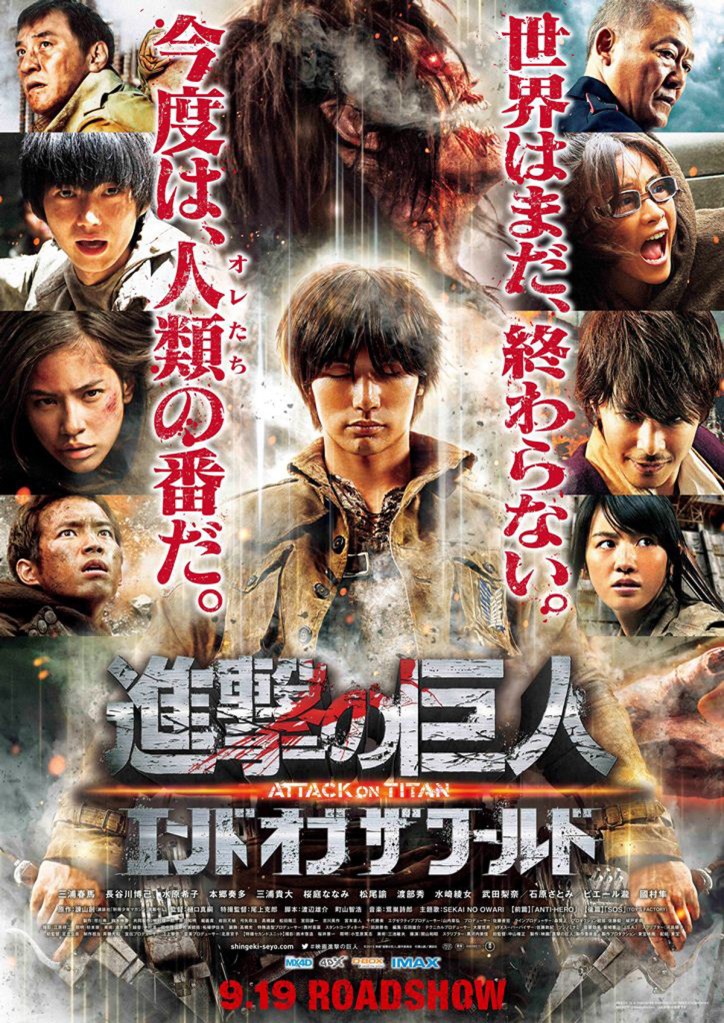
Attack on Titan: The Movie – Part 2: End of the World (進撃の巨人 ATTACK ON TITAN エンド オブ ザ ワールド, Shinji Higuchi, 2015)

166831_02Review of the second Attack on Titan live action movie first published by UK Anime Network.


Attack on Titan: The Movie – Part 1 ended on a humdinger of a cliff hanger, so this concluding half of the two part movie is one  which carries a fair amount of expectation regardless of reactions to the first instalment. Picking up more or less straight after the end of Part 1, the situation continues to be desperate as the mission to acquire explosives to blow the wall closed is an abject failure. Thanks to Eren’s (Haruma Miura) efforts, the Titan onslaught has eased off but he now finds himself in the direct firing line of sinister dictator Kubal (Jun Kunimura). Coming up with an alternative plan to recover the dud bomb we saw in the beginning of the first film, our intrepid band of comrades decide to return to their former home paving the way for the massive Titan on Titan frenzy finale.

Whereas Attack on Titan: The Movie – Part 1 attempted to reframe itself as a monster movie, The End of the World places itself firmly within the comic book genre. Rather than a frightened populace desperately trying to protect itself from the sudden arrival of man eating giants, The End of the World introduces a series of human lead super Titans who will eventually be duking it out during the film’s finale.

Largely, The End of the World eschews the thematic concerns of the first film in favour of large scale action scenes but it does come up with a few new ideas of its own. Towards the beginning, it seems as if The End of the World is about to undercut all the unpleasant fascistic connotations of the previous film by bringing Eren into contact with the Survey Corps who are now the rebel resistance but this turns out to be a hollow offering as the squad is then painted as a renegade militia commanded by a madman.

After his original imprisonment, Eren wakes up in a minimalist, low ceilinged white room which contains a ‘50s style jukebox with a cover version of the old time hit The End of the World already playing. Despite the ban on machines “the government” has apparently stockpiled some of these “artifacts” for their own use which also includes a rather prominent remote control for an Apple TV. At this point we’re shown some archive footage which explains the birth of the Titans and the creation of the “modern” society, the implication being that the Titans are part of an elaborate governmental propaganda scheme designed to keep the unruly populace firmly in line. The Titans reappeared at a political crisis point as the government felt the loyalty of its people waning and also feared that the plan to explore outside of the walls would weaken their authority. Having already instituted authoritarian policies such as limiting access to childbirth, the government used the Titan threat to galvanise support through fear.

This sequence begins to offer an entirely different reading of the film – one which is more fully hinted at in the final post-credit sequence, but is then largely forgotten. Aside from a nasty slice of possible domestic violence and some PTSD End of the World stays away from further character driven drama, leaving Shikishima to ham things up with an increasingly camp performance whilst behaving in a very ambiguous way towards Eren which proves awkward when considering further information provided regarding Eren’s childhood. As a whole, the Attack on Titan movies have a major problem with internal consistency, piling plot holes upon plot holes yet still failing to make any of its central conceits remotely compelling.

However, The End of the World does improve on some aspects of the previous film – notably in its tighter running time and action set piece finale (lengthy exposition sequence and extremely long recap aside). Production values appear a little better, there is far less of the bad CGI which marred the first film, and there’s even some more interesting production design to be found too. The Hollywood style heroic ending with the sun shining and the score soaring might appear less clichéd when considered alongside the alternate reading offered by the post-credits sequence, but then again this may be another red herring just like the resistance group which originally appeared to offer hope but was then summarily discredited.

The two live action Attack on Titan movies come at the original franchise from vastly different angles and are often at odds with each other. Some of these inconsistencies may be explained by the post-credits sequence which is, perhaps, a hook for a putative third film but only adds an additional layer of confusion to what is already an overloaded premise. All of that aside, The End of the World does offer slightly more straightforward, comic book style trial by combat action heading into its finale even if it does lay on the exposition a little thickly. Whilst offering some mild improvements over the first film, End of the World fails to rescue the project as a whole but is likely to provide satisfaction to those left hanging after the curtain fell on part one.


English subtitled trailer:

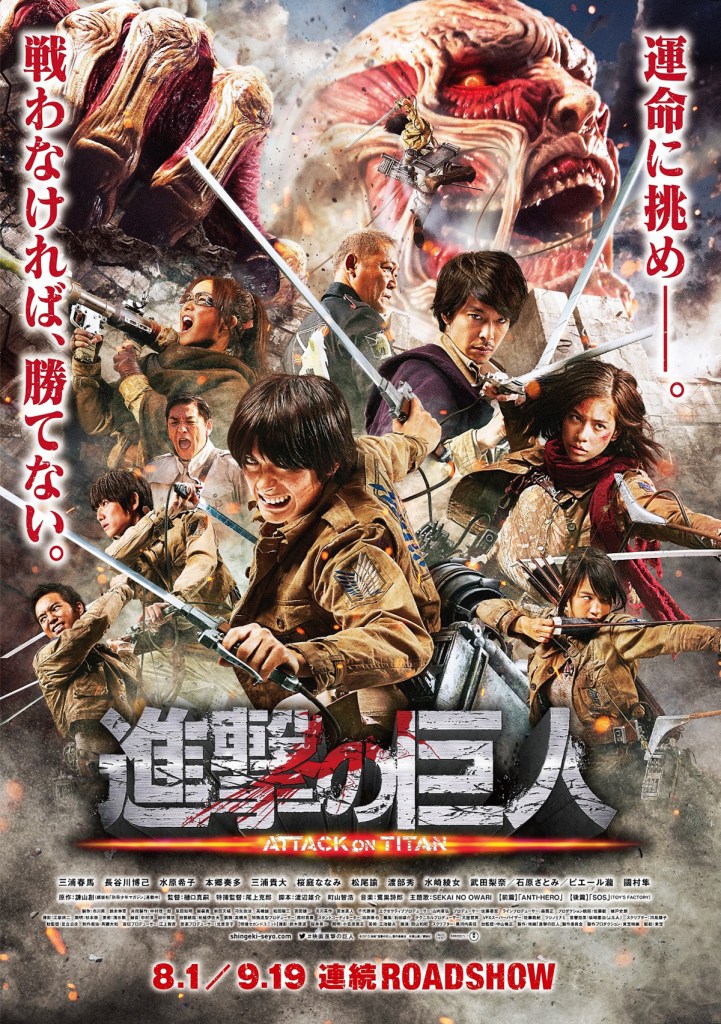
Attack on Titan: The Movie – Part 1 (進撃の巨人 ATTACK ON TITAN, Shinji Higuchi, 2015)

Attack on Titan p1Review of the first of the two part live action Attack on Titan (進撃の巨人 ATTACK ON TITAN, Shingeki no Kyojin) extravaganza first published by UK Anime Network.


It is a law universally acknowledged that a successful manga must be in want of an anime adaptation. Once this simple aim has been achieved, that same franchise sets its sights on the even loftier goals of the live action movie. This phenomenon is not a new one and has frequently had extremely varied results but fans of the current cross over phenomenon that is Attack on Titan may find themselves wondering if perhaps more time should have been allowed before this much loved series tried its luck in the non animated world.

Throwing in a few changes from the source material, the film begins with the peaceful and prosperous walled city where childhood friends Eren, Armin, and Mikasa are young adults just about to start out on the next phase of their lives. Eren, however, is something of a rebellious lost soul who finds himself gazing at the land beyond the walls rather than on a successful future in the mini city state. However, little does he know that the Titans – a race of man eating giants responsible for the destruction which saw humanity retreat behind the walls in the first place, are about to resurface and wreak havoc again. His dreams of a more exciting life may have been granted but humanity pays a heavy price.

Fans of the manga and anime may well be alarmed by certain elements of the above paragraph. Yes, the film makes slight but significant changes to its source material which may leave fans feeling confused and annoyed as the film continues to grow away from the franchise they know and love so well. For a newcomer, things aren’t much better as characterisation often relies of stereotypes and blunt exposition to get its point across. Attack on Titan actually has a comparatively starry cast with actors who’ve each impressed in other high profile projects including Haruma Miura (Eternal Zero), and Kiko Mizuhara (Norwegian Wood, Helter Skelter) as well as Kanata Hongo (Gantz) but even they can’t bring life to the stilted, melodramatic script. Things take a turn for the worse when Satomi Ishihara turns up having presumably been given the instruction to play Hans as comic relief only with a TV style, huge and bumbling performance.

That said, there are some more interesting ideas raised – notably that even a paradise becomes a prison as soon as you put a wall around it. Indeed, everything seems to have been going pretty well inside the walls until Eren suddenly decides he finds them constraining. Once the Titans break through, the very mechanism which was put in place for humanity’s protection, the walls themselves, become the thing which damns them as they’re trapped like rats unable to escape the Titan onslaught.

Machines are now outlawed following past apocalyptic events – humanity apparently can’t be trusted not to destroy itself and this cheerful, feudal way of life is contrasted with the chaos and pollution which accompanied the technologically advanced era. Unfortunately, a reversion to distinctly old fashioned values also seems to have occurred as we’re told you need permission to get married (as sensible as this may be from a practical standpoint in a military society) and the single mother gets munched just as she’s making the moves on a potential new father for her child. The Titans themselves have also been read as a metaphor for xenophobia which isn’t helped by the almost fascist connotations of the post attack society.

Much of this is really overthinking what appears to be an intentionally silly B-movie about man eating giants running amok in a steampunk influenced post-apocalyptic society but then it does leave you with altogether too much time to do your thinking while you’re waiting for things to happen. The original advent of the Titans is a little overplayed with the deliberately gory chomping continuing far too long. Action scenes fare a little better but suffer from the poor CGI which plagues the rest of the film. This isn’t the Attack on Titan movie you were expecting. This is a monster movie which carries some extremely troubling messages, if you stop to think about them. The best advice would be to refuse to think at all and simply settle back for some kaiju style action but fans of either campy monster movies or any other Attack on Titan incarnation are likely to come away equally disappointed. It only remains to see if Part 2 of this bifurcated tale can finally heal some of the many holes in this particularly weak wall.


US release trailer: