12.12: The Day (서울의 봄, Kim Sung-soo, 2023)

Sometimes, the bad guys win. Kim Sung-soo’s long-awaited return after superb underworld drama Asura, 12.12: The Day (서울의 봄, Seoul-ui Bom) explores one of the darkest hours of recent Korean history as all hopes for democracy and freedom are dashed by a 1979 coup by General Chun Doo-hwan whose reign turned out to be far worse than that of his predecessor, Park Chung-hee who had been assassinated by a member of his own security team some months previously.

Yet Kim is less concerned with the coup itself than why so few people tried to stop it. Though everything appears to be going very badly for Chun (Hwang Jung-min), he eventually succeeds in taking Seoul by force while opposed by a solo general who is the lone guardian of justice and righteousness. Lee Tae-shin (Jung Woo-sung) first turns down a promotion to command the Seoul garrison and accepts it only when it’s explained to him that Jeong (Lee Sung-min), the army chief of staff, hopes to use him as a bulwark against Chun whom he fears is indeed preparing for an insurrection. Sure enough, Jeong is eventually abducted by Chun’s minions, who run the security division, on a trumped up charge of being involved with Park’s murder while Chun desperately needs the duly elected president of a democratising Korea to sign his arrest warrant so his blatant power grab will be legitimised rather than branded a “coup”.

Only the president doesn’t play along. He insists on following proper protocol and getting the approval of the defence minister all of which is vexing for Chun who is left humiliatingly standing in his office while the president holds his ground. The defence minister has, as it turns out, fled to the American embassy in his pyjamas where he finds little sympathy while the film subtly implies that the Americans advise him to return and back Chun who is doubtless considered much more useful to them politically.

Though Tae-shin and another officer at HQ try to warn of a brewing coup, their orders are often overruled by superiors either because they do not take the situation seriously or are actively siding with Chun whose “Hanahoe” faction has taken over a significantly large proportion of the military. Kim zooms in on militarism as the fatal flaw in this botched defence system as it seems no one can act without first receiving an order from above nor are they equipped to make critical decisions on a personal level as to whether or not an order should be obeyed. Tae-shin calls on countless devisions for backup but finds them either actively allying with Chun or refusing to get involved believing it is a hopeless battle. Tae-shin asks what the army is for if it refuses to fight at the crucial moment and abandons its responsibility to protect the interests of its citizens in simply allowing Chun to seize power but receives no real answer. 

Chun has already aroused suspicion for his handling of the investigation into Park’s death, reportedly bringing in countless people with no obvious connection to the case and torturing them. The men who support him want to continue Park’s “glorious revolution” which was in itself a repackaging of Colonial-era Japanese militarism, and fiercely resist the idea of “democracy” advocating totalitarian views that the ordinary person longs for a strong hand at the wheel and to be absolved of the responsibility of choice which ironically fits perfectly with hierarchal structure of the Army. The film paints Chun, slight, small, and bald, as a man with a chip on his shoulder apparently resentful of military elites and the wealthy. He craves power because of his own insecurity and a desire to get one over on righteous men like Tae-shin which might be why his line about Chun being unworthy of the uniform of a Korean solider seems to get to him. 

Using the film language of the 1970s such as heavy grain and split screens, Kim keeps the tension on a knife edge even though the conclusion is all too inevitable. Tae-shin cuts a heroic figure, standing alone on a bridge and forcing back the advancing tanks solely with his imperious righteousness but in the end it’s not enough, there are too few like him and too many like Chun whose maniacal laughter is intercut with scenes of Tae-shin in the torture facility which lies beneath the facade of government. Bleak, but also angry, Kim’s extraordinarily controlled political thriller is damning in its condemnations of a militarising culture and the ever present threat which accompanies it.


International trailer (English subtitles)
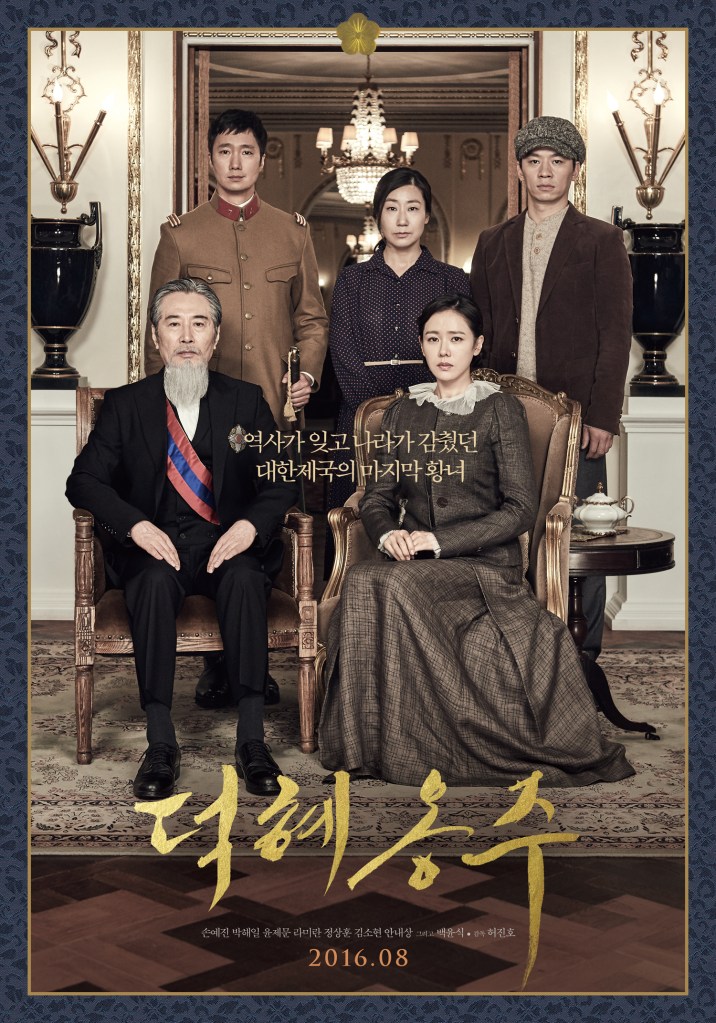
The Last Princess (덕혜옹주, Hur Jin-ho, 2016)

last-princessReview of Hur Jin-ho’s The Last Princess first published by UK Anime Network.


Filmic biopics of real life historical figures are not generally known for their fierce adherence to fact, but The Last Princess (덕혜옹주, Deokhyeongjoo) is unusually honest in its approach in the sense that it includes a brief opening statement to the effect that the film pays very little attention to historical veracity. Hur Jin-ho adapts the story of Korea’s last princess, Yi Deok-hye (Son Ye-jin), as recounted in a novel by Kwon Bi-young, whilst indulging the genre he’s best known for – romantic melodrama. Another of the recent spate of films to address Korea’s colonial past, The Last Princess is the story of a woman who was fiercely loyal to her homeland, even in the face of harsh opposition and final rejection by the very people she’d been striving so hard to protect.

Told in a non-linear fashion, The Last Princess spans the majority of Deok-hye’s life from her opulent childhood in the royal palace to her eventual repatriation to Korea in the mid 1960s. In 1919, nine years after Korea had been annexed by the Japanese, Deok-hye lives in the palace with her loving father, the former Emperor (Baek Yoon-sik), and her mother, the concubine Lady Yang (Park Joo-mi). Her carefree days soon end when she witnesses her father’s death by poison and comes to understand her precarious position as puppet royalty of a subjugated regime.

Her life, and those of her remaining family members, is largely in the hands of a traitorous civil servant, Han (Yoon Je-moon), whose fierce loyalty to the Japanese emperor knows no bounds. Deok-hye is unwilling to assist him in his desire to use her as a tool to promote the “Japanisation” of the country and so is packed off to the mainland to study with the promise that she can return to live with her mother in Korea after her studies have ended. Needless to say she does not return.

In a touch of cinematic romanticism, the film elides two characters into one in the otherwise fictional character of Kim Jang-han (Park Hae-il). The son of a resistance fighter loyal to the emperor, Jang-han was betrothed to Deok-hye when they were both children and later returns to her as an adult in Japan where he is active in the Resistance, before coming back to find her years after the war. Jang-han hatches a plan to help Deok-hye and the other royal family members escape for exile in Shanghai but the the pair are eventually separated.

Recalling other recent Korean Resistance movies Age of Shadows and Assassination, The Last Princess has its share of action as Deok-hye and Jang-han attempt to escape the Japanese occupation and foster the revolution from abroad. The villain of the piece this time around is not so much the Japanese but the Koreans who willingly helped them as as exemplified here by the odious Han. Han is the most typically melodramatic character and only lacks a moustache to twirl to complete the effect. Hellbent on ingratiating himself with the Japanese, Han is determined to harness his princess’ appeal to sell the virtues of the Japanese state. When Deok-hye resolutely refuses to play along, he threatens her family members and friends in an attempt to force her compliance but finds her love for her country too strong to be bent by his egocentric cruelty.

Sent away and kept a virtual prisoner far from home, there is little Deok-hye is able to do in service of her nation. Introduced to the Resistance operating in Japan, she begins to see a way to help and eventually finds herself taking a stand when blackmailed into reading out a propaganda speech in front of a collection of forced labourers. Beginning the speech in Japanese as ordered, Deok-hye finds she cannot continue and eventually makes her real feelings known in Korean as she instructs the people in front of her not to give up, she will be right along side them fighting to regain their homeland. In a touch of Casablanca inspired drama, a chorus of Arirang suddenly springs up among the crowd, much to the consternation of the Japanese officers expecting a show of contrition, as the Princess herself is whisked off to pay a heavy price for her “betrayal”.

The Last Princess forces its heroine through constant loss – of her home, of her position, of her family, of a future, of love, of a child, of happiness, of her mind, and most importantly of her nationality. Deok-hye never wanted to be Japanese, did not travel to Japan of her own volition, and did her best to resist even at great personal cost. Nevertheless she finds eventually finds herself barred from her homeland due to opposing political concerns when the fledgling Republic fears the misuse of a powerful symbol like a royal family to frustrate the democratic future. Played with wonderful sensitivity by leading actress Son Ye-jin, Deok-hye suffers as her nation suffers, longing for independence both personal and national but finding only new cages everywhere she goes. Despite the unconvincing ageing makeup of the latter part of the film and an overly intrusive score, The Last Princess is an impressively produced prestige picture which plays its melodrama credentials to the max but is also undoubtedly moving in recounting the tragic story of its heroine whose constant misuse and lack of agency mirror much of the history of the nation she holds so dear.


Reviewed at the 2016 London Korean Film Festival.

International trailer (English subtitles)