
Parasyte The Movie Part 2 (寄生獣 完結編, Takashi Yamazaki, 2015)

parasyte part 2Review the concluding chapter of Takashi Yamazaki’s Parasyte live action movie (寄生獣 完結編, Kiseiju Kanketsu Hen) first published by UK Anime Network.
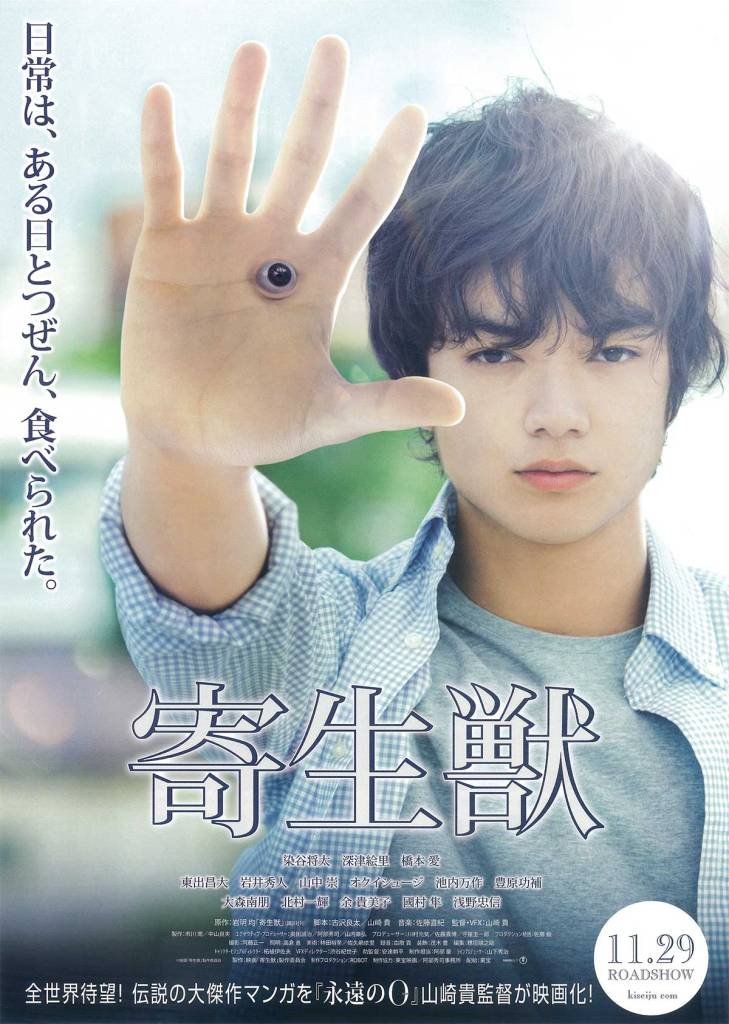

So, at the end of Part 1, Shinichi and Migi had successfully dispatched their creepy fellow student enemy in the midst of high school carnage but if they thought it was over their troubles were only just beginning. While Shinichi and Migi struggle to define what it is that they are, Ryoko Tamiya’s network is also showing cracks as her increasing levels of humanity contrast with her fellow Parasytes’ ambivalent attitudes to their host species. Ryoko may regard humans as the best hope for the survival of her kind, but you can’t argue with the fact that humanity is often the biggest threat to its own survival. The Parasytes may have a point when they describe us as a pestilence, blighting the planet with our lack of interest in our own living environment. Parasytes, dispassionate as they are, are better equipped to take the long view and ensure the survival of the Earth if only so that they may live in it.

Diverging slightly from the sci-fi movie norm, the police have cottoned on to the Parasyte threat and even uncovered the city hall based conspiracy though they haven’t quite got it all figured out yet. They are also completely unprepared to deal with the big bad that is Goto – a super Parasyte introduced in a Hannibal Lecter inspired cameo at the end of the previous film. Goto also has a minion, Miki, intent on making trouble whereas Ryoko still has various “experiments” on the go including her recently born son and a blackmail scam involving a low rent photojournalist. Add to the mix a dangerous serial killer who can ID Parasytes and the end of mankind seems like a very real possibility.

By this point, Shinichi and Migi have developed a symbiotic relationship which includes endearing little episodes like cooking dinner together with Migi using his unique capabilities to chop veg and make the ultimate miso soup. Ryoko has now given birth to her son and finds herself unexpectedly attached to her experimental offspring. After playing peekaboo with him one evening, she mimics the baby boy by laughing out loud and observing her reflection. Her human disguise has begun to feel good – what she wants now is less colonisation than peaceful co-existence. If Parasytes and humans could truly become one, embracing both the dispassionate Parasyte capacity to plan for their survival and the human capacity for compassion, perhaps both could achieve mutual salvation.

However, Ryoko’s comparatively hippy trippy viewpoint won’t play city hall and the new mayoral stooge is not as well disposed to humanity as his co-conspirator. In attempting to remove Ryoko’s various irons from the fire, the local government gang do nothing so much as invite their own destruction both at the hands of Ryoko herself and at those of the police. However, the police have not banked on Goto who has already become more powerful than they could possibly imagine. The series’ big bad, Goto isn’t given much of an opportunity play the mastermind card but is allowed to expound on his philosophy during the final fight. He says he hears a voice which instructs him to devour the whole of humanity but, after thinking about who this voice might belong to, he concluded that it belongs to humanity itself, begging to be released from its cycle of self destruction.

Less than subtle philosophising aside, Yamazaki maintains the approach and aesthetic from the first film though Part 2 is a little more serious in tone and more given over to meaningful speechifying than its gore filled predecessor. The body horror shenanigans are much less prevalent until the quite gruesome practical effects based final fight, though we’ve already seen enough Parasyte carnage by this point to know the score. That said, the Terminator 2 inspired car sequence and Goto’s unexpected superhero metamorphosis more than satisfy the craving for explosive action.

Parasyte plays with dualities to the max as Ryoko and Shinichi travel the same path from opposite directions ending by meeting somewhere in the middle and parting on a note of understanding rather than one of conflict. In the end, the film’s major message seems to be a plea for harmony in all things. One of Ryoko’s final thoughts casts grief as another kind of parasite – invading the soul, corrupting it and transforming a once rational person into a creature of fear and rage. She eventually finds an answer to all of her questions in the most human of things, emotional connection becomes her salvation and her final hope was that this union of pragmatism and passion could serve as a plan for the salvation of both species.

Even if Parasyte is a little blunt in delivering its well worn messages about the mankind’s negative effect on the planet, the essential baseness of the human spirit, and that desire for survival in one form or another is the driving force of all life, it does so in an interesting fashion and generally avoids falling into the cod philosophy trap of more seriously minded science fiction adventure. Once again Yamazaki marshals all his powers to create a well produced genre-hybrid of a blockbuster movie which takes its cues from 80s genre classics and is well anchored by a series of committed, nuanced performances from its admittedly starry cast.


Parasyte The Movie: Part 2 is available on DVD and blu-ray in the UK from Animatsu Entertainment.

English subtitled trailer:

Parasyte The Movie Part 1 (寄生獣, Takashi Yamazaki, 2014)

parasyte part oneReview of Takashi Yamazaki’s adaptation of Hitoshi Iwaaki’s manga Parasyte – Parasyte: The Movie Part 1 (寄生獣, Kiseiju) first published by UK Anime Network.


Humans – are we the biggest threat to our planet and ultimately our own survival? If the world population were halved, would we also halve the number of forests that are burned and the damage that we’re doing to our natural environment? These thoughts run as a voice over beginning the full scale blockbuster adaptation of Hitoshi Iwaaki’s classic manga which was also recently adapted into a critically acclaimed anime. The Parasyte of title most obviously refers to the extraterrestrial microbes which are climbing into the driving seat of an unsuspecting host’s brain with nothing less than the colonisation of our entire species on their “minds”, yet, is it we ourselves who are the real parasites feasting on the corpse of our dying planet? Parasyte is that rare blockbuster treat that is content to give us man-eating, shapeshifting, monsters and gore filled destruction but also wants us to dig a little deeper into our own souls at the same time.

Shinichi Izumi’s (Shota Sometani) mum (Kimiko Yo) probably told him not to sleep with his headphones on but luckily they’re about to save his life as a weird little bug tries to crawl into his ears but finding them blocked opts for the arm instead. Wrapping the cord around his elbow tourniquet style, Shinichi is able to stop the bug’s progress but the parasite has taken root and Shinichi is horrified to find his right hand is no longer his own but is now controlled by a dispassionate alien that eventually names himself “Migi”.

Shinichi and Migi develop an odd kind of partnership born of their mutual dependency which is threatened only by the presence of other Parasytes who have successfully infiltrated a human brain and can blend in with the general populace (aside from their cold and robotic natures). To his horror, Shinichi discovers a new teacher at his school is actually a Parasyte stooge who recognises the “research” potential of a hybrid team like Shinichi and Migi. Becoming very keen on “experiments” Ryoko Tamiya (Eri Fukatsu) has also mated with one of her fellow Parasytes in the hopes of exploring what will happen with the birth – will it be purely a human child seeing as it’s born of two human bodies or will something of the Parasyte get through? However, Ryoko’s “network” of Parasytes aren’t all as committed to scientific research as she is and Shinichi and Migi quickly find themselves becoming humanity’s last line of defence against the invading creatures.

Shinichi is the teenage lead of the picture but in this first part at least it seems to be Ryoko leading the show. She gives us the original voice over and it’s her burgeoning motherhood that gives the film its clearest ideological standpoint. As the dispassionate Ryoko comes to develop the beginnings of maternal pangs and a desire to ensure the survival of her child (or perhaps just her “experiment”), so Shinichi finds his humanity being erased by the parasitical “child” he is gestating in the form of Migi. At the same time Migi begins to take on a protective mentality towards his host which may be more than simple self preservation particularly after a traumatic near death experience bonds the two even tighter together, in a biological sense at least.

Though the film obviously references former genre classics, in particular Invasion of the Bodysnatchers with its difficult to detect pod people, it steers clear of the “red scare” inspired sense of paranoia and the feeling of intense mistrust that exists even between supposedly good friends. Migi is able to sense (to a degree) his own kind making the presence of potentially dangerous Parasytes easier to detect but the fact that the Parasytes are able to colonise and use the form of someone all too familiar to confuse their enemies restores something of their power to lurk unsuspected in the shadows.

All this seems to suggest that the big screen live action adaptation of Parasyte would be a fairly serious affair yet the tone is often lighthearted, maintaining the darkly humorous buddy comedy side of the relationship between normal teenager Shinichi and the almost omniscient yet strange Migi. Migi, as played by veteran actor Sadao Abe who is perhaps most closely associated with comedic roles, has a thirst for a different kind of “brains” than his fellow Parasytes and quickly devours any and all knowledge he can get his “hand” on though he lacks the emotional intelligence to make sense of everything he learns and thus is dependent on his host Shinichi to get a fuller understanding of the human world.

Like the blockbuster mainstream films of recent times Parasyte boasts generally high production values on a par with any Hollywood movie though it has to be said that the film is often undermined by unconvincing CGI. However, this is mainly a problem with the action scenes and Migi himself is generally well integrated into the action and oddly adorable to boot. In some ways it might have been interesting to see a fully “in camera” take on the effects ala Cronenberg whose spirit is most definitely evoked throughout the film which also harks back to ‘80s body horror with its synth score highlights and generally gruesome scenes of carnage. Though it’s hard to judge the overall effect from just this first instalment of a two part film which drops a decent number of threads to be picked up in part two, part one at least serves as a tantalising appetiser which only heightens expectations for its final conclusion.


Parasyte: The Movie Part 1 is currently available on DVD and blu-ray in the UK from Animatsu Entertainment with Part 2 to follow in June 2016.

The Kirishima Thing (UK-anime.net review)

thekirishimathingThis is from a million years ago but it was caught up in the queue at UK-anime.net and has only just been liberated! Also I wrote this when I was deathly ill (festival fever is a real thing!) so I’m not entirely sure it’s completely coherent. Anyway, have at it – The Kirishima Thing reviewed at Uk-anime.net


What’s up with that girl, why is everyone crying?

Must be the Kirishima thing again, right? It’s got everyone all riled up.

Hey, what exactly happened with that? Where is Kirishima?

You didn’t hear?! Kirishima quit the volleyball team! And nobody’s heard from him since, doesn’t answer calls, doesn’t answer texts – he’s in the wind….

Damn, man, that’s cold! Wonder what happened….

What happened with Kirishima, why he’s upped and quit the volleyball team quite suddenly right after having been made captain and with the team on course to win a big championship actually turns to out be almost totally irrelevant. We may speculate on why someone might just do that but we can never really know. What is important is that Kirishima’s unpredictable action causes a seismic wave to rip through the social structure of his class. With Kirishima gone, everyone else starts to question their own place in the social hierarchy – are they really where they want to be, where they ‘belong’ within the all important high school pecking order? Some threaten to move up and others down but will anything be the same ever again?

The ‘cool’ kids are in the ‘going home’ club or possibly ‘in a sports team but blowing off practice’, the next level are ‘kind of in a club because it’ll look good on my application forms (it’s not like I like it or anything)’ and then at the bottom we have the geeky guys and girls who are really into their club activities – exemplified here by the downtrodden film club. When Kirishima just quits and effectively demotes himself from the A crowd by quitting the volleyball team nobody’s really certain of anything anymore – what’s cool, what’s not, what do I care? The volleyball team feel betrayed by their captain’s absence, the cool boys are puzzled and uncertain without their leader to look to, the popular girls doubt their status now the alpha guy isn’t around and the film club….carry on as normal and try to ignore all the silly drama going around the school.

However, there are those in the higher echelons who maybe feel they don’t belong there. One of the cool girls has a secret liking for ‘geeky’ films but is frightened of becoming ‘one of them’ and losing her ‘popular’ status. Another girl, nominally one of the cool girls both hates and admires her friends for their vacuity and refusal to see whats going on around them. She is the only who really sees what’s going on everywhere, but even she too is afraid of losing her position. The most troubled and changed though is Hiroki, Kirishima’s ‘best friend’ who nevertheless didn’t know anything about his friend’s decision. Half in half out of the baseball team, he’s trapped between the cool world of the going home club and the slightly less cool one of being able to do something very well. The only people who aren’t really affected are the film club who are, to some extent, too invested in their own sense of inferiority to really notice what’s going on everywhere else.

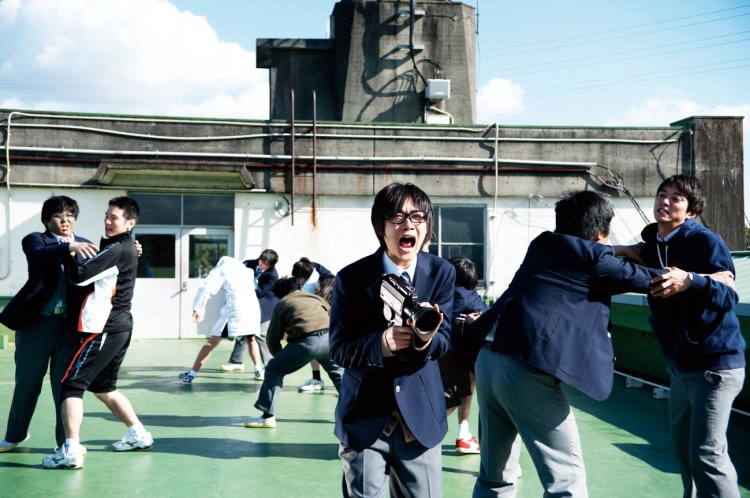
The film club  are in some ways the heart of the film as they both refuse to see and ultimately document the social fracturing that’s going on within the school. They seem to think themselves very hard done by -‘they’re always winning’ complains one boy after they find a location they want to use already occupied and later ‘I won’t cast them when I’m a director’ about the annoying popular clique who’ve just been laughing at them loud enough for them to hear before they’ve even gone past. However, they are the key to the film’s climactic roof top confrontation scene as the film club’s high school zombie invasion movie is rudely interrupted by the popular kids’ desperate search for Kirishima. This leads to a day of the dead style zombie fantasy sequence as the film club zombies devour the unwitting volleyball stars and popular girls which is the highlight of the film. The intermingling of the two groups which would never normally have anything to do with one another finally forces the ramifications of the Kirishima thing to come to a head. In some senses it clears the air; the tensions have boiled over and worked themselves out. However, for some the outcome is far from clear and they remain trapped between levels of high school cool.

The Kirishima Thing is certainly not for for those who like a lot of action, zombies aside, or something with a heavier plot element, but as an ensemble character study it excels. As an allegory for the wider problem of conformity/social norms vs individuality and self recognition in the adult world it’s certainly a very apt parable but all of the characters concerned are very well drawn and each afforded a degree of sympathy and understanding. The Kirishima thing strikes a more realistic tone than the director’s previous films (Funuke: Show some love you losers!, Perfect Nobara) which took place in a world of heightened reality but still has a strongly comic tone. An extremely nuanced and layered tale, The Kirishima Thing may require multiple viewings to completely appreciate but it’s certainly well worth the investment in time.


Also look out for fellow queue inmates Kumiko the Treasure Hunter and Tale of Iya which, I am assured, will shortly become eligible for parole.