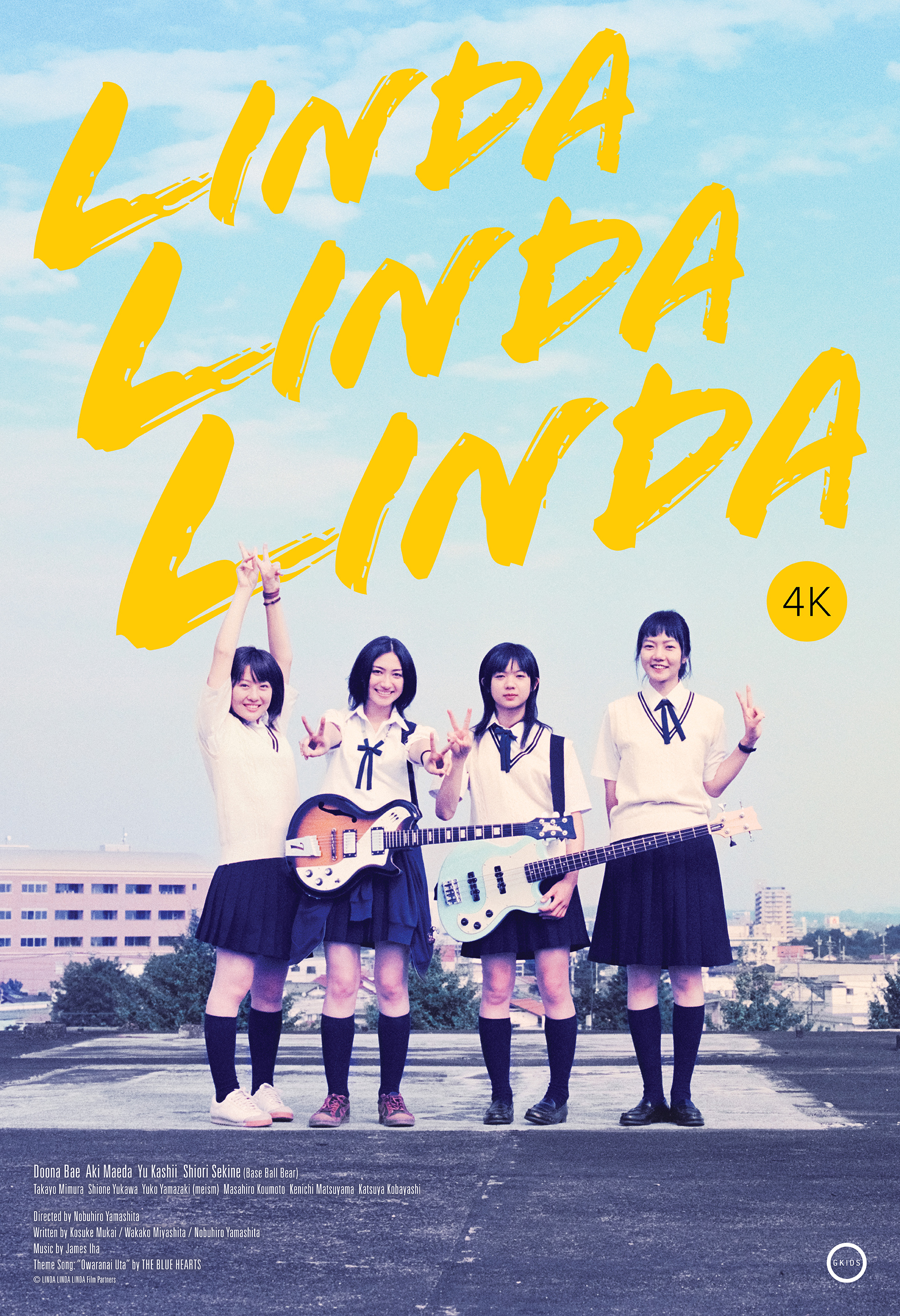
Linda Linda Linda (リンダ リンダ リンダ, Nobuhiro Yamashita, 2005)

“We’ve only got a little more time to be the real us,” according to a young woman making a promo video for the upcoming school festival, but who really is the “real us”? Now celebrating its 20th anniversary, Nobuhiro Yamashita’s wistful high school dramedy Linda, Linda, Linda (リンダ リンダ リンダ) is in many ways about the process of coming into being along with the anxieties of what comes next. “We won’t end here,” the girl later adds, “We won’t let our high school days become a memory,” yet they already are in a kind of contemporaneous nostalgia and elegy for idealised youth.

Or at least, there’s already a kind of reaching back taking place as the tracks the girls pick for a replacement act are by The Blue Hearts, a 1980s punk band that has become a kind of cultural touchstone echoing a sense of youthful alienation and rebellion. “Linda Linda” is the kind of song everyone knows, and even if for some reason they don’t or don’t even speak Japanese, can at least join in with the riotous chorus. It’s this sense of universality that eventually gives it its power as torrential rain brings the entire school inside just in time to see the girls’ belated act and find themselves captivated by its infectious energy and an identification with their own sense of insecure anxiety.

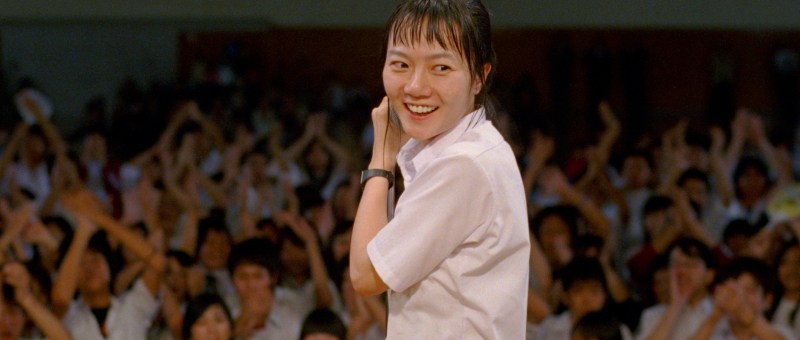
It’s also the serendipitous rain that allows lonely songstress Takako an opportunity to perform having previously declined to do because it’s no fun playing on your own and all her former bandmates graduated the previous year. Moe, the girl who broke her fingers playing basketball in PE leaving the original band members unable to take the to the stage, also gets an opportunity to sing having otherwise been denied a moment of closure in being prevented from taking part in her final school festival. While Moe feels intensely guilty about rendering all their time spent rehearsing somewhat pointless, it’s really the drama between founding members Kei and Rinko that leads to the band’s demise in Rinko’s conviction that it’s “meaningless” to continue while the others decide to go ahead anyway asking Korean exchange student Son (Bae Doona) to be their vocalist because she just happened to come down the stairs at the right moment and said yes because she didn’t really understand what they were saying.

Prior to her involvement with the band, Son had been a rather isolated figure trapped in the “Japan-Korea Culture Exchange Exhibit” which seems to have been more her teacher’s idea than her own and in any case gets no actual visitors. Her Japanese is a bit limited and most of her interactions are with a little girl who lends her manga to help her learn quickly, but becoming part of the band allows her to find her voice both literally and figuratively in taking the lead as the vocalist. A boy who claims to have fallen in love with her (Kenichi Matsuyama) goes to the trouble of learning a long speech in Korean to convey his feelings, yet a bemused Son replies to him in Japanese that she’s pretty indifferent to his existence before switching to Korean to explain that she’s leaving because she’d rather be hanging out with her friends with an expression that implies she’s only just realised that’s what they are. By contrast, she has a bilingual conversation with guitarist Kei (Yu Kashii) in which they seem to understand each other perfectly and each express how glad they are that they got to be in the band together. 

Similarly, it’s the concert itself that seems to heal rifts with a simple “Are you alright?” from Rinko (Takayo Mimura) to Kei whose friendship might, as someone says, essentially be too close for them to really get along. Drummer Kyoko (Aki Maeda) decides to declare her feelings for a longstanding crush before the concert. In the end she doesn’t manage it, but it doesn’t quite matter somehow because their performance is itself a kind of coming into being in which “the real us” comes into focus if also in a moment that itself becomes romanticised or idealised as an encapsulation of youth. Yamashita travels through the school festival as if it were a passage from one state of being to another, from the noodle stalls and crepe stands to haunted houses and the boy creating his own moment through encapsulating them on film, before ending with an unending song “so we can laugh tomorrow,” and the “real us” lives on.


Linda Linda Linda opens in US cinemas 5th September courtesy of GKIDS.

Trailer (English subtitles)

Waterboys (ウォーターボーイズ, Shinobu Yaguchi, 2001)

Japan has really taken the underdog triumphs genre of sports comedy to its heart but there can be few better examples than Shinobu Yaguchi’s 2001 teenage boys x synchronised swimming drama Waterboys (ウォーターボーイズ). Where the conventional sports movie may rely on the idea of individual triumph(s), Waterboys, like many similarly themed Japanese movies, has group unity at its core as our group of disparate and previously downtrodden high school boys must find their common rhythm in order to truly be themselves. Setting high school antics to one side and attempting to subvert the normal formula as much as possible, Yaguchi presents a celebration of acceptance and assimilation as difference is never elided but allowed to add to a growing harmony as the boys discover all new sides of themselves in their quest for water borne success.
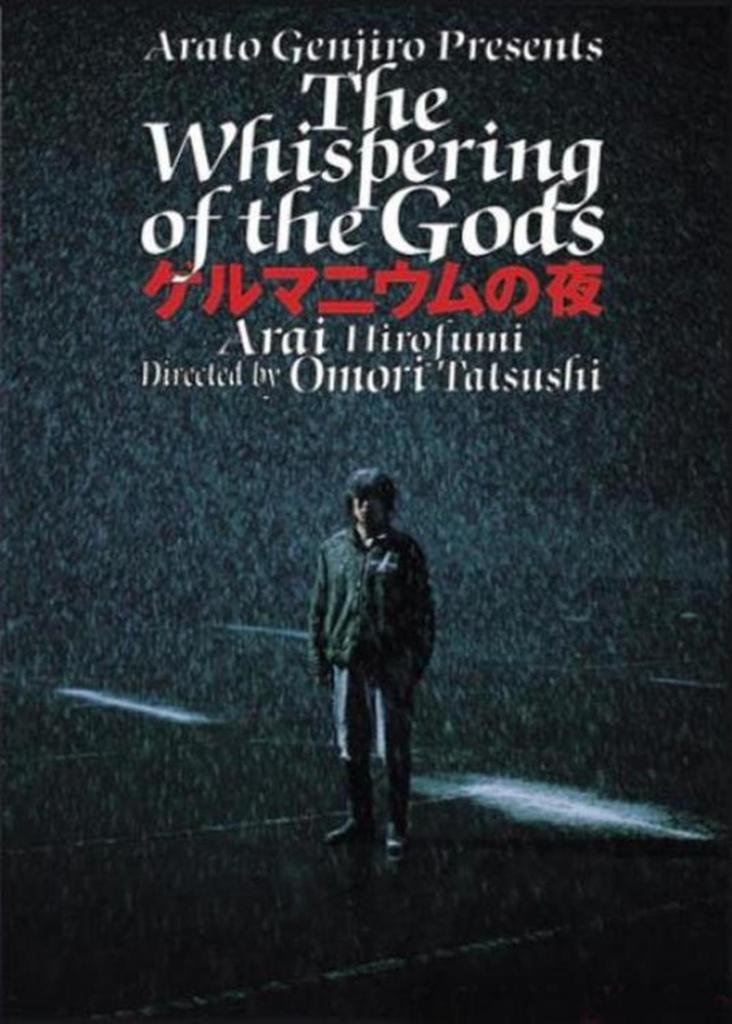
Dreamy high school boy Suzuki (Satoshi Tsumabuki) is currently the only member of his high school’s swimming team, and unfortunately he’s not a particularly good swimmer. His interest is piqued when he spots a synchronised swim meet, but he forgets all about it until a new teacher arrives and pledges to revive the school’s fortunes in the pool. Seeing as their new teacher is a pretty young woman with an interest in swimming, the team suddenly becomes much more popular but when she reveals her synchronised swimmer past numbers dwindle once again. Unfortunately, the hot new teacher suddenly has to leave the school so the boys are left to fend for themselves in their new and possibly embarrassing career in a generally feminine sport.

Being teenage boys who only started this whole thing because of the pretty teacher, most of the other guys are are looking for a way out but they also don’t like to be called quitters and so they become determined to make a success of themselves. Suzuki, who secretly wanted to become a synchronised swimmer anyway, is the most committed but also, perhaps, the least confident in his choice of sport as he embarks on a tentative romance with a girl from another school – herself an enthusiast of the more masculine karate. Terrified that she will find out and laugh at him, Suzuki goes to great lengths to avoid telling her what it he really does in his club activities, possibly putting the growing romance at risk in the process.

This mild challenge to masculinity is the main joke of the film but Yaguchi neatly subverts as the guys become cool again thanks to mastering a difficult skill and creating an impressive spectacle through hard work and group mentality. The boys gain an unlikely mentor in the form of a dolphin trainer at Sea World who they hope will be able to train them in the same way he trains his marine creatures but quickly sets them off on some Karate Kid style practical training which involves a lot of menial tasks around the park before dumping them at the local arcade to play dance dance revolution until they learn the art of synchronicity through the power of idol pop. Waterboys is, essentially, a hymn to the harmonious society as the boys eventually find their common rhythm and the power that comes from many acting as one.

Unusually, this does not requite a loss of individuality or for any erasure of essential personality traits but rather a greater need for acceptance as difference merely adds to the strength of the whole. Though there are a fair few gay jokes in what is essentially a movie about high school boys in skimpy trunks, the joke is not homosexuality but reactions to it as Yaguchi adopts a “get over it” attitude and so when one of the boys does confess his love for another it’s treated with no particular reaction other than lack of surprise. Similarly the cross dressing mama-san from the local gay club (a surprising turn from Akira Emoto) becomes one of their greatest supporters and may provide comic relief but is never a figure of fun. In order to succeed the boys will need to be in tune with each other, but that in tune sounds better when it allows for harmony rather than insisting on dull monotony.

Visually inventive and often hilarious, Waterboys lacks the heart of Yaguchi’s similarly plotted Swing Girls but nevertheless succeeds in its tale of inexperienced young guys working hard and achieving the impossible, growing up and discovering new things about themselves as they do. Waterboys may be lighthearted, crowd pleasing fun, but its good natured message that great things are possible when determined people work hard at them together, and that group harmony does not necessarily require social conformity, only add to its warm and gentle tone.


Korean trailer (Korean captions/subtitles only)

The Whispering of the Gods (ゲルマニウムの夜, Tatsushi Omori, 2005)

whispering of the godsIf you’ve ever wondered what it’s like to live in hell, you could enjoy this fascinating promotional video which recounts events set in an isolated rural monastery somewhere in snow covered Japan. A debut feature from Tatsushi Omori (younger brother of actor Nao Omori who also plays a small part in the film), The Whispering of the Gods (ゲルマニウムの夜, Germanium no Yoru) adapted from the 1998 novel by Mangetsu Hanamura, paints an increasingly bleak picture of human nature as the lines between man and beast become hopelessly blurred in world filled with existential despair.
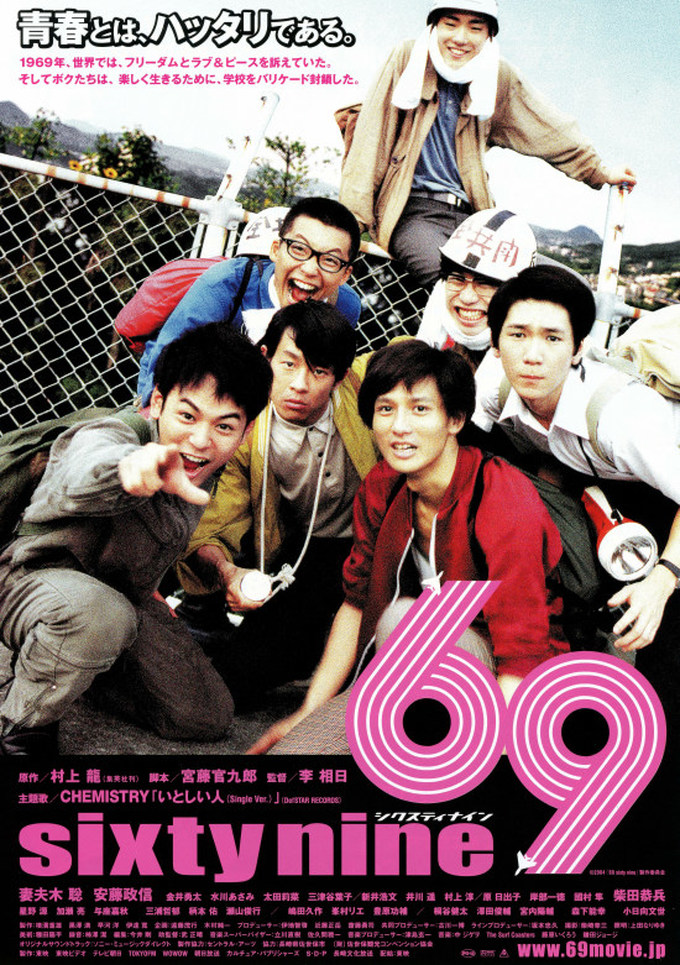
Rou (Hirofumi Arai) has returned to the religious community where he was raised but his reasons for this seem to have everything and nothing to do with God. He claims that he “kind of killed some people” and also says he’s a rapist, but there’s no way to tell how much of what he says is actually the truth. After opening with a sequence of bulls trudging through snow, we see Rou listening to a priest read from the bible, but we also see that Rou is giving the priest a hand job whilst looking resolutely vacant. Later, after expending some pent-up anger by thrashing around some with junk and kicking a dog, Rou has a heart to heart with a novice nun, Kyoko, which quickly results in a forbidden sexual relationship. Forbidden sexual relationships, well – “relationships” isn’t quite the right word here, perhaps transactions or just actions might be more appropriate, are very much the name of the game in this extremely strange community of runaways and reprobates each keen to pass their own suffering down to another through a complex network of abuse and violence.

An early scene sees Rou throw a metal pipe across his shoulders in an oddly Christ-like pose. He’s certainly no Messiah, he wants to take revenge on these people by being the very worst of them, but ultimately he does come carrying a message. Using the same tools against them as they’ve used against him all his life, he exploits the loopholes of religiosity to expose its inherent hypocrisy. He confesses sins he may or may not have committed as well as those he plans to commit. In giving him unconditional absolution for an uncommitted sin, has the priest just given him a free pass to balance the celestial books by going ahead and violating a random nun? As well as well and truly messing with the resident priest’s head, Rou’s rampant sexuality also exposes the latent longings present within the nuns themselves who are supposed to control their sexual urges, brides of Christ as they are, yet they too covertly indulge themselves in receiving satisfaction from the various kinds of strange sexual behaviour currently on offer.

Life on the farm is nature red in tooth and claw as one particularly brutal scene sees a male pig castrated with a pair of garden shears during a failed act of copulation. Later a pig will lie in neatly dissected pieces, dripping with blood and fluid. There’s no romance here, just flesh and impulse. Forming a kind of friendship with a younger boy, Toru, who is also being abused by the priests at the compound, Rou offers to take revenge for him but it seems the boy just wanted to confide in someone, to begin with. Later, Rou will take a kind of action and Toru offers to repay him by continuing the behaviours he has learned through a system of perpetual manipulation, unwittingly drawing Rou even more deeply into the spiral of abuse and hypocrisy that he set out to destroy.

Omori opts for a straightforward arthouse aesthetic which matches the bleakness of the environment and barrenness of spirituality found in this supposedly Christian commune. In fact, Omori had to go a roundabout route to get this film shown given its controversial nature which saw him set up a temporary marquee theatre to avoid having the film cut to get an Eirin certificate before getting it into more mainstream cinemas in his desired version. What it has to say about the base essence of humanity is extremely hard to take, though no less valid, and its picture of a hellish world filled with nothing but despair punctuated by guilt filled sexual episodes and violence in which there is nothing left to do but continue shovelling shit until you die is an uncomfortably apt metaphor for contemporary society.


Mangetsu Hanamura’s source novel does not appear to be available in English but actually seems to be even more disturbing than this extremely depressing film – more info over at Books From Japan.

Unsubbed trailer:

69 (Lee Sang-il, 2004)

69Ryu Murakami is often thought of as the foremost proponent of Japanese extreme literature with his bloody psychological thriller/horrifying love story Audition adapted into a movie by Takashi Miike which itself became the cornerstone of a certain kind of cinema. However, Murakami’s output is almost as diverse as Miike’s as can be seen in his 1987 semi-autobiographical novel 69. A comic coming of age tale set in small town Japan in 1969, 69 is a forgiving, if occasionally self mocking, look back at what it was to grow up on the periphery of massive social change.

The swinging sixties may have been in full swing in other parts of the world with free love, rock and roll and revolution the buzz words of the day but if you’re 17 years old and you live in a tiny town maybe these are all just examples of exciting things that don’t have an awful lot to do with you. If there’s one thing 69 really wants you know it’s that teenage boys are always teenage boys regardless of the era and so we follow the adventures of a typical 17 year old, Ken (Satoshi Tsumabuki), whose chief interest in life is, you guessed it, girls.

Ken has amassed a little posse around himself that he likes to amuse by making up improbable fantasies about taking off to Kyoto and sleeping with super models (oddly they almost believe him). He talks a big about Godard and Rimbaud, posturing as an intellectual, but all he’s trying to do is seem “cool”. He likes rock music (but maybe only because it’s “cool” to like rock music) and becomes obsessed with the idea of starting his own Woodstock in their tiny town but mostly only because girls get wild on drugs and take their tops off at festivals! When the object of his affection states she likes rebellious guys like the student protestors in Tokyo, Ken gets the idea of barricading the school and painting incomprehensible, vaguely leftist jargon all over the walls as a way of getting her attention (and a degree of kudos for himself).

69 is a teen coming of age comedy in the classic mould but it would almost be a mistake to read it as a period piece. Neither director Lee Sang-il nor any of the creative team are children of the ‘60s so they don’t have any of the nostalgic longing for an innocent period of youth such as perhaps Murakami had when writing the novel (Murakami himself was born in 1952). The “hero”, Ken, is a posturing buffoon in the way that many teenage boys are, but the fact that he’s so openly cynical and honest about his motivations makes him a little more likeable. Ken’s “political action” is merely a means of youthful rebellion intended to boost his own profile and provide some diversion at this relatively uninteresting period of his life before the serious business of getting into university begins and then the arduous yet dell path towards a successful adulthood.

His more intellectual, bookish and handsome buddy Adama (Masanobu Ando) does undergo something of a political awakening after the boys are suspended from school and he holes up at home reading all kinds of serious literature but even this seems like it might be more a kind of stir crazy madness than a general desire to enact the revolution at a tiny high school in the middle of nowhere. Ken’s artist father seems oddly proud of his son’s actions, as if they were part of a larger performance art project rather than the idiotic, lust driven antics of a teenage boy but even if the kids pay lip service to opposing the war in Vietnam which they see on the news every night, it’s clear they don’t really care as much as about opposing a war as they do about being seen to have the “cool” opinion of the day.

Lee takes the period out of the equation a little giving it much less weight than in Murakami’s source novel which is very much about growing up in the wake of a countercultural movement that is actually happening far away from you (and consequently seems much more interesting and sophisticated). Were it not for the absence of mobile phones and a slightly more innocent atmosphere these could easily have been the teenagers of 2003 when the film was made. This isn’t to criticise 69 for a lack of aesthetic but to point out that whereas Murakami’s novel was necessarily backward looking, Lee’s film has half an eye on the future.

Indeed, there’s far less music than one would expect in the soundtrack which includes a few late ‘60s rock songs but none of the folk/protest music that the characters talk about. At one point Ken talks about Simon & Garfunkel with his crush Matsui (Rina Ohta) who reveals her love for the song At the Zoo so Ken claims to have all of the folk duo’s records and agrees to lend them to her though his immediately asking to borrow money from his parents to buy a record suggests he was just pretending to be into a band his girl likes. Here the music is just something which exists to be cool or uncool rather than an active barrier between youth and age or a talisman of a school of thought.

Lee’s emphasis is firmly with the young guys and their late adolescence growth period, even if it seems as if there’s been little progress by the end of the film. There’s no real focus on their conflict with the older generation and the movie doesn’t even try to envisage the similar transformation among the girls outside of the way the boys see them which is necessarily immature. That said, the film is trying to cast a winking, wry look back at youth in all its eager to please insincerity. It’s all so knowingly silly, posturing to enact a revolution even though there’s really no need for one in this perfectly pleasant if slightly dull backwater town. They’ll look back on all this and laugh one day that they could have cared so much about about being cool because they didn’t know who they were, and we can look back with them, and laugh at ourselves too.


Ryu Murakami’s original novel is currently available in the UK from Pushkin Press translated by Ralph McCarthy and was previously published in the US in the same translation by Kodansha USA (but seems to be out of print).

Unsubtitled trailer:

and just because I love it, Simon & Garfunkel At the Zoo