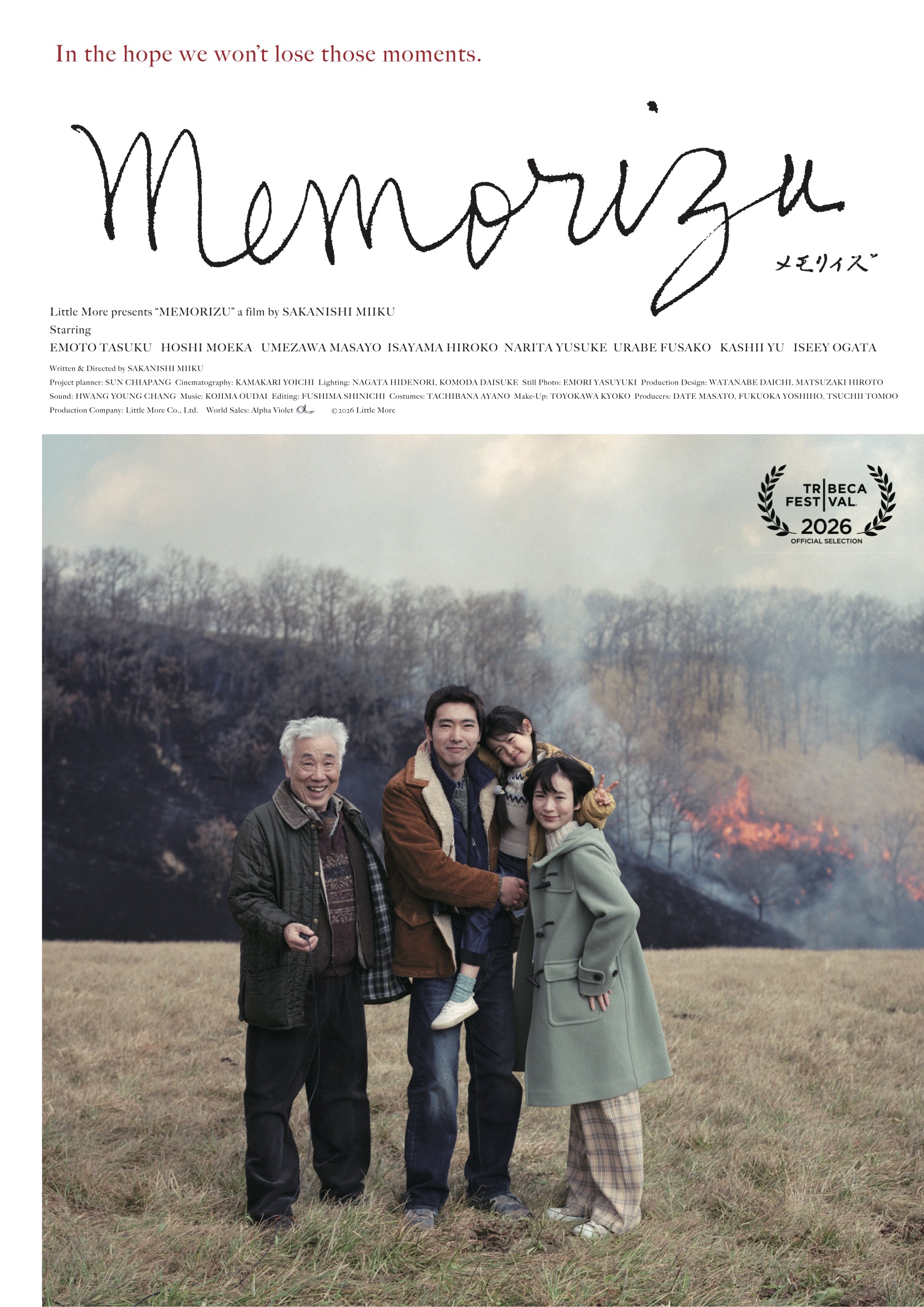
Trying to calm a nervous groom, ageing photographer Makoto (Issei Ogata) tells him that he also took his grandfather’s wedding pictures in a moment that speaks of several kinds of continuity all at once. Yet why is that we take photos? Is it for ourselves, as a kind of proof of existence “to remember we were here,” or so that we can share these moments with others and create shared memories to paper over the rift of absence?
The weight of nostalgia hangs heavy over Makoto’s photography studio, but the irony is that it’s son-in-law, Yuta (Tasuku Emoto), who’s come to look after him while he recuperates after breaking a leg, and therefore has no particular attachment to this place or the landscape given that it is not the place where he grew up. Nevertheless, this sense of distance is perhaps why Yuta finds himself taking photos on his smartphone and documenting his daily live in the peaceful rural environment as a means of keeping in touch with his wife, Yuki (Moeka Hoshi), and daughter, Hana, who were supposed to be coming with him but had to cancel at the last moment.
These photos are often spontaneous and sparked by the desire to share a moment or re-experience it later, whereas the photographs taken at Makoto’s studio are more deliberate. Someone has made a decision to have their photo taken either for a prosaic reason such as an application form, or because they too want to mark an important event like a wedding or the birth of a child. These are not events that anyone is likely to forget, but the physical object of the photograph becomes a repository for the emotions the subjects and photographer were feeling at that moment which might otherwise me transitory but can now be re-accessed through film.
The same can be true of the photos and videos Yuta takes on his phone which enable a kind of time lapse communication between himself and his family in which one can be both present and absent at the same time. Yet there’s an implication that the ease with which we take photos in the present day has diluted has their potency. Yuki calls up the photo app on her phone is ad plunged into a sea of images, mainly of her young daughter, so many that she will likely never open most of them again while the vastness of the archive might discourage looking at any of them at all beyond the already visible thumbnail.
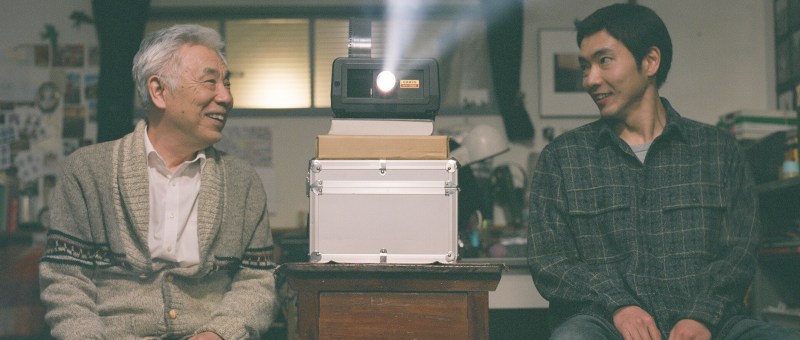
Even so, there’s a degree of poignancy in Makoto getting out the slide projector to show Yuta old pictures of his later wife and Yuki as a child as we see the same images recreated by the adult Yuki and Hana making exactly the same trip with the images appearing in Yuta’s mind like photographs. As Shiori and the young Yuki move further and further away from the camera, there’s a sense of continuing in these repeated images like a film negative running through a projector as one generation slowly replaces another. Though Shiori is already gone, her presence is felt through its absence in the empty seat next to Makoto as he remembers the time they saw a burning field, or her coat still hanging on the wall now on its own as Makoto has given his jacket to Yuta.
The gift of the jacket furthers Yuta’s identification with Makoto, though as one might expect the situation is a little awkward to begin with. Nevertheless, as he settles into the relaxed pace of rural life, the pair begin to bond and develop a familial relationship of their own. Sakanishi bookends the film with scenes of open windows, the first that of a ferry looking out onto the sea. Its rounded corners give it the aesthetic of film while the scene constantly changes to explore how various people react to it. Some look out on the sea as they eat, others more or less ignore it or get on with their work. The closing shot, meanwhile, is a timelapse photo through Makoto’s bedroom window capturing the changing seasons. The lesson is perhaps that the human eye is also a camera and that our lives our made up of these small, barely memorable moments that can nevertheless amount to something greater than ourselves.
Trailer (English subtitles)
 Reteaming with popular boy band V6, SABU returns with another madcap caper in the form of surreal farce Hold Up Down (ホールドアップダウン). Holding up is, as usual, not on SABU’s roadmap as he proceeds at a necessarily brisk pace, weaving these disparate plot strands into their inevitable climax. Perhaps a little shallower than the director’s other similarly themed offerings, Hold Up Down mixes everything from reverse Father Christmasing gone wrong, to gun obsessed policemen, train obsessed policewomen, clumsy defrocked priests carrying the cross of frozen Jesus, and a Shining-esque hotel filled with creepy ghosts. Quite a lot to be going on with but if SABU has proved anything it’s that he’s very adept at juggling.
