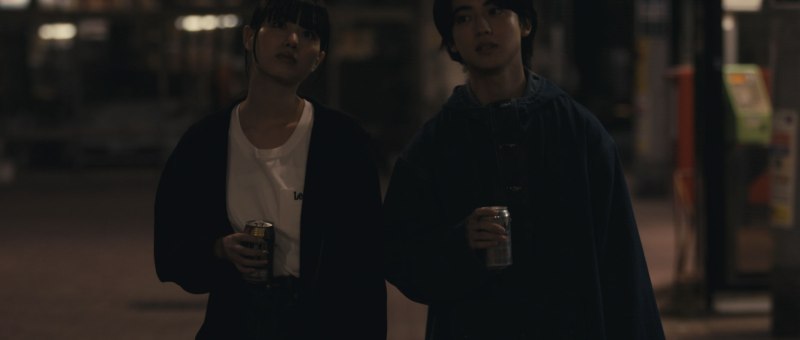
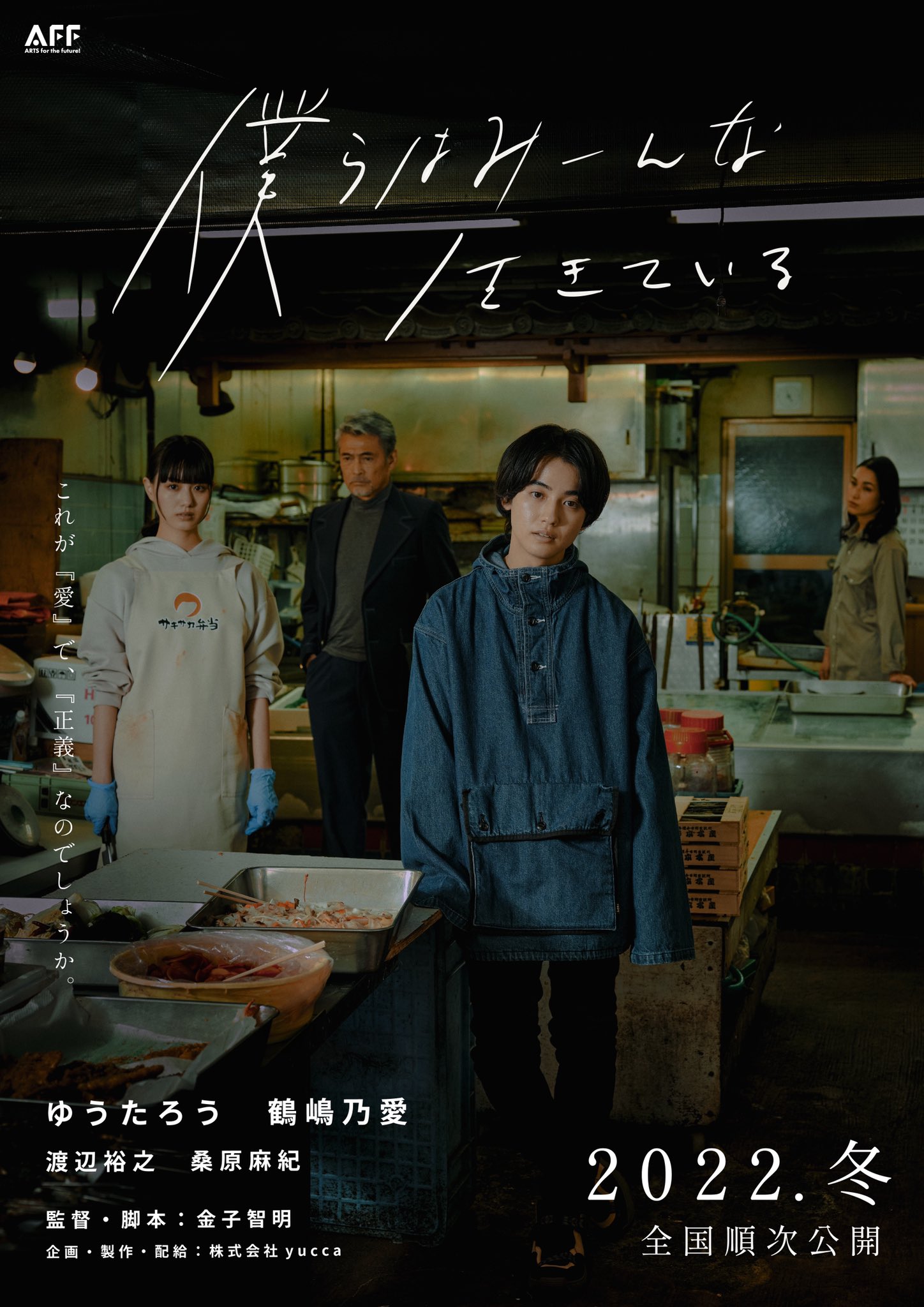
Dead Fishes (僕らはみーんな生きている, Tomoaki Kaneko, 2022)

Fearing he knows nothing of the world, a young man comes to Tokyo in search of experience but finds his horizons broadened a little more than he might have liked in Tomoaki Kaneko’s bleak indie drama Dead Fishes (僕らはみーんな生きている, Bokura wa Minna Ikiteiru). Legacies of poor parenting, either from an overabundance of love or.a lack of it, continue to cast a shadow over the futures of the young while love otherwise makes people do funny things that defy both logic and humanity.

One of the key reasons Shun (Yutaro) leaves his rural hometown is to get away from his parents and their tempestuous marriage though it’s also true that his mother has become more than a little possessive and he clearly does not want to end up trapped by her all his life. He dreams of becoming a writer, but tells new friend Yuka (Noa Tsurushima) that writing for him was more of an escapist than artistic exercise. Most of his books are of the kind where nothing really happens, a kind of wish fulfilment writing stories about the happy family he never had in which parents and children enjoy cheerful days out at the beach or the zoo, which is why he suspects publishers aren’t biting.

But Yuka has parental resentments too, explaining that her mother took her own life after her father abandoned them before she was born. She has a healthy distrust of adults and the in-built cynicism of someone twice her age but also resents herself for having been unable to enact revenge on her absent father. Nevertheless, she feels sympathy for the old people living in the local care home who have also been, according to her, “abandoned” by their families who no longer wish to care for them. Their boss, Yuriko (Maki Kuwahara), is currently caring for her mother who is suffering with dementia and occasionally becomes violent or refuses food though as the pair discover she is also mixed up with her much older boyfriend’s heinous scheme to help overburdened children knock off their elderly relatives through slow poisoning or an “accident” in return for a portion of their life insurance money.

The scheme both bears out the corrupted relationship between parent and child and the darkness of the contemporary society in which, as the Chairman (Hiroyuki Watanabe) says, the elderly can benefit their families only by dying. Despite having become aware of the goings on at the bento shop, neither Yuka nor Shun are particularly motivated to do anything to stop them, simply living on in resentment or disapproval. Yuriko tells him that he can’t understand her actions because he’s too young and has never been in love, but it’s also true that she was supposed to get a healthy payout for the slow poisoning of the man the Chairman made her marry for appearance’s sake who is likewise aware they’re planning to kill him but basically allowing them to because of love. Love is also the justification Shun’s mother gives when she arrives unnanounced and ends up talking to Yuka, explaining that she’s never thought Tokyo was right for her son so she’s found him a job back home which is after all not really her decision to make. 

But then again even Shun’s writing dreams become corrupted by the city when he’s hired to write a column for a pornographic magazine that’s only distributed in local brothels. Even the editor who hires him appears beaten down and desperate, explaining that he was once a writer too but seemingly ashamed of his current profession later decided to cut his losses and return to his hometown stopping to warn Shun only not to turn out like him or to let himself be changed by the environment he now finds himself in.

By contrast, Yuka’s flighty roommate Mika (Haruka Kodama) says she’d rather die than live with dead fish eyes escaping from her own despair and disappointment through casual sex work to supplement her income from working at a black company. Claiming that all you need in life is a money and good reputation, she’s planning to string this out until the end of her 20s in the hope of meeting a nice man to settle down with for a traditional housewife existence. Bleak in the extreme, Kaneko leads this moribund small town a sense of futility and emptiness and sees little way out for an orphaned generation other than to surrender themselves to the indifference of the world around them.


Original trailer (no subtitles)
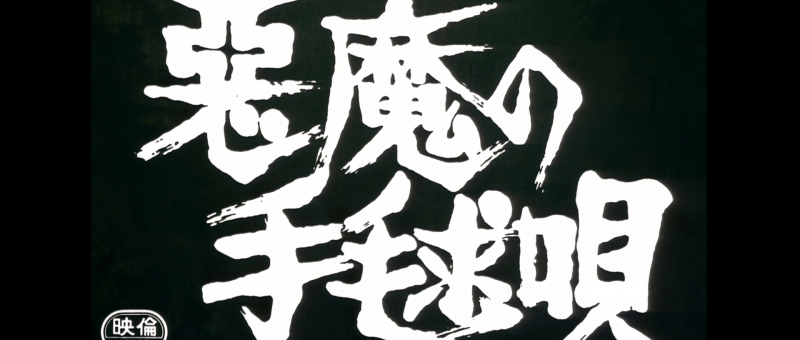
The Devil’s Ballad (悪魔の手毬唄, Kon Ichikawa, 1977)

Devil's Ballad posterA year after his box office smash The Inugami Family, Kon Ichikawa returns to the world of eccentric detective Kosuke Kindaichi with The Devil’s Ballad (悪魔の手毬唄, Akuma no Temari Uta). Like many a Kindaichi mystery, Devil’s Ballad finds him called upon to delve back into the past to satisfy an ageing detective’s anxiety about an old case, only to be faced with a series of new ones as a consequence. This time, however, the mystery leans less on buried secrets than deeply held grudges, betrayals, and lingering feudal feuds as the post-war society tries and fails to free itself from ancient oppressions.

The film opens with a tryst between two adolescent lovers in the ominously named “Devil’s Skull Village” in 1950. Yasu (Yoko Takahashi), the girl, is at pains to let her boyfriend, Kanao (Koji Kita), know that she is keen to take the relationship to the next level but he is old fashioned and wants to wait until their union is formalised. The pair are interrupted by some of their friends who are in the middle of planning a celebration for a visit from a girl who moved to the city, Chie (Akiko Nishina). Meanwhile, Kindaichi (Koji Ishizaka) has arrived at the inn owned by Kanao’s mother Rika (Keiko Kishi) on invitation from a retired policeman, Isokawa (Tomisaburo Wakayama), who wants Kindaichi to look into the murder of Rika’s husband twenty years ago. Isokawa, then a young rookie, is convinced that Rika’s husband was not the victim but the murderer and the corpse actually belonged to another man entirely – Onda, a drifter who defrauded half the village with a wreath making scam.

Rika and her children – 20-year-old Kanao and his younger sister Satoko (Eiko Nagashima) who has prominent facial birthmarks and rarely leaves the house, came to the village with her husband and are therefore slightly divorced from the longstanding social rivalries. The village has two noble families – the Yuras and the Nires. Feeling the need to modernise, the Nires bet everything on vineyards and it paid off. The Yuras, by contrast, were defrauded by Onda’s wreath scam and lost their fortune and social standing. Yasu, Kanao’s girlfriend, is a daughter of the Yuras, but the Nire’s have been petitioning Rika for quite some time to have her son marry their daughter, Fumiko (Yukiko Nagano), who also has a crush on him (though this is largely irrelevant to her father’s dynastic ambitions). When the younger generation start getting bumped off in ways eerily similar to a local folk song, Kindaichi and Isokawa are on the case, wondering if these new murders have anything to do with their old one.

Despite its 1950 setting, Devil’s Ballad is unusual in resolutely making an irrelevance of the war which only receives a brief mention as an explanation for why some of the case files have been destroyed and for why marriage is such a hot button issue given the lack of men and abundance of women. Nevertheless, the crimes span a turbulent 20 years of Japanese history with the original murder taking place in the early ‘30s during a period of economic instability following the Manchurian Incident. In the socially conservative pre-war era, it seems Onda also got around and may have fathered several illegitimate children with women in the village, some of them noble, some not. These buried secrets seem primed to bubble to the surface now that the children are coming of age and marriage again becomes an issue as worried parents try to think of acceptable ways to block potentially “inappropriate” matches without sending their children off into ruinous elopements or tipping off the wrong people that their kids may not be their kids.

The crimes themselves, old fashioned as they are, are partly reactions to a changing society. We discover that the reason Rika and her husband were forced to come back to the village was that their showbiz careers were stalling – she was a vaudeville performer specialising in shamisen, and he a “benshi” (narrator of silent films) who became convinced his job was obsolete after witnessing a subtitled print of Morocco. Likewise, the two rival families cannot let go of their petty provincial privileges, and as Kanao angrily snaps back at his mother, Japan is now a democratic country and he is free to choose his own wife at a time of his own choosing with or without parental blessing. This remote village is perhaps isolated from the privations of the post-war world but it’s also stuck in the past, hung up on past transgressions and unable to move forward into the new era. However, the primary motivations for murder are as old as time – guilt, humiliation, and self preservation.

Ichikawa keeps things simple but splices in a few strange, avant-garde sequences of kokeshi dolls menacingly bouncing balls coupled with shifts to black and white, fast-paced reaction shots, and stuttering still frame sequences all while Kindaichi showers innocent passersby with his famous dandruff, the idiot police officer continues to offer ridiculous theories while his sergeant dutifully follows him around, and the local bobby perfects a line in hilarious pratfalls. Overlong at two and a half hours and falling prey to the curse of the prestige crime drama in spoiling its mystery through casting, the Devil’s Ballad may not be the best of the Kindaichi mysteries but offers enough of a satisfying twist to prove worthy of the Kindaichi name.


Original trailer (no subtitles)