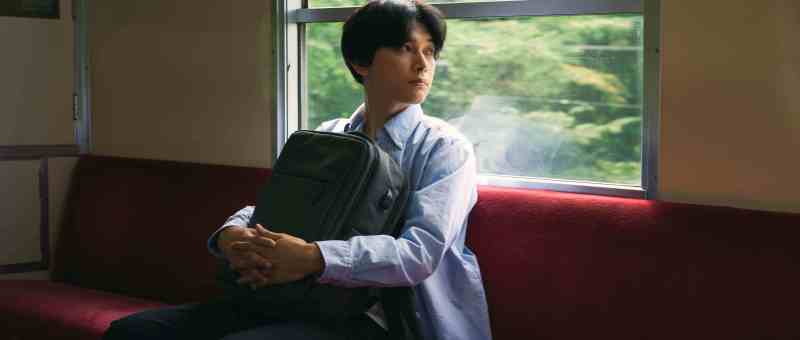

Mipo O had been quietly building a reputation as one of Japan’s most promising young indie directors with such lauded films as The Light Shines Only There but has been on an extended hiatus since 2015’s Being Good. Living in Two Worlds (ぼくが生きてる、ふたつの世界, Boku ga Ikiteru, Futatsu no Sekai) marks her return to filmmaking after taking a break to raise a family and, adapted from from an autobiographical book by Daisuke Igarashi, not only explores the realities faced by the deaf community but the complicated relationship between a son and his mother.
Indeed, at times the issue is less that both of Daisuke’s (Ryo Yoshizawa) parents are deaf as it is that he does not listen. When he becomes a teenager, his mother Akiko (Akiko Oshidari) spends a huge amount of money on a high tech hearing aid because she wants to hear his voice, though most of what he says to her is hurtful and unpleasant. His older self is probably regretful, ashamed of the way he treated his mother in particular but also in regards to his rejection of his family because he felt embarrassed by their difference in what is a fiercely conformist culture. He doesn’t give his mother a letter about parents’ day because he doesn’t want her to come and also thinks it would be pointless because she wouldn’t be able to hear anything anyway. Later he tries to get his grandmother to come with him to a parent teacher meeting about his plans for high school and beyond, telling his mother she’d only be in the way. In fact, the meeting is quite awkward because the teacher talks directly to him without trying to include Akiko while Daisuke makes infrequent signs under the table as if embarrassed to have the teacher see them.
As a young child, Daisuke had interpreted for his mother using sign language publicly despite the awkward attitude towards it at home. His grandmother writes things down on paper instead, telling him that it’s too difficult for her to learn. That doesn’t make sense to his young brain as after all he’s picked it up since birth. But this early tension perhaps contributes to his increasingly conflicted feelings. When he brings a friend home, he asks him why his mother speaks in such a funny way but of course it’s normal to Daisuke and this perhaps innocent question begins to cement for him that his family isn’t “normal” and he isn’t like the other children. Resentment towards his mother only grows to the point he begins to blame all of his problems on her including his failure to get into the better high school though she has done nothing but support and encourage him. As she points out, she never had any choice about her schooling and received little education because her parents thought she’d recover her hearing and refused to send her to a specialist school until she was 14 meaning she was just sat there all day twiddling her thumbs while unable to make friends with hearing children who mostly ignored her.
The parents were also against the idea of her marrying her husband Yosuke (Akito Imai) because he was also deaf, nor did they support their decision to have a child believing two deaf parents would not be able to raise one safely or effectively. Such attitudes lay bare the lingering stigma towards disability which remains even within the family unit. Unable to separate himself from being the child of working class deaf parents, the teenage Daisuke abruptly moves to Tokyo with a vague idea of becoming an actor signalling his internal search for an independent identity. The film hints that his liminal status existing between the worlds of the hearing and the deaf has left him with subpar communication skills as seen in his repeated faux pas at job interviews until he finally tells the truth and is offered a job on the spot. There’s an intimacy involved in his interactions with his parents which often can’t be understood by others, but also a less pleasant undercurrent in the way these interplay with speech and his own decisions of when to switch between dialogue and sign.
Having gone to Tokyo to escape being the child of deaf parents, he discovers that being “ordinary” doesn’t really suit him either and only begins to accept his identity after meeting a deaf woman at a pachinko parlour who invites him to her class for learning sign language in a more a formal way while another of her pupils gently explains to him that though he means well he sometimes does them a disservice by taking over as a hearing person when he should let them do the things they can do for themselves. The absence of musical score and variation in the sound mix emphasise Daisuke’s transition between worlds and his own attempts to locate himself within them eventually discovering the equilibrium that allows him to realise he was the one who couldn’t hear along though his mother had always been talking to him. Touching but resisting sentimentality, O’s poignant drama never shies away from the failings of its protagonist but equally from those of the society within which he lives that can itself be unwelcoming of difference.
Living in Two Worlds screened as part of this year’s BFI London Film Festival
International trailer (English subtitles)
 Windows on Worlds