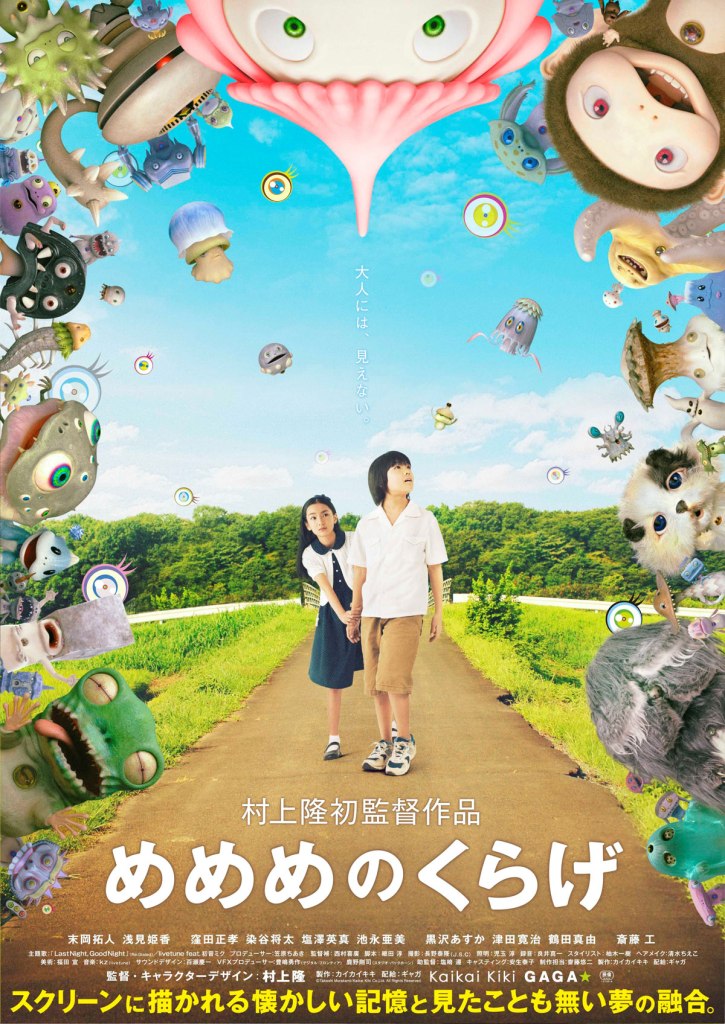
 Jellyfish Eyes (めめめのくらげ, Mememe no Kurage) is the feature film debut of the internationally popular Japanese artist, Takashi Murakami. Well known for his cutesy character designs which are as likely to turn up in the world’s best regarded art galleries as they are on a kid’s backpack, Murakami is one of Japan’s most highly regarded art exports. Having unsuccessfully tried to raise interest in the more obvious totally CG animation, Murakami has enlisted the help of gore master Yoshihiro Nishimura for some director’s chair tips in creating a live action/CGI hybrid. Jellyfish Eyes is very definitely a kids’ movie, calling it a “family film” seems unfair when the age cut off is most likely around seven or eight years old but those who meet the (lack of) height requirement are sure to lap it up.
The story is set in post-tsunami Japan as Masashi (Takuto Sueoka) has finally moved out of the earthquake evacuation centre with his mother (Mayu Tsuruta) to live in a new town. As it will transpire, the two have moved there alone as Masashi’s father (Kanji Tsuda) has been killed in the tsunami and his mother has a brother (Takumi Saito) in the area. Not long after he moves in, the boy makes a new friend in the shape of a Jellyfish-like creature who floats in the air and loves eating the same kind of snacks as Mashashi. The creature, christened Kurage-bo (Jellyfish Boy), becomes a firm fixture in Masashi’s life and when he arrives at school Masashi realises Kurage-bo is not the only one of his kind. In this strange town all the kids have a weird little creature friend they can control by means of a smartphone app. Predictably some of the meaner boys use them to fight, but could there be a more sinister reason for the appearance of these very odd little guys? and what’s up with the bizarre religious cult that’s located right next to the creepy science lab? This is a very strange town indeed.
The film’s Japanese title, Mememe no Kurage, is a little reminiscent of the master work of the late Shigeru Mizuki, Gegege no Kitaro and like that perennially popular franchise the film focuses on the daily lives of children as they have strange adventures with supernatural creatures. The central premise is that a shady group of black clad scientific researchers (played by Masataka Kubota, Shota Sometani, Hidemasa Shiozawa, and Ami Ikenaga) claim to have found the key to surpassing natural disasters like earthquakes and it relies on the particles generated by the negative emotions of human children. Predictably it’s not long before things go from bad to worse and a giant kaiju-like creature descends on the town requiring the kids to work together to combat the marauding monster before it destroys the entire planet.
To be frank the film sounds a lot more entertaining that it turns out to be. Though undoubtedly very cute and not exactly uninteresting, it all ends up feeling, well, “superflat” only in an unintended way. The photography is generally basic though the CGI itself is of an extremely high quality and perfectly toned to match Murakami’s thematic concerns. Structurally it’s all over the place with the central ideas emphasised a little too strongly only to be thrown out of the window for the sugar rush finale of a million adorable monsters all fighting to the death for their cute as a button sad children masters. There’s quite a lot of darkness and melancholy lurking around the edges but the adorable little critters seem tailor-made for keeping the bad stuff in the background.
Like all good children’s movies the messages are the usual ones about the importance of friendship, sharing, teamwork and doing what’s right but it feels like Murakami has quite a lot of other things to say about reliance on forms of technology (and in particular what that can open the door to) and the state of post earthquake Japan that don’t quite come through. Having said that Jellyfish Eyes boasts some amazing visuals in its adorably cute cast of F.R.I.E.N.Ds and though a little messy is perfectly watchable. A festive treat for younger members of the family, Jellyfish Eyes is full of youthful idealism in the power of simple sincerity and genuine human feeling to win through against even the most terrifying of monsters but ultimately fails to offer much beyond its cutesy visuals.
Here’s a trailer – it says the creatures are invisible to adults but they aren’t (but some of them can make themselves transparent, if that makes sense).
 Windows on Worlds