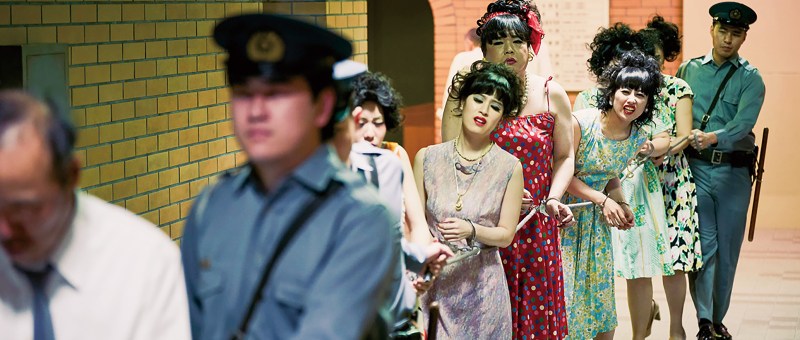

The police of mid-1960s Japan have a problem. They’re desperately trying to clean up the streets. But they keep running into transgender sex workers whom they can’t arrest because the working of the anti-prostitution laws explicitly targets women only, and in legal terms the people they’re picking up are regarded as male, so they have to release them. Knowing they can’t touch the women, a resentful police officer decides to go after the doctor who treated them instead.
Inspired by a real-life incident, Blue Boy Trial (ブルーボーイ事件, Blue Boy Trial) examines the social and legal repercussions of the actions taken against Dr Akagi (Takashi Yamanaka) after he was charged with supplying drugs illegally and breaking the anti-eugenics legislation by performing sterilisations while treating transgender people. Though Akagi agrees to plead guilty to the drugs charge, he refuses to move on eugenics, insisting that the surgery he performs is a legitimate medical practice that has nothing to do with any eugenicist ideology. The lawyer appointed for him, Kano (Ryo Nishikido), has an uphill battle ahead but hopes he can convince the judges by putting some of the women Akagi helped on the witness stand, to show that the treatment he gave them was medically necessary.
But part of the problem is necessarily that many of these women work in the sex industry. They aren’t respected, and their testimony won’t be either. That’s why Kano is keen to get Sachi on board seeing as she lives what the court will consider a conventional, “respectable” life like any other woman’s. Nevertheless, his request is insensitive and he appears not realise what exactly what he’s asking. If Sachi (Miyu Nakagawa) takes the stand she will be outing herself and putting the life she’s managed to build on the line. One of the other women Kano asks to testify takes her own life after being described as “mentally ill” in court and accosted by a drunk man outside it. When a picture of Sachi and her partner Akihiko (Ko Maehara) is featured in a newspaper report, she’s fired from her job in a cafe with her manager (Kiyohiko Shibukawa) accusing her of “fraud” for having responded to a job ad that clearly stated it was for “women only”.
Even Kano, to begin with, repeatedly refers to the women as “he” and uses slur words to describe them. Focussed more on winning the case, he pursues avenues that are offensive such as characterising the surgery as treatment for a mental health condition, asking why they “decided” to become women, and probing them on intimate details such as their sexual experiences as “men”. Aside from prejudice towards the LGBTQ+ community, these attitudes also hint at the latent misogyny in the wider society which is still defined by traditional gender roles. Tokita (Junpei Yasui), the conservative prosecutor, makes a fairly nonsensical point about all the men who died in the war, accusing the women of being “selfish” and unpatriotic in giving up their manhood while panicked that transgender people threaten the very fabric of society as if he were worried that every man secretly wants to be a woman. In her emotional testimony, Sachi rejects his insistence on a socially defined gender binary and states that conforming to what he defines as a woman would also be inauthentic. What Akagi’s surgery helped her become was only her true self.
To that extent, Sachi’s partner Akihiko (Ko Maehara) is also unmanned by virtue of his disability. He too experienced prejudice and could not beat “small-town life”, much like Sachi in having been excluded by his otherness. He knows all about Sachi and has accepted her, presenting her with a ring though they cannot be legally married, but even in the big city they cannot find the freedom to live happy quiet lives. Sachi’s friend Ahko (Sexy Izumi) agreed to testify to claim the right to live well for the younger generation, so they could be free to live their lives without having to hide. The fact that Akagi is found guilty may not be surprising given the nature of the law as it was, though it did in a round about way legitimise the idea of confirmatory surgery as a legitimate medical procedure by suggesting guildelines to be followed in order for it to take place legally. Nevertheless, the first fully legal surgery did not take place until 30 years later, while those like Sachi continued to face prejudice and were forced to live their lives without the ability to be fully themselves. Even so, Sachi at least seems to have found her own happiness and fulfilment despite the social hostility that haunts her existence.
Blue Boy Trial screens as part of this year’s Japan Foundation Touring Film Programme.
Trailer (English subtitles)
Images: © 2025 “Blue Boy Trial” Film Partners
 Windows on Worlds