Diamond Diplomacy (Yuriko Gamo Romer, 2025)

Perhaps it’s strange to think of a sport as a national pastime, given that many transcend borders with global networks and shared histories that span centuries. Yet American-born sports are largely played only in America and perhaps it’s the relatively small scale of their most successful export, baseball, that makes it such a rich source of cultural exchange. There might therefore be a mild contradiction that both the US and Japan think of baseball as a national game as if it could belong only to one, though they don’t so much tussle for the soul of the sport as bounce it back and forth in a continual process of exchange. 

Yuriko Gamo Romer’s documentary Diamond Diplomacy explores the way in which baseball has fostered a relationship between the two nations that has survived severe strain. As a historian points out, baseball predates judo in Japan and became a symbol of its modernisation during the Meiji era. As soon as they began to play, Japan was beating the Americans at their own game as teams of schoolboys triumphed over elite squads from local warships leaving the sailors with a degree of wounded pride to have lost at a game they created. 

A video montage likens the equipment worn by the catcher to that worn by kendo players with its chest armour and grilled visor, while other interviewees wonder if it doesn’t play into a cultural mindset in which the individual sublimates themselves into a collective and commits themselves to a higher goal as a member of a team. Others describe it as Japan’s first purely recreational sport and suggest that it adopted samurai traits and martial arts philosophy which gave it a seriousness and a rigour that was at odds with the way the game was played in the US. American players who later came to play in Japan report consternation with the training regime, explaining that in general they only practised for a couple of hours before hitting the golf course while Japanese players trained 10 hours a day. This intensity may have contributed to the team spirit, but also, according to some, reflects a fundamental difference in cultural philosophies, While American players believe one is born with talent and can sharpen it only to a certain extent, in Japan they believe that it’s hard work that produces results and the more you train the better you can get regardless of innate talent.

Nevertheless, according the documentary, Japanese baseball fans continue to look up to the American leagues and it was the process of bringing over top stars such as Babe Ruth and Lou Gehrig during the 1930s that fostered a sense of connection between the two nations. These sporting relationships became a way of staving off conflict and brokering peace, though endured even once war had broken out. Internees in America describe finding hope and purpose in self-built diamonds, while the resurgence of baseball also contributed to the post-war recovery and a restored sense of national pride. In America, however, Japanese players were prevented from joining the major leagues and faced discrimination until Mashi Murakami was signed to play in the US in the mid-1960s. No other Japanese players were allowed to go play in America until Hideo Nomo exploited a loophole by retiring to accept a transfer only to be viewed as a traitor in Japan.

Nevertheless, the nation soon came round and Nomo’s games were later broadcast live on television making him a national hero. The film positions Ichiro Suzuki and Shohei Ohtani as the inheritors of this legacy, continuing the cross-cultural interplay between the two nations into the present day. An interviewee charts changing attitudes to the US and finds a correlation between the presence of Japanese players in America, suggesting that they fell to their lowest in the post-war period during the economic conflicts of the 1980s in which the US feared the newly dominant force of Japan in the bubble era, but improving with the arrival of Japanese players in US leagues in the lost decade of the ‘90s. Baseball continues to be a more isolated sport than some with each nation mainly focussed on their domestic game with no formal infrastructure for international competition outside of special organised matches, but perhaps that’s what makes this unique relationship possible in the push and pull of cross-cultural interaction through the shared love of sport.


Diamond Diplomacy screens 25th April as part of this year’s San Diego Asian Film Festival Spring Showcase.

Trailer (English subtitles)

BAKA’s Identity (愚か者の身分, Koto Nagata, 2025)

What does a name really mean? Can you really start over just by swapping your current identity for a new one, and what would that actually mean for the rest of your new life? Two young men who’ve been failed by adults and authority figures become involved with yahoo boy-style cyber crime, only in this case the aim of their romance fraud is to trap men they already know are poor and desperate and convince them they can turn their lives around by lending their identities to “someone in trouble”. 

It’ll only be for two years, they say. Just lie low, try not attract attention from the authorities. Though the targets also get a new identity in the form of a driving license with another name, they’re told not to use it for driving because the police will run checks on it if they have an accident. But the truth is that despite the widespread believe that it’s easy to disappear in Japan, it’s actually quite hard to live without a formal proof of identity through the family register system. You can’t rent an apartment or get a regular job, because on paper you don’t exist. The fake ID they’ve been given is only good enough to pass as proof of age. It’s not going to stand up if someone actually does more than glance at it.

But even if the idea of being able to wipe everything clean and start again might be attractive, the reality it not quite so easy. You can’t just wipe away your existing fears and traumas, and they’ll follow you even into your new life. Takuya (Takumi Kitamura), who’s been doing this sort of thing longer, is conflicted on realising their latest mark, Egawa (Yuma Yamoto), is a broken man who can’t get over the death of his daughter at the hands of his wife. Though Takuya, and the young woman they have assisting them with the scam, don’t want to do something like this to someone who’s already suffered so much, this world is pretty brutal and in reality they no longer have much choice.

Kisara (Mizuki Yamashita) is only involved in the scam because her mother stole her scholarship fund and she needed money for university, but she’s since dropped out and seems to be doing this kind of thing full-time. Takuya too seemingly had no parental support and sold his own identity to pay for medical treatment he hoped would save his brother, but he died anyway. That might be why he feels so protective of Mamoru (Yuta Hayashi), a young man he met in a homeless shelter run by the yakuza for the purpose of getting them to apply for benefits and then stealing them all. Mamoru was also abandoned by his mother and suffered physical abuse in his familial environment. Takuya brings Mamoru in on the scam and his life in the criminal underworld thinking it would help him, only to later feel guilty when events spiral out of control.

Takuya may look to his boss, Sato (Goichi Mine), as a kind of big brother figure, but also knows that he most likely plans to throw him under the bus while plotting to rob gangland kingpin Joji (Kazuya Tanabe) of a windfall gained through gold smuggling. Various people warn Takuya that it’s best to get out now, because if you go too deep you never will, but Takuya knows his bid for escape is likely to fail even when he turns to former mentor Kajitani who convinced him to sell his identity in the first place. The irony is that Takuya sold his name without a second thought and doesn’t really think his identity’s worth anything, which might be why he thought it was worth rolling the dice just to see if he could change his situation. The film’s Japanese title might ask us who we thought was being “fooled,” the men whom Takuya scammed who convinced to give up their identities for what seemed to them at the time a lot of money, or Takuya and Mamoru deluded both by the opportunities of a life of crime and by the allure of escape. In the all end, all any of them really have is each other and the unexpectedly genuine connections that arise between them in opposition to a society that has already discarded them and a hellish underworld in which an identity is just another commodity to be bought, sold, or sacrificed at will.


Trailer (no subtitles)

The Waves Will Carry Us (人生海海, Lau Kek-huat, 2025)

Yao explains to a wealthy couple in Taiwan how they can change their nationality to preserve their wealth, “investing” in another country in order to buy citizenship to a place that has a taxation system that is more advantageous to their circumstances. But the people he’s talking to remark on his accent and after learning he came from Malaysia jokingly tell him that he passes himself off as Taiwanese quite well with the implication being he’s deceived them in some way, while it’s ironic that someone who’s immigrated to Taiwan is helping them “emigrate” from it.

This seems to upset Yao a little bit. Just as it does when he goes to donate blood with some Taiwanese friends, but is refused because he comes from a “high-risk area”. He points out that they might not reject someone from Europe or America in the same way as someone from South East Asia, while this very denial of his blood seems to suggest that it’s not possible for him to ever be “Taiwanese” no matter no long he might have lived there. Any children he might have would not really be either. Lau Kek-huat’s The Waves Will Carry Us (人生海海, rénshēnghǎihǎi) jumps back over a hundred years to ask what really is a “homeland” and what meaning there is in this world of borders and documentation that take questions of identity and belonging out of the individual’s hands.

Yao came from Malaysia, but as a member of the ethnic Chinese community, he isn’t completely accepted there either. His grandfather came as a child from China, but when independence was granted, he was excluded from citizenship applications because he did not speak Malay and risked losing his land and farm as an undocumented person. He had come there with his uncle who dreamed of untold riches in South East Asia, but found only hard work and dire conditions. Before they left, their relatives had performed a ritual which taught them never to become “barbarians” or risk losing their way home. Quan and his uncle keep their hair in pigtails despite the mocking of those around them and are discouraged from eating the local durian fruit which becomes a favourite of Yao’s father. 

Yet when government officers march into his father’s funeral for which his sister has splashed out on a traditional Taoist burial suit, he learns his father secretly converted to Islam and must be laid to rest in the Muslim burial ground having undergone an Islamic funeral. As he says to his brother Cai who is an activist protesting the corrupt government, it is easier to be a Muslim in this society. You can get cars and loans more easily, not to mention have multiple wives. The government officer looks at him with similar suspicion to the Taiwanese couple, claiming that he understands the “Chinese mindset,” and is sick of people who convert to Islam for purely cynical reasons and never practise the religion. This is what you get, he seems to say as he rejects Yao’s attempts to bribe him and confiscates his father’s body.

It turns out that the reason may not have been so cynical after all, but nevertheless the family is forced through the farce of burying a doll in order to complete the Taoist funeral rites without which they cannot really lay their father to rest. Yao’s and Cai’s mad decision to exhume him from the Muslim burial ground is then an attempt to bring him “home,” though the concept is one that’s in other ways constantly shifting. Yao’s niece asks her mother where Yao’s “home” is now, though the answer they come up with is only that home is wherever he is. That the body ends up getting lost is an indication of its statelessness but also a restoration of freedom in being uncoupled from the notion of national identity. 

Still, young Quan wondered if the stars here were the same as they were back home or if they’d travelled so far the ancestors could no longer protect them. Everyone must find a way to survive, Yao’s father had told him, though his brother Cai may think he’s coward for going to Taiwan rather than staying in Malaysia and trying to make things better like he is with the protest movement. The irony is that their father died on Independence Day draped in a Malaysian flag, while they later use it as a bandana to cover their faces when confronting the police as they try to rescue their father’s body only to enter another kind of in between space, if one in which they are freer to claim their own identity.


The Waves Will Carry Us screened as part of this year’s CinemAsia Film Festival.

Trailer (English subtitles)

Sunshine Women’s Choir (陽光女子合唱團, Gavin Lin, 2025)

The healing power of music allows a collection of women to transcend their incarceration in Gavin Lin’s tear-jerking prison drama, Sunshine Women’s Choir (陽光女子合唱團). Inspired by Kang Dae-kyu’s 2010 Korean film Harmony, Lin shifts the focus to female solidarity while highlighting how each of these women has been victimised under a patriarchal society. Participating in the choir becomes the sunshine in their lives, giving them a sense of connection and purpose that reunites them with the people they once were before the traumatic events that brought them to prison.

Hui-zhen (Ivy Chen Yi-han) gave birth to her baby Yu-shin after being convicted of murdering her abusive husband who had become violent and paranoid after being declared bankrupt during the 2008 financial crash. He did not want the baby, and began beating Hui-zhen in order to engineer a miscarriage. Hui-zhen, however, held out and was able to carry Yu-shin to term, which is what has earned her the admiration of prison guard You-wen who implies she was pressured into an abortion she didn’t want. Allowed to keep her daughter for the first three years, Hui-zhen is raising Yu-shin with the help of her doting cellmates who’ve become an extended family invested in Yu-shin’s future.

That might in some ways seem a little rosy, and prison life is presented as almost cosy as if Hui-zhen were engaging in a protracted series of sleepovers were it not for the occasional bouts of violence that, at one point, get her sent to solitary. Nevertheless, there is a sense that the women maybe better off in here, safe from male violence and interference and allowed a different kind of “freedom” even while imprisoned and subjected to the rigid routines of the jail. Even so, Chief Fang (Miao Ke-li), the head of the women’s prison, is not keen on Hui-zhen keeping Yu-shin whose presence requires adjustments to her carefully controlled order. She continually advises Hui-zhen to have her adopted early because this is no environment to raise a small child. 

Hui-zhen is faced with a choice when she discovers that Yu-shin has an eye condition that could lead to visual impairment that can’t be properly treated in the prison. Resolving that she may have to give her daughter up, Hui-zhen suggests starting the choir on noticing that she likes music and wanting to give her something to remember after they’ve parted. Being in the choir also helps the other women make peace with their past traumas while giving them a  sense of solidarity, not only that they were not alone in the suffering they experienced on the outside, but that they can encourage and support each other now no matter who they may have been before.

But this sense of solidarity also extends beyond the prison walls when it’s revelead that Yu-shin has been adopted by a same-sex couple. Yu-shin’s adoptive mother sympathises with Hui-zhen and accepts her place in Yu-shin’s life even while agreeing to Hui-zhen’s request never to tell her that her mother was a murderer. Similarly, Hui-zhen’s former cellmates watch over Yu-shin from the shadows after their releases, continuing their roles as secret aunties to ensure she grows up happy and healthy, never encountering the kind of suffering that led them to be incarerated.

Then again, the ironic nature of Hui-zhen’s fate suggests that she’s being punished a second time for the same crime which began at least as self-defence, and was ultimately committed to save the life of herself and her child even if it fits a legal definition of murder. The older woman she shares a cell with similarly pays for a crime she’s spent a lifetime atoning for that was motivated by her cheating husband’s rejection of their son who had learning difficulties. Just as Hui-zhen’s husband had blamed and beat her, Granny’s (Judy Ongg) husband becomes cruel due to the perceived wound to his masculinity and social standing as the father of a child he sees as imperfect, while their daughter is more or less forgotten about. That she is ultimately unable reconcile with her mother until it’s too late seems like another cruel irony. Nevertheless, the song the choir sings insists that they were never once forgotten, and this final affirmation of selfless maternal love is in the end, the force that heals all wounds allowing the women to move from the traumatic past and into new lives of sunshine and happiness.


Sunshine Women’s Choir opens in UK cinemas on 17th April courtesy of Central City Media.

Trailer (English subtitles)
731 (Zhao Linshan, 2025)

When Dead to Rights was released last year, there was outcry in some quarters that a horrific historical event was being misused for propaganda purposes to fuel hate against the Japanese. These claims were not unfounded, but if the film’s propaganda aims were subtle enough to fly over the heads of those with little knowledge of China and its history, the same cannot be said of 731 which is guilty of every charge levelled at Dead to Rights while simultaneously being a flippant examination of very real and heinous war crimes committed by Japan predominantly against the Chinese, but also Russians and prisoners from other parts of its empire.

Those familiar with the subject matter may recall that there were no known survivors from Unit 731, a scientific unit conducting inhumane human experimentation such as vivisection, as the Japanese murdered all of the remaining prisoners and destroyed the facilities at the end of the war. The film may be based on reports of an escape attempt in the summer of 1945, but descends into nihilism as the hero is ultimately unable to live up to the reputation of the man from whom he’s stolen his identity. Wang Yongzhang (Jiang Wu) calls himself Wang Zicheng, supposedly responsible for leading another prison revolt and escape in the 1930s and thereafter becoming active in the resistance. Wang is, however, a pragmatic coward and quickly finds himself given the task of delivering food to the other prisoners, apparently because of his talent for languages which includes Russian and Korean as well Japanese and Mandarin, though he is not supposed to talk to any of them aside from repeating slogans. In any case, he’s content to go along with the Japanese guards in order to preserve his life up to the point that he discovers what’s really going on at Unit 731 and realises that his predecessor was the man he first met on his arrival and has now been murdered.

The atmosphere, however, is decidedly odd with its moments of misplaced humour and takes on an almost squid game-esque aesthetic as announcements are made by a little girl stating that the prisoners have been brought here because they are “sick” and will be “free” when they are”cured”. Obviously, the Japanese officers have different definitions of “cured” and “free” than would usually be assumed, just as they refer to the prisoners as “logs” in their records which obviously means that they are fully aware what they are doing is wrong and they’ll have to face the consequences when all this comes to light. Prisoners are bizarrely made to follow an oiran procession to be “freed”, while many of the staff members dress in formal kimonos rather than military uniforms. The building itself is labyrinthine in design and aesthetically well designed, while the insistence on cleanliness, so they can be sure their biological weapons work as opposed to prisoners just dying of concentration camp diseases, ensures everything sparkles with science fiction sheen. 

On the other hand, the partial suggestion is that these people are “sick” because they’re culturally Chinese, and need to get better by becoming good Japanese citizens who accept the Emperor’s benevolence which is why they make the children read announcements. But at the same time, no one’s getting out of here anyway, and there’s no real explanation for the children’s strange role in the apothecary. Ahistorically, there’s a female Japanese officer who seems to have a hangup about maternity and sleeps next to a pregnant prisoner. She also speaks incredibly bad Japanese to the extent that another character questions where she’s from, but no further point is made aside from her generalised sadism. That the film is so gory in some places almost ends up giving these very real, heinous crimes a camp quality while focusing not on the people being flayed alive or frozen and having their limbs smashed, but the weird room of foetuses in jars. Ishii, meanwhile, the head of the project, seems very interested in the baby of a Chinese doctor who otherwise embarrassed them by being able to figure out how to cure the plague they were developing as a biological weapon with traditional medicine ingredients.

The whole thing makes very little sense, but is really only leading up to sentences like “how could there be Japanese in heaven?” while the film ends with footage of people attending an exhibition on Japanese war crimes along with a pointed reminder that most of the key personnel involved with Unit 731 were never prosecuted because the Americans granted them immunity in exchange for their research. It seems to be suggesting there is again an existential threat, and that there will be “no survivors” this time either if China does not assert itself. Nevertheless, in doing so, it sells a rather surprising message for a propaganda film in making its hero a failure, a man who in the end could not lead his fellow countrymen to freedom but only to death in direct contrast to the resolution usually found in films like this which is included only in the final title card stating that the Chinese people finally put paid to 14 years of Japanese aggression and scored a win for the global anti-fascist movement, which at least seems a little ironic in the light of contemporary authoritarianism. Completely baffling on several levels, the film seems to undercut itself at every opportunity and lands somewhere in the realms of nihilistic fairytale and bizarre fever dream.


731 is available on Digital in the US courtesy of Well Go USA.

Trailer (English subtitles)

A Story About Fire (燃比娃, Li Wenyu, 2025)

A young monkey sets off on a journey to claim fire from the gods and also discover the secrets of his origins in Li Wenyu’s poetic indie animation A Story About Fire (燃比娃, ránbǐwá). Loosely based on the classic Qiang legend Ranbiwa Steals Fire, the film is also a tale of human enlightenment and coming of age as the hero and his trusty wolf friend Doggie traverse an icy, barren land looking for the so-called Holy Mountain in order to return warmth to the earth.

Animated in a style reminiscent of classical ink paintings, the tale is told along parallel lines as we follow Ranbiwa and Doggie intercut with the original journey of the AWUBAJI, the chief of the human tribe, who travelled to the mountain but brought back only the baby Ranbiwa and a white stone. As an adolescent, Ranbiwa is told that it is now his turn to journey to the mountain as a kind of rite of passage, which is to say he’ll become a man in all senses of the word, yet none who were sent have ever returned let alone brought fire back with them. As Ranbiwa gets closer to the mountain, he learns to walk standing upright like a human and finally has his tail bitten off by the monster that guards the cave of fire marking his transition into the world of adulthood and also the enlightenment of mankind as he unlocks his own future and banishes the cold.

To get there, however, he must traverse difficult terrain with little to nothing to eat and with only his best friend Doggie, a friendly wolf, to help him. Together they learn to survive by killing and eating other animals, which is both a kind of fall and also an example of the necessity of working with the natural world. This is truly nature red in tooth and claw as the pair inhabit this very primal world where violence and survival are synonymous. Nevertheless, even in this cold place, Doggie often gives Ranbiwa warmth by curling around him and protecting him from predators. When sources of food begin to decline as they approach the mountain, Ranbiwa is able to eat the fruit from the trees but Doggie is not. Ranbiwa gives him the meat he’d been saving as an act of true friendship and appreciation. 

On their travels they also rescue a young girl and eventually help her reunite with her family who have a large herd of woolly mammoths. Though they agree to give Ranbiwa and Doggie a lift to the mountain, they, by contrast, are heading towards where the sun rises in search of the same thing but on the plains rather than the mountain. Ranbiwa is happy the girl has found her family, but also sad to part with her even if this, the first of two partings, also marks the beginning of a transition from one state to another. Ranbiwa has never seen fire, but he’s never seen the rain either and each of things is necessary to return balance to the world.

Having studied under the legendary Ma Kexuan who worked as an animator on Havoc in Heaven and Nezha Conquers the Dragon King, Li spent six years completing the project alone while working as a professor of animation at the University of Sichuan, the area where the Qiang resided. The minimalism of the opening sequences eventually gives way to beautiful pastoral imagery of plum trees in bloom and the fiery battle in the cave of darkness in which Ranbiwa achieves Nirvana and receives enlightenment, the complexity mirroring Ranbiwa’s own path towards sophistication. At one point, images of civilisations throughout history fly by at breakneck speed lending Ranbiwa’s quest an elegiac quality as if all of human history stemmed from this one moment in which a little monkey toppled the oppressive holy mountain and liberated fire from the gods to return it to the people. Sparse narration adds to the mythical feel while lending a personal dimension to Ranbiwa’s story as he struggles to uncover his past and find out who he really is while finding solace in the warmth of friendship even in the harshest of winters.


A Story About Fire screens in Chicago 11th April as part of the 20th edition of Asian Pop-Up Cinema.

Trailer (English subtitles)
Mag Mag (禍禍女, Yuriyan Retriever, 2025)

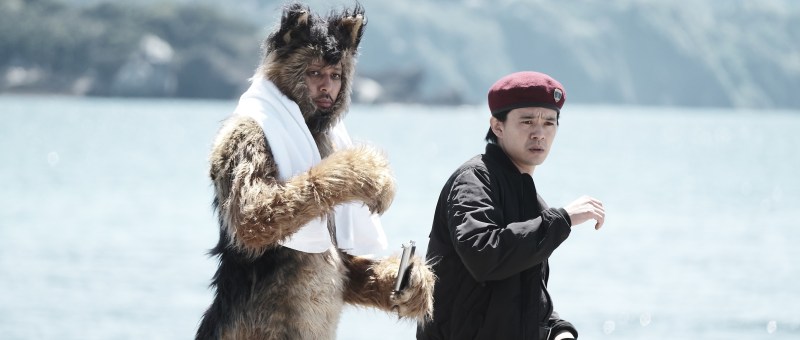
The funny thing is, Mag Mag is only visible to the man she’s currently in love with, though what she seems to represent is the grudge of the unrequited lover whose gaze is never returned. The first release from K2 Pictures, a new production company launched in 2024 with the intention of shaking up the Japanese film industry by moving away from the production committee system, comedienne Yuriyan Retriever’s first feature sets out as if it’s asking why women become fixated on terrible men, only to eventually subvert its central premise with a series of unpredictable twists.

It’s true enough that (almost) all of Mag Mags targets deserve exactly what they get. The men are selfish and insensitive, bullying or abusive. Shunsuke (Fuku Suzuki), the first victim appears meticulously doing his hair in the bathroom mirror as if bearing out his vanity and self-obsession. Many of the men are popular and handsome, but the attention they get has only made them cruel and arrogant. Takuya (Junsei Motojima), the original victim said to have given birth to the curse of Mag Mag, is beloved of half the school but can’t resist punching down by making fun of a girl considered to be unattractive who had left him a love letter. Yurika Yoshida (Marina Mizushima), whose name is very similar to that of the director, is believed by some to have become Mag Mag after taking her own life and cursing Takuya in the process, but most of all represents the ugliness of the male gaze in being constantly berated for her appearance. The other kids tell her to lose weight and get plastic surgery, while Takuya takes her love letter as an insult to his status as king of the school. Mag Mag is described as being “freakishly tall” which also hints at ideas of monstrous femininity.

Perhaps this is one reason why Mag Mag rips out the eyes of her victims, though the point is that they were always pointed in the wrong direction anyway. Sanae is obsessed with an artist named Hiroshi (Oshiro Maeda), though he’s made a nude statue of another named Rumi apparently from his imagination and without her consent, which hints again at the self-involved nature of male desire. He does not appear to really notice Sanae (Sara Minami), though Rumi (Mai Fukagawa) may not be lying when she says he found her creepy. After Hiroshi’s death, Sanae begins investigating Mag Mag in attempt to unmask her and avenge Hiroshi, only to ultimately see herself in the vengeful spirt’s sinister cries of “I love you” which aren’t so different from those expressed for Hiroshi while essentially stalking him from her shrine lair. 

Nevertheless, this misdirected gaze is going in both directions as we, the viewers, too do not really see the person we should have been looking at all along. Deep-seated senses of inadequacy can provoke the jealously and resentment of unexpected and seriously inappropriate targets, and perhaps what we’re looking at here isn’t the societal urge to mock an “unattractive” woman who dares to ask for love, but rather the toxic rage of an invisible man who loathes those who seem to be unfairly popular with women despite being terrible human beings and unpleasant to be around. Perhaps in the end, it’s Sanae’s “delusional” fixation pitted against the passivity of a man who believes himself to be unattractive and in fact becomes so because of his intense self-loathing.

But then, there does appear to be a real ghost and unflinching embrace of the arcane with its Shinto priests, lines of prohibition, and apparently magic trees whose ability to end bad relationships is potentially more than just psychosomatic, or just little psycho. Yuriyan Retriever’s absurdist humour blends perfectly with the grimness of the Mag Mag curse and the world it seems to mirror. With an overt reference to Guard of the Underground, she celebrates and subverts J-horror tropes while skewering contemporary entertainment trends in her house share fantasia of hopeful youngsters that turns out to be a quasi-incestuous nest of betrayal and misplaced desire. Influencers too are a one-way relationship, and you only see what they you want you to. Mag Mag, however, just might let you go if only you’re brave enough to say you love her too rather than, like her unfortunate victims, spurning her affections and thereby invoking and ancient curse born of the suffering of an unreturned gaze.


Mag Mag screens in Chicago 10th April as part of the 20th edition of Asian Pop-Up Cinema.

Trailer (English subtitles)
A Foggy Tale (大濛, Chen Yu-hsun, 2025)

A young girl witnesses the horrors of the White Terror when she travels from her rural hometown to retrieve the body of her brother who has been executed by military police in Chen Yu-hsun’s otherwise light-hearted odyssey through 1950s Taipei, A Foggy Tale (大濛, dà méng). The title refers to a story the heroine’s brother Yun (Tseng Jing-hua), whose name means “cloud”, tells twice. First, it’s a metaphor for a resistance movement as two drops of water join many others to form a cloud that then descends on a patch of land that makes it farmable. Secondly, the second water droplet never makes it to the cloud, but instead becomes trapped half way and dissolves into the mist.

It is, however, into a foggy town that Yue (Caitlin Fang) arrives after leaving alone when her uncle, who has taken over her parents’ house following both of their deaths, explains that he can’t pay to retrieve Yun’s body. Their aunt is already resentful of the money they spent trying to save, and in truth does not want the extra mouths to feed of her niece and nephew. She would much rather have the house, which she regards as her husband’s rightful inheritance anyway, to herself for her sons to be the masters of. While he was in hiding, Yun had approved of Yue’s desire to become a teacher though she’s been taken out of school and, as he says, women in the country generally have little other choice than to become wives and mothers working the land. 

To add to the sense of displacement, Yue has an older sister in Taipei whom she’s never met because she was fostered out as a future daughter-in-law before Yue was born. Hsia (9m88) has since left the family who brought her up after refusing to marry the man she was betrothed to because they had been raised like siblings, though he remains somewhat resentful and badgers her to return. She had been acquainted with Yun while he was a student in the city, but has no idea that he has been killed after being arrested as a possible “communist” for protesting against the regime. 

Though she may not have felt it in the country, the forces of oppression are all around Yue in the city in the very presence of the military police. After being caught sleeping in the street, she’s taken in and beaten up by a policeman for talking back, while they also push her to “explain” where she got her money as a prelude to confiscating it for themselves. A kind yet flawed rickshaw driver (Will Or Wai-lam) who saves her from being kidnapped and sold into sex work, explains to her that the funeral home even charges for the bullets that were used to shoot her brother and she likely needs two or three times as much as she thought or they’ll throw him in a mass grave with the other victims of the regime.

Years later, an older Yue who has fulfilled most of her dreams though she no longer speaks Taiwanese with her adult daughter but Mandarin, sees a news report about the discovery of a mass grave and checks the names of those identified looking for someone she lost. This unearthing of the buried is past of symbolic of the desire to expiate this history, though Yue does not find the answers she’s looking for and the question is left hanging. When times where unbearable, Yun had told her to wind his watch forward and think of the Taiwan years to come that would be better where people could be free from oppression and exploitation. It took longer than expected, but some of that world has come to be, the film seems to say, if not completely and still with this mist hanging in the air that is the victims of the White Terror. Still, Yue’s story has its share of whimsy as she chases through the backstreets of a labyrinthine city. She encounters both kindness from the justice-loving rickshaw driver who tries to help but also scams her out of her brother’s watch only to return it years later as a means of assuaging his guilt, and cruelty from the men who tried to sell her, the secret policeman who apparently went into business, and unforgiving detectives. But in other ways, what she finds is a kind of peace and her place as a part of this nation and society as time continues its eternal march forward.


A Foggy Tale screens in Chicago 10th April as part of the 20th edition of Asian Pop-Up Cinema.

Trailer (English subtitles)

Republic of Pipolipinas (Republika ng Pipolipinas, Renei Dimla, 2025)

Declaring herself sick of being a Filipino, disillusioned farmer Cora decides to secede from the Philippines and start her own nation which she calls the “Republic of Pipolipinas”. She chose this name, she says, in memory of the People Power Revolution in 1986 which showed her that anything is possible when people work together for the nation. She may have spelled “people” in a non-standard way, but really what does that matter if it sounds right and you know what she means?

A mocumentary shot in the style of Parks and Rec, Renei Dimla’s deadpan satire uses its heroine’s zany idea to explore the contemporary reality of the Philippines in which many others are also sick of being Filipino and want to start again. What Cora most objects to is that the local authorities are trying to take her land which her family have been farming since the days of her great-great-grandfather. They say they have deeds going back to the Spanish colonial era saying the land is theirs, but Cora points out that’s really just neocolonialism. How can they tell a Filipino woman that this land doesn’t belong to her? Her children are buried there, and so she refuses to move, sending letters from the office of the President of the Republic of Pipolipinas to the mayor telling them that if they come on her land she’ll charge them with trespassing which incurs a fine to be paid in ducks, chickens, and cows.

In a way, that might demonstrate that Cora is living in the past, but she has a point when she says that she doesn’t want money in the Republic of Pipolipinas because that’s when you start getting corruption. Most of her neighbours think she’s a bit mad, but see her as a local eccentric, except for the few who think she might have killed her abusive husband with rat poison. Nevertheless, many of them are mired in poverty. The lady at the local shop lets Cora pay in eggs, but another woman comes and asks to add to her tab because there’s nothing to feed the children and her husband hasn’t been paid again. Local boy Ogie has dropped out of school because his mother’s ill. She’s refusing to see a doctor because they can’t afford it. Cora puts back some of her purchases and asks for the money instead which she gives to Ogie so his mother can get medicine. 

Many of the people who later join the Republic of Pipolipinas have similar problems. One woman has lost a son to extrajudicial killing. A man working as a tour guide hates himself for greeting people so warmly when he knows the country is in a bad way and the vision they sell to tourists is a lie. But once the Republic of Pipolipinas starts to grow, the same kind of issues appear. Led by actress Alessandra de Rossi playing a version of herself, the new citizens become frustrated with Cora’s lack of sophistication and begin talking about constitutions and what kind of nation they want the Republic of Pipolipinas to be while vying for power.

Cora asks herself why they’re expected to die for the nation when the government’s job is to keep people safe from harm. After discovering that her farm is to be bulldozed to build a waste treatment centre, or really a landfill site filled with rubbish imported from Korea and other wealthy nations, she discovers corruption in the local government and tries to expose it only to end up being accused of embezzlement herself, which is ironic because she consistently rejected the presence of money precisely because it leads to corruption. Even a local official who refuses to believe Cora would do something like that sheepishly admits that it’s difficult to avoid temptation once in power, as if corruption is an inevitability that can’t be resisted. But even collaborators aren’t exempt from the wrath of the regime. The mayor believes he’ll weather this storm just fine and continue to “serve the people” while throwing his underlings under the bus.

At heart, Cora isn’t really sick of being Filipino, she just wants the Philippines to be a better place for the children to grow up. She can’t stand the flag ceremonies and enforced patriotism, the expectation that they must serve a nation which no longer serves them. What she holds onto is a lesson that her father taught her during the People Power Revolution, that the nation is not abstract concept but collection of people who can still turn this thing around no matter how hopeless it might seem now.


Republic of Pipolipinas screens in Amsterdam 10th/11th April as part of this year’s CinemAsia Film Festival.

Trailer (English subtitles)

The Period of Her (Erlina Rakhmawati, Yulinda Andriyani, Praditha Blifa, Sarah Adilah, 2025)

Four emerging female filmmakers explore the experiences of women in contemporary Indonesia in anthology film The Period of Her. Though in different styles and approaching the issues from different angles, each of the segments highlights the ways in which women suffer disproportionately due to double standards in a fiercely patriarchal culture, from being prevented from following their dreams to being trapped at home by an abusive partner expecting total obedience from his wife.

Perhaps the clearest indication of this is that the women are expected to scrub their sanitary pads to remove “dirty” blood even though they are disposable and will just be thrown away. Women are often seen trying to wash blood stains out of their clothes and towels as if expected to hide the evidence of their womanhood. Nisa gets her period during swimming training and is immediately forced to reckon with her sudden entrance into adulthood. Though she enjoyed swimming and was good at it, now that she is a woman it is no longer permitted. They tell her that she’s polluting the water, while it’s now improper for her to wear “revealing” swimming costumes. At first, she tried to keep it a secret from her school friends, but once they find out she has to dress differently, marking her out as an “adult”, though she is clearly still a child no different from the other girls. Though her male teammate doesn’t agree with the way she’s being treated and just wants to swim with her again, he is eventually picked to represent the school while Nisa is forced to retire. She takes a used, unscrubbed, sanitary towel and smears blood over the display cabinet featuring all her trophies and certificates for which the school has taken all the credit.

Nisa’s mother had also wanted to pursue her dream of swimming, but was pulled into an early marriage meaning she had to give it up which isn’t what she wants for Nisa. But motherhood is it seems the only role for a woman. Wati also turns down her husband’s sexual advances because of her menstrual cramps, but he too becomes angry and is apparently fed up with her inability to conceive a child after five years of marriage. He says this is the reason that he married her, but, at the same time, refuses to be examined by a doctor unwilling to consider that the issue may lie with him. His family have called her a failure as a wife, while Watik complains that she’s struggled for five years trying to prove her husband’s manhood. When she comes across an abandoned baby, it seems like all her problems are solved, though her husband is unhappy complaining that he wanted her to have his child, not raise someone else’s, and then bizarrely taking them both to a brothel in search of help.

Rendi, a cheating boyfriend, similarly says he can do what he likes and smirks that his girlfriend, Shela, wasn’t a virgin anyway so he doesn’t owe her anything even if they slept together. The girl she caught him with, Desi, tells her that Rendi said he was bored with her, though he’s evidently made no attempt to end the relationship or treat Shela as anything other than object. She can’t really challenge him, but becomes so enraged during the traditional dance she’s performing that the MC has to stop it for her safety. Nevertheless, she pretends to be possessed by a spirit to call Rendi out, seeing as he’s at the festival in the guise of a “virgin shaman”. Despite the animosity that might exist between them, the episode ends on a note of female solidarity as Shela and Desi share a drink on the way home, laughing together as they ride away on their motorbikes.

An inversion of this female solidarity can be seen in the final segment, Not Dead Enough, in which an overbearing husband drops dead of a heart attack after picking up a machete to attack his previously meek wife who has been pushed to breaking point by his uselessness. On waking up, he discovers himself in a world in which gender roles have been completely reversed. He is now bullied by his domineering wife and a host of female debt collectors, not to mention casually sexually harassed even though he’s not really allowed to go out of his house. He has only the solidarity of the other husbands who try to help and take care of him. In place of hijabs, they wear bicycle helmets on their heads, and are expected to serve their wives with absolute obedience. Experiencing period pain for the first time along with the threat of violence from his wife and other women, Kempas gets a taste of his own medicine and realises what it’s like to live as a woman in this society, though he never really gets the opportunity to put what he’s learned into practice and be a better man and husband. Each of the women is, in their own way, trapped by the patriarchal order and struggling to find a way to live while looked down on and dismissed by men who think it’s their birthright to be served and take each refusal as an assault on their manhood.


The Period of Her screens in Amsterdam 9th/10th April as part of this year’s CinemAsia Film Festival.

Trailer (English subtitles)