A2 (Tatsuya Mori, 2001)

“Japanese society is definitely worse than it was five years ago” according to director Tatsuya Mori, returning to the subject of Aum Shinrikyo following his 1998 documentary A, “It is definitely warped.” In A2, he wonders if the legacy of the 1995 sarin gas attack on the Tokyo subway has affected society in unexpected ways as its rage and fear is channeled in the wrong direction in its pathological hatred of the new religion sect without attempting to understand why the attack happened or why people continue to follow the cult’s teachings given its violent history. 

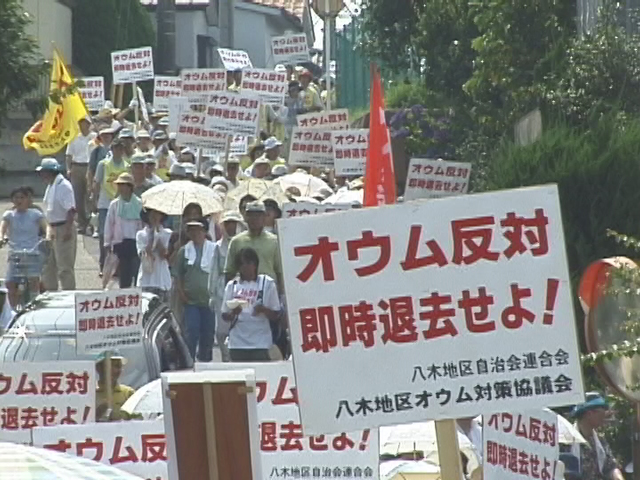
Five years on, Aum has rebranded as Aleph and distanced itself from the teachings of Shoko Asahara but is still holding out on coming up with a plan for compensating victims and their families while some members directly involved in the attack remain on the run (the final fugitive was apprehended only in 2012). The government has decreed that those who had no connection to the incident should be allowed their constitutionally guaranteed rights to practice their religion, but as Mori follows them the current members face constant harassment in the local communities in which they attempt to settle. As someone later puts it, there is no real solution, once Aum is rejected they have no option but to move on to another town where the same thing will happen again with no real progress made. 

Even so, in one particular community the locals become almost friendly to the Aum members they are also keeping under close and intensive surveillance. Though instructed not to interact with them, some residents explain that they personally would prefer to be on friendly terms, others jokingly even offering them food or alcohol over the fence and almost sorry to see them leave when their rental contract finally expires. Through their admittedly hostile interactions, they’ve come to accept the members of Aum as distinct from their association with the sarin gas attack and no longer harbour the same sense of fear they once held for the unknown quantity of the new religion organisation. 

On the other hand, the fear and anxiety which has become linked with Aum has been hijacked by right-wing nationalist groups seeking to manipulate it for their own gain as they step into the vacuum created by a lack of action with their own ideas for potential solutions to the Aum problem. Their solutions are not as extreme as one might assume, but advocate for Aum’s forced disbandment with no practical plans for how that might happen. As Aum members admit, as a new religion organisation they often attract those who are vulnerable and looking for solutions to their own mental anguish. Faced with the intense harassment they face in smaller communities, these members are often pushed towards taking their own lives while the press has sometimes also attempted to manipulate their image for personal gain one man claiming he was essentially abducted and taken to hospital on the grounds he seemed malnourished but was prevented from leaving after getting the OK from a doctor as the police had already issued a statement about him which the press had printed without verifying. 

The current Aum members frequently complain that they have been misrepresented by the press while Mori himself is on one occasion accused of being an Aum sympathiser when challenging potential inaccuracies or asking if those participating in anti-Aum activity might be better off trying to understand them instead. This seems to be the direction in which some of the protests have drifted, local societies putting up signs to encourage thse who might want to leave the organisation to reassure them that they will be reaccepted by mainstream society, that their friends and relatives with whom they have severed ties are waiting for their return. The members, however, are often so disconnected from “worldly” matters that they may not know what mainstream society is, Mori’s brief questioning of an official revealing that she is unable to recognise the names of even the biggest contemporary pop stars. “Ultimately harmony can’t be achieved, can it?” Mori asks somewhat rhetorically, worrying that the psychological strain placed on the followers not only in the austerity of their religion but their treatment by wider society cannot but lead to further damage while opinions on either side are unlikely to soften. 


A2 streams worldwide (excl. Japan) via DAFilms until Feb. 6 as part of Made in Japan, Yamagata 1989 – 2021 (films stream free until Jan. 24)

Original trailer (no subtitles)

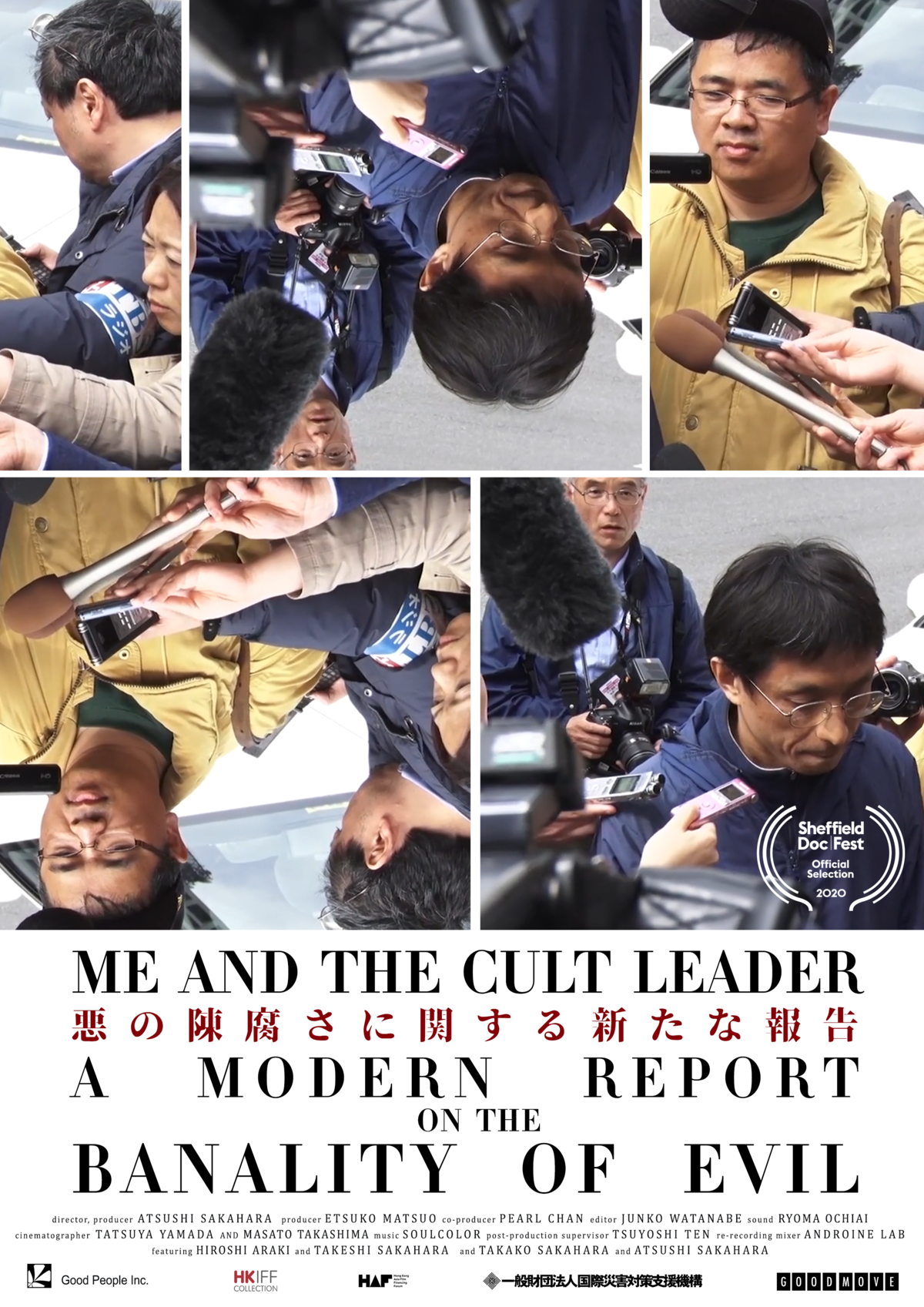
Me and the Cult Leader (AGANAI -悪の陳腐さについての新たな報告, Atsushi Sakahara, 2020)

How can you continue to serve an ideology which you know is responsible for a heinous act that offends your sense of moral righteousness? That’s a question that Atsushi Sakahara, a survivor of the sarin gas attacks on the Tokyo subway, finds himself asking in his documentary Me and the Cult Leader (AGANAI -悪の陳腐さについての新たな報告, Aku no Chinpusa Nitsuite Aratana Hokoku), as he meets with Hiroshi Araki, a current member of Aleph, the successor to Aum, the cult which planned and executed the 1995 act of terrorism which led to the deaths of 13 people and left 6200 injured, many like Sakahara with life changing consequences. 

Yet Sakahara’s purpose is the opposite of polemical, he merely reaches out to Araki in an effort to understand the mindset not only of someone who joined Aum in the early ‘90s and was a member at the time of the attack though not directly involved, but of someone who stayed and continues to believe in the teachings of cult leader Asahara who was executed in 2018 after years on death row along with other members responsible for Japan’s only exposure to domestic terrorism. Throughout it all, however what he seems to want is some kind of apology, or at least an act of contrition, something which proves elusive as the distant, thoughtful Araki largely refuses to engage as if afraid to accept that the ideology to which he has devoted all his adult life may in fact be corrupt and empty. 

Araki’s justifications run mainly to technicalities. He does not exactly deny that members of Aum were responsible for the attack, but explains that their guilt is the most logical explanation given the available evidence which includes their own confessions and so concludes it is likely the truth. The two men travel together on a kind of pilgrimage back to their respective hometowns which happen to be in the same area of the country, while in another coincidence they also attended the same university at the same time. A jovial presence, Sakahara attempts to hurry the near silent Araki along, pushing him to open up which he eventually does but failing to elicit from him anything which might begin to free him from the icy grip of his ideology. 

Sakahara subtitles his film “A modern report on the banality of evil”, and there’s certainly something of that as the film opens in a subway station, Sakahara and Araki merely two ordinary middle-aged men in anoraks waiting for a train. Yet Araki is clearly not an “evil” man. He appears to be thoughtful and sensitive, often breaking down in tears as the journey forces him to remember his life before he renounced the world, the vision of his grandmother waving him off at the station after a summer holiday leading back to that of his mother as he severed connection with her to join with Aum. He doesn’t quite explain what led him to join the cult save being overwhelmed by Asahara’s charisma when he gave a speech at Kyoto university in the early ‘90s, Sakahara having witnessed him arrive the year before but jokingly shouting out for the famously outlandish cult leader to show off his talent for levitation, save that he became disillusioned with consumerism after a pencil case he lusted over as a child lost its lustre when he got it home. The training, he goes on, caused him to lose the capacity for joy or pleasure, leaving him he explains with no other choice than to join the cult because there was no longer anything left for him in the outside world which had become unbearably painful as a result.

Yet knowing what he knows, how can he go on practicing Asahara’s teachings? Sakahara tries not to push him, only once or twice pressing for an answer as to whether or not he sees and understands his suffering and feels remorse, later introducing him to both his parents in an effort to prove that actions have wider consequences, that he is not the only victim but that others suffer because of his suffering. Meeting Sakahara’s equally compassionate mother and father does appear to move something with him, evoking a loose apology even if he immediately walks back on it with some manichean justifications that Sakahara is also responsible for everything that’s happened to him because it is all a result of his choices, good and bad. 

The unavoidable conclusion is perhaps that Araki is simply afraid to confront the implications of everything he’s seeing lest his entire worldview collapse and he realises he’s wasted all of his adult life serving a corrupt and empty ideology. Sakahara acts with total warmth and compassion for his dilemma, even at one point quite literally buying him a coat because he’s only brought his anorak despite it being freezing (Araki also constantly carries a sleeping bag because his asceticism seems to extend to beds and futons), patiently listening to his often sad stories of youth but every revelation is followed by extended silence, Araki shifting back inside himself unwilling risk bursting the bubble. Sakahara, however, remains patient hoping for the day that the cultist will finally see the light. 


 Me and the Cult Leader streams in the US until Oct. 31 as part of this year’s San Diego Asian Film Festival.

Original trailer (English subtitles)