Honeko Akabane’s Bodyguards (赤羽骨子のボディガード, Junichi Ishikawa, 2024) [Fantasia 2025]

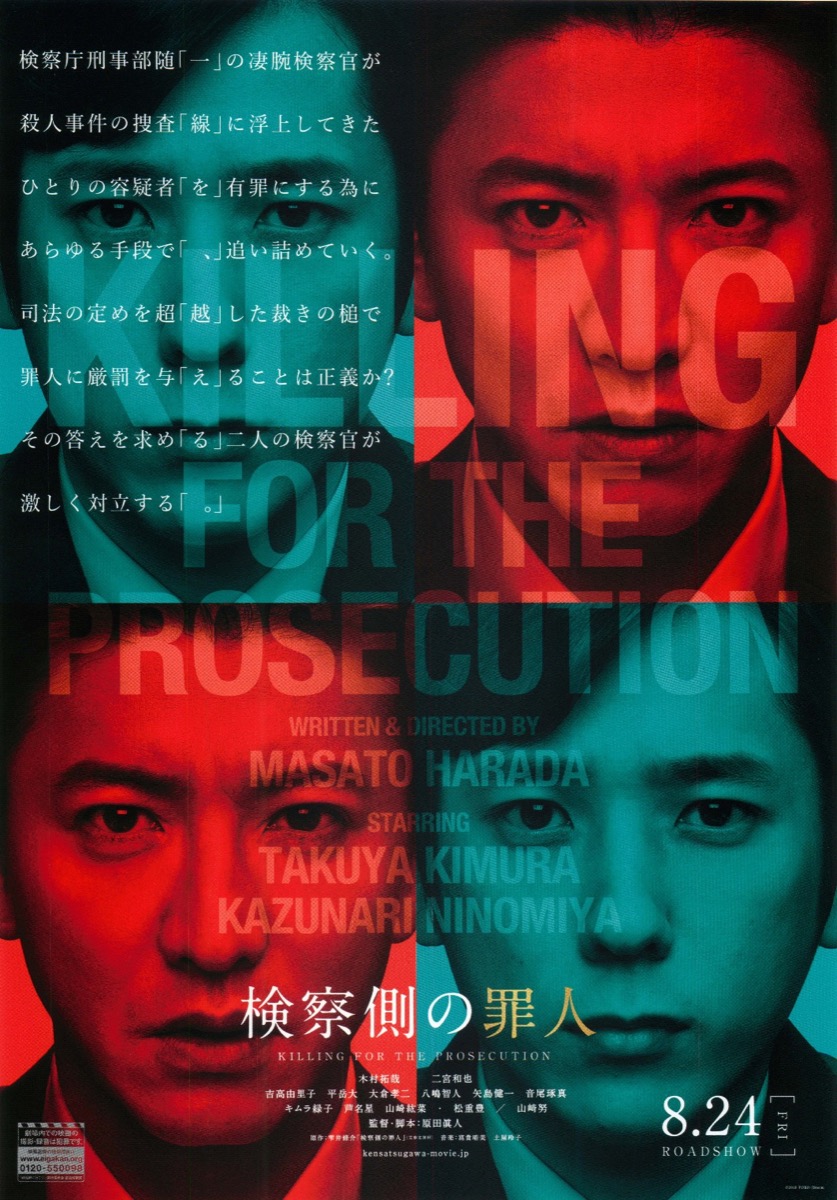
Unbeknownst to her, a high school girl’s entire class is actually made up of bodyguards hired by her distant father, whom she doesn’t know either, to keep her safe because his work makes her an easy target for international criminals. Adapted from the manga by Masamitsu Nigatsu, Junichi Ishikawa’s Honeko Akabane’s Bodyguards (赤羽骨子のボディガード, Akabane Honeko no Bodyguard) is in some ways fairly typical of the genre in its parade of unrealistic hairstyles and over-the-top humour, but also anchors itself in a genuine sense of friendship and youth solidarity as the class come together under a charismatic leader not only to protect Akabane but each other too.

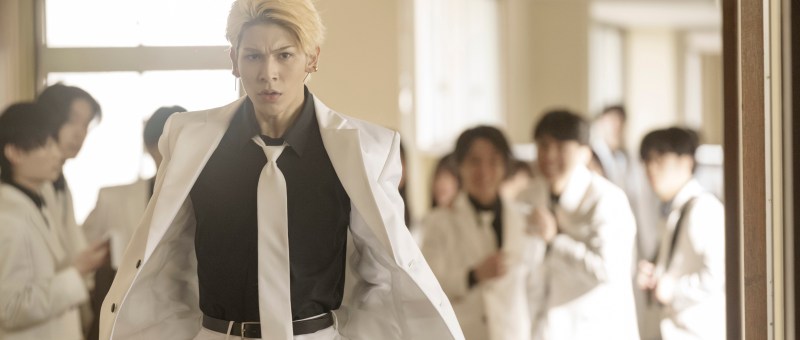
That charismatic leader would be Ibuki, a cocksure delinquent and childhood friend of Akabane’s who’s also been carrying a torch for her all these years. Nevertheless, it comes as quite a surprise when he’s officially hired by Jingu (Kenichi Endo), a man who claims to be the head of Japan’s Security Services. After his wife died, he decided to place Akabane for adoption to keep her safe from the duplicitous world in which he lived. But now there’s a 10 million yen bounty on her head and every criminal enterprise he’s ever been after is desperate to get their hands on her. What Ibuki doesn’t know is that he’s hired the rest of the class too who all have various skills from rhythmic gymnastics to torture. It’s imperative that Akabane never find out that she’s a target, nor that Jingu is her biological father, and continues to live a “normal” carefree life.

She certainly appears to have no skills of her own other than her ability to quote legal infractions in her desire to become a lawyer like her adopted parents. While this may on some level remove her agency in making her dependent on her classmates for protection, it’s also Akabane that takes the initiative in romance by making overtures to the otherwise diffident Ibuki. Other the other hand, she’s painted as the mirror image of her sister, Masachika (Tao Tsuchiya), who has been raised as a boy and taught to be an assassin but craves the kind of love and affection Jingu pours on Akabane. 

This is one reason that she is eventually able to find unexpected common ground as she and Akabane are obviously both firmly on team Ibuki with Akabane thankful that someone else can see Ibuki’s good side even if most people mistake him for being a scary and dangerous person. Like his father, the late policeman, he believes that to protect someone you must protect everything they love which is why he’s desperate to protect the whole of the class too so that Akabane’s world remains consistent. Most of the other students aren’t too invested in their jobs and are only doing this for the paycheque, but eventually end up coming together thanks to Ibuki’s insistence that he won’t leave them behind. Not only does he need their help to protect Akabane, but genuinely respects their friendship and wants to save them too.

Then again, we’re presented with a series of images of paternal and hierarchal failure. Ibuki’s own father was killed in the line of duty and while alive had little time for his son, if like Jingu trying to keep his child out of the dangerous world in which he lives. Jingu gave up one daughter to keep her safe, but has a strained relationship with the second who feels like a failure and is desperate for a chance. Even the head of the class is compromised as he first proves himself willing to sacrifice the lives of his men in achieving their goal of protecting Akabane and then seems to commit several blunders including being unable to unmask a mole. Ibuki becomes a de facto leader, but at the same time what emerges under him is a relationship of equals and solidarity between those in a similar situation. They are no longer working for Jingu or following their leader’s orders but thinking for themselves and actively protecting each other. 

Ishikawa puts together some excellent action sequences that demonstrate what a well-oiled machine the students can be in standing up against criminality while maintaining the zany humour and making Ibuki an oddly pure figure of warmth and integrity as he resolves to protect all of those around him if most especially Akabane to whom he is unable to voice his real feelings. She meanwhile, admittedly a damsel in distress, is at least taking the lead when it comes to their romance even if she continues to needle him about his rough and uncouth behaviour. Honeko Akabane is it seems very well protected from any threats that come her way save perhaps that of her hidden past.                                                                                                                                    


Honeko Akabane’s Bodyguards screened as part of this year’s Fantasia International Film Festival.

Original trailer (no subtitles)
Killing for the Prosecution (検察側の罪人, Masato Harada, 2018)

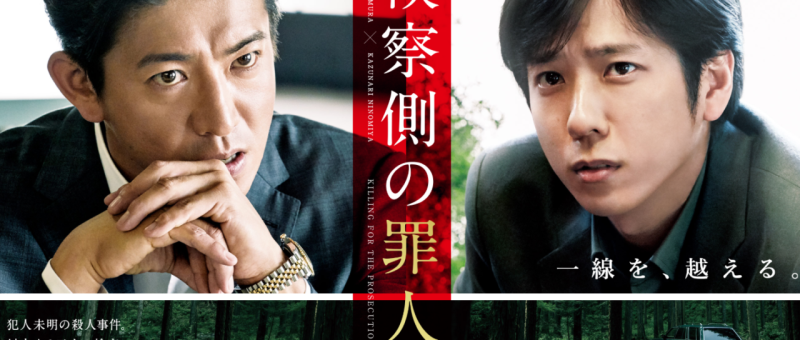
Killing for the Prosecution posterThe vagaries of the Japanese legal system have become a persistent preoccupation for anxious filmmakers keen to interrogate the continuing rightward shift of the contemporary society. Stretching right back into the post-war world, filmmakers from Yoji Yamada and Yoshitaro Nomura to the more contemporary Masayuki Suo and Gen Takahashi all had their questions to ask about the courts system before Hirokazu Koreeda pushed the dialogue in a slightly different direction with the probing The Third Murder. Killing for the Prosecution (検察側の罪人, Kensatsugawa no Zainin) picks up Koreeda’s baton and brings with it all the baggage of the aforementioned films in asking similar questions about the nature of justice and most particularly within the context of Japan under the conservative government of Shinzo Abe.

In the contemporary era, rookie prosector Okino (Kazunari Ninomiya) gets a prime Tokyo job working for his mentor Mogami (Takuya Kimura) which begins with investigating a bloody double murder of an elderly couple who were apparently running an illicit side business in usurious loans. The suspect list includes a series of shady characters, but one catches Mogami’s eye – Matsukura (Yoshi Sako), a man arrested and subsequently released in relation to a brutal murder of a school girl Mogami had known and liked while he was a student. Unable to let the case rest, Mogami finds himself fixated on the idea of nailing Matsukura for the pensioner murder in order to get justice for the previous killing which has now passed the statute of limitations.

Meanwhile, Mogami himself is also embroiled in a conspiracy surrounding an old friend, Tanno (Takehiro Hira), now a senator accused of corruption. Harada opens with a brief prologue set during Okino’s final pre-graduation briefing in which Mogami offers a somewhat cynical lecture on the role of the prosecution and the nature of justice. Like the lawyers at the centre of The Third Murder, he is keen to emphasise that the truth is rarely relevant in the face of the law and that justice is a game won by constructing impenetrable narrative. He insists that “there is no such thing as rain which washes away guilt”. Yet his love of justice is so fierce that he collects and displays gavels – a complicated symbol seeing as Japan doesn’t use them but like many other countries has internalised an association with them thanks to American movies.

America, in itself, becomes a complicated facet of Mogami’s judicial confusion as he finds himself pulled between left and right. In his meetings with Tanno, we originally find him complicit with the regime, presumably acting to protect his friend and thereby enabling his corruption but we later come to realise that the opposite is true – that the pair of them are complicit in the system in order to undermine it. Tanno, apparently disillusioned with right wing politics and committed to pacifist ideals, attempted to blow the whistle on systemic political corruption and has been hung out to dry. Lamenting that there is no press freedom in Japan, he has been unsuccessful in his attempts to frustrate a persistent shift towards remilitarisation (apparently hastened by his own wife who has embarrassingly enough been photographed at a neo-nazi rally) but coldly cuts off Mogami’s offer of further assistance by reminding him that he too is “part of the system”.

Mogami goes rogue, but he does so more for reasons of personal vengeance than pursuit of justice. Desperate to nail Matsukura he begins to bend his narrative while his earnest rookie underling, Okino, remains conflicted about his boss’ increasingly suspicious behaviour. Yet the possibility remains, if Matsukura didn’t do it someone else did. If Mogami has Matsukura pay for this crime rather than another one, perhaps a kind of justice is served but a dangerous man would still be out there. In the end, Mogami transgresses in pursuit of his own kind of justice becoming the kind of “criminal” prosecutor he cautioned Okino against becoming in his already cynical opening speech.

That aside, Mogami ties his crimes to a long history of injustice and oppression in allusion to his grandfather’s accidental survival of the battle of Imphal thanks to a kind of purgatorial space known as “Hotel Tanang” to which he returns in an oddly surreal dream sequence which places himself and Tanno as descendants of men who refused to die for oppressive imperialistic concerns. The “Skeleton Road” buys him an uneasy alliance with a genial yakuza (Yutaka Matsushige) who provides another source of temptation to turn to the dark side, but the question he seems to be left with is whether it’s acceptable to pursue one’s own kind of justice in the knowledge that the justice system is inherently corrupt.

Okino, who might ordinarily be our hero, seems to say no but lacks the courage to resist – unlike his steadfast assistant, Saho (Yuriko Yoshitaka), who is combating injustice in her own though perhaps no more ethical (and still less than altruistic) ways. “People die, things break, all the same”, Matsukura rambles as if to lay bare the film’s nihilistic leanings as it points out a litany of seemingly irreparable social ills. Mogami breaks cover for an instant when meeting with a police officer after overhearing a woman trying to press a rape charge and being rebuffed, stopping briefly on his way out to encourage her to keep pressing her case in solidarity with her solitary quest against a seemingly impenetrable wall of indifference, while the mild foreshadowing of a contemporary preoccupation about what to do with the problem of elderly drivers in an ageing society becomes an odd kind of punchline in a bleak existential joke. Dark and cynical, Killing for the Prosecution sees little cause for hope in the increasing murkiness of its constantly declining moral universe, finding release only in its final, frustrated scream.


Original trailer (no subtitles)