All Greens (万事快調〈オール・グリーンズ〉, Takashi Koyama, 2025)

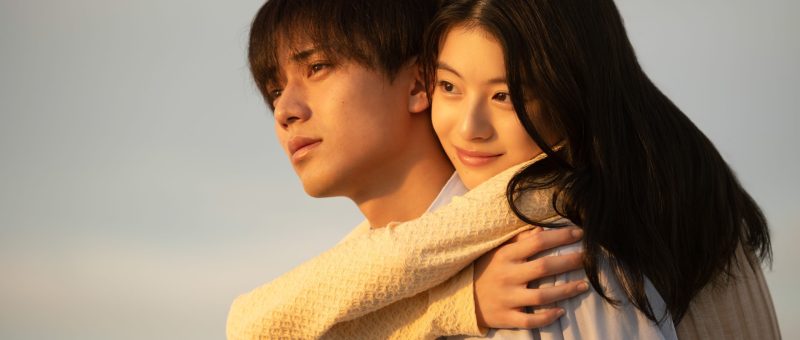
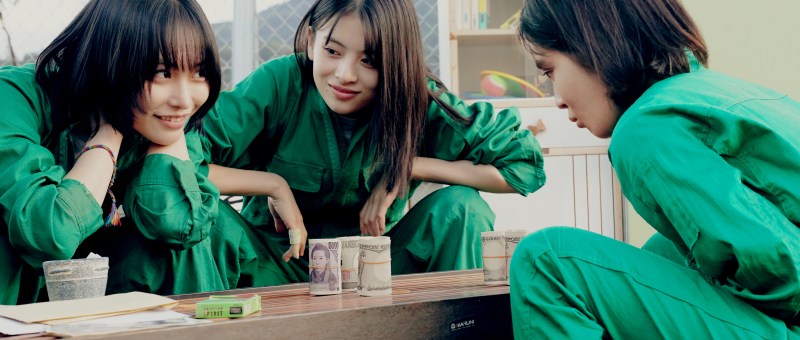
Consumed by rural ennui, three teenage girls set on a dramatic plan for escape in Takashi Koyama’s darkly comic youth drama, All Greens (万事快調〈オール・グリーンズ). The title turns out to be apt, not only in ironically referencing the drugs at the film’s centre, but also that the girls are all still fairly naive and just trying to figure out their place in the world. Whatever that may turn out to be, it’s clear that each of them is constrained by their circumstances from abusive fathers to absent parents and outdated patriarchal ideals.

The reduced horizons of their lives are evident in Hidemi’s (Sara Minami) description of the school as a place where everyone’s either given up on exams or is too poor to access better education. She and Mako (Mizuki Yoshida) seem to resent popular girl Milk (Natsuki Deguchi) and her seemingly perfect life, but are unaware that circumstances are similar to theirs or that she too is longing to escape this dead-end town. Hidemi is sick of her abusive father and submissive mother and finds release through rap music. Mako wants to be a manga artist, but is under pressure from her family who expect her to marry a man to take over their farm. And Milk has become a mother to her mother who appears to have had a mental breakdown following the death of her husband, a nuclear plant worker caught up in a radioactive incident. 

The attitude of Mako’s family may seem excessively old-fashioned, but seems to reflect the traditional culture of the village. When the teacher warns their class about a flasher, he tells the girls to travel in groups and avoid going home alone while ensuring their skirts are not too short as if that had anything to do with the likelihood of being flashed. The three girls are briefly united when they witness a woman and her small child being dumped in the middle of an intersection by an abusive spouse. They hear later that the woman snapped, killed her abusive husband and burnt his house down before drowning herself and her daughter in the river. Each of them fear ending up like this woman, as if the village itself were an abusive spouse from whom they can’t escape. Hidemi’s dreams of rap stardom are even disrupted when she’s offered a promising opportunity with a “beat master” who first tells her he’s quitting the business because he’s getting married and needs a more stable line of work, and then matter-of-factly says that the job is conditional on sleeping with him. He even tried to drug her drink, but Hidemi has a healthy level of suspicion regarding men who offer help, so she switched their drinks which is how she finds out he has a safe full of marijuana seeds.

The drugs offer a more literal kind of escape in the prospect of a small business the three girls could operate illicitly together without really thinking about the consequences beyond the hope of making enough money to leave town. Later they bring in two fellow students who need money because they are gay and want to move in together to escape their oppressive families, though Hidemi’s assertion that karma isn’t real may seem hubristic while playing into her sense of the world as a lawless place in which there are no real consequences for anything because she’s used to seeing bad guys get away with their crimes. In trying their luck in the big city, however, the girls find themselves out of their depth as their small-town gangster dreams implode in the face of the realities of urban crime. 

In the end, the only real answer may be to burn it all down, but the sense of solidarity between the girls has at least given them the courage to chase their dreams even if they may still prove elusive. As the fumes make their way through the school, it provokes a sense of liberation as the old codes of conformity begin to dissolve and people say what they really feel. It may be only temporary and perhaps lead nowhere at all, but for the moment at least the road ahead is wide open.


All Greens screened as part of this year’s Nippon Connection

Trailer (no subtitles)
Honeko Akabane’s Bodyguards (赤羽骨子のボディガード, Junichi Ishikawa, 2024) [Fantasia 2025]

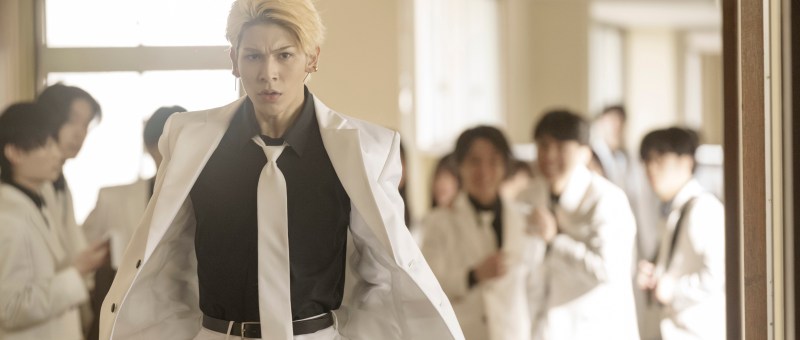
Unbeknownst to her, a high school girl’s entire class is actually made up of bodyguards hired by her distant father, whom she doesn’t know either, to keep her safe because his work makes her an easy target for international criminals. Adapted from the manga by Masamitsu Nigatsu, Junichi Ishikawa’s Honeko Akabane’s Bodyguards (赤羽骨子のボディガード, Akabane Honeko no Bodyguard) is in some ways fairly typical of the genre in its parade of unrealistic hairstyles and over-the-top humour, but also anchors itself in a genuine sense of friendship and youth solidarity as the class come together under a charismatic leader not only to protect Akabane but each other too.

That charismatic leader would be Ibuki, a cocksure delinquent and childhood friend of Akabane’s who’s also been carrying a torch for her all these years. Nevertheless, it comes as quite a surprise when he’s officially hired by Jingu (Kenichi Endo), a man who claims to be the head of Japan’s Security Services. After his wife died, he decided to place Akabane for adoption to keep her safe from the duplicitous world in which he lived. But now there’s a 10 million yen bounty on her head and every criminal enterprise he’s ever been after is desperate to get their hands on her. What Ibuki doesn’t know is that he’s hired the rest of the class too who all have various skills from rhythmic gymnastics to torture. It’s imperative that Akabane never find out that she’s a target, nor that Jingu is her biological father, and continues to live a “normal” carefree life.

She certainly appears to have no skills of her own other than her ability to quote legal infractions in her desire to become a lawyer like her adopted parents. While this may on some level remove her agency in making her dependent on her classmates for protection, it’s also Akabane that takes the initiative in romance by making overtures to the otherwise diffident Ibuki. Other the other hand, she’s painted as the mirror image of her sister, Masachika (Tao Tsuchiya), who has been raised as a boy and taught to be an assassin but craves the kind of love and affection Jingu pours on Akabane. 

This is one reason that she is eventually able to find unexpected common ground as she and Akabane are obviously both firmly on team Ibuki with Akabane thankful that someone else can see Ibuki’s good side even if most people mistake him for being a scary and dangerous person. Like his father, the late policeman, he believes that to protect someone you must protect everything they love which is why he’s desperate to protect the whole of the class too so that Akabane’s world remains consistent. Most of the other students aren’t too invested in their jobs and are only doing this for the paycheque, but eventually end up coming together thanks to Ibuki’s insistence that he won’t leave them behind. Not only does he need their help to protect Akabane, but genuinely respects their friendship and wants to save them too.

Then again, we’re presented with a series of images of paternal and hierarchal failure. Ibuki’s own father was killed in the line of duty and while alive had little time for his son, if like Jingu trying to keep his child out of the dangerous world in which he lives. Jingu gave up one daughter to keep her safe, but has a strained relationship with the second who feels like a failure and is desperate for a chance. Even the head of the class is compromised as he first proves himself willing to sacrifice the lives of his men in achieving their goal of protecting Akabane and then seems to commit several blunders including being unable to unmask a mole. Ibuki becomes a de facto leader, but at the same time what emerges under him is a relationship of equals and solidarity between those in a similar situation. They are no longer working for Jingu or following their leader’s orders but thinking for themselves and actively protecting each other. 

Ishikawa puts together some excellent action sequences that demonstrate what a well-oiled machine the students can be in standing up against criminality while maintaining the zany humour and making Ibuki an oddly pure figure of warmth and integrity as he resolves to protect all of those around him if most especially Akabane to whom he is unable to voice his real feelings. She meanwhile, admittedly a damsel in distress, is at least taking the lead when it comes to their romance even if she continues to needle him about his rough and uncouth behaviour. Honeko Akabane is it seems very well protected from any threats that come her way save perhaps that of her hidden past.                                                                                                                                    


Honeko Akabane’s Bodyguards screened as part of this year’s Fantasia International Film Festival.

Original trailer (no subtitles)

Drawing Closer (余命一年の僕が、余命半年の君と出会った話。, Takahiro Miki, 2024)

Takahiro Miki has made a name for himself as a purveyor of sad romances. Often his protagonists are divided by conflicting timelines, social taboos, or some other fantastical circumstance, though Drawing Closer (余命一年の僕が、余命半年の君と出会った話。, Yomei Ichinen no Boku ga, Yomei Hantoshi no Kimi to Deatta Hanashi) quite clearly harks back to the jun-ai or “pure love” boom in its focus on young love and terminal illness. Based on the novel by Ao Morita, the film nevertheless succumbs to some of genres most problematic tendencies as the heroine essentially becomes little more than a means for the hero’s path towards finding purpose in life.

17-year-old Akito (Ren Nagase) is told that he has a tumour on his heart and only a year at most to live. Though he begins to feel as if his life is pointless, he finds new strength after running into Haruna (Natsuki Deguchi) who has only six months yet to him seems full of life. Later, Haruna says he was actually wrong and she felt completely hopeless too so actually she really wanted to die right away rather than pointlessly hang round for another six months with nothing to do and no one to talk to. But in any case, Akito decides that he’s going to make his remaining life’s purpose making Haruna happy which admittedly he does actually do by visiting her every day and bringing flowers once a week.

But outside of that, we never really hear that much from Haruna other than when she’s telling Akito something inspirational and he seems to more or less fill in the blanks on his own. Thus he makes what could have been a fairly rash and disastrous decision to bring a former friend, Ayaka (Mayuu Yokota), with whom Haruna had fallen out after the middle-school graduation ceremony that she was unable to go to because of her illness. Luckily he had correctly deduced that Haruna pushed her friend away because she thought their friendship was holding her back and Ayaka should be free to embrace her high school life making new friends who can do all the regular teenage things like going to karaoke or hanging out at the mall. Akito is doing something similar by not telling his other friends that he’s ill while also keeping it from Haruna in the hope that they can just be normal teens without the baggage of their illnesses. 

The film never shies away from the isolating qualities of what it’s like to live with a serious health condition. Both teens just want to be treated normally while others often pull away from them or are overly solicitous after finding out that they’re ill but at the same time, it’s all life lessons for Akito rather a genuine expression of Haruna’s feelings. We only experience them as he experiences them and so really she’s denied any opportunity to express herself authentically. Rather tritely, it’s she who teaches Akito how to live again in urging him that he should hang in there and continue to pursue his artistic dreams on behalf of them both. Meanwhile, she encourages him to pursue a romantic relationship with Ayaka, in that way ensuring that neither of them will be lonely when she’s gone and pushing them towards enjoying life to its fullest.

Nevertheless, due to its unbalanced quality and general earnestness the film never really achieves the kind of emotional impact that it’s aiming for nor the sense of poignancy familiar from Miki’s other work. Perhaps taking its cues from similarly themed television drama, the production values are on the lower side and Miki’s visual flair is largely absent though this perhaps helps to express a sense of hopelessness only broken by beautiful colours of Haruna’s artwork. Haruna had used drawing as means of escaping from the reality of her condition, but in the end even this becomes about Akito with her mother declaring that in the end she drew for him rather than for herself. Even so, there is something uplifting in Akito’s rediscovery of art as a purpose for life that convinces him that his remaining time isn’t meaningless while also allowing him to discover the desire to live even if his time is running out.


Trailer (English subtitles)