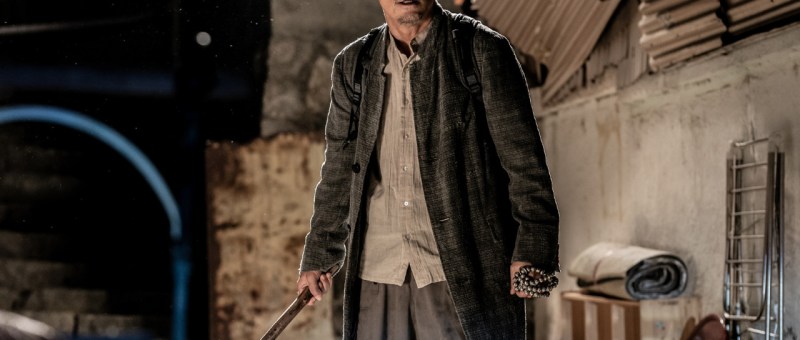

“But even the most trivial moments of our predetermined fate are meaningful as pieces of the whole” according to embittered former monk Jin-su having reached a moment of philosophical epiphany after bringing his karmic retribution full circle. Another in the recent series of Buddhist supernatural thrillers from Korea, Kim Tae-hyoung’s The 8th Night (제8일의 밤, Je8ileui Bam) once again turns apocalyptic as an ancient evil is set for accidental revival thanks, largely, to the wounded pride of a bitter old man.
As the opening voice over explains, thousands of years ago the world was threatened by a powerful demon. Luckily, Buddha managed to vanquish him, tearing out his two eyes, one black one red, and burying them on opposite sides of the Earth in order to prevent them ever being reunited. Some people, however, just can’t resist chaos which is presumably why Professor Kim (Park Hae-joon) insists on retrieving the canister containing the Red Eye from its desert resting place, thereafter releasing its power when his discovery is rejected by both Buddhist and scholarly authorities. Sensing a disturbance in the equilibrium of the world along with the upcoming Blood Moon, priest Hajeong (Lee Eol) realises the prophecy of which he has been a guardian is about to come true. His big, somewhat unethical plan, is to kill off one of the seven pre-ordained victims of the Red Eye which he plans to possess in order to reunite with its partner in and stop it body hopping towards the apocalypse.
You can make a case for greater good, but murdering an innocent person to put an end to a curse seems at best unfair, not to mention not very Buddhist. Hajeong sends young monk Cheong-Seok (Nam Da-reum) to track down his former pupil, Jin-su (Lee Sung-min) then known as Seonhwa to give him the instruction to assassinate the “Virgin Shaman” with a holy axe to stop Red Eye in its tracks. Jin-su is seemingly unconflicted about the murder but is carrying his own baggage, now living as a resentful construction worker. As it turns out, he and Cheong-seok are also linked by a karmic circle of guilt and trauma that the boy doesn’t remember and Jin-su has been running away from since leaving the temple. Meanwhile, he is also plagued by voices of departed spirits he for some reason refuses to help cross over to the other side.
Meanwhile, over on the side of the rational, two policemen mirror the monks’ movements as they investigate the strange paper chain of mummified corpses turning up all over the city. Veteran cop Ho-tae (Park Hae-joon) feels responsible for his feckless associate Dong-jin, blaming himself for an accident which has left him physically impaired while resisting instructions from his boss to fire him. Yet the pair are entirely ill equipped to investigate this case of spiritual malevolence, confused by its religious connotations but perhaps filled with suspicion on realising that all of the victims belong to the same “meditation group” for people with suicidal thoughts which has been offering “free” blood tests and apparently paying for attendance. Described by one as more like a cult, the shady meditation group might be one kind of evil but what they’re currently facing is on an entirely different level.
The irony is that it’s Jin-su who must learn to save the world by finding closure with his own traumatic past, generating a paternal bond with young monk Cheong-seok who is so excited by the world beyond the temple that he accidentally breaks his vow of silence and then can’t stop talking. Cheong-seok’s sense of wonder and confusion, unsure what to do about the meat he keeps finding in his food but also slightly bemused by Jin-su’s willingness to eat it for him, stands in direct contrast to Jin-su’s embittered cynicism as he attempts to resist his destiny only to receive a ghostly reminder that you can’t escape your fate and, in any case, his duty would simply fall on the successor, Cheong-seok. In order to save the world, he has to free not only himself but also Cheong-seok too from the cycle of karmic retribution which binds each of them in the “agony and anxiety” of the monster’s separated eyes, determining to set them to rest once again to restore a sense of balance in a destabilising world. A buddhist procedural, Kim’s supernatural horror may rediscover that hell is a place on Earth but eventually allows its heroes the possibility of escape if only in the willingness to free themselves from the shackles of the traumatic past.
Original trailer (English subtitles)



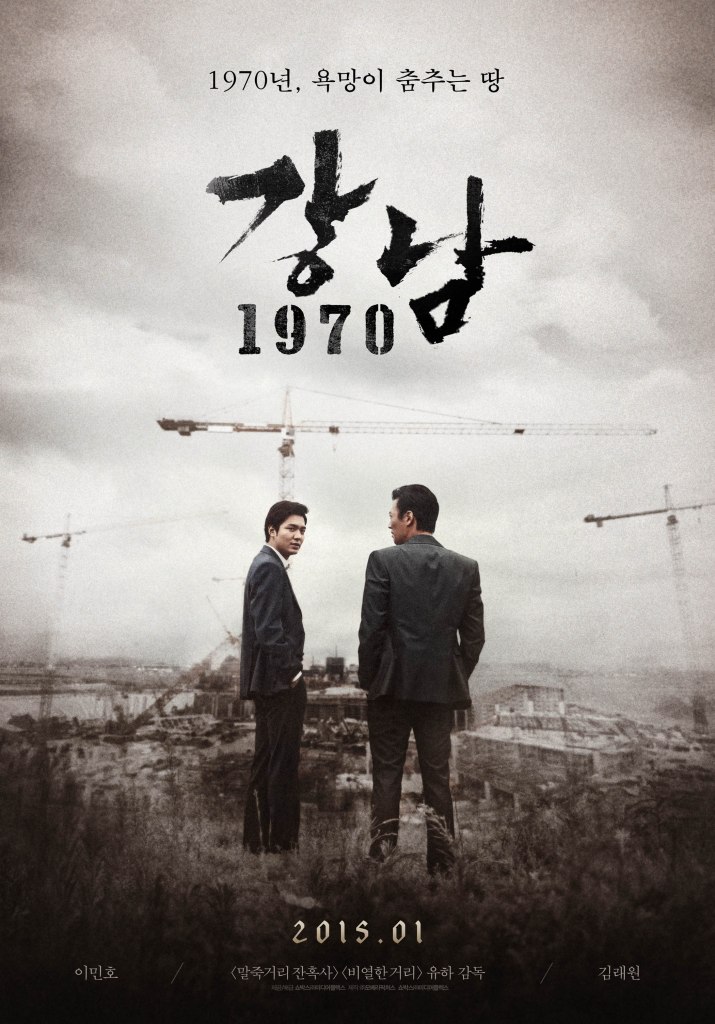 Yoo ha takes us back to the 1970s for some Gangnam Blues (강남 1970, Gangnam 1970) in a sorry tale of fatherless men caught up in dangerous times of ambition and avarice, very much at the bottom of the heap and about to be eclipsed by the “new world” currently under construction. Back then, Gangnam really was all just fields, owned by farmers soon to be cheated out of their ancestral lands by enterprising gangsters engaged in a complicated series of land grab manoeuvres, anticipating the eventual expansion of the bursting at the seams capital. Far from the shining city of today, Gangnam was a wasteland frontier town, the sort of place where a man can make a name for himself trading on his wits and his fists alone.
 Windows on Worlds