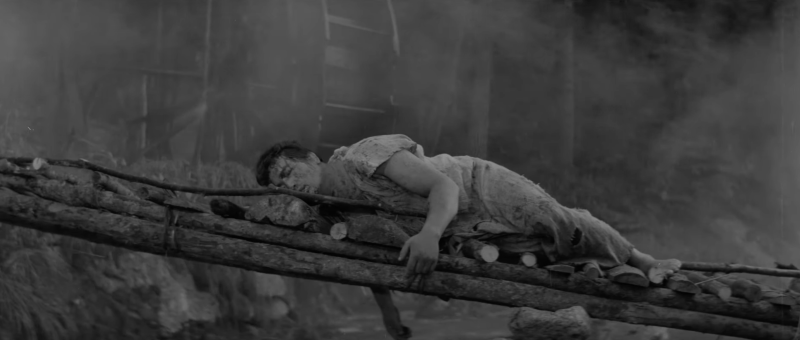
A Water Mill (물레방아, Lee Man-hee, 1966)

It’s not every day you wander into your own funeral. Or to be more precise, the death rite that Bong-won (Shin Young-kyun) unwittingly intrudes on in Lee Man-Hee’s feudal era fable A Water Mill (물레방아, Mullebanga) is for someone who died in a time no can remember. The old lady who explains it to him says that it happened long before she was born, implying at least the villagers have been enacting this ritual since time immemorial yet it’s almost as if Bong-won were walking towards a point of origin, drawn inexorably by forces beyond his control to play his part in this immortal ritual dance.

To that extent, Bong-won becomes a kind of “everyman” in this cautionary tale by virtue of the fact that he is nameless. Asked for his surname, he says he isn’t sure. It might be Kim or Park, later someone else says Lee which fills out the triumvirate of Korea’s most common family names. He says at one point that he doesn’t remember his mother, but thinks that she may have been a sex worker and his father a man who didn’t pay. But the fact he has no last name places him firmly at the bottom of the feudal hierarchy and most at the mercy of its hypocrisies and contradictions. He was on his way somewhere else when he fatefully found a sock floating the river that seems to flow towards him from his own future but that he will later gift perhaps to its original owner, the mysterious Geum-boon (Ko Eun-ah) with whom he falls in a deep, obsessive love that takes over the whole of his life.

Others in the village tell him that there is no such woman. An old man assures him she must have been some kind of ghost or supernatural creature come to trick him and Geum-boon does indeed take on a kind of eeriness. After deciding to stay in the village and look for her, Bong-won catches sight of Geum-boon in a forest glade bathing naked in a pool as the bright summer sun beats down on her but when he eventually makes his way down the mountain she has already disappeared. In chasing Geum-boon, he chases death but most evidently in the ways his obsession with her causes him to contravene the feudal order. He rebels against the landlord he was working for in refusing to collect her debt, then contracts himself to another in order to pay it so that he might marry her.

But ghost or not, Geum-boon is herself constrained by feudalism’s aggressive patriarchy. Force married to an invalid, she cared for him for three years until his death and then is pressed for his debts by the local landlord who wields them against her in order to claim her body. Married to Bong-won who has become an indentured servant, she is once again pursued by a landlord insistent on his droit du seigneur who exiles Bong-won to the pottery fields to get him out of the way. Geum-boon’s ambivalence does seem to give her a sometimes demonic quality as she laughs in the face of the landlord like something possessed and though she at first seems to like Bong-won and fear the attentions of the landlord she is also intrigued by the frankness of his current mistress who sees in her relationship with him the possibilities of transgressing class boundaries not to mention escaping a dull husband who will never be anything other than a servant. 

The film seems to suggest that Bong-won is powerless, while Geum-boon does at least have some power to wield. Even the landlord tells her that he has nothing to offer other than his money and power and even if becoming lady of the manor is a little far-fetched it seems unreasonable to criticise her if she did decide to become the landlord’s mistress as the path towards overcoming her circumstances lies in trading her body for influence. One could argue Bong-won does the same in leveraging his strength and his labour, but all it buys him is further exploitation and the eventual humiliation of knowing the landlord has been sleeping with his wife. 

Feudalism therefore destroys natural human emotions such as love when all life is transactional in a constant, and largely futile, struggle for survival. Bong-won turns to the spiritual realm for help, asking a shaman how he can win back his wife but she gives him the rather bizarre instructions to steal three sets of underwear and throw them in the river on 3rd August while bowing to the west. Needless to say, that doesn’t work out very well for him. The fates truly do seem to be against Bong-won. Lee adds a touch of supernatural dread as Bong-won finds himself surrounded by howling winds as he fatefully makes his way towards the water mill and his destiny. The ritual dance is perfectly recreated as Bong-won and Geum-boon retake their roles in the play, their actions matching those of the masked players as Bong-won collapses on the bridge just as the demon had though there is no positive resolution in what is now both reality and fable. What we’re left with is the tragedy of feudalism, but also the maddening futility of obsessive desire for that which is and has always been ever so slightly out of reach.
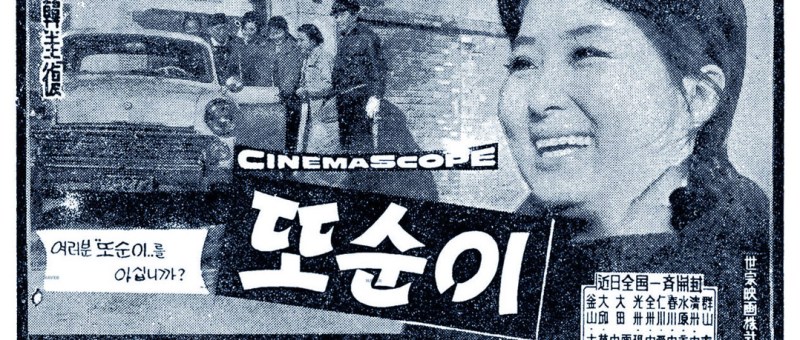
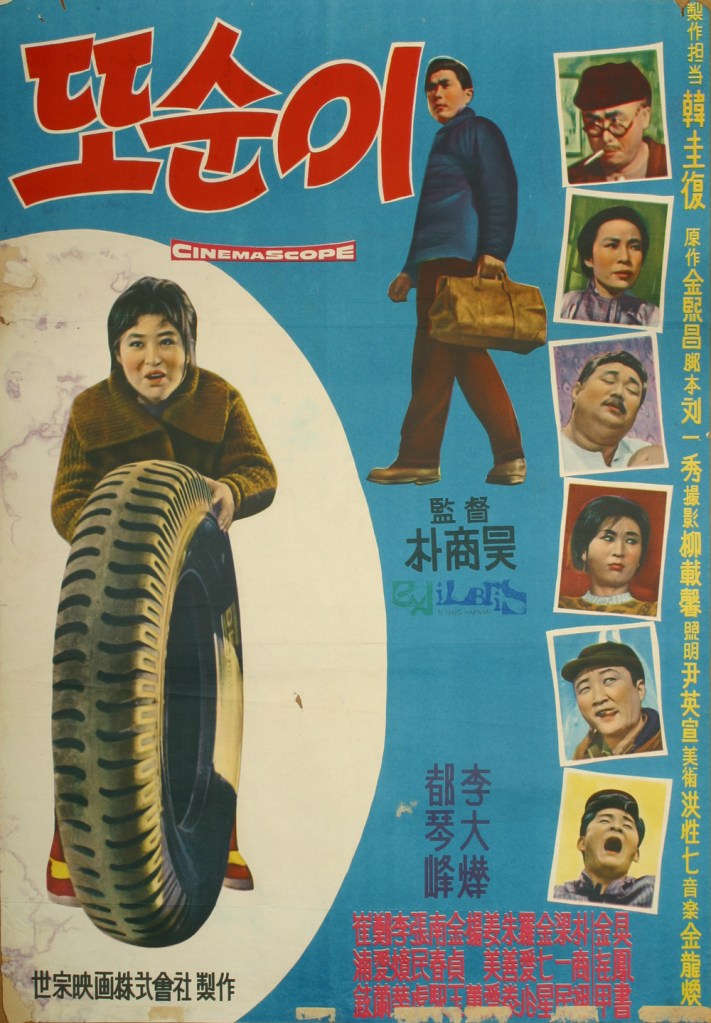
Tosuni: The Birth of Happiness (또순이, Park Sang-ho, 1963)

Korean Cinema had enjoyed a small window of freedom following the April Revolution that brought down the government of Rhee Syngman, but that window was closed all too soon by the Motion Picture Law brought in under Park Chung-hee which reformed the film industry and instituted an increasingly stringent censorship regime. Despite that, however, 1963 was something of a banner year which saw the release of such enduring classics as The Marines Who Never Returned, Bloodline, and Goryeojang. In comparison, Park Sang-ho’s Tosuni: The Birth of Happiness (또순이) seems like a much smaller film but was the fourth highest grossing that year, possibly because it was inspired by a hugely popular radio serial. Standing in direct contrast to contemporary melodrama, Tosuni puts a positive spin on go getting capitalistic individualism as its salt of the earth working class heroine defiantly makes her dream come true on her own despite the parade of useless men that attempt to drag her down. 

The cheerful Tosun (Do Kum-bong) is the daughter of Choi Jang-dae (Choi Nam-hyeon) who came from the North with nothing but the shirt on his back and now owns a bus company. A difficult, miserly old man, Jang-dae has a loathing for people who depend on others which is why he sends a young hopeful, Jae-gu (Lee Dae-yeop), packing when he turns up with a letter of recommendation and asks for a job as a temporary driver. Unbeknowst to Jang-dae, Tosun had already encountered Jae-gu on the bus where her father had sent her on an errand only to complain she’s not come back with as much money as he hoped. Tosun asks her father for a 50 won payment for her work but he refuses, leading to a blazing row during which Tosun points out that while both her parents were out working she was basically their housekeeper so he owes her around 15 years in back pay and is also in contravention of the child labour laws. Seeing as she was looking after them all these years, she feels she’s already well acquainted with the “independence” her father always seems so keen on. Eventually she storms out, vowing to become a success on her own. Jang-dae is annoyed to have lost the argument but also oddly proud, realising that he brought Tosun up right and impressed that she actually stood up to him and can obviously take care of herself. 

Tosun certainly is a very capable woman, working hard, taking every job going, and making money wherever she goes. Jae-gu, meanwhile, turns out to be something of a layabout, never really looking for a job but spending all his money drinking with the madam, Su-wol (Na Ae-sim), in a local cafe. Tosun carries on doing her own thing but also wants to help Jae-gu, not least because they pledged to try and achieve their dream of owning a modern motor car together. Jae-gu knows that Tosun is perfectly capable of getting the car on her own and is mildly put out by it, sore over wounded male pride despite her assurances that even if she’s the one who gets the money together he’s the one who’ll be driving. That’s perhaps why he’s so easily suckered by an obvious scam when he gets together with a friend who’s met a guy who needs to shift some tyres, but only after dark when there’s no one around. Tosun thinks it’s fishy, especially if they can’t take the tyres right away, but goes along with it to make Jae-gu feel better. 

Like Jae-gu, most of the other young men are also selfish and feckless, dependent on and exploitative of female labour to get them out of trouble. Tosun’s brother-in-law (Yang Il-min) is forever lying to his in-laws to get loans for spurious business opportunities which never work out, complaining that he can’t “slave away as a temporary driver forever” but taking no proactive steps to change his circumstances despite the responsibilities of being a husband and father. Jae-gu’s friend, meanwhile, takes the opportunity of his wife being in hospital waiting to give birth to their child to try it on with Tosun who manages to fend him off but has a major loss of confidence because of the shock of his betrayal. 

Tosun’s mother hadn’t wanted her to move out not only because that means she’s alone in the house with the difficult Jang-dae, but because being an “independent” woman was somewhat unheard of and she’s worried her daughter will lose her virtue, or at least be assumed to be a loose woman, after leaving home before marriage. Tosun might be a little naive and extremely good hearted, she keeps unwisely lending money to people who obviously aren’t going to pay her back, but as she keeps pointing out she didn’t move out for fun she wants her independence. That’s one reason she keeps Jae-gu at arms length even though she’s fallen in love with him despite her constant exasperation. 

Tosun is in many ways the embodiment of a capitalistic work ethic, proving that you really can make it if you just knuckle down. The car represents both independence itself and a sense of modernity, as demonstrated by the excited commotion among Tosun’s friends and neighbours when she finally gets one and arrives to take her parents for a drive. Even the brother-in-law suddenly realises he might be better off working for Jang-dae rather than living a feckless existence of constant and humiliating failures trying to get rich quick. That’s the problem with the younger men, apparently, they want everything right away, like Jae-gu and his tyre deal, and aren’t really prepared to work at it. Tosun sorted the tyre problem in her own cooly handled fashion, outwitting the unscrupulous vendor but doing it without malice and only showing him she won’t be had. Is the motor car and everything it represents the birth of happiness? Maybe not, but it doesn’t hurt, and Tosun unlike her father seems to have retained her good heart, setting off into an admittedly consumerist but hopefully comfortable future, a back seat driver but behind her own wheel. 


Tosuni: The Birth of Happiness is available on English subtitled DVD from the Korean Film Archive in a set which also includes a digital restoration before/after comparison and stills gallery plus a bilingual booklet featuring essays by Kim Jong-won (film critic & professor), and Park Yu-hee (film critic & research professor). It is also available stream online via the Korean Film Archive’s YouTube Channel.

Break up the Chain (쇠사슬을 끊어라, Lee Man-hee, 1971)

Break Up the Chain poster1970 had been a difficult year for Lee Man-hee. A conflict on the set of The Goboi Bridge in which Lee intended to star against the advice of his regular team resulted in the end of his creative relationship with screenwriter Baek Gyeol and cinematographer Lee Suck-ki. Meanwhile, he’d also suffered a crisis in his personal life after parting ways with actress Moon Jeong-suk who had been both a lover and a muse. To top it all off he also had some financial problems and didn’t work at all for the year following Goboi Bridge’s release – a significant period of time in the high-speed world of early ‘70s Korean cinema in which it was not unheard of for a director to make as many as 10 films in one year. Break Up the Chain (쇠사슬을 끊어라, Shwisaseuleul Geunheola) was intended to be something of a “come back” but it finds Lee defeated, doing what he does best but also playing the game he never really wanted to play in succumbing to the patriotism epic (albeit a little tongue in cheek).

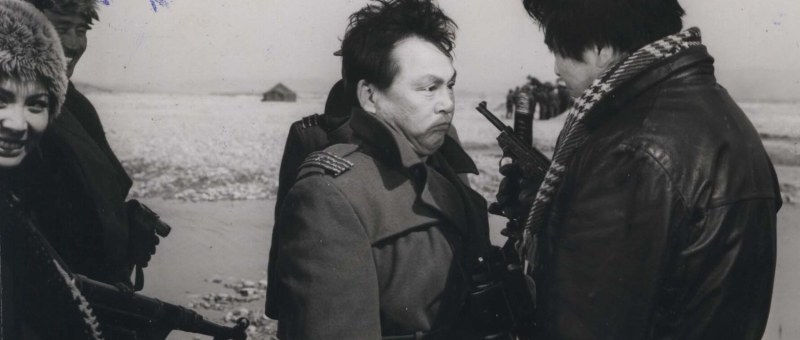
Riffing off Sergio Leone, Lee frames his resistance romp as a Manchurian western. A mysterious golden Buddhist statue has more than just monetary value as it also contains a list of the names of resistance operatives which can be revealed with the use of a special chemical formula. Three men are after it – Cheol-su (Namkoong Won), an adventurer for hire who might or might not be working for the resistance; Tae-ho (Jang Dong-hwi), a petty gangster; and Dal-geon (Heo Jang-kang), a collaborator working with the Japanese. The men are each interested in the statue for selfish reasons – Cheol-su for his reputation, Tae-ho for the money, and Dal-geon for the prestige. None of them is interested in the resistance movement itself, the statue’s importance in relation to it, or anything really beyond themselves and their day-to-day lives.

Of course, as this is a patriotism epic, the men eventually come round to the greatness of Korea as their individual quests converge and they find themselves alongside the resistance surrounded by the Japanese. The Japanese are largely a bumbling bunch who remain unaware of the statue’s “real” power even whilst holding it, thinking only of its monetary value as a lump of gold or work of art they could export abroad for financial gain. Confronted and faced with failure, the leader of the Japanese is firstly humiliated by his defeat at the hands of the resistance but then decides to show them the greatness of the Japanese army by committing Harakiri right there on the spot. Stripping off the captain begins to get cold feet, suddenly struck by the enormity of the moment when one of his lieutenants draws his sword ready for the beheading. The Japanese captain then seems to come down with “a cold” and resolves to visit the medical tent instead.

The early drama revolves around the interplay of the three self-interested outsiders as they scheme and plot to make use of each other and get the statue for themselves. Of the three, Cheol-su emerges as the most “noble” even though his quest is mercenary enough – his name is his business and thus he wants the statue to fulfil his contract and maintain his sense of integrity as a gun for hire. Tae-ho is merely interested in financial gain with a mild desire for social revenge and the thrill of outsmarting a rival, but both men are filled with an intense distaste for men like Dal-geon who have “betrayed” the countrymen they too have refused to serve. That aside, Tae-ho and Dal-geon begin to form a weak alliance of the opportunistic as they bond in their mercenary intentions, while Cheol-su lingers on the outside as his quest ties him more closely with the independence movement. Eventually the trio realise they have to work together to get the statue, even if their ultimate intention is to double cross the others and keep it for themselves. They do however suddenly rediscover their patriotic spirit, resolving to give the statue to the people who need to most while they ride off into the sunset in search of other ways to serve their country.

Set in dusty Manchuria (where the resistance movement operated in exile), Break Up the Chain is part of the short-lived boom of Korean “westerns” which were popular in the late ‘60s and early ‘70s. Lee abandons his experimental ambitions and aims squarely for the populist, reaching only for post-modern irony in his boys own adventure story filled with feats of daring do and flight on horseback. Yet he comforts himself with that sense of irony, pulling away from the absurd adventures of our heroes to show the faces of men dying in snow reminding us that their flight from the horror of war was perhaps a rational one rather than an act of cowardice or a failure of patriotism. Nevertheless, Lee seems to be at odds with himself as he gives in (to a point) and presents a silly story of amoral chancers suddenly rediscovering their “Koreanness” in the barren wastelands of Manchuria but does so with a sense of bitterness which conspires to rob the tale of its childish sense of fun.


Available to stream online via the Korean Film Archive’s YouTube Channel.