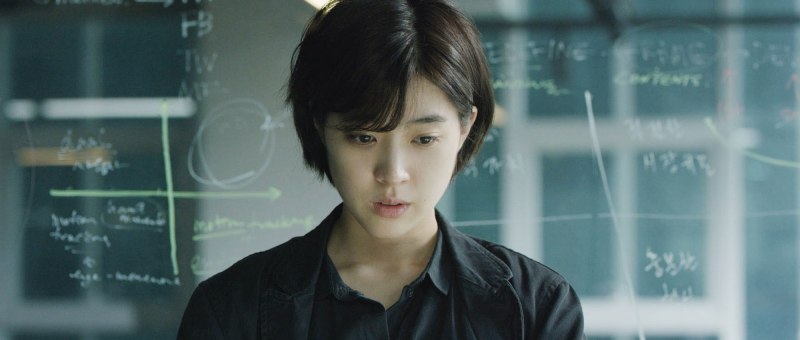
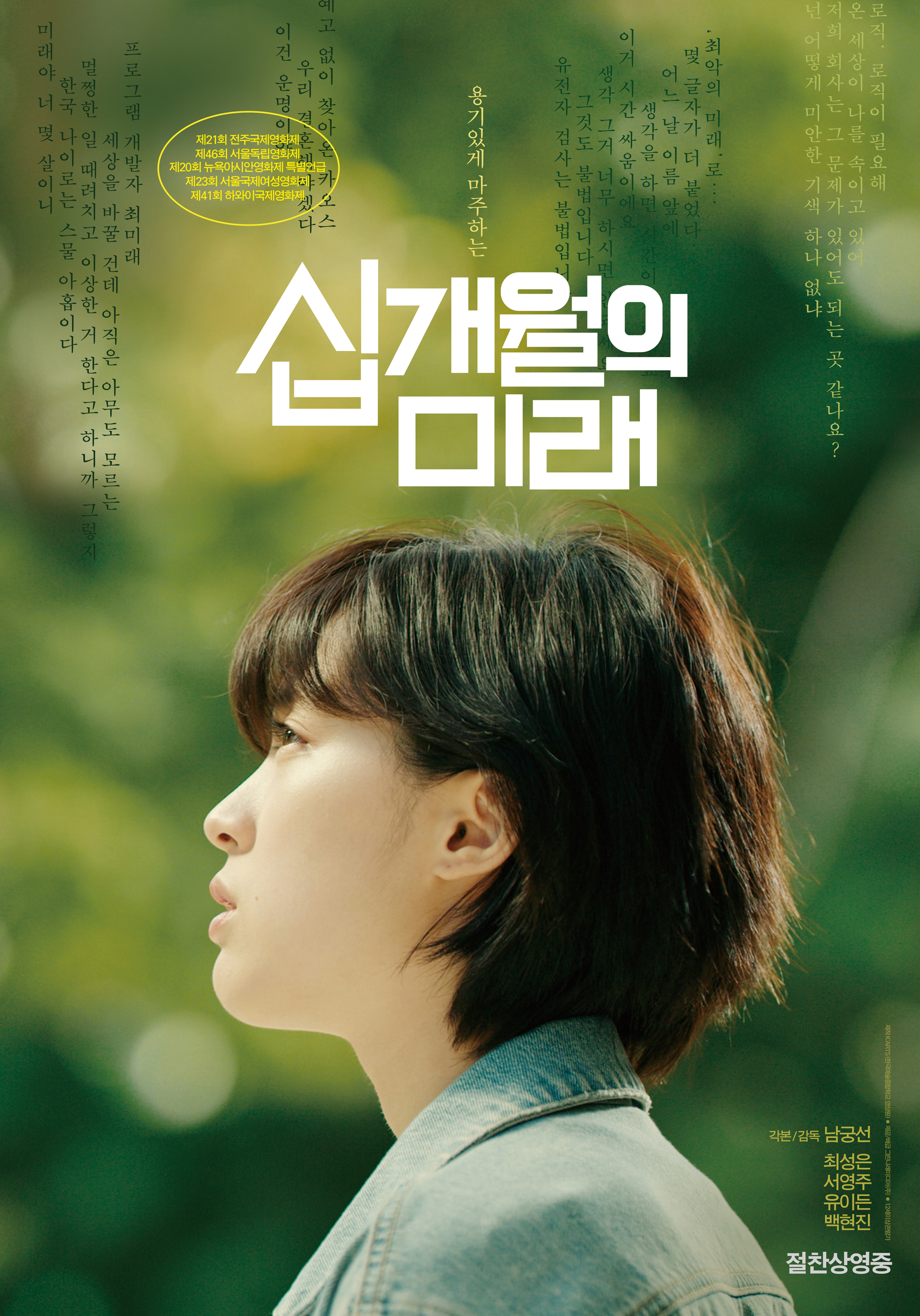
“I’m still the same person, exactly the same one as a few months ago, and everyone’s suddenly mad at me like something’s wrong” the heroine of Sun Namkoong’s Ten Months (십개월의 미래, Sib Gaewolui Milae) complains as an unexpected pregnancy sees fit to cause untold “chaos” in her personal and professional lives. Mirae’s (Choi Sung-eun) predicament exposes a host of double standards in a still conservative, patriarchal society in which both giving birth and not is somehow “selfish” while a pregnant woman, especially an unmarried one, is almost a taboo expected to hide herself away until she emerges from her chrysalis as a “mother” having entirely shed her old identity.
The reason Mirae’s pregnancy comes as such a surprise to her is that, presumably in part in order to avoid exactly this sort of situation, she can’t remember having been intimate with her diffident boyfriend Yoonho (Seo Young-joo) for the past few months. After a little thinking he realises it probably happened during a drunken fumble after a friend’s birthday party Mirae had clean forgotten. In any case, Mirae is not the sort of woman who’d ever harboured an intense desire to become a mother, it just wasn’t something particularly on her radar, and in many ways it couldn’t have come at worse time. While Yoonho is unexpectedly excited by the news of his impending fatherhood and immediately proposes, Mirae isn’t so sure.
The problem is, in the Korea of 2018, she doesn’t have a lot of options. In shock at the doctor’s office she asks about an abortion but is reminded it’s illegal outside of a few mitigating circumstances such as rape or incest (abortion was finally decriminalised only in 2021), and while there are apparently “safe” places where it’s possible to have the procedure done illicitly they are extortionately expensive not to mention carrying a hefty fine if you get caught. Mirae is unconvinced she wants to keep the baby, but she’s not the sort of person who finds it easy to contemplate breaking the law and continues to vacillate even while reminded that even the illegal clinics have a cut off point at which it would become unethical to perform a termination.
Meanwhile, she’s also worrying what effect her pregnancy may have on her career. Her father, who somewhat stereotypically opened a friend chicken shop after retiring, didn’t approve of her decision to leave a well-paying job at a major company to join a start up even if Mirae believes they’re “going to change the world”. It doesn’t help that Yoonho is technically unemployed as an aspiring entrepreneur trying to sell his prototype handsfree smartphone accessory in the shape of a cute dragon meaning her income is all they have to live on. When she’s told the company is relocating to Shanghai it throws her dilemma into stark relief while also exposing Yoonho’s latent conservatism as he reacts with extreme negativity to the idea of going with her, pathetically attacking Mirae for not supporting his project while eventually reminding her she’s about to be a “mother” as if implying she no longer has the right to make such subjective decisions. By the look on his face he knows he’s gone too far and said the wrong thing, but it’s too late.
When she tells her boss that she’d like to take the job but also needs him to be aware she’s pregnant, he too becomes indignant. Firstly confused because Mirae is not married, her boss then withdraws the offer and declares himself hurt, “betrayed”, seemingly annoyed that Mirae doesn’t even seem “sorry” for all the inconvenience she’s causing him. When she calls him on his sexism, he blames her for making him out to be the bad guy when he’s doing nothing illegal because shockingly it’s not illegal in Korea to fire someone for being pregnant even if he seems to know it’s not a good look. She begins to feel foolish that she invested so much emotionally in what she saw as a shared endeavour only to be pushed out as if she’s being punished for some kind of transgression just for the audacity of having a child sending a clear signal that motherhood is still deemed incompatible with the workplace.
Yoonho’s overbearing father seems to be of much the same opinion, her soon-to-be mother-in-law unironically gifting her a frumpy apron while the conservative couple begin to pressure her to move in with them at their pig farm where they’ve already managed to pressgang the largely emasculated and previously vegetarian Yoonho into working. Unsure about the baby, Mirae was even less convinced by the necessity of a shotgun marriage especially as the emotionally immature Yoonho for all of his latching on to the idea of fatherhood to escape the reach of his own father grows ever more resentful towards his overbearing parents while entirely unable to stand up to them.
And then, there’s all the other stuff that no one really wants to talk about like the possibility of dying in childbirth which is not so much a thing of the past as most people assume even if much less likely, while Mirae’s previously 100% together friend seems to be displaying the signs of post-natal depression or at least infinite exhaustion with her husband apparently having skipped town on a business trip leaving her all alone with their newborn baby. Mirae couldn’t see why some people were so desperate to have children, but gradually comes round to the idea transgressively choosing to raise her child alone no matter the “chaos” the unplanned pregnancy has caused to her life as she knew it. She may have feared being “erased”, instructed by Yoonho’s father that her life is no longer her own and she now exists solely in service of her child, but chooses to see the birth as a new beginning not least for herself as she embarks on this new phase of her life very much on her own terms and of her own free will.
Ten Months screened as part of this year’s New York Asian Film Festival.
Original trailer (no subtitles)

 Windows on Worlds