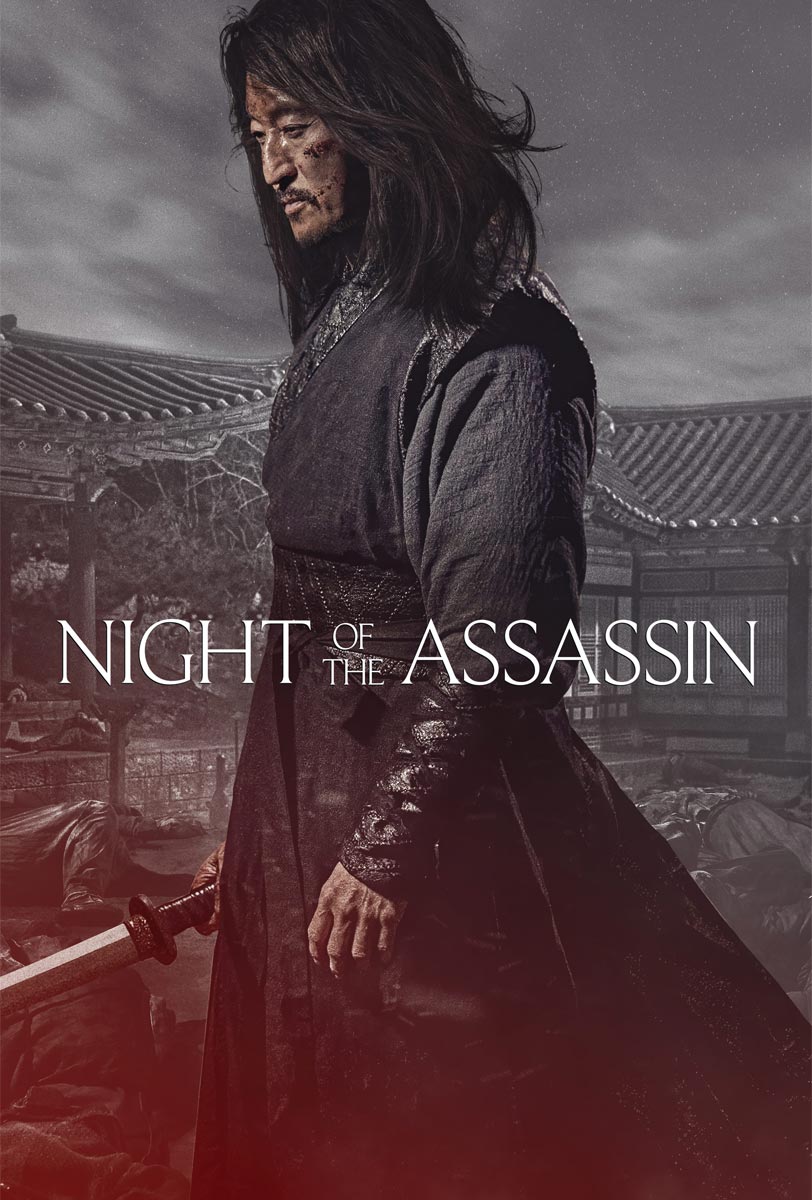
Night of the Assassin (살수, Kwak Jeong-deok, 2023)

The vagaries of the times take a toll on the heart of a killer for hire in Kwak Jeong-deok’s low budget historical drama, Night of the Assassin (살수, Salsu). Set in feudal Korea, the film takes place in a world in which “human lives have no meaning” and corrupt authorities fight amongst themselves while exploiting the suffering people for their own gain. As someone later says there is no end to a person’s greed in this constantly uncertain society. 

Inan (Shin Hyun-joon) is regarded as the best assassin in Joseon seeing as his targets always end up dead, but it seems the moral duplicities of his life as a sword for hire have begun to weigh on him and resulted in a heart that is in effect broken. His doctor warns him that his body can no longer support martial arts (or sleeping with women) while the only thing that might help him is a mythical herb, Mahwangcho, he isn’t really sure actually exists. Weakened as he is, knives are quickly out for Inan though somehow he manages to escape living a quiet life searching for the herb and reflecting on the dark deeds of his life. 

A year later he fetches up in a village where he’s taken in by a widow, Seon-hong (Kim Min-kyung), after making a non-violent intervention on seeing her bullied by local guards. Soon he becomes a waiter at her roadside restaurant and becomes a surrogate father figure to her young son, Chil-bok, who ironically enough wants to become an assassin when he grows up having become obsessed with a martial arts serial while determined to get revenge for his father who was killed by bandits while searching for a herb. 

The bandits are the reason Inan can’t just go and look for the Mahwangcho himself seeing as they pretty much own the mountain and are not so secretly in league with the guards where corrupt official and former gang boss Ibang (Lee Moon-sik) has made a bundle getting the local peasants hooked on opium so he can press them into debt and then take their land. Only, Ibang has had enough of working with bandit chief Baek Ga and figures he may as well use Inan, after learning his true identity, to take him out and put a weaker willed subordinate “in charge” while running things from behind the scenes. 

Inan is fighting a battle on several fronts, the first being his health and his reluctance to fight because of it which is also a symbolic manifestation of his moral conflict with his life as a hired killer. As he tells Chil-bok, they weren’t all bad guys even if he rationalises to himself that every one dies some day so today is as good tomorrow. Ibang justifies himself that he’s appeasing the bandits by containing them in the mountain while simultaneously peddling opium to the local population to make it even more difficult for them to resist him. Then again, Inan doesn’t rise up to free the villagers nor even to take out the bandits to get access to the mountain but only in defence of Seon-hong and her son when Ibang uses them to manipulate him into killing Baek Ga.

The film is framed as a kind of fable much like that in the serial Chil-bok is reading only related by an old friend of Inan’s who’s retired from the underworld and is attempting to live a quiet life in the country though as he points out real life doesn’t always have a neat ending. As such, the film works in a minor hook for a sequel in the mysterious identity of whoever it is sending assassins after Iban and the reasons why they want him dead though there may be a kind of explanation in the flashback scenes to his life as a young assassin. Likewise, the film has a kind of episodic structure in which Iban battles with a coldhearted mercenary much like himself and a female assassin with red eyes who seems to have some kind of hypnotic superpower. Though obviously constrained by budgetary limitations, Kwak’s attention to costuming and architecture help lend a potent sense of place to the feudal-era setting while the visceral quality of the action scenes reinforces Inan’s existentialist questioning in a land in which human life has little value.


Night of the Assassin is available to stream now in the US via Hi-YAH! and will be released on DVD & blu-ray Aug. 8 courtesy of Well Go USA.

International trailer (English subtitles)
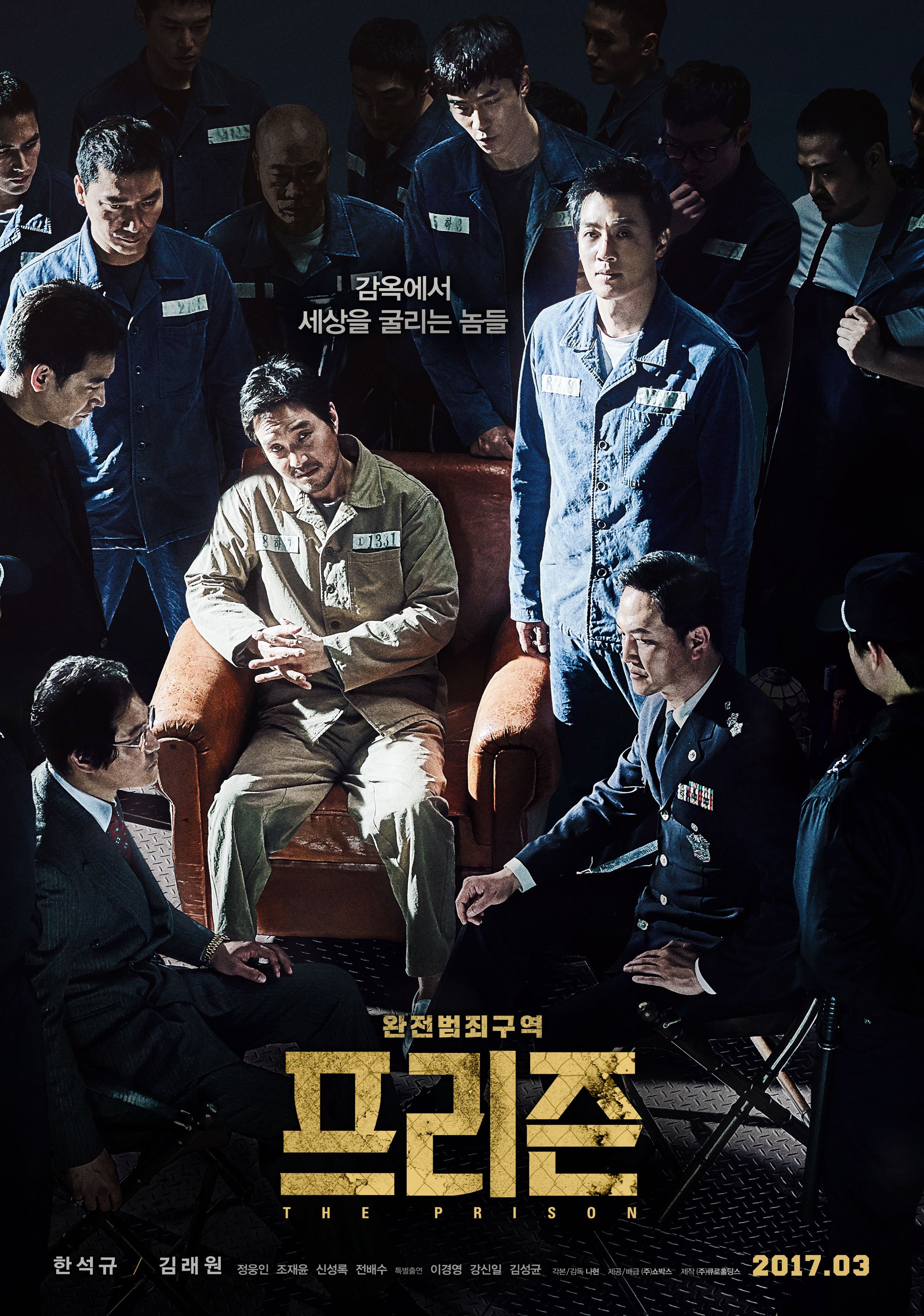
The Prison (프리즌, Na Hyun, 2017)

prison poster bigPrison can be a paradise if you’re doing it right, at least if you’re a top gangster in the movies. Na Hyun’s The Prison (프리즌) paints an interesting picture of incarceration and the way it links into his nation’s infinitely corrupt power structures. When investigators wonder why a crime spree suddenly came to an end, one of the frequently offered explanations is that the perpetrator was most likely arrested for another crime but what if you could turn this obviously solid alibi to your advantage and get those already behind bars to do your dirty work for you?
Disgraced policeman Song Yoo-gun (Kim Rae-Won) has wound up imprisoned alongside several of the men he himself helped put away. Like many cops who suddenly find themselves on the other side of the bars, Yoo-gun’s life is not easy. Badly beaten, tortured, and threatened with amputation Yoo-gun eventually starts fighting back and seizes the most likely path to prison survival – allying himself with the inside’s big guy, Jung Ik-ho (Han Suk-Kyu). Ik-ho, a notorious gangster famous for eating the eyeballs of his enemies, is the one who’s really in charge around here, not least because he’s the one running the gang of prison based hitmen trotted out to take care of the bad guys’ hit list.

What starts out as an intriguing idea quickly descends into predictability as Yoo-gun and Ik-ho face off against each other, finding common ground and camaraderie but ultimately existing on the plains of good and evil. Yoo-gun has his own reasons for landing himself in prison but his policeman’s heart still loves truth and justice even if he’s forced to become a prisoner whilst in prison. While he goes along with Ik-ho’s crimes, joining in the violence and intimidation he practices, he also wants to take Ik-ho down even if it means becoming him in the process.

While the interplay between the two men forms the central axis of the film as they develop an odd kind of grudging friendship which may still end on the point of a knife at any moment, Na tries his best to recreate the world of the grim ‘80s action thriller. Technically speaking, The Prison is set in the ‘90s (not that viewers outside of Korea would notice aside from the external lack of mobile phones, computers, internet etc) but wants to be the kind of tough, bruisy, fight heavy action movie they don’t make any more in which a righteous hero defeats a large-scale conspiracy by jump kicking hoodlums. He almost succeeds in this aim, but never quite manages to anchor the ongoing background conspiracy elements with the intense pugilism of the prison environment.

Yoo-gun and Ik-ho are obviously a special case but aside from their efforts, prison life in Korea is not too bad – the guards are OK, the warden is ineffectual, and the inmates are running the show. Nevertheless the prison is the centre of the conspiracy as elite bad guys take advantage of put upon poor ones who’ve found themselves thrown inside thanks to ongoing social inequality, trading cushy conditions to guys who’re never getting out in return for committing state sponsored crimes. Needless to say, someone is trying to expose the conspiracy which would be very bad news for everyone but rubbing them out might prove counter productive in the extreme.

Na lets the in-house shenanigans drag on far too long, pitching fight after fight but failing to make any of his punches land with the satisfaction they seem to expect. Flirting with the interplay between Yoo-gun and Ik-ho in wondering how far Yoo-gun is prepared to go or whether he is destined to become his criminal mentor rather than destroy him, Na never fully engages with the central idea preferring to focus on the action at the expense of character, psychology, or the corruption which underlines the rest of the film. Nevertheless The Prison does have the requisite levels of high-octane fights and impressive set pieces including the fiery if predictable prison riot finale. Life behind bars isn’t all it’s cracked up to be after all, the corrupt elites of Korea will have to actually pay people to off their enemies. Predictable and poorly paced, The Prison is best when it sticks to throwing punches but might be more fun if it placed them a little better.


The Prison was screened at the 19th Udine Far East Film Festival.

International trailer (English subtitles)

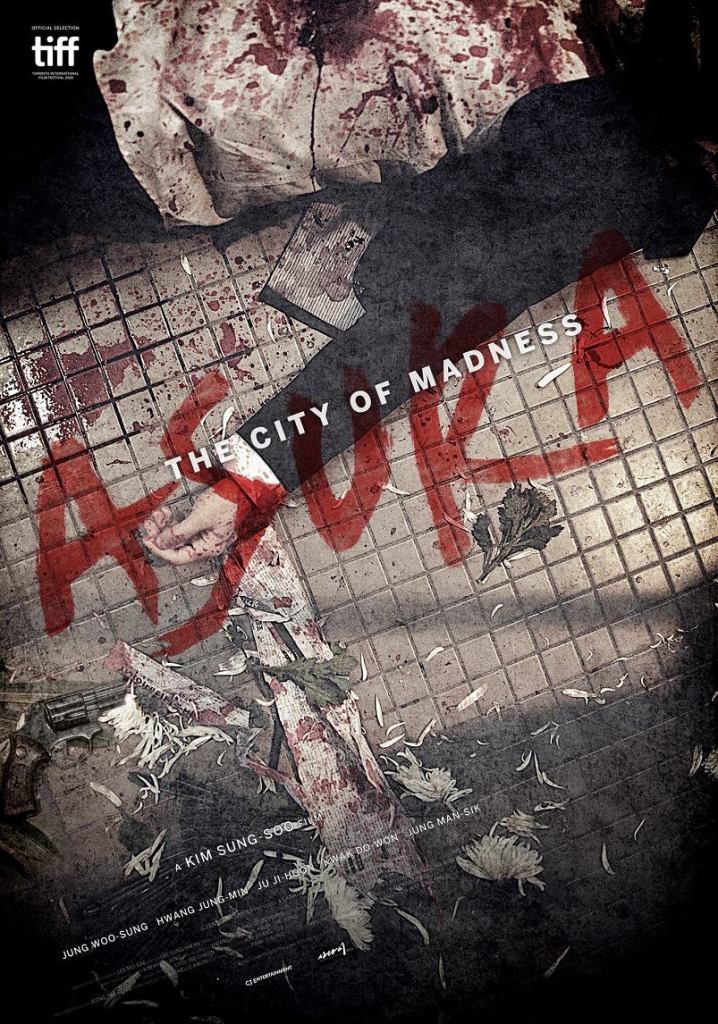
Asura: The City of Madness (아수라, Kim Sung-soo, 2016)

asura-poster

Review of Kim Sung-soo’s Asura: The City of Madness first published by UK Anime Network.


Abandon all hope, ye who enter here. It’s a shame the title City of Violence was already taken, Asura: The City of Madness (아수라, Asura) is a place of chaos in which carnage has become currency. Re-teaming with actor Jung Woo-sung fifteen years after Musa the Warrior, Kim Sung-soo’s Asura: The City of Madness is, at heart, B-movie pulp steeped in the hardboiled world of tough guys walking alone through the darkness, but even if film noir’s cynicism is out in force, there’s precious little of its essentially chivalrous mentality to be found in this fiercely amoral universe.

World weary policeman Han (Jung Woo-sung) has been moonlighting as the “gun-dog” of corrupt crime boss mayor, Park (Hwang Jung-min), and soon plans on quitting the legitimate force to work for city hall full time. After helping Park “relocate” an inconvenient witness, Han runs into a problem when another policeman turns up and promptly gets killed, drawing unwanted attention to his shady second job. This also brings him into contact with a righteous prosecutor, Kim (Kwak Do-won), who claims to be hellbent on exposing Park’s not quite legal operations and ousting him from power in the hope of a less corrupt regime emerging. Despite his lofty claims, Kim’s methods are little different from Park’s. Han soon finds himself caught in the middle of a legal cold war as he tries to play both sides one against the other but slowly finds neither worth betraying.

The film’s title, Asura, is inspired by the creatures from Indian mythology who are imbued with immense supernatural power yet consumed by negative emotion, relentlessly battling each other in a quest for material rather than spiritual gain. The very male world of Annam is no different as men trade blows like money and wear their wealth on their faces. There are no good guys in Annam, each is involved in a desperate fight to survive in which none can afford luxuries such as pity or morality. Han emerges as the film’s “hero” not out of any kind of nobility or a desire to do good, but simply in being the least actively bad. Able to see the world for what it is – a hell of chaos and cruelty, Han is, perhaps, the best man his environment allows him to be but this same knowledge eats away at him from the inside as he’s forced to act in a way which betrays his own sense of righteousness.

Annam is a world founded on chaos. The forces which are supposed to represent order are the very ones which perpetuate a state of instability. The police are universally corrupt, either working for themselves or in the pay of larger outside forces, and the municipal authorities are under the control of Park – a vicious, mobbed up, sociopath. Prosecutor Kim who claims to represent the resistance against this cosmology of corruption is not what he seems and is, in fact, another part of the system, willing to resort to blackmail, torture, and trickery in order to achieve his vainglorious goal. Yet for all that, the force that rules is mere chance – the most meaningful deaths occur accidentally, the result of shoddy construction work and high testosterone or in the indecision of betrayal. Death is an inevitability for all living creatures, but these men are, in a sense, already dead, living without love, without honour, and without pity.

Kim Sung-soo makes a point of portraying violence in all of its visceral reality as bones crack and blood flows with sickening vitality. The film is extreme in its representation of what could be termed ordinary violence as men engage as equals in hand to hand combat until the machetes and hacksaws come out to combat the shootout finale, complete with the Korean hallmark corridor fight.

Beautifully shot with a neo-noir aesthetic of the nighttime, neon lit city filled with crime ridden back alleys, Asura: The City of Madness is a grimy, hardboiled tale of internecine violence fuelled by corruption and self serving compliance. The ‘80s style lowkey synth score adds a note of anxiety to the proceedings, hinting towards an almost supernatural presence in this strange city populated by the walking dead and morally bankrupt. An epic of “unheroic” bloodshed, Asura: The City of Violence presents a world which thrives on pain where men ease their suffering by transferring it to others. Bleak and nihilistic in the extreme, this is the hard edge of pulpy B-movie noir in which the men in the shadows wish they were as dark as the city streets, but find themselves imprisoned within a series of private hells which are entirely of their own making.


Reviewed at the 2016 London Korean Film Festival.

International trailer (English subtitles)