Vital (ヴィタール, Shinya Tsukamoto, 2004)

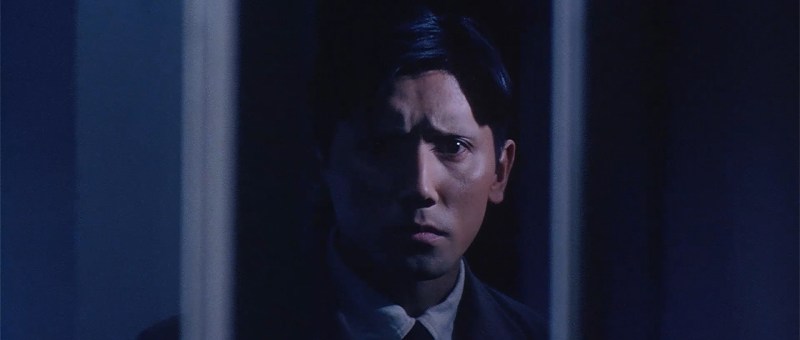
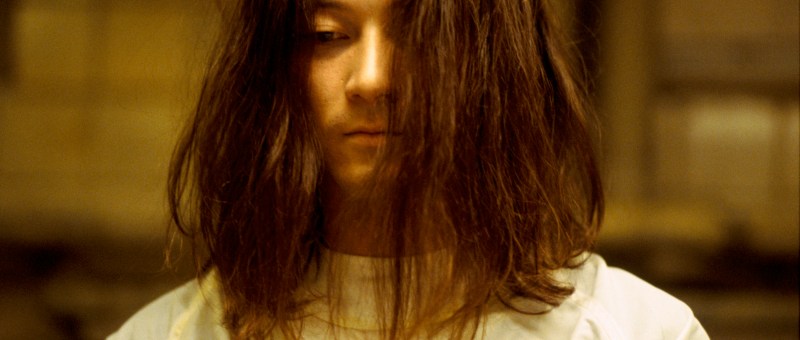
“There is the vast realm of the unconscious,” one of the professors explains to vacant medical student Hiroshi a soon-to-be physician attempting to heal himself from a trauma he doesn’t fully understand. Perhaps as the title implies, Vital (ヴィタール) sees Tsukamoto branch out from his vistas of urban alienation to find a new paradise in nature albeit one that it exists largely in the mind and that the hero can never fully return to because this place of life is also one of death which exists inside a kind of eternity.

This explains to some extent Hiroshi’s (Tadanobu Asano) temporal confusion. Having lost his memory following a car accident in which he later learns his girlfriend Ryoko (Nami Tsukamoto) was killed, he shifts between “reality” and what first seems to be flashbacks of his unremembered past but are actually taking place in a kind of alternate, perhaps idealised reality in the “vast realm of the unconscious” as Hiroshi attempts to reconstruct his image of Ryoko along with that of himself. Another of his professors more philosophically asks were lies the seat of the soul in the human body and is this something that Hiroshi maybe unconsciously looking for during his anatomy classes in which he is coincidentally assigned Ryoko’s body to work on only realising when he sees her tattoo in one of his visions. 

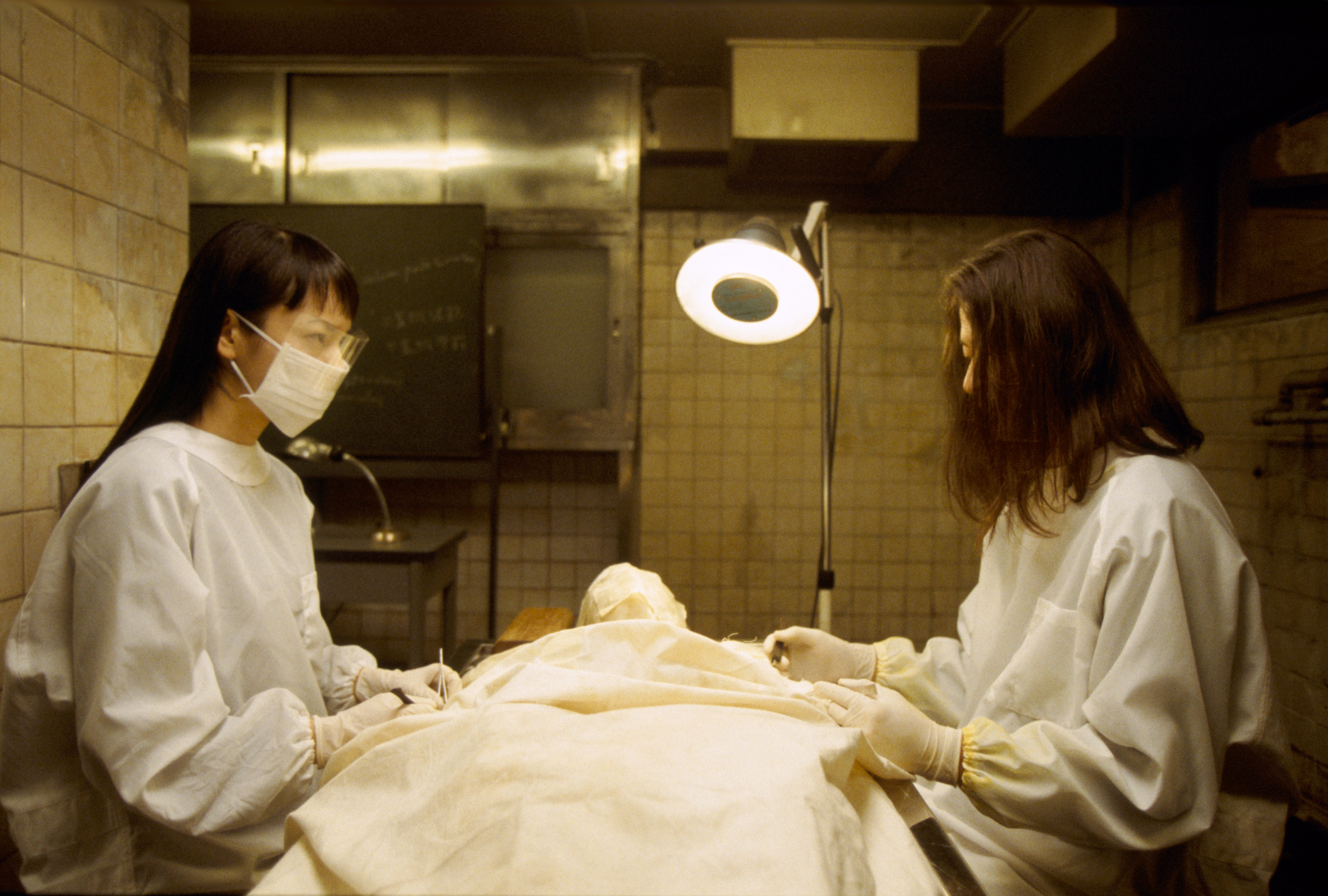
In some ways this grim task of dissection is a bid for greater intimacy, to take Ryoko apart and then put her back together as the students diligently do at the end their studies reassembling the bodies and placing them in coffins in keeping with culturally specific death rituals. The faces of the cadavers are covered with a bag until the students are instructed to remove them, but they are always reminded to treat the dead with dignity and that their role here is one of understanding as they attempt to work out not only how these people died but also how they may have lived. Hiroshi causes conflict with some of his fellow students on just this point, seeming rather creepy in his vacant intensity over the body while also wanting to take ownership over that of Ryoko rather than work as part of the group complaining that the others are too clumsy and it’s affecting his ability to learn. 

Ryoko’s father comes to say that though he once blamed Hiroshi, his daughter had been in a way dead for a long time before she died, the light apparently going out of her eyes when she was still in high school. Only in Hiroshi’s unconscious does she say that she didn’t want to die despite an apparent obsession with death in Hiroshi’s other resurfacing memories/visions of her as symbolised in her repeated requests for him to strange her during in sex. Another of the professors had said that the suppressed desires of the unconscious could create conflict and this alternate reality is also in some senses Hiroshi’s own latent desire for death, to be with Ryoko in this new paradise that is founded on an idyllic beach rich with nature and sunshine where they are free to be together liberated from the oppressions of civilisation. 

Indeed, it’s been raining all through the film as if in expression of Hiroshi’s gloomy mental state but we later learn that Ryoko’s most treasured memory was simply standing in the rain with him and breathing in its scent. Verdant nature is aligned with the vitality that is often absent from the soulless concrete of a city in which everyone seems to exist in tiny, separate worlds which only border on but never join each other. Ikumi (Kiki), a strange female student who develops a fascination with Hiroshi, has an illicit conversation with a professor she’s apparently been sleeping with each of them speaking into mobile phones while standing steps apart. Tsukamoto often isolates the protagonists, placing them in corners or blurring the periphery as if they alone existed in this moment. In Hiroshi’s idealised alternate reality, these barriers disappear as he and Ryoko share an entire world in love and freedom. 

The irony is that he resurrects himself through the process of dissecting Ryoko’s dead body. His Da Vinci-like sketches begin to shift as do the ink-like shadows on the wall amid the reflection of the rain as Hiroshi stares vacantly trying to reassemble his past. Through accepting Ryoko’s death, he rediscovers life and is in a sense reborn insisting he will continue medicine even though his professor and parents advise him not to given what he’s just been through though his parents had also said that before the accident they didn’t really think he had it in him to become a doctor. Their disapproval may explain some of the pressures he was experiencing as perhaps was Ryoko that may have urged them to long for death. In any case, what the film presents is the archaeology of grief, a prolonged period of introspection and loneliness and a seeking of intimacy no longer really possible but discovered only in the vast realms of the unconscious.


Vital is released on UK blu-ray 30th September courtesy of Third Window Films.

Original trailer (English subtitles)

Shadow of Fire (ほかげ, Shinya Tsukamoto, 2023)

The ruins of a firebombed city become a purgatorial space haunted by tortured souls who cannot escape the traumatic wartime past in Shinya Tsukamoto’s eerie voyage through post-war Japan, Shadow of Fire (ほかげ, Hokage). Even the small boy (Ouga Tsukao) who desperately looks for a place to belong is plagued by nightmares of the flames that took his home and family while it otherwise seems that those around him live their lives in the shadow of a war which for many is still far from over. 

This state of ruination is immediately brought home to us by the heightened presence of sound. Not only do the cicadas buzz amid the scorching heat of an oppressive summer, but we constantly hear the sound of people walking over rubble or the clinking of broken glass. The unnamed woman we first meet (Shuri) lives in a room behind a small bar which appears to have scorch marks across the fusuma, a dank and dingy place filled with hopelessness and despair. The woman herself has a vacant look, a little dead behind the eyes either numbed with the sake a neighbourhood man brings her as pretext for extracting sexual favours or simply too tired of life to think much about it. Though she technically runs a bar, it’s more of a front for her only means of supporting herself, casual sex work, though as later becomes apparent she too may have been slow poisoned not only by the war but it’s immediate aftermath and the lingering traumas of those left behind and those who returned. 

The boy who eventually comes to stay with her remarks that those who did not come back did not turn into scary people, as if they were somehow lucky to have escaped this purgatorial hellscape. Later he wanders through the black market and discovers an abandoned tunnel filled with returned soldiers who stare out at him with vacant eyes sitting with eerie stillness like dormant zombies. He spots a man among them that he knew well, a young soldier (Hiroki Kono) who had been a teacher before he was drafted and took a maths textbook with him to war as a kind of talisman that reminded him he’d survive and teach again. The soldier had formed an odd kind of family unit with the woman and the boy, almost as if the husband she lost in the war and son who died in the firebombing, had been returned to her but his trauma refuses to set him free surfacing in moments of unexpected violence that hint at war’s realities. 

Later the boy meets another man with a traumatic past though one who sees himself as both victim and villain, resentful towards himself and the militarist regime that convinced him to betray his humanity and do dreadful, terrible things in its service. Tellingly this man, Shuji (Mirai Moriyama), is the only one granted a name. Perhaps names are only for the living, there’s a part of Shuji that is painfully alive a way that others aren’t even as he fixes his sights on his revenge as if it would somehow restore the humanity that was taken from him. Completing his quest, he lets down his hair and proclaims that for him at least the war is finally over. His commander, meanwhile, appears to have been living a fairly nice and successful life reminding him that he should stop dwelling on the past because it was after all a war and such things are only to be expected.

Shuji uses the boy in a way that seems counterproductive, taking advantage of the gun he’d found to help him take revenge on war. The woman tries to change the boy’s path, instructing him not to steal but to work honestly for his pay and to try to be better than this infinitely corrupted world. He wanted to be her protector, in his way acting as guide trying to free those around him from the purgatorial space of ruin and destitution but when he asks a medicine seller if he can exchange his money for something that will cure sickness he is told it’s not enough. He then tries to buy a dress for the woman, as if anticipating the salvation through consumerism that will eventually arrive though the constant sound of gunshots from the black market might indicate that for some at least there’s only one way out. The old man who visits the woman explains that he only approaches the ones who look okay, but that in the end you never really know. Shot in the half light or caught from behind the previously friendly take on an almost demonic intensity, wandering ghosts or broken souls already half consumed by the flames that in their minds at least are still burning and casting their shadows over the scorched earth of a traumatised society.


Shadow of Fire screened as part of this year’s Japan Foundation Touring Film Programme.

International trailer (English subtitles)

Gemini (双生児 GEMINI, Shinya Tsukamoto, 1999)

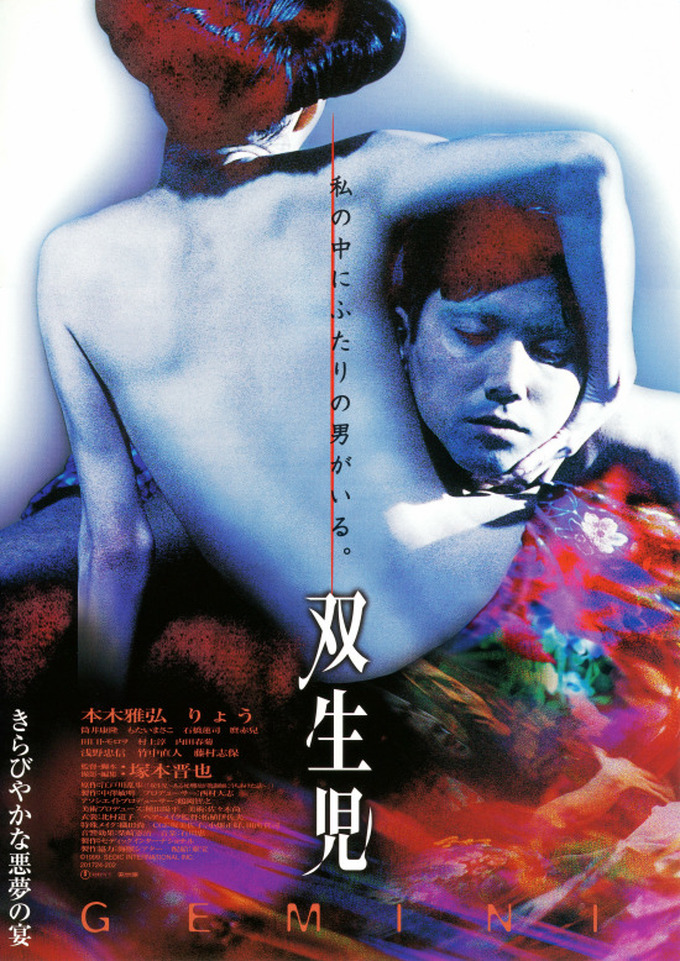
Shinya Tsukamoto made his name as a punk provocateur with a series of visually arresting, experimental indie films set to a pounding industrial score and imbued with Bubble-era urban anxiety. Inspired by an Edogawa Rampo short story, 1999’s Gemini (双生児 GEMINI, Soseiji Gemini) is something of a stylistic departure from the frenetic cyberpunk energy of his earlier career, marked as much by stillness as by movement in its strikingly beautiful classical composition and intense color play. Like much of his work, however, Gemini is very much a tale of societal corruption and a man who struggles against himself, unable to resist the social codes which were handed down to him while simultaneously knowing that they are morally wrong and offend his sense of humanity. 

Yukio (Masahiro Motoki) is a war hero, decorated for his service as a battlefield medic saving the life of a prominent general during the first Sino-Japanese War. He’s since come home and taken over the family business where his fame seems to have half the well-to-do residents of the area inventing spurious excuses to visit his practice, at least according to one little boy whose mum has brought him in with a bump on the head after being beset by kids from the slums. “They’re just like that from birth” Yukio later tells his wife echoing his authoritarian father, “the whole place should be burned to the ground”. A literal plague is spreading, but for Yukio the slums are a source of deadly societal corruption that presents an existential threat to his way of life, primed to infect with crime and inequity. His home, which houses his practice, is hermetically sealed from those sorts of people but lately he’s begun to feel uneasy in it. There’s a nostalgia, a sadness, a shadowy presence, not to mention a fetid stench of decay which indicates an infection has already taken place, the perimeter has been penetrated. 

The shadowy presence turns out to belong to his double, Sutekichi whose name literally means “abandoned fortune”, a twin exposed at birth as unworthy of the family name owing to his imperfection in the form of a snake-like birthmark on his leg and raised by a travelling player in the slums. Having become aware of his lineage, Sutekichi has returned to make war on the old order in the form of the parents who so callously condemned him to death, engineering their demise and then pushing Yukio into a disused well with the intention of stealing his identity which comes with the added bonus that Yukio’s wife, Rin (Ryo), was once his. 

Rin’s presence had already presented a point of conflict in the household, viewed with contempt and suspicion by Yukio’s mother because of her supposed amnesia brought on by a fire which destroyed her home and family. Yukio had reassured her that “you can judge a person by their clothes”, insisting that Rin is one of them, a member of the entrenched upper-middle class which finds itself in a perilous position in the society of late Meiji in which the samurai have fallen but the new order has not quite arrived. In Rin modernity has already entered the house, a slum dweller among them bringing with her not crime and disease but a freeing from traditional austerity. In opposing his parents’ will and convincing them to permit his marriage, Yukio has already signalled his motion towards the new but struggles to free himself from the oppressive thought of his father. He confesses that as a battlefield physician he doubted himself, wondering if it might not have been kinder to simply ease the suffering of those who could not be saved while his father reminds him that the German medical philosophy in which he has been trained insists that you must continue treatment to the very last. 

This is the internal struggle Yukio continues to face between human compassion and the obligation to obey the accepted order which includes his father’s feelings on the inherent corruption of the slum dwellers which leads him to deny them his medical knowledge which he perhaps thinks should belong to all. The dilemma is brought home to him one night when a young woman is found violently pounding on his door wanting help for her sickly baby, but just as he makes up his mind to admit her, putting on his plague suit, a messenger arrives exclaiming that the mayor has impaled himself on something after having too much to drink. Yukio treats the mayor and tells his nurses to shoo the woman away, an action which brings him into conflict with the more compassionate Rin who cannot believe he could be so cynical or heartless. 

Where Yukio is repressed kindness, a gentle soul struggling against himself, Sutekichi is passion and rage. Having taken over Yukio’s life, he takes to bed with Rin who laughs and asks him why it is he’s suddenly so amorous. She sees or thinks she sees through him, recognising Sutekichi for whose return she had been longing but also lamenting the absent Yukio who was at least soft with her in ways Sutekichi never was. “It’s a terrible world because people like you exist” Sutekichi is told by a man whose fiancée he robbed and killed. Yukio by contrast is unable to understand why this is happening to him, believing that he’s only ever tried to make people happy and has not done anything to merit being thrown in a well, failing to realise that his very position of privilege is itself oppressive, that he bears his parents’ sin in continuing to subscribe to their philosophy in insisting on their innate superiority to the slum dwellers who must be kept in their place so that they can continue to occupy theirs. 

Apart, both men are opposing destructive forces in excess austerity and violent passion, only through reintegration of the self can there be a viable future. Tsukamoto casts the austerity of the medical practice in a melancholy blue, contrasting with the fiery red of the post-apocalyptic slums, eventually finding a happy medium with the house bathed in sunshine and the family seemingly repaired as a doctor in a white suit prepares to minister to the poor. Having healed himself, he begins to heal his society, treating the plague of human indifference in resistance to the prevalent anxiety of the late Meiji society. 


Gemini is released on blu-ray in the UK on 2nd November courtesy of Third Window Films in a set which also includes a commentary by Tom Mes, making of featurette directed by Takashi Miike, behind the scenes, make up demonstration featurette, Venice Film Festival featurette, and original trailer.

Original trailer (English subtitles)

Haze (ヘイズ, Shinya Tsukamoto, 2005)

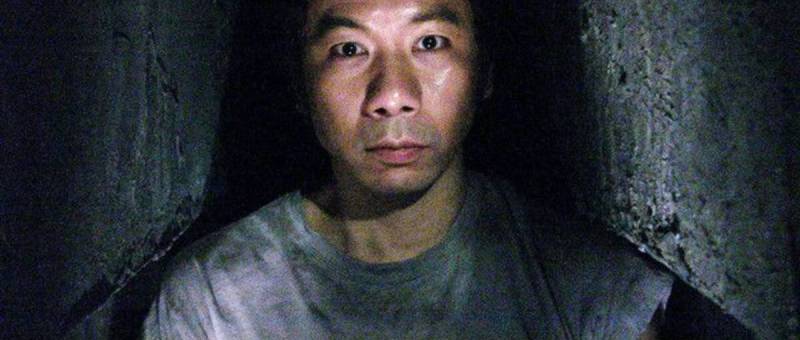
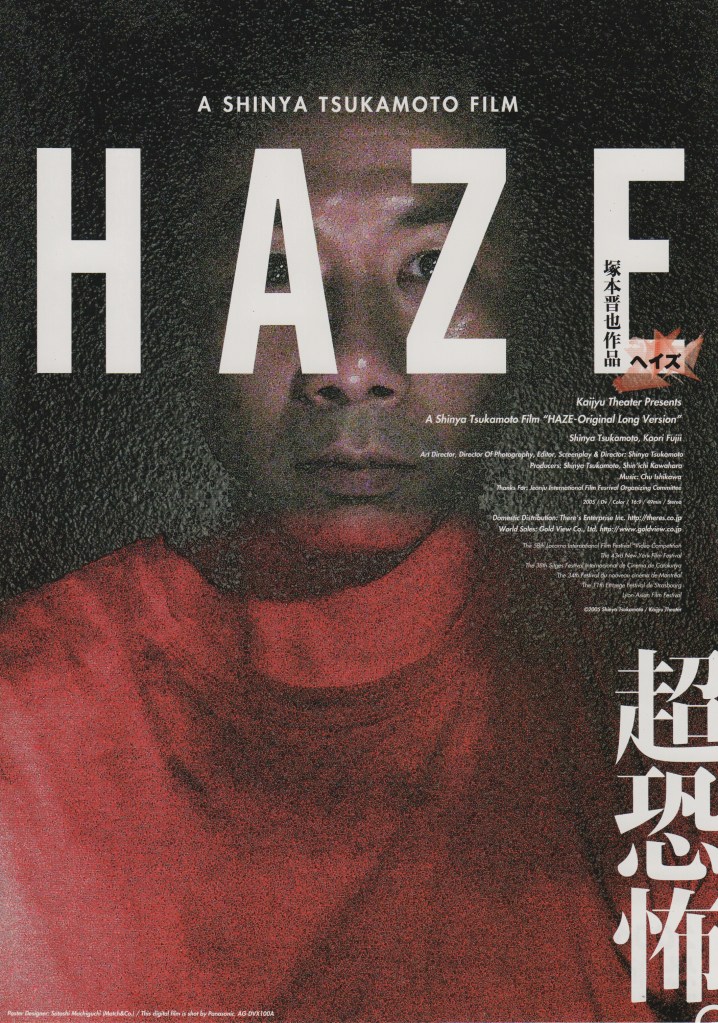
“Nothing spectacular is waiting for us even if we get out of here anyway” according to the imprisoned hero at the centre of Shinya Tsukamoto’s Haze (ヘイズ). Tsukamoto began his career with a series of tales of urban anxiety, a fear of increasing mechanisation which rendered a man mere slave to his physicality. Created as part of Jeonju International Film Festival’s digital project and later expanded to its current length, Haze skews in a slightly different direction, repurposing the director’s trademark body horror as a kind of depression metaphor as the unnamed hero, played by Tsukamoto himself, attempts to climb out of a pit of despair while experiencing momentary echoes of the traumatic event which has trapped him there. 

As the film opens, a man (Shinya Tsukamoto) wakes up in a confined space with no knowledge of how he got there or memories of his previous life. He convinces himself this must be a dream but believes if it were he would’t feel pain, which he later does not least from the gaping and unexplained wound near his hip. Left with no other choice, he crawls forward in search of an exit, gripping on literally by the skin of his teeth as he climbs through barbwire, beaten on the head by a strange contraption attacking him from what looks like an arrowslit in a castle. He glimpses other figures writhing in pain through a gap in the wall, some of whom are then torn apart while he later comes across great machines of human butchery and finds himself wading through severed limbs until he finally encounters another survivor, a woman (Kaori Fujii), who is minded to escape the way she believes she came in while the man is already beginning to give up on the idea of survival. 

The man meditates on what might have brought him here, as if it makes a difference or would help him to escape. He wonders if a war has broken out and he’s been taken prisoner, has been abducted by a weird cult, or is a plaything of a “rich pervert” enacting his own version of The Most Dangerous Game. He is perhaps crawling through hell, only one that may be of his making as a kind of metaphor for life’s battering as he pushes forward blindly, lacerating himself in pursuit of freedom while strangely indifferent to the suffering of others who appear not to have been so lucky. 

The woman is unable to provide any more explanation, lamenting that this may be their finally resting place but insisting that she is getting out. The man isn’t so sure, listening to her plan with scepticism, but once again wondering how he got here. Asked who is behind this the woman can only reply that it seems to be “a really big and dark thing, neither a human being nor a beast. You find yourself in total darkness being dismembered and floating in the water”. “If you see nothing ahead you eventually end up here” the man replies. After drifting off, the woman tells the man that she had a sensation of waking up alone somewhere dark and feeling lonely, “like falling into a place like this”. 

Later she remembers that she wanted to go somewhere, but was imprisoned here before she could run away. The man harps back on his theories again, wondering if it was a rich pervert after all, though this seems like a lot of bother to go to for sadistic kicks. He doesn’t stop to wonder what it was the woman wanted to escape, life itself or an intolerable situation and what the motives might be of the person who tried to stop her leaving. In fact, his own “sweet memory” is a bright and cheerful one of watching fireworks which he remembers liking a lot, though fireworks are perhaps also tiny sparks of life which blink out far too soon. Questioned about the motives of the hypothetical rich pervert, the woman suggests he might have done something like this to make her “go back” to wherever it was that she was desperate to leave. In any case, even if it’s back “there”, she is determined to escape and, perhaps paradoxically, gives the man the courage to follow though it’s he who eventually vows to “save” her. 

The path towards escape is itself a kind of rebirth, pushing through blood and viscera towards the light, the hazy dawn of the title. Something has perhaps been overcome if only in the brief moments of unconsciousness between life and death and perhaps because of that single “sweet memory”, unreliable and hazy as it might eventually prove.


Haze is available on blu-ray as part of Third Window Films’ Tsukamoto box set which also includes his latest film Killing and a new restoration of Adventures of Electric Rod Boy all of which are accompanied by audio commentaries by Tom Mes.