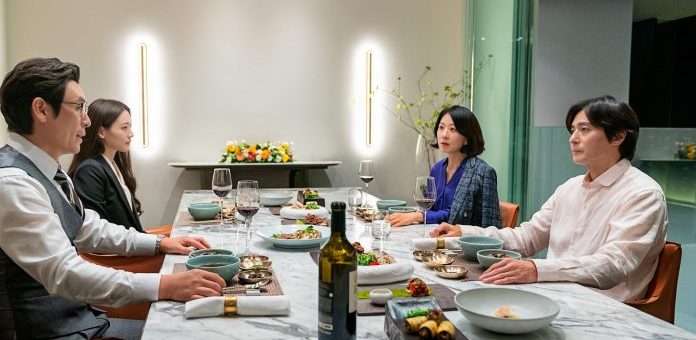
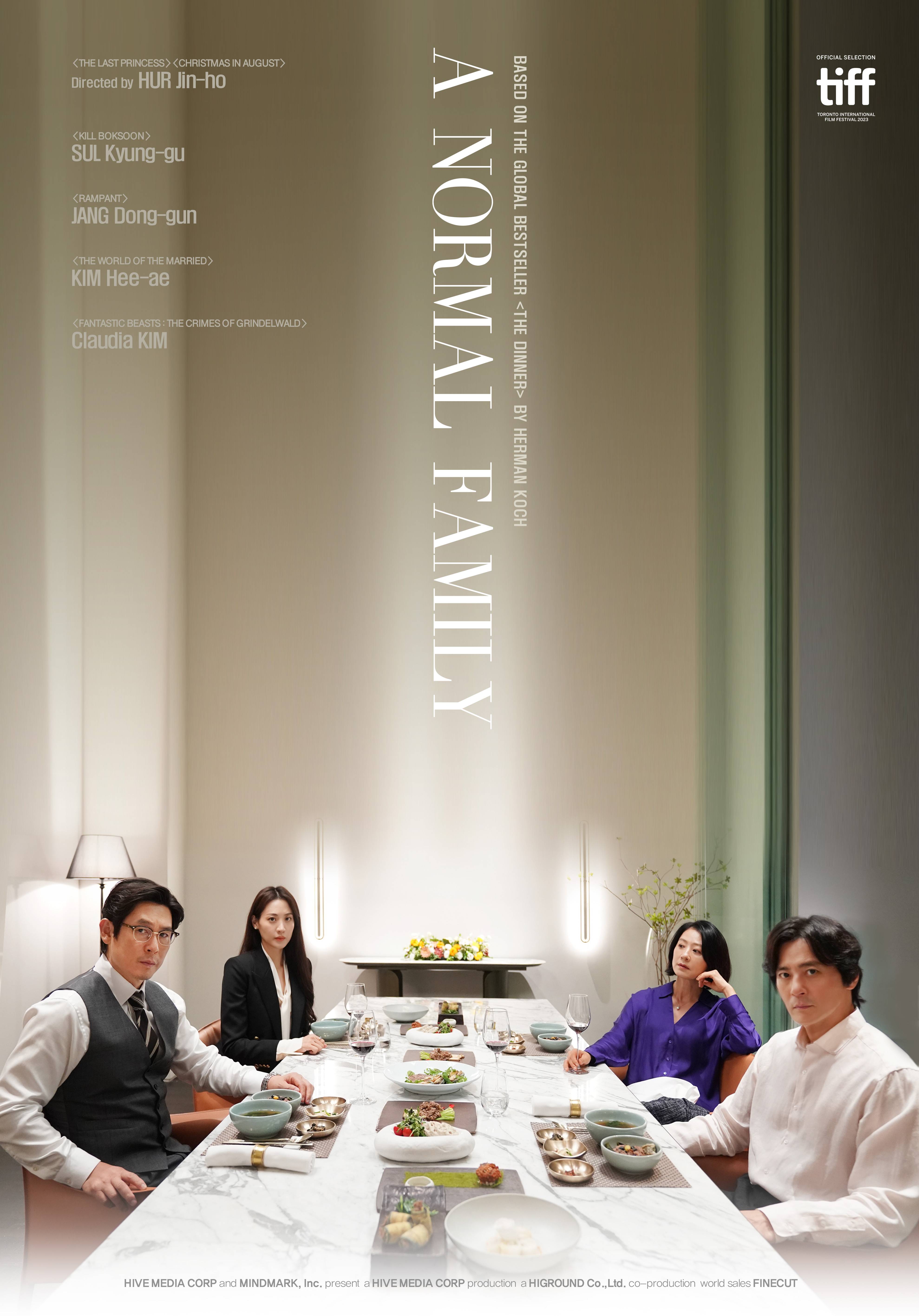
“Parents are weak before their children” according to an apparently doting dad in Hur Jin-ho’s A Normal Family (보통의 가족, Botong-ui Gajok), yet later he will have to ask himself what it means to be a father and what exactly it is that he’s raising his daughter to be. Based on the Dutch novel The Dinner and a departure for Hur who is best known for romantic melodrama, the film nevertheless takes aim at the chaebol culture of the contemporary Korean society in which consequences are only for those without means.
Twin cases further exacerbate the rift between two brothers, cynical lawyer Jae-won (Sol Kyung-gu), and earnest doctor Jae-gyu (Jang Dong-gun) as one finds himself defending the feckless son of a wealthy industrialist, and the other doing his best to save the life of a child seriously injured when a case of road rage resulted in the death of her father. Meanwhile, the brothers’ respective children, Jae-won’s daughter Hye-yoon (Hong Ye-ji), and Jae-gyu’s son Si-ho are later the subject of a viral video which appears to show two teens beating a homeless man half to death.
Jae-gyu had resented his brother and rejected the idea of Si-ho doing an internship at his hospital on the grounds that he wants him to grow up to be a person with “integrity” rather than one who’d unfairly use his privilege and connections to get ahead. Yet as time moves on we begin to wonder if it isn’t also a little because he’s ashamed of his son who is socially awkward and apparently struggling academically. His wife Yeon-kyung (Kim Hee-ae), meanwhile, is a classic helicopter parent who spends an evening out repeatedly calling Si-ho’s phone and irritated when he doesn’t pick up. The implication is that they’re so hellbent on getting Si-ho into a good university to fulfil their own sense of esteem as parents that they’ve raised a child to conventional success that they’ve lost sight of what might actually be best for him as a whole individual.
On realising Si-ho maybe the violent teen in the video, Jae-gyu’s first instinct is to go to the police but he soon loses his moral authority on failing to follow through. Once again, the question is whether they choose to protect Jae-gyu from the consequences of his actions because they fear for him or because they fear the embarrassment his criminal status would bring to them. On the surface, Jae-woo has no such qualms, immediately torching the dress Hye-yoon was wearing that night while going into damage limitation mode trying to keep the teens’ identities secret. Yet he must also reckon with the fact that he’s brought her up in a world without consequences in which conventional morality no longer really applies to her because she is wealthy and has an elite lawyer for a father.
In any case, just as Jae-gyu’s morality began to crumble so Jae-won begins to wake up to the idea that perhaps it’s a problem that his teenage daughter and her cousin beat a man half to death and then went back to their lives without batting an eyelid. Hye-yoon shows no remorse, cheekily asking her father for a car he promised her if she passed her exams while later expressing the view that as the man was homeless, a person who in her eyes had failed to achieve personhood through attaining markers of conventional success such as a degree and steady job, his life was of no consequence. Yeon-kyung later says something similar, not understanding why they’re making a fuss over “someone like that” whose life is worth nothing in comparison to her son’s future.
Yeon-kyung is also relentlessly rude to Jae-won’s second wife, Ji-su (Claudia Kim), who is from a much more ordinary background and does everything she can to try and get along with her. Ji-su presents a much more conventional moral compass in considering what kind of mother she wants to be not only to her own newborn child but to Hye-yoon who like Yeon-kyung mainly treats her with contempt. It’s she who begins to wonder if covering this up is really the right thing for Hye-yoon and Si-ho or if failing to show them that actions have consequences will only encourage them to behave in ways otherwise offensive to a commonly held sense of humanity.
The brothers switch sides, but the truth is that each of them has been teaching their children the wrong lessons in creating a world in which money settles everything and consequences are only for those who can’t pay. Yeon-kyung tries to justify herself that as she’s done a lot of good deeds it somehow balances out, Si-ho too echoing her on suggesting going to church as if you could buy your right to behave badly by saving up goodness points which is also another way of saying that consequences don’t apply. The children think that as long as they fulfil the role they’re expected to play, get good grades and become successful members of society, then nothing else really matters. Darkly comic, Hur’s steely drama suggests that the inequalities of the contemporary society, the elitism and anxiety have slowly eroded not only the most essential of relationships but the soul of the nation’s children who know nothing other than those with money need not pay for their crimes.
A Normal Family screened as part of this year’s London Korean Film Festival.
Original trailer (English subtitles)
 Windows on Worlds