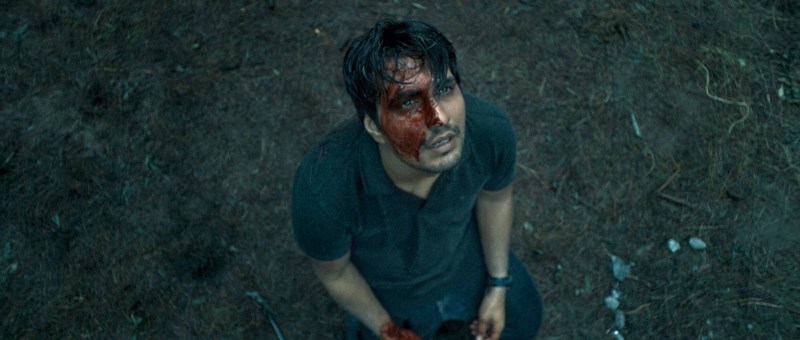
Death Knot (Tali mati, Cornelio Sunny, 2021)

Orphaned siblings attempt to process the dark legacy of the superstitious past in the debut feature directed by and starring actor Cornelio Sunny, Death Knot (Tali mati). Travelling from the comforting sophistication of the modern city back into the eerie darkness of the ancient forest, the pair find themselves confronted first by a filial dilemma and then a spiritual conundrum in their potential destiny which their possibly shamaness mother may have gone to great lengths in order to prevent. 

As the film opens, Hari (Cornelio Sunny) texts with his younger sister Eka (Widika Sidmore) who somewhat sexistly tells him not to stay single too long because he needs someone to cook for him. Falling asleep watching a program in which a woman remarks on the presence of jinns as manifestations of energy that can’t be seen by the naked eye, Hari has a strange dream in which he witnesses his mother hanging herself in the forest in the middle of the night uttering only the words “stay away”. As it turns out, Eka had exactly the same dream and a phone call from their estranged uncle who rather bluntly tells them that their mother is dead and as the villagers won’t have anything to do with her they need to come for the funeral, confirms their worst fears. Ignoring the warning in the dream, Hari, Eka, and her husband Adi (Morgan Oey) drive back to their home village but quickly find themselves out of their depth trying to figure out what’s going on. 

The first clue is the reaction from a previously friendly old woman who suddenly gets up and walks off after exclaiming that the body should have been burned not buried when Hari stops to ask for directions. The second clue is that only three people including their uncle turn up for the funeral. The third clue is that everyone keeps telling them to leave town right away while the fourth is that they can’t because of a mysterious storm that has apparently closed all the roads. Meanwhile, hostile uncle Rahmen immediately asks for what seems like a lot of money to cover his expenses for the clandestine funeral and then wastes no time staking his claim to their mother’s house. Though neither of the siblings want it, the request offends Hari who feels guilty that he never really got to know his mother and is wary of abandoning the last traces of her in the house she once owned. 

Described by Adi as creepy, the house does however have a dark legacy, the pair already aware that their father left and took them to the city because of their mother’s strange behaviour that saw her ostracised by the other villagers who suspected her of being a shamaness responsible for a strange phenomenon known as “The Harvest” in which spates of suicides take place across a specific month. Hari tries to rationalise it away, pointing out that it’s hard to live in rural poverty and putting a label on unexplained deaths is easier than admitting that people are taking their own lives because of economic precarity and an ongoing sense of despair, but with the increasing strangeness all around him he has to admit a degree of spiritual unease in this fiercely traditional world he is ill-equipped to understand. 

Rather than hauntings and jump scares, Cornelio Sunny concentrates on conjuring an atmosphere of supernatural dread in which anyone may suddenly become a grinning demon, performing strange ritualistic dance and odd movements only to suddenly disappear from view. An educated man from the city, Hari quickly becomes fed up with talk of ancestral deities, pacts with the devil, and black magic, only latterly accepting his role within an arcane system and understanding that his mother’s distance may have been her way of protecting him which has in the end backfired. Yet having destroyed the symbol of this spiritual oppression, Hari discovers that there may be no escape from its darkening legacy or the atavistic superstitions of the villagers, an ominous cloud always hanging over him even as he faces the final choice of whether to continue fighting or accept the inevitable. Proceeding with moody fatalism, the ironically titled Death Knot ensnares its confused hero in a tightening noose of spiritual dread and filial guilt before cutting him adrift a victim of his own sophistication. 


Death Knot streamed as part of this year’s hybrid edition Udine Far East Film Festival.

Original trailer (English subtitles)

Gundala (Joko Anwar, 2019)

“If we see injustice before our eyes and do nothing then we’re no longer humans” the idealistic father of a future superhero instructs his young son, trying to impart a sense of humanitarianism as a basic moral good. It’s a lesson the boy will find himself unlearning and resuming later, his innocence well and truly destroyed by an often cruel and cynical society only to be reawakened to the idea that it doesn’t need to stay that way. Among the most recognisable names of Indonesian cinema, Joko Anwar turns his hand to the creation of a local comic book cinematic universe, adapting the 1969 comic Gundala by Harya “Hasmi” Suraminata for the present day filtering contemporary Jakarta through classic Gotham. 

Operating as an origin story for the titular hero, Gundala opens with the young hero Sancaka (Muzakki Ramdhan) unable to prevent his father’s (Rio Dewanto) death due to his fear of electrical storms when he is first set up by a duplicitous factory boss and then assassinated while leading a protest for fair pay and conditions. Soon after, Sancaka loses his mother (Marissa Anita) too after she is forced to go to the city for work and never returns. Ending up a ragged street kid, he’s saved from an attack by a rival gang by an older boy (Faris Fadjar Munggaran) who teaches him how to protect himself physically and mentally by convincing him that the only way to survive on the street is keep his head down and walk on by even if it looks like others are in trouble. 20 years later the adult Sancaka (Abimana Aryasatya) is an aloof young man working as a security guard at a print house where his sympathetic mentor Agung (Pritt Timothy) begins to remind him of his father in his conviction that “living is no use if you stop caring and only think about yourself”, while he also finds himself defending the woman next-door, Wulan (Tara Basro), and her young brother Teddy (Bimasena Prisai Susilo), from hired thugs sent to intimidate them because of their involvement in a protest against the forced redevelopment of a local marketplace.  

Events seem echo around him. The major villain Pengkor (Bront Palarae) is also an orphan but on the opposing side as the son of a cruel plantation owner murdered by his not altogether ideologically pure workers whose desire for fair pay and conditions he had resolutely ignored. According to cynical politician Ridwan (Lukman Sardi), Pengkor became a union organiser of his own, leading an uprising at the abusive orphanage he was placed into by a cruel uncle hoping he’d die and free up the inheritance, thereafter becoming a kind of godfather to the fatherless with a thousands strong army of eternally grateful orphans he saved acting as sleeper agents for a coming revolution. 

Pengkor’s nefarious plan involves fostering a conspiracy surrounding contaminated rice said to make the unborn children of the women who eat it turn out “immoral”, a generation of psychopaths unable to tell right from wrong. Fairly unscientific, it has to be said, but playing directly into the central questions of the nature of “morality” in a “immoral” society. Can it really be “moral” for bosses to exploit their workers and get away with it, for politicians to cosy up to gangsters and remain complicit with corruption, and for a man like Pengkor to be the only hope for orphaned street kids otherwise abandoned and ignored by a wilfully indifferent society? Pengkor decries that hope is the opiate of the masses, but that’s exactly what Gundala eventually becomes for them in his “electric” ability to resist, eventually rediscovering his humanity as he designates himself as the embodiment of “the people” pushing back against the forces of oppression and seeming at least to win if only momentarily.  

Young Sancaka’s fear of lightning is, in essence, a fear of his power and his social responsibility something he is quite literally shocked into accepting. In a world of quite striking social inequality, he finds himself the lone defender of the oppressed whose very existence spurs others, including previously cynical politician Ridwan, into rediscovering their own humanity in the resurgent hope of a better future. As someone puts it, peace never lasts long but you keep fighting for it because every moment is precious. Not so much a battle of good versus evil as a battle for the meaning of good, Anwar’s Gundala recalibrates the anxieties of the late ‘60s for the modern era and creates an everyman hero not only to resist them but to foster a spirit of resistance and humanity in the face of heartless cynicism. 


Gundala streams in Poland until 6th December as part of the 14th Five Flavours Film Festival.

Original trailer (English subtitles)