
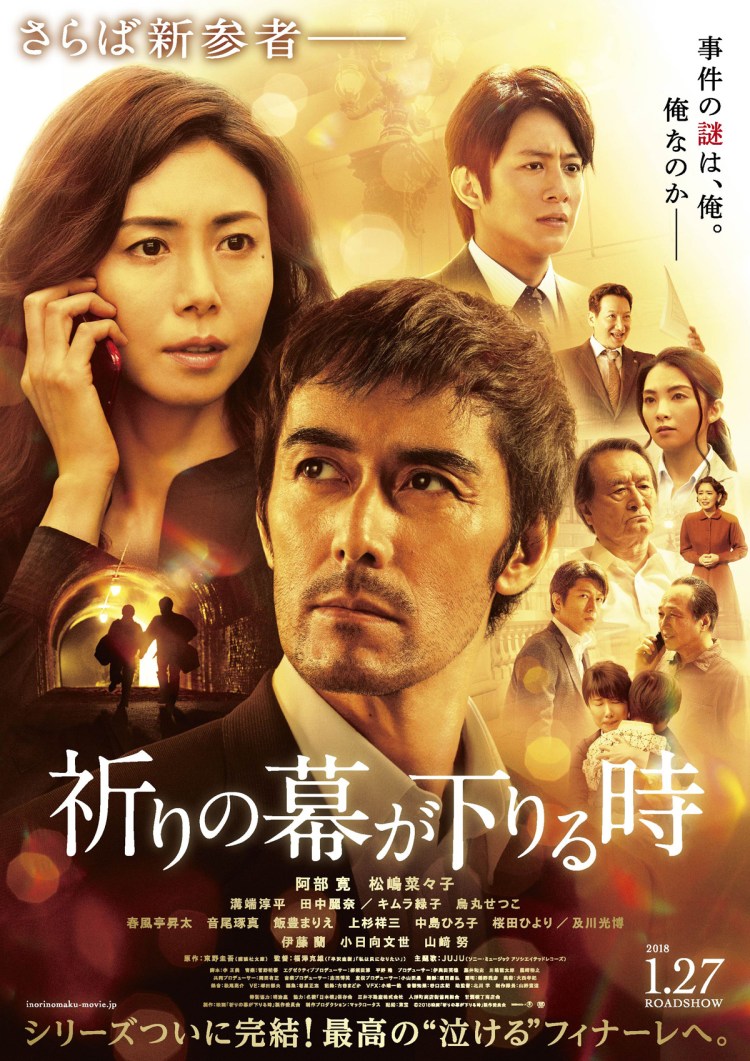
 Detective Kyoichiro Kaga has become a familiar screen presence over the last decade or so in a series of films and TV dramas starring popular actor Hiroshi Abe which might make it something of a surprise that The Crimes That Bind (祈りの幕が下りる時, Inori no Maku ga Oriru toki) is, after a fashion, a kind of origin story and touted as the culmination of the long running franchise. Another of prolific author Keigo Higashino’s key detectives, Kaga’s stalking ground has always been Nihonbashi where he has managed to make himself a friendly neighbourhood cop but, as it turns out, dedication is not the only reason he’s refused promotions and transfers to stay in what is, professionally at least, something of a backwater.
In fact, the film begins way back in 1983 when a young woman, Yuriko (Ran Ito), ran away from her husband and son to become a bar hostess in Sendai offering only the explanation that she felt herself unworthy of being a wife and mother. Some years later in 1997, she met a nice man – Watabe, but died of natural causes in 2001 at which point we discover that she is none other than the long lost mother of our master detective whom she abandoned when he was only eight years old. Being a compassionate man, Kyoichiro Kaga is not angry with his mother only sorry he did not get to see her before she passed and eager to meet the man who made her last years a little happier. Only, it appears, Watabe has also disappeared without trace. The only thing the Mama-san at the bar where Yuriko worked can remember about him is that he once said he often went to Nihonbashi. Kaga searches for the next 16 years with no leads, which is when the main case kicks into gear with the discovery of a badly decomposed body of a woman in a rundown Tokyo flat.
Of course, the two cases will turn out to be connected, giving Kaga an opportunity to investigate himself and come to terms with his difficult family circumstances including his strained relationship with his late father whose coldness he blames for driving his mother away. Parents and children will indeed develop into a theme as Kaga digs into why his mother might have done the things she did while also trying to reverse engineer his clues to figure out why he seems to be at the centre of an otherwise completely unrelated case.
Meanwhile, pieces of the puzzle seem to drop into place at random such as the fortuitous discovery of an old woman claiming to have lost her memory so that she can stay in hospital who may or may not be linked to one of the prime suspects – a top theatre director also known to Kaga thanks to a chance encounter some years earlier. In a neat twist, the theatre production she is currently trying to put on is Love Suicides at Sonezaki – a sad tale of young lovers, an adopted son of a merchant and a courtesan, who realise that they have no freedom to pursue their desires and so decide that their only solution is double suicide. The truth that Kaga uncovers leads him in much the same direction only the love at stake is familial rather than romantic and built on the strange filial interplay of the connection between a parent and a child.
It is quite literally “crimes that bind”, but Kaga’s repeated mantra that lies are the shadow of truth, illuminating as much as they conceal, does not quite fit with the incident he has been investigating which largely hinges on coincidences which place him, improbably, at the centre and tip him off to the hidden connections which will crack the case. Which is to say, the solution lies in the killer overplaying their hand (though for reasons unrelated to crime) and thereby undermining their carefully won subterfuge. Torn between solving the murder and exploring Kaga’s melancholy backstory, The Crimes That Bind finds itself falling between two stools even as its twin plot strands begin to dovetail as neatly as one assumes they eventually will, laying bare the central themes of parental sacrifice and belated filial gratitude. Playing best to those already invested in the Kaga franchise, Katsuo Fukuzawa’s adaptation may serve as a fitting conclusion (to this arc at least) but cannot quite overcome its over-reliance on confessional flashback as method of investigation or the improbable qualities of its admittedly twist filled central mystery.
International trailer (English subtitles)
 Windows on Worlds