Leonor Will Never Die (Ang Pagbabalik ng Kwago, Martika Ramirez Escobar, 2022)

A grief-stricken screenwriter resolves to write her way out of self-imposed inertia while trapped in a world of her own creation in Martika Ramirez Escobar’s meta dramedy Leonor Will Never Die (Ang Pagbabalik ng Kwago). Drawing inspiration from the action exploitation films of the 1980s, the film asks some big questions about grief and agency and the role stories play in our lives while celebrating a sense of community in cinema along with the accidental immortality it may grant. 

Once a successful screenwriter of action films, Leonor Reyes (Sheila Francisco) is now an elderly lady who has largely shut herself away following the tragic death of her eldest son, Ronwaldo (Anthony Falcon). Her youngest, Rudie (Bong Cabrera), still lives with her but as she later reveals there is distance between them and a sort of repellant dependency in which each resents the other and longs for freedom while simultaneously afraid to chase it. When Leonor “forgets” to pay her electricity bill and is berated by Rudie, she is handed a newspaper by the ghost of Ronwaldo containing an ad for a screenplay competition and decides to dust off the script she broke off when he died. While taking a cigarette break, she is hit on the head by a flying TV thrown out by the man next-door fed up with his wife’s addiction to soap operas and finds herself falling into the world of the film hoping she can save the hero, also named Ronwaldo (Rocky Salumbides), from his tragic fate. 

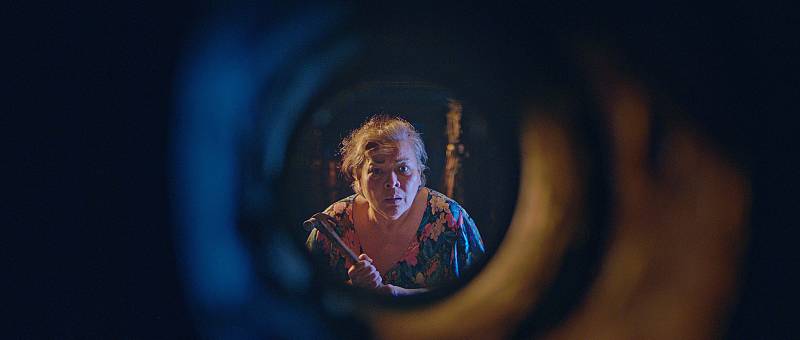
Shifting into a grainy 4:3 with mono aural sound, Escobar perfectly recreates the world of retro action drama but subtly updates it from its Marcos-era backdrop in replacing activists with drug users, her authoritarian thugs carrying out extrajudicial killings for reasons of intimidation. The movie Ronwaldo is set on revenge against a corrupt mayor and his vigilante son who shot his brother and then placed a pistol and a small packet of drugs next to the body, resisting authoritarianism in a way it may not have actually been possible to do so directly in the movies of the past. In any case, Leonor slips into her own screenplay as an awkward omnipotent force writing as she goes but struggling with her own role and agency before picking up a hammer and venturing into danger to rescue the hero and his love interest herself.  

From the other side of the screen, Rudie asks her if she’d be OK with someone else finishing her screenplay which is in a way asking her if she’s alright with her final decisions being made for her. That might be what Leonor is trying to decide for herself by rewriting in real time, searching for the right ending for her life’s story. Rudie had resented his mother, blaming her for keeping him behind when he planned to apply for an overseas work visa to join his boyfriend abroad but she wonders if he isn’t just using her as an excuse while afraid to take the risk. She by turn insists she can manage alone, but is perhaps afraid she can’t which, along with the grief she feels over Ronwaldo’s death, leads her to push him away. 

Leonor’s coma perhaps brings them both clarity that allows them to discover what it is they really want, Rudie finally handing agency back to his mother in telling her do what she has to do in a world of her own creation while she tells both her sons to be sure they write their own lives. The doctor had told Rudie that Leonor was trapped in a world between sleeping and waking and that you can’t wake someone who is not asleep, they will have to find a way to escape by themselves something which in one way or another Leonor perhaps does coming to terms with Ronwaldo’s death and breaking free of her grief through recapturing her creative spirit if writing a poetic end for herself. Then again as an authorial voice breaks through, life is never as simple as narrative and we’re rarely given the opportunity to edit our own stories or decide the way in which they end, perhaps Leonor isn’t either but even so passes into a world of joy and song in which there are no real endings only a great expanse of cinema. Charmingly surreal and filled with good humour, Leonor Will Never Die is at once the story of an old woman rediscovering herself while letting go of her grief and a celebration of escapist pleasures as paths towards self actualisation. 


Leonor Will Never Die screens in Amsterdam on 30th October as part of this year’s Imagine Fantastic Film Festival.

US release trailer (English subtitles)
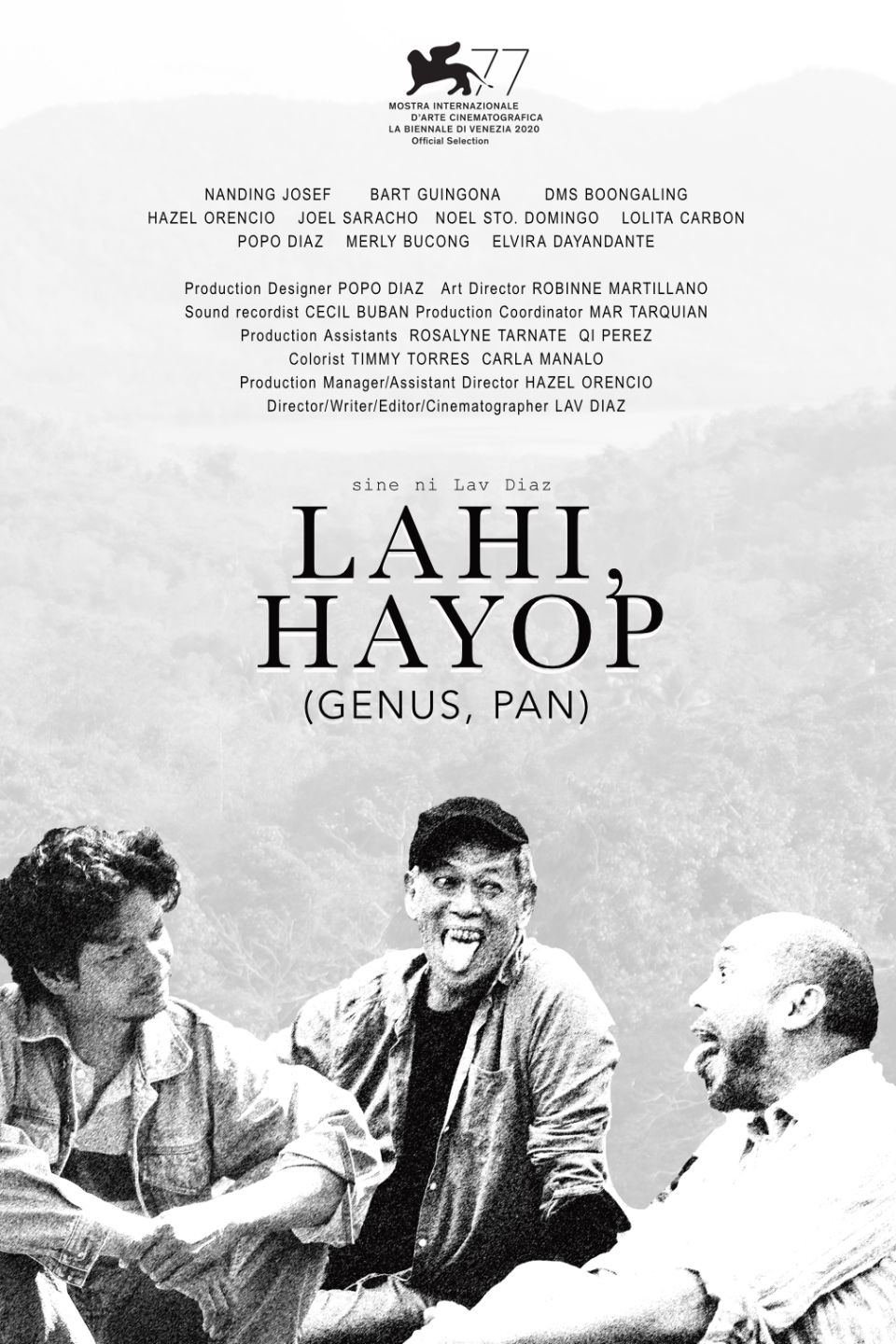
Genus Pan (Lahi, Hayop, Lav Diaz, 2020)

“Use your mind not your emotions” the hotheaded youngster of Lav Diaz’ Genus Pan (Lahi, Hayop) is repeatedly told, perhaps ironically by an earnest man of faith. Diaz’ shortest work in quite some time at a comparatively trim 156 minutes, Genus Pan is also among his most accessible in its seeming directness but carries with it hidden depths in its questioning of the “unevolved” human psyche, no better than an ape unable to overcome its baser instincts or cure the curse of human selfishness in which the only way to escape oppression is by becoming an oppressor. 

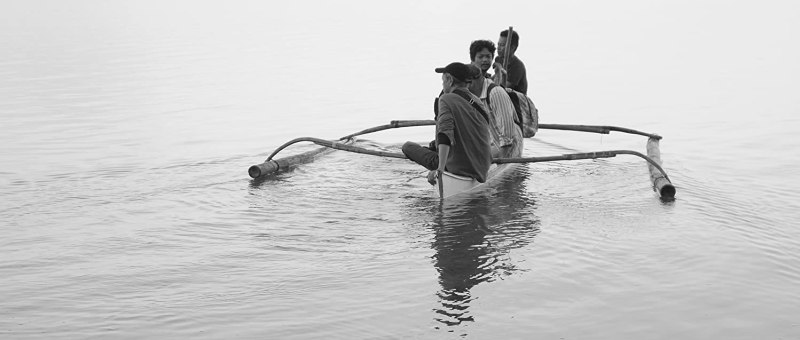
This is what Andres (Don Melvin Boongaling) fears has happened to his sometime friend, Baldo (Nanding Josef). As the film opens, the men are collecting their pay but as is customary the money is depleted before it even enters their hands with so many charges and deductions symptomatic of a world of normalised exploitation. Baldo found jobs at the goldmine for the young Andres and his old friend Paulo (Bart Guingona) but expects a cut of their pay as a brokerage fee, money Andres is loathe to give him both on principle and because he needs it to pay for medical treatment for his ailing sister. Baldo, however, is unsympathetic accusing the young man of ingratitude and disrespect. The three men are to travel back to their home village together on a boat Baldo has paid for, instructing the boatman to drop them at the far end of the island in order to avoid having to pay any more “fees” to the various authorities they may otherwise encounter in town, after which they will journey on foot through the forest. 

The forest itself is a primal place in which man is most aware he is also an animal. This fact is perhaps brought home to the men thanks to a broadcast received on Paulo’s radio in which a psychologist expounds on the idea that the human brain is largely underdeveloped, the marking of a developed mind a predisposition towards altruism. There is not so much difference, he argues, in the mind of an average human with that of an ape, “Genus Pan”, ruled by its basest instincts of selfishness and violence. Left alone in the forest and forced into mutual dependency, the differences between the three men each in their own way archetypes begin to strain their relationship. Paulo, a deeply religious man who spends most of his time reading the bible, is the peace maker but is also hiding a dark secret which perhaps informs his unexpectedly cynical advice to the earnest Andres who declares himself sick of his world of constant corruption, unwilling to be “a witness to this kind of dirt all my life”. Andres resents Baldo not only for the practical impact of his attempts to extort him, but that he has given in to the world’s venality and become another oppressor just like everyone else. Paulo advises him to use his head not his heart which would doubtless tell him that resistance is futile, but even in his nobility Andres cannot escape his rage at this infinitely feudal world in which a powerful few carry untold authority. He alone raises concerns about conditions at the goldmine where being buried alive is not an uncommon occurrence, not to mention the other mysterious deaths and disappearances, and longs for answers as to the murder of his brother he suspects for refusing to pay bribes to the local authorities, along with the spurious imprisonment of a local woman, the rape of a pair of sisters, and abuses against an indigenous mountain community.  

At the forest’s edge, Paulo reveals to him what it might have cost to escape his oppression as a member of a circus ruled by a cruel and sadistic tyrant, lamenting that in truth they were never able to escape Hugaw Island the ironic name of which apparently means “dirt”, given to it under the Japanese occupation in which it housed a comfort women station where women kidnapped from surrounding islands were forced into sexual slavery. The action shifting to another three men, the oppressors the Captain (Popo Diaz), Sergeant (Noel Sto. Domingo), and the least “developed” mind of all the calculating thug Inggo (Joel Saracho), further history of the island is revealed in its past as a smuggling hub unfairly defamed by foreign powers who spread rumours of its dangers to keep the curious away. Inggo longs to get his hands on the “jar of truth”, a burden later entrusted to Baldo’s daughter Mariposa (Hazel Orencio) who can move only very slowly yet is often carrying tremendous weight. 

Shooting in his familiar style, monochromatic static camera and long takes, Diaz’ shocking shift to handheld to dramatise false testimony as Inggo conspires against Andres to quell his rebellion hints at the irrational instability of “truth” and its potential for misuse at the hands of men like Inggo. A lone holdout against post-colonial feudal oppression, Andres’ refusal to capitulate cannot stand. As Paulo had warned him, he is a threat to the social order. The “smart” ones play along, and then like Baldo they join in while the Inggos of the world continue to prosper in their smug and heartless cruelty. “The island people are mute” a bereaved mother laments, “fear has taken over”. Ending on a note of intense anxiety, Genus Pan suggests that the civility we believe separates man from beast is at best paper thin while resistance is met only with futility when those in power are free to act with absolute impunity. 


Genus Pan streams in the UK 11th October, 5.30pm to 14th October, 5.30pm as part of this year’s BFI London Film Festival.

Original trailer (English subtitles)