Beast Alley (けものみち, Eizo Sugawa, 1965)

In the opening title sequence of Eizo Sugawa’s Beast Alley (けものみち, Kemonomichi), a thick blob of inky blackness gradually expands over an aerial view of the city until it obscures it entirely. The title card which then appears is written in plain white, but will reappear at the film’s conclusion this time ashen as if it too had been singed by the deeply ironic flames with which the film ends. Based on a novel Seicho Matsumoto and scripted by The Beast Shall Die’s Yoshio Shirasaka, the film similarly takes an incredibly cynical view of the modern post-war society in which it is revealed the militarists are still basically in charge and presiding over a deeply corrupt social order. 

The big bad, Kito (Eitaro Ozawa), says as much when he states the need for reforming the nation’s “rotten political system” by which he means post-war democracy. Kito made his made his money doing deeply dodgy things in Manchuria in addition to running an exploitative coal mine in Japan. Now mainly bedridden, he basically runs the country as a far-right political fixer working in tandem with big business and the yakuza who have traditionally been big supporters of conservative and nationalist forces. Early on we see one of his underlings negotiating with politicians to ensure that Taiyo Roads will be hired be hired for a large scale construction project planning to put highways all the way through Tokyo. As we later discover, he’s prepared to go to great lengths in order to achieve his goal, going so far as to have a sex worker murdered to implicate the uncooperative CEO of a rival construction film into resigning by threatening to frame him for the crime so they can install their stooge in his position. 

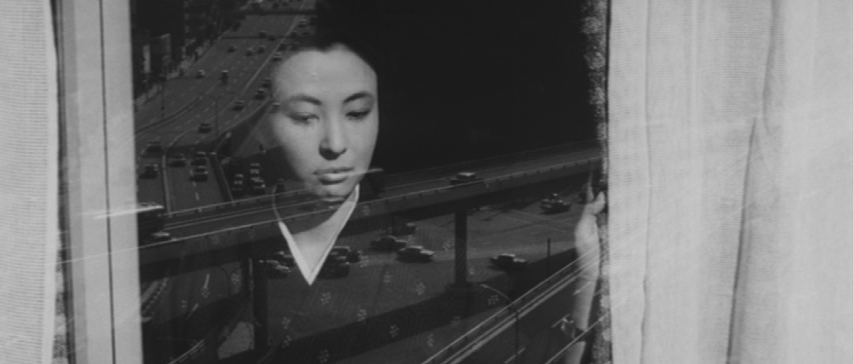
It’s into this world that everywoman Tamiko (Junko Ikeuchi) is drawn while working as a hotel maid at a traditional Japanese inn. Trapped in a bad marriage to a man who is also bedridden yet still attempts to rape her when she returns home to find him in bed with the housekeeper, Tamiko longs for escape and is therefore ripe for the picking when approached by Kotaki (Ryo Ikebe), the manager of an upscale Western hotel, to join him in an unspecified enterprise which will apparently make her very rich. The only catch is that she will have to “get rid” of her “dependent”, which she probably wanted to do anyway, by burning down her house with him inside it. Once she’s done this, there is no turning back for her even if she had not developed complicated feelings for Kotaki who is both her salvation and damnation. 

Tamiko’s husband had failed to give her the comfortable life that he had promised, something which she thinks Kotaki can deliver even if it requires her to become the plaything of Kito whom does she actually seem to like even if aware of the precarity of her position and still in thrall to Kotaki. Leaving the hotel so abruptly was however a strategic error as it arouses the suspicious of (originally) earnest cop Hisatsune (Keiju Kobayashi) who quickly realises that Tamiko set the fire to kill her husband. Though he seemed to be motivated by justice, Hisatsune too is soon corrupted explaining to Tamiko that he has become cynical and jaded. Years of police work have shown him that true criminals know how to break the law and get away with it so he can’t do anything about them, but “good” people, like he implies Tamiko, are pushed into crime by desperation and are easily caught. Tamiko wields her sexuality against him by agreeing to a tryst, though when it doesn’t go to plan he tries blackmail and then rape before she, ironically, manages to escape from his bungled crime. 

Hisatsune’s corruption is gradual and self serving. He starts with suspicion, tailing Tamiko in the interests of justice but also because he desires her, before stumbling on the conspiracy, putting the pieces together, attempting to use them for his own gain and trying to blow a whistle mostly out of resentment. Kito’s reach is all encompassing. Hisatsune is warned off investigating certain aspects of the crime by his senior officers and is then fired on Kito’s instructions for fiddling his expenses after harassing Tamiko. He tries to give his findings to his boss but it goes nowhere and then tries the press but is given the brush off, the editor his reporter friend refers him to gently implying he’s just a crank with an axe to grind. Of course, it turns out that the reporter is already in league with dodgy lawyer Hatano (Yunosuke Ito) who is Kito’s right-hand man. 

The connections between the three men, Kotaki who was once a communist, Hatano, and Kito go back to Manchuria and the corruptions of militarist era which it becomes clear has never really ended. Kito has only one rival and it’s another faction of the conservative ruling party who are probably just waiting for him die. Attempts are made on his life and they don’t go well for those who make them. Even if Hatano hoped to simply inherit an empire he, as he points out, put in much of the work to build he is sorely mistaken while Tamiko may intellectually understand that Kito’s death would place her in a precarious position but carries on regardless. “You never know who will betray you in this world” Kotaki laments, echoing Kito’s later claim that his Buddhist statues are the only ones will never betray him even as sleeps next to a statue of Aizen Myo whom he ironically claims protects mankind from their lust and desire. 

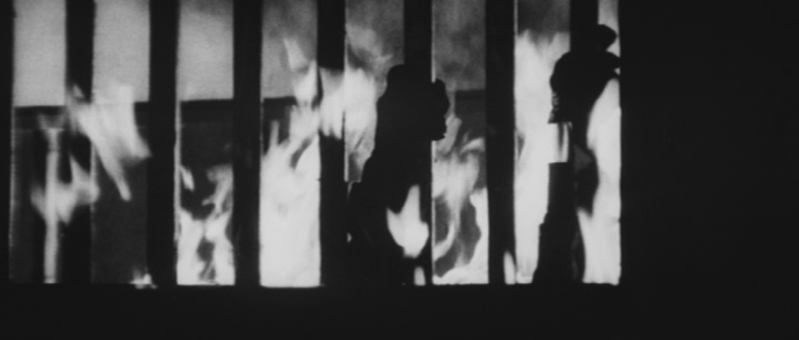
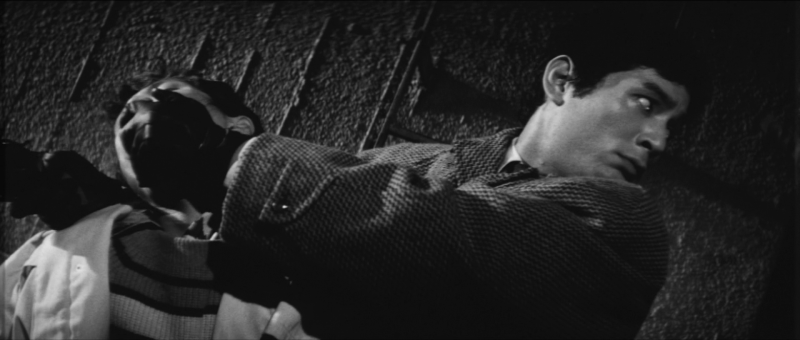
It could be said that desire is Tamiko’s undoing, but as Hisatsune had suggested perhaps you couldn’t blame her for longing to be free of the bedridden husband who had not delivered what he promised her. As she said, she was doing what could to survive even if you’d think she’d know putting on a ring taken from the finger of a murdered woman is akin sealing your own fate. Sugawa shoots with a noirish sense of dread, tracking Tamiko with her coat drawn up around her face as she tries to leave the scene of her crime, and makes the most of his fiery imagery before ending on a note of cynical laughter amid the inescapable hell the of post-war society. 


Original trailer (English subtitles)
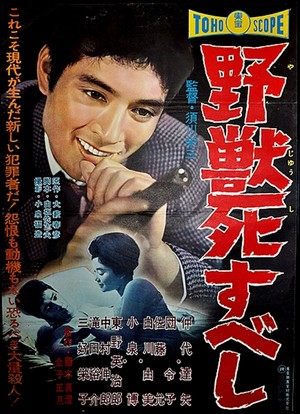
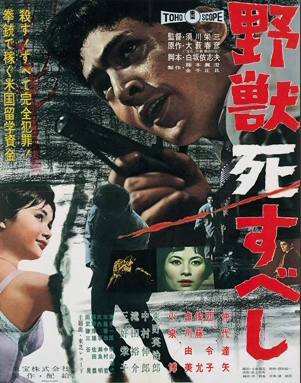
The Beast Shall Die (野獣死すべし, Eizo Sugawa, 1959)

“He’s not a beast. No, he’s a robot. A machine created by a modern, twisted society” according to a frustrated policeman acknowledging that a sociopathic killer is going to get away with his crimes because when it comes right down to it he’s just that good. Eizo Sugawa’s The Beast Shall Die (野獣死すべし, Yaju Shisubeshi) is the first of several adaptations of the hardboiled novel by Haruhiko Oyabu, Sugawa would himself direct a “sequel” 15 years later while a better-known version would prove a hit for Toru Murakawa in 1980 with action star Yusaku Matsuda in the leading role, and a two-part V-cinema adaptation would follow in 1997. The 1959 edition however is very much an expression of the anxiety of its times, a slightly reactionary take on the post-Sun Tribe phenomenon hinting at a generational divide between the nihilistic, hyper individualist post-war generation and their confused though morally compromised forbears. 

As the film opens, three policemen meet in a pub one of whom proudly shows off a Robby the Robot toy he’s picked up for his young son and is intending to give him on returning home from work. Sadly, however, Okada (Akira Sera) will never make it home because, for largely unexplained reasons, he is shot dead by nihilistic American literature student Date (Tatsuya Nakadai) who bundles the body into the boot of a car which he then simply abandons. Date never reveals much of a motive for this first murder, but he does later use Okada’s warrant card and service weapon to facilitate later crimes. 

The problem, at least for earnest policemen Kawashima (Eijiro Tono), a veteran cop and father of seven, and idealistic rookie Masugi (Hiroshi Koizumi) who is engaged to barmaid Yoko (Yumi Shirakawa) but drags his feet over the marriage because of his precarious life as a law enforcement officer, is an ideological divide within the contemporary police force. “Investigations are about science. And science is the best” according to their boss, reflecting a new faith in forensics prioritising physical evidence from the crime scene over a policeman’s intuition. From a modern perspective, this seems to be the right call though Kawashima and Masugi appear to find it both restrictive and mildly insulting as if their experience on the job now counts for nothing. They also worry that such rigid thinking prevents thorough investigation, and they might have a point in the boss’ continued insistence that the crimes must be down to “gang activity” even though the evidence clearly points at someone connected to the university or perhaps a disgruntled salaryman with access to the uni gun club. 

Kawashima and Masugi lament that they feel powerless to act because they don’t have the right to arrest someone on the basis of a “hunch”, and the film seems to agree with them as Date continues to commit his crimes unbothered by law enforcement though really who wants to live in such an authoritarian society that the police can haul you in solely because they think there’s something odd about you and “feel” you must be guilty of a crime even in the absence of conclusive evidence? Nevertheless it’s precisely these ideological divides that Date wilfully exploits while planning his hits, his second targets also reflecting the continuing Sinophobia of post-war cinema in impersonating a police officer to rob, but interestingly not kill, a pair of Chinese gangsters running an illegal gambling racket. 

Hearing Date’s back story, we realise that society has in a sense warped him in witnessing an injustice done to his father which later led to his suicide while his mother was apparently engaging in an affair with the man who framed him. He strongly argues that the only response to the “chaos, madness, and contradictions” of the modern society is to “show our beastly nature”, wilfully abandon humanistic morality and conventional civility in favour of an individualistic satisfaction of one’s personal desires above all other concerns. Date is certainly an amoral man who has no problem with sacrificing those he determines to be lesser beings for his own gain, but as even Masugi reveals his thinking may not be out of line with that of his generation. Many people are driven to murderous rage, he argues, but do not act on it because of a social taboo. 

As the film opens, a group of left-wing students is holding a rally in support of the anti-ANPO protests ahead of the treaty’s imminent renewal, though the professors mock them from inside insisting that their politics is not genuine only a reflection of the despair they feel in their society knowing that even if they graduate all that awaits them are low-level salaryman jobs with little promise of advancement. Those who can’t even manage that, they joke, turn to academia. Date’s professor (Nobuo Nakamura) affects sympathy with his poverty but also wilfully exploits him, getting him to do translations of novels which will later be published under his own name while it seems to be an open secret that he owes much of his success to the fact that he married into a prominent family which allowed him to spend five years studying abroad in America. 

Meanwhile, his students philosophise on the psychology of crime insisting that a “robotic, truly ruthless personality” can only come from a “mechanistic society like the US” while Japanese criminals are generally “emotional” in that crimes are committed because of “love affairs, resentment, finances”, “petty humanistic motives” which society can easily understand if not exactly condone. Date, admittedly a student of American literature with his eyes firmly set on going abroad, entirely disproves this theory. His crimes appear to be dispassionate and committed largely for practical reasons, the later ones at least with money as the motive even if he also derives a thrill from his amoral rebellion against the system. His poverty is offered as a justification yet we also see him abuse and manipulate those weaker than himself, humiliating an old lady trying to sell flowers in the bar where Yoko works while later talking a fellow student suffering with TB and unable to pay his tuition into helping him commit a robbery. 

Perhaps in someways uncomfortably in continuing a motif associating homosexuality with sadistic criminality, it’s also heavily implied that Date is bisexual, encountering an effeminate young man on the street with whom it is clear from their conversation he has previously been intimate to later use him as cannon fodder when engaging in a firefight with Chinese gangsters, while there is also an obvious homoerotic charge to his relationship to the student who later becomes a temporary accomplice. His relations with women are somewhat caddish and perfunctory, his sometime girlfriend Tae (Reiko Dan) telling the police that Date is a player who only sleeps with the same woman three times before becoming bored with her. Date’s attitude, though interestingly enough not his crimes, may reflect a societal misogyny, impoverished medical student Tae later refused access to the morgue because it’s not something a woman should see, though Tae herself later claims that it’s Date’s coldness and cruelty that draw her to him. Seemingly unable to feel genuine emotion for others, it nevertheless appears that Date is in a sense moved enough by Tae’s ability to embrace his inner darkness to eventually decide to alleviate her poverty on realising he no longer needs his ill-gotten gains because he’s secured his passage to America through more legitimate means. 

A reaction to the post-Sun Tribe sense of moral panic about disillusioned post-war youth, The Beast Shall Die suggests that for the moment at least those like Date are in an unassailable position thanks to an overly liberal justice system as the two policemen lament their inability to prevent his escape through judicial means while turning their attention to Tae though there’s no real way they can know that Date gave the stolen money to her rather than taking it with him or depositing it in some other location even if she’s walking around with an ugly handbag that might be full of cash. Alternating between an acceptance of Date’s nihilistic, crypto-fascist philosophy in implying that those who obey the rules of civility are doing so solely because they are too weak to break them, and advocating for a more authoritarian society in which policemen are free to act on their “hunches”, Sugawa’s take on Oyabu’s hard boiled tale of societal corruption and warped post-war morality has its reactionary qualities even as it ends on a note of ambiguity that implies order will eventually triumph though not, it seems, today. 


Original trailer (no subtitles)