Genocide (昆虫大戦争, Kazui Nihonmatsu, 1968)

In the early 1960s, tokusatsu movies had begun to slide towards something which was much less serious than the early days of the genre, but as the decade went on others edged in the direction of the ‘70s paranoia thriller expressing a nihilistic view of contemporary Cold War geopoliticking. Given the rather provocative English title Genocide (昆虫大戦争, Konchu daisenso), as opposed to the more recognisably genre-inflected “great insect war”, Kazui Nihonmatsu’s wasp-themed disaster film is part anti-nuclear eco-treatise and part anti-US spy movie.

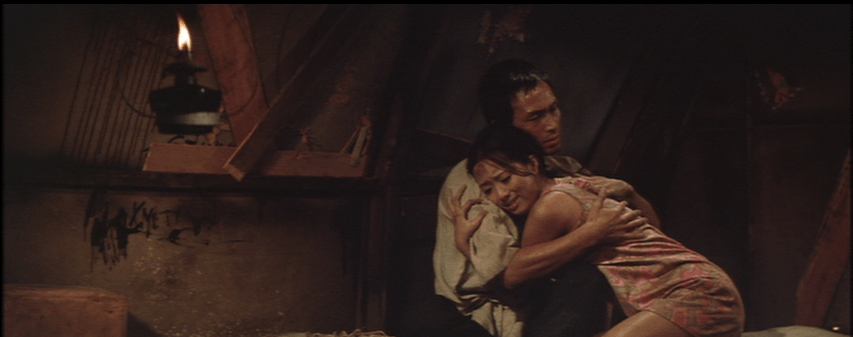
Then again, the film’s secondary hero, Joji (Yusuke Kawazu), a Japanese man obsessed with collecting rare insects he sends alternately to a researcher in Tokyo and a foreign woman living locally, cannot exactly claim the moral high ground. When he spots a US bomber falling out of the sky and runs to investigate the descending parachutes, he’s in the middle of tryst with Annabelle (Kathy Horan) while his wife waits for him patiently at home. Not only that, he picks up an expensive watch dropped by one of the airmen and attempts to sell it, he later claims to buy something nice for his wife, Yukari (Emi Shindo). Meanwhile, the voice of reason Dr. Nagumo (Keisuke Sonoi) is also seen conducting experiments on animals, injecting insect venom into a squirming guinea pig while explaining that the toxin affects the nervous system and causes madness and death. 

For all his own moralising, it’s this callous and selfish disregard for life which caused so many problems. The insects have apparently become fed up with human volatility and have decided that they don’t care what humans do to each other but they won’t go down with us in a nuclear war so the only solution is total eradication. The film’s true moral centre, the innocent Yukari, had tried to stop Joji capturing insects, reminding him that “insects have babies too,” while unbeknownst to him the insects he’d been capturing for Annabelle had been used for her sinister experiments to “breed vast numbers of insects that drive people mad and scatter them across the world.”

Annabelle’s quest is one of revenge, claiming that she doesn’t trust humans and likes insects because they don’t lie. She’s currently working with Communist spies supposedly researching deadly nerve toxins but with no loyalty to the regime, only the desire for the eradication of humanity in revenge for the murder of her parents in the holocaust. The Americans, meanwhile, only care about getting the H-bomb that the downed bomber had been carrying, eventually admitting that they’re considering simply detonating it to wipe out the insect threat in total indifference to the lives of those who live on the islands. When Nagumo challenges him, the American officer pulls a gun. One of the soldiers refuses the command to detonate, but is then killed. 

The Americans reject the idea that it was “insects” that brought the plane down, but tell on themselves on insisting that the airman onboard was hallucinating having become addicted to drugs to help him overcome his fear of combat situations. The insects do indeed cause him to hallucinate but with flashbacks back to his time in Vietnam, loudly exclaiming that he won’t go back there before asking for more drugs and being injected by a medic. The American officers claim they’re fighting for “freedom and independence,” but it rings somewhat hollow and is immediately challenged by Nagumo. “Sacrifices must be made in war,” they retort when he points out that detonating the bomb will not only kill everyone on the islands but irradiate the rest of Japan, wiping out the Japanese as if they too were merely insects. 

Even so, Nagumo too wants to wipe out the insects rather than consider the implications of their concern or find a way to live with them. Annabelle might have had a point when she said that human beings only knew hate despite her entirely twisted and exploitative plan to use the insects to complete her mission of eradicating humanity. In any case, in contrast to other similarly themed films, Nihonmatsu keeps things fairly realistic despite the outlandishness of the narrative, frequently cutting back to closeup footage of an insect biting into human flesh with its pincers before ending on an image of a nihilistic and internecine destruction that suggests there may be no real hope for us after all.

Rainbow Over the Pacific (夜明けの二人, Yoshitaro Nomura, 1968)

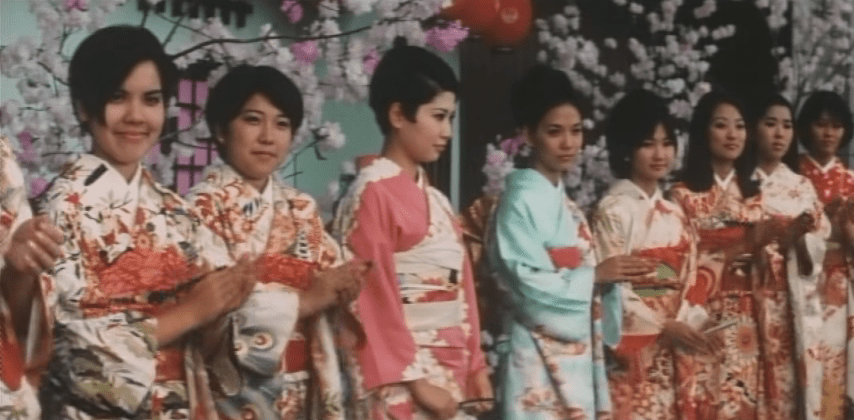
Yoshitaro Nomura is most closely associated with a series of gritty crime thrillers that dug deep into the dark heart of post-war Japan. It may seem surprising therefore to see him helming this generally cheerful if occasionally melancholy musical romance created as a star vehicle for singer Yukio Hashi in commemoration of 100 years of Japanese migration to Hawaii. Curiously pitched, Rainbow Over the Pacific (夜明けの二人, Yoake no Futari) arrives somewhere between extended tourist reel and accidentally colonialist soft propaganda that nevertheless never shies away from the complicated relationship between the two nations. 

As the film opens, hero Hideo (Yukio Hashi) is a something of a slacker working in a photo studio with a crush on an aspiring model. When she shows up late to what he thought was a date and then tells him she’s getting married before dumping her fiancé’s ex on him, he finds himself taking pity on the jilted girlfriend while they drown their mutual sorrows in the beerhalls of post-war Tokyo. Audrey Reiko Misaki (Jun Mayuzumi) is a third generation Japanese-Hawaiian who loves all things Japan and is becoming quite fond of Hideo though he abruptly tells her that it’s been fun but they live in different countries so it’s best they call it quits. Reiko goes back to Hawaii and tries to forget about her double romantic heartbreak in Japan while Hideo continues to be an unserious man berated by his grumpy granddad and exasperated mother not least because of his reluctance to get married. A year later his mentor takes him with him on a trip to the US stopping over in Hawaii where finds himself hoping for a fateful reunion with Reiko. 

Before that, however, he and his boss are met by a Japanese-American man who takes them on a tour of the island and explains that all the swanky hotels are owned by Japanese companies. “Anything you can find in Japan you can find in Hawaii” he insists, at once exoticising the environment and trying to sell it as a place that the growing Japanese middle classes might feel comfortable going on holiday because it is almost like being in Japan only of free of the intense atmosphere of the era of high prosperity where everyone works all the time. But then something a little strange happens, Sakata (Hiroyuki Nagato) points at the elephant in the room and begins talking about Pearl Harbour before visiting a cemetery where many men of Japanese descent who lost their lives fighting for the US in Europe are buried. Even so, he quickly points out that the Japanese community continue to dominate the political realities of the island with several Japanese-Americans elected to the Senate one of whom he actually interviews on camera. 

As for Hideo, he is at times a fairly crass tourist who accidentally mocks the traditional singing of a middle-aged Hawaiian. Much of the narrative appears to have been designed to take in most of the important tourist sites on the islands which are each marked with onscreen katakana as are several important landmarks in Japan in the later part of the film which almost does the same thing in showing off historical Kyoto and the Nara deer. After re-encountering Reiko, Hideo finds himself sucked into various kinds of romantic drama, accidentally coming between a local girl and her boyfriend whose relationship is strained by his wealthy father’s disapproval (much like Hideo he is thought to be an unserious man) and then getting into a dangerous situation with a rival suitor whose cool exterior masks a volatile intensity. 

Ironically enough, through his Hawaiian adventures Hideo becomes a “serious” man resolving to buckle down and work hard though seemingly abandoning his dreams of romance out of a kind of misplaced bro code that in a roundabout way undermines the message of solidarity between Hawaii and Japan in implying that Reiko must choose between the two but then refusing to respect her choice. Further parallels are drawn in the reunion of Hideo’s great uncle who has since become a respected teacher at a Japanese school and his grumpy grandfather who is exposed as a dissolute layabout who returned to Japan in disgrace after giving up in the face of the harshness of life for Japanese migrants, Nomura utilising stock footage to demonstrate the many difficulties they faced in trying to make new lives for themselves in Hawaii. Of course, this being a star vehicle for Hashi, he gets several opportunities to sing including a rendition of the title of song while the film at times turns into a musical though the melancholy, foggy conclusion perhaps plays against the expectations of the genre. In any case, the film appears to be a fascinating document of an increasingly globalising Japan which nevertheless looked for itself even while seeking escape.


Blackmail is My Life (恐喝こそわが人生, Kinji Fukasaku, 1968)

81eOlRLzY4L._SL1200_Suffice to say, if someone innocently asks you about your hobbies and you exclaim in an excited manner “blackmail is my life!”, things might not be going well for you. Kinji Fukasaku is mostly closely associated with his hard hitting yakuza epics which aim for a more realistic look at the gangster life such as in the Battles Without Honour and Humanity series or his bloody tale of high school warfare, Battle Royale but he also made a few comedies too and often has his tongue firmly in his cheek. Blackmail is My Life (恐喝こそわが人生, Kyokatsu Koso Waga Jinsei) is nominally a crime film, it follows the adventures of a group of young people having a lot of fun doing crime and crime related activities, but the whole thing’s so flippant and ironic that it threatens to drown itself in late ‘60s cool. It doesn’t, of course, it swims around in it whilst looking cool at the same time.

Shun starts the film with a slightly melancholy voiceover (a technique much borrowed in the ‘90s). He was young, he was ambitious but the best thing was he had friends who were more like family. He breaks up with his girlfriend and mopes about his awful job cleaning toilets at a cabaret bar but one day he overhears something about a scam going on with the whiskey they’ve been selling. Shun spots a business opportunity to get his own back on the cabaret owners and get some dough in the process. So begins his life as a petty blackmailer and it’s not long before he’s got his three best mates trapping businessmen into compromising situations so they can film it and blackmail them. The gang carry out petty crime and everything would probably be OK for them if they had stuck to shallower waters, not tried to get revenge for a family member’s death and, crucially, known when they were in way over their heads. Could it really ever be any other way for a self confessed small time punk?

Shun is a bit of an odd duck really. As a girlfriend points out, he’s always thinking about the past like an old man rather than the future, like a young one. He has an irreverent attitude to everything and a vague sense of entitlement mixed with resentment at having missed out in Japan’s post-war boom town. The blackmailing not only allows him to feel smugly superior to everyone else as if he’s some kind of mastermind trickster, but of course also allows him to live the highlife on the proceeds with far less time spent working himself to the bone like the average salaryman.

However, he also has this unexplained sadness, almost as if he’s narrating the film from the point of view of its ending despite being smack in the middle of it. When thinking of happy things he always comes back to his gang of friends enjoying a joyful, innocent day on the beach but later he starts having flashes of rats drowned in the river. Somehow or other he fears he’ll end here, dead among the detritus of a world which found no place for him. He tries to convince himself he’s bucking the system, trying to start a revolution for all the other young punks out there but at the end of the day he’s just another hungry scrapper terrified he’s going to land up on the trash heap.

Like a lot of Fukasaku’s other work, Blackmail is My Life is bright and flashy and cool. Full of late ‘60s pop aesthetics, the film seems to have a deep affinity with the near contemporary work of Seijun Suzuki, in fact one of the characters is always whistling Tokyo Nageremono, the theme tune to Suzuki’s pop art masterpiece Tokyo Drifter. Having said that Fukasaku swaps nihilistic apathy for a sort of flippant glibness which proves a much lighter experience right through until the film’s fairly shocking (yet inevitable?) ending.

Not quite as strong as some of his later efforts, Blackmail is My Life nevertheless brings out Fukasaku’s gift for dynamic direction though the comparatively more mellow scenes at the sea are the film’s stand out. Pulling out all the stops for his crazed, POV style ending with whirling cameras and unbalanced vision Fukasaku rarely lets the tension drop for a second as Shun and co. get hooked on crime before realising its often heavy tarrifs. Another bleak and cynical (though darkly comic) look at the unfairness of the post-war world, Blackmail is My Life may not rank amongst Fukasaku’s greatest achievements but it wouldn’t have it any other way.


Blackmail is My Life is available with English subtitles on R1 US DVD from Homevision and was previously released as part of the Fukasaku Trilogy (alongside Black Rose Mansion and If You Were Young: Rage) by Tartan in the UK.