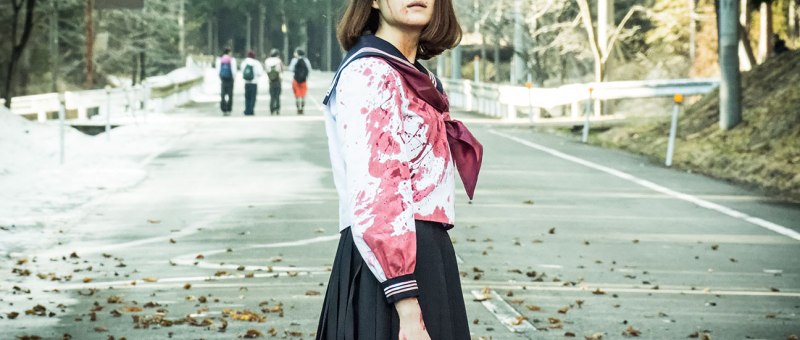
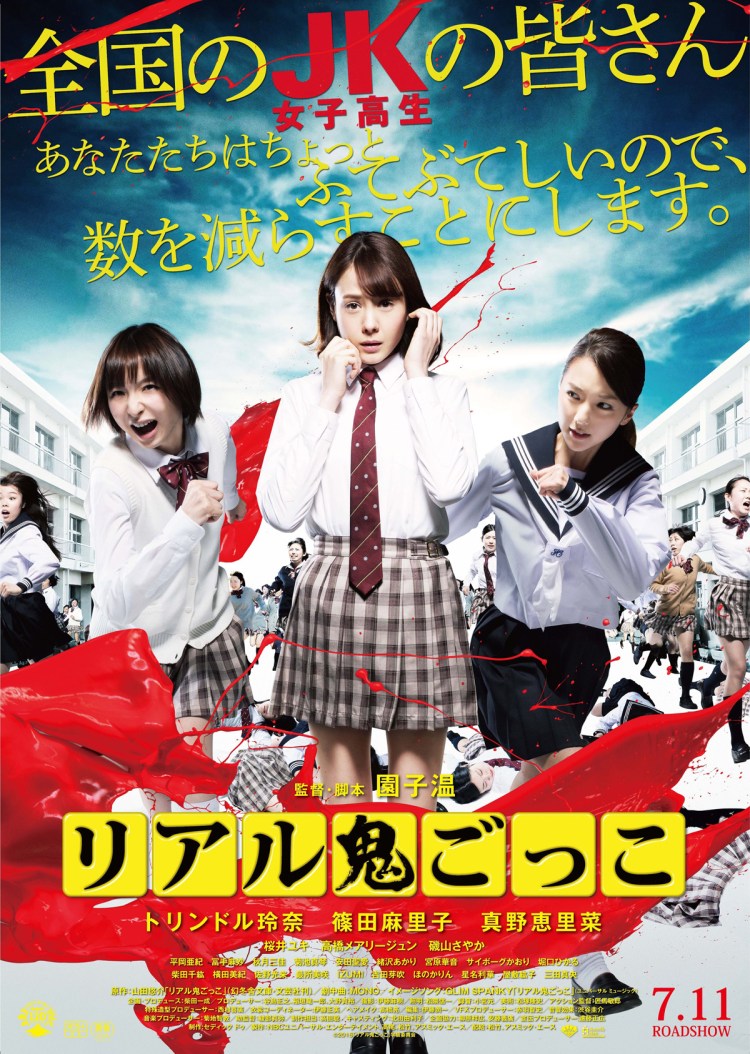
Tag (リアル鬼ごっこ, Sion Sono, 2015)

tag posterYou could say Sion Sono is back, though with six films released within a year it’s almost as if he just nipped out to make a cup of tea. At first look Tag (リアル鬼ごっこ, Riaru Onigokko) seems as if it might be towards the bottom of the pile – school girls running away from things for 90 minutes whilst contending with awkward gusts of wind, but this is Sion Sono after all and so there’s a whole world of craziness going on below the surface.

The action begins with a gaggle of school girls on a bus. Two of them start ribbing the girl on the opposite bank of seats, Mitsuko (Reina Triendl), because she’s always writing poetry. The pen gets knocked out of her hand and as she bends down to pick it up she notices a white feather stuck to the clip. Gazing at the improbable symbol, Mitsuko becomes the only survivor when a sudden gust of wind blows the top off the bus taking all of the other passengers’ heads with it. Mitsuko starts running, re-encountering the dreaded wind monster over and over again before stopping at a stream to wash the blood off her face and change into the cleaner set of clothes she finds abandoned there.

After this she finds herself ending up at an entirely different school where everyone seems to know her. Has she gone mad, had a psychotic break? If not then then she’s about to as an attempt to ditch class with some of the other girls results in yet another freak school girl apocalypse.

Running again, Mitsuko ends up at a police box where another woman seems to know her but insists her name’s Keiko (Mariko Shinoda). Oh, and it’s her wedding day today! That’s not even the last time that’s going to happen and it’s far from the weirdest thing that’s going to happen to Mitsuko today. As a friend of Mitsuko 2’s reminds us, “Life is surreal, don’t let it get to you”.

Answers come, after a fashion. Though Tag is nominally based on a novel by Yusuke Yamada (previously adapted into a long running film series), Sono apparently did not even read the book and has only taken its theme – everyone with the same surname being hunted down and exterminated, and repurposed it for his own ends. This time rather than a common surname, it’s an entire gender that is forced to live under constant threat as the plaything of a far off entity that is as invisible and ever present as the wind. It’s no accident that everyone we meet up until the half way point is female, and that the first (presumed) male we meet is wearing a giant pig’s head. Mitsuko and her cohorts have in fact been used as a literal toy by the men on the other side of the curtain. Their very DNA has been co-opted for the “entertainment” of the male world without their consent or even knowledge, and even if she had known, Mitsuko is powerless to resist.

The solution that is found is both very old and very profound. It’s far from an original ending to this kind of story though in these hands, and used in this way, it can, and has, caused offence. Tag wants to ask you about life, about death, about agency and misogyny – but it wants to ask you all those things whilst watching school girls get ripped apart by the same wind that keeps blowing their skirts up. Sono has his cake and eats it too. There will undoubtedly be those that feel that far from satirising mainstream attitudes to women, Sono has, in fact, indulged in the worst parts of them.

If all of that was sounding a little heavy, Tag runs (literally) at breakneck speed with barely any time for conscious thought between the first bizarre case of gore filled mass murder and the next. It’s also strangely beautiful with a hazy, dreamlike veneer full of repeated images and scenes of idyllic serenity. Is any of this real? Who could really say. The ultramodern, indie score also strikes a slightly hypnotic note lending to the feeling of freewheeling weightlessness.

In many ways, Tag has much more in common with early Sono hit Suicide Club thanks to a general thematic sensibility than to any of his more straightforward work since. That said, Tag never quite resolves itself in a wholly satisfying way and though its final moments are filled with a poetic sensitivity, there’s a certain barrier created by its ambiguity that feels unfinished rather than deliberate. Another predictably “not what it looks like” effort from Sono, Tag may just come to be remembered as his most considered effort of 2015.


First Published on UK Anime Network in November 2015.

Playing at the Leeds International Film Festival on 18th November 2015.

Other movies playing at Leeds include Assassination Classroom, Happy Hour, Our Little Sister and Love & Peace.

Can’t find a subtitled trailer for some reason but to be honest you’ll get the gist of it:

Asleep (白河夜船, Shingo Wakagi, 2015)

asleep posterBased on the third of three short stories in Banana Yoshimoto’s novel of the same name, Asleep (白河夜船, Shirakawayofune) is an apt name for this tale of grief and listlessness. Starring actress of the moment Sakura Ando, the film proves that little has changed since the release of the book in 1989 when it comes to young lives disrupted by a traumatic event. Slow and meandering, Asleep’s gentle pace may frustrate some but its melancholic poetry is sure to leave its mark.
Terako (Sakura Ando) is a young woman who sleeps a lot. Almost all the time, in fact. The kept woman of a married man whose wife, oddly enough, is in a coma following a traffic accident, Terako has been in a kind of limbo since her former roommate and good friend committed suicide by taking an overdose of sleeping pills. Prior to her death, Shiori had taken up an unusual occupation – she lies next to lonely strangers who just want to know that someone is watching over them while they sleep and will be there when they awake. This also meant that she rarely had the opportunity to sleep herself as her occupation demanded keeping a watchful eye over her charges and falling asleep on the job seemed like a lapse of professionalism.

Mr. Iwanaga, Terako’s boyfriend, is an enabler of the first order. He prefers that Terako not work so that she’s available for him whenever he feels the need to call meaning that she’s always at home, sleeping. She sleeps and sleeps but finds no relief from her exhaustion. Even her dates with Iwanaga feel “like the shadow of a dream”. The constant flashbacks and meandering timelines perfectly reflect someone trying to think through the distorted reality of fractured sleep where the boundaries between dream and reality have become impossibly blurred.

There’s an odd sort of triumvirate of sleeping women here – Terako herself who does little but sleep but is still constantly exhausted, Shiori who denied herself sleep until ultimately deciding to take enough sleeping pills to go to sleep forever and Iwanaga’s wife who’s trapped in coma. At one point, in a conversation which either happened some time ago or not at all, Shiori remarks that Iwanaga has Terako “on pause” because he’s afraid to move on from his wife (the fact of his having an affair while his wife is lying in a hospital bed even has Terako labelling him a cold, unfeeling man but then she says she likes that kind of thing anyway). It’s as if she’s waiting for someone to hit the spacebar to wake her up again, though Iwanaga is “on pause” too – torn between the choice of abandoning his wife who will likely never wake up and being labeled heartless, or sacrificing the rest of his life in devotion to a memory.

Help does come, in a way, through the intervention of a either a dream or a kind of cosmic transference – an impossible conversation between two women equally in need of it. Shingo Wakagi’s adaptation is more interested in psychology and existential questioning than it is in hard realities or concrete solutions. A vignette of a moment in a young woman’s life, Asleep gives us little in the way of backstory or explanatory epiphanies, and finally ends in the characteristically ambiguous way many Japanese novellas often do though there is a hint at a possible shift in Terako’s life offered by the final images. A poetic meditation on dream, memory, grief and loneliness, Asleep is beautifully framed, if appropriately distant, look at modern life in limbo.


Reviewed at Raindance 2015

First Published on UK Anime Network in 2015.

Makeup Room (メイクルーム, Kei Morikawa, 2015)

SBLEkl5First Published on UK Anime Network


It’s a little known fact that everyone seems to know, but the Japanese pornography industry is one of the most lucrative in the world producing countless hours of “AV” or “adult video” movies every year. No one expects the world of erotic filmmaking to be glamorous, but rest assured Makeup Room is not interested in exploring the dark side of the industry either. For the characters involved in this rather witty backstage drama it’s just another working day filled with personal concerns and petty office disputes.

In fact, Makeup Room began as a stage play and occupies just the one set – the green room where the various starlets hang out before the performance. The star of the show in here is the veteran makeup artist, Kyoko, who is responsible both for creating whichever look the director has asked for from innocent school girl to sexy cop or dominatrix and for providing guidance and moral support as she chats away to the various divas and ingenues who occupy her chair. Porno shoots happen very fast, the team only have a brief amount of time in this location before the next crew arrive to shoot another porno so everything needs to go to plan. Today, nothing goes to plan. The lead actress is late, another actress has an undisclosed tattoo meaning she’ll have to switch roles requiring some hasty script edits, and the new girl who’s apparently an inexperienced nymphomaniac is having a few last minute jitters. The director’s stressed, the veteran actress is getting antsy and they’re all just lucky Kyoko is around to keep everything running smoothly!

Makeup Room starts with a rather worrying disclaimer to the effect that this was an extremely low budget shoot and that given the materials available, there is a degree of stuttering in the video which cannot be fixed. In actuality it isn’t that much of a problem but you’d have to admit Makeup Room is never a very pretty looking film. Perhaps appropriately it has a very cheap video look and a simplistic directing style using mostly static shots camera from different angles of its one set location.

However, the rather basic approach does allow the script and performances to shine. Undoubtedly witty, the dialogue both rings true and offers a fair amount of humour at the expense of the diverse cast and crew many of whom are played by real life AV actresses making their “debuts” in a purely narrative film. This is not a tale of fallen women forced into the sex industry through a series of traumatic events, each of the women is fine with their career choice and likes what they do. Though one character reveals that many of the people in her life don’t know what she does and not all of those who do approve, including her boyfriend who’s only just found out and not taken it well, mostly the women talk about the practicalities of their work. Whether that’s having a tattoo that’s much larger than your manager tells people it is, or having your nails done right before finding out you’re down for a lesbian scene meaning they’ll all have to be cut off, or chatting about the way your work is going to change as you get older, the kind of workplace problems that occur perhaps aren’t altogether different than those women experience in all industries.

Director Kei Morikawa has had a long career in the AV industry as well as in more mainstream fare and makes good use of his personal experience to create a film which at least feels very authentic as well as giving the impression of a group of friends getting together to send themselves up in classic style. Full of frank humour though very little explicit content, Makeup Room comes across as a warm and refreshingly straightforward look at the Japanese porn industry though its extreme low budget stylings are likely to put off viewers who prefer the glossier side of things.


Out now from Third Window Films

Fires on the Plain (野火, Shinya Tsukamoto, 2015)

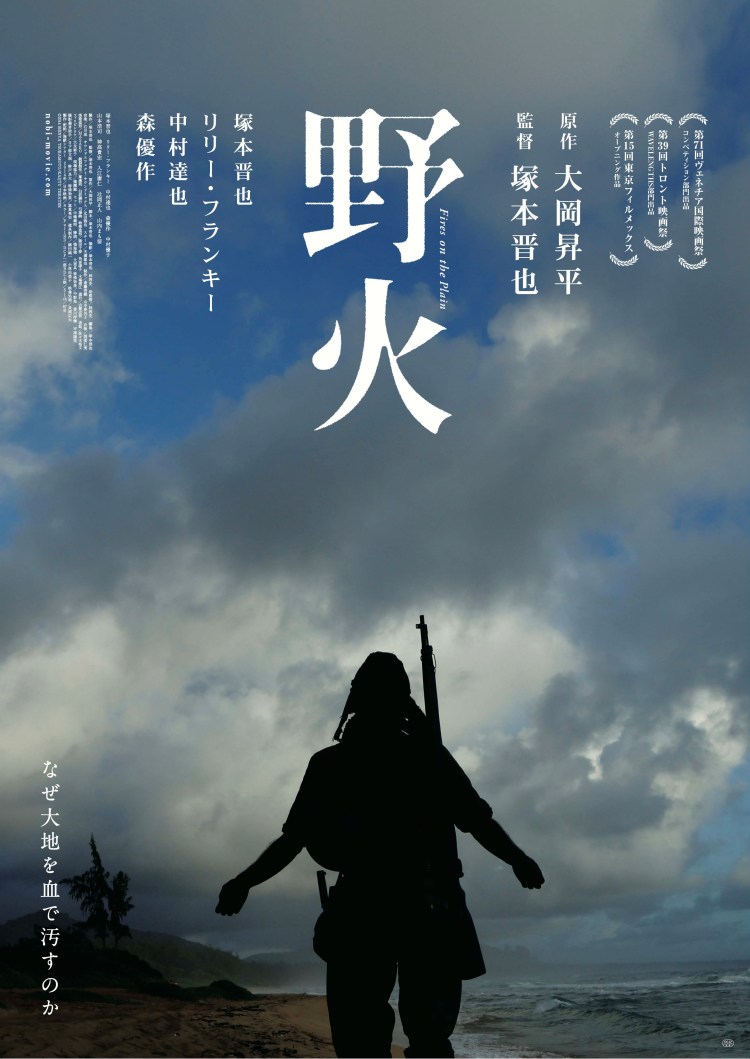
fires on the plain 2015 posterShinya Tsukamoto is back with another characteristically visceral look at the dark sides of human nature in his latest feature length effort, Fires on the Plain (野火, Nobi). Another take on the classic, autobiographically inspired novel of the same name by Shohei Ooka (previously adapted by Kon Ichikawa in 1959), Fires on the Plain is a disturbing, surreal examination of the effects of war both on and off the battlefield.

Late in the war when it’s almost lost though no one wants to admit it, Corporal Tamura (Shinya Tsukamoto) finds himself suffering with TB on the Philippine island of Leyte where supplies, and tethers, are running short. Shortly after being punched in the face by his commanding officer, he’s given five days’ worth of supplies and ordered to march to the field hospital for treatment as no one wants a sick man weighing down the unit. Only, when he finally arrives at the field hospital, they have their hands full (literally) with the battlefield wounded. Marching back to his unit again, Tamura is ordered back to the field hospital and told to use his grenade to ease the burden on his fellow soldiers if refused. So begins Tamura’s fevered, mostly solitary odyssey across the beautiful landscape of the Philippine jungle suddenly scarred with corpses, the starving and the mad.

Tsukamoto’s adaptation sticks closer to the original novel than Ichikawa’s 1959 version, though both eschew Ooka’s Christianity. Tamura is a man at odds with his fellow soldiers. Formerly a writer he’s “an intellectual” as one puts it, and a little on the old side for a corporal. Coughing and wheezing, he shuffles his way through just trying to survive. Unlike Ooka’s original novel in which the protagonist’s Catholicism makes suicide an unavailable option, it’s the memory of Tamura’s wife which stays his hand on the pin of his grenade. Tamura wants to go home, to escape this hellish island full of the walking dead, hostile locals and hidden clusters of enemy troops.

To get home, to survive, what will it cost? There was barely any food left to start with. The original five days’ worth of rations Tamura was given amounted to a handful of yams. On his second trip to the military hospital he was given nothing at all. There’s no wildlife, even if you manage to find some plant roots they’ll need cooking. Of course, there is one abundant source of food, except that it doesn’t bear thinking about. Tsukamoto’s version takes a less ambiguous approach to the idea of cannibalism than Ichikawa’s which removed Tamura’s moral dilemma by having his teeth fall out through malnutrition and rendering him unable to indulge in “monkey meat” even if he might have succumbed. Death feeds on death and there’s no humanity to be found here anymore where men prey on men like animals.

There’s no glory in dying like this. Half starved, half mad and baking to death in the heat of a foreign jungle abandoned by your country which cared so little for its men that it never thought to conserve them. When you make it home, if you make it home, you aren’t the same you that left. The things you had to do to get there stay with you for the rest of your life, and not just with you – with all of those around you too. Wars don’t end when treaties are signed, they survive in the eyes of the men who fought them.

A timely and a visceral look at the literal horror of war, Tsukamoto’s Fires on the Plain is a refreshingly frank, if stylised, examination of the battlefield. Limbs fly, heads explode, organs are exposed and brain fragments leak out of ruined corpses. At any other time, Leyte would be a paradise of lush vegetation, colourful flowers and beautiful blue skies but it’s corrupted now by the fruits of human cruelty. This is what it means to go to war. There’s nothing noble in this – just death, decay and eternal grief. Though the film often suffers from its low budget and some may be put off by the stark, hyperreal cinematography, Fires on the Plain is another typically troubling effort from the master of discomfort and comes as a warning bell to those who still think it is sweet and fitting to die for one’s country.


Reviewed at Raindance 2015.

Original trailer (English subtitles)

First published by UK Anime Network.

Pluto (명왕성, Shin Su-won, 2013)

GSEOiWzAs we’ve seen lately, there are certainly no shortage of films looking at the complicated and often harsh world of high school in Korea. Pluto (명왕성, Myungwangsung) takes a sideways look at the darker side of academic excellence when the praise and prestige of being one of the top students becomes almost like a drug and makes otherwise bright young people do things even a heroin addict in serious need of a fix might at least feel bad about afterwards with an all encompassing sense of entitlement that gives them a lifetime free pass for even the worst transgression.

June (David Lee) is a bright young boy from a regular high school who’s just transferred into an elite boarding school educating the country’s next great hopes. He may have been a top student at his old school, but here he’s merely average as the school hotshots are pretty quick to point out. Here, the top ten students are treated like princelings – a special computerised teaching room, no curfew, better rooms, better resources and they can more or less do what they like so long as they keep their grades up. Occasionally someone manages to bump one of the top ten from the list but they quickly get kicked out again. The top ten operate like some kind of swatters mafia – they all stick rigidly together, swapping hot tips for the upcoming exams that they refuse to share with the others and engaging in a series of increasingly cruel “pranks” they term rabbit hunts.

The film opens with the police finding the body of the previously number one student Yu-jin (Sung Joon) in a wood with June’s phone lying next him having been used to film the entire grisly affair. June is arrested for the murder but is released after his alibi checks out. Sick of all the struggle and unfairness, June puts his particular talents to use to try and teach the world a lesson about the sort of people this system is producing.

The picture Pluto paints of the Korean schools system is a frankly frightening one in which academic success is virtually bought and paid for or guaranteed by class credentials. Yes, the top students obviously must have ability – some of their activities may come close to cheating but interestingly nobody seems to want to try actual deception to get ahead. However, that natural ability has clearly been bolstered by their parents’ wealth. Attending an elite school and spending more than some people earn on private tutors geared towards knowing how to get into the best universities undoubtedly gives them advantages which are out of reach for others no matter how smart they may be. Perhaps that’s fair enough in a capitalist society, they didn’t ask to be born to rich parents and who would turn that sort of help down if offered it? However, though they may possess the virtues of discipline, hard work and a desire to succeed what they lack is any sort of empathy or even common human decency. Engaging in a series of manipulative hazing exercises, the elite group will stop at nothing to protect their status specialising in thuggery, blackmail, rape and even murder. The sort of people this system is advancing are not the sort of people you want running your schools and hospitals, they are morally bankrupt and only care about their own standing in the eyes of others.

Perhaps it’s fitting that this elite boarding school is housed inside a former compound of the Korean secret police, including a subterranean layer of prison-like tunnels once used as a torture chamber. Aside from the obvious school as torture analogies, much of them film seems to be about what people choose to ‘unsee’. The headmaster of the high school is aware of the ‘untoward’ behaviour of some of his pupils but refuses to do anything in case it upsets their well connected parents, damages the reputation of his school or has an adverse effect on those all important test results. The ‘Pluto’ of the title is referenced in June’s university application essay on the demotion of Pluto from the accepted list of planets. He argues that this is unfair and a fallacy as it’s illogical to measure anything by its proximity to the sun which is, after all, just another star which will eventually die like all the others. Just because it’s a little different looking, you shouldn’t necessarily categorise it as being in some way ‘inferior’ based on a set of fairly flimsy criteria. June, like Pluto, hovers in uncertain orbit on the periphery – always wanting in but perpetually locked out. Naturally gifted but from an ‘ordinary’ background where his single mother sells insurance for OK money, June can’t hope to compete with these elite kids even if his capabilities may be greater. A lot of decisions have already been made as to what people choose to see, have chosen to regard as an ideal, even if the reality is painfully obvious.

Though oddly funny in places for such a hard hitting film, Pluto is a difficult watch at times and paints a depressing picture of the high pressured nature of the Korean educational system and of human nature in general. The elite group are universally awful people who run the gamut from arrogant, entitled prigs to snivelling cowards which makes it difficult to feel any sort of sympathy and you start to long for bad things to happen to them which somewhat undermines the film’s premise. Perhaps the problem is just that they were awful people who were enabled by a system rather than people who started out good and were corrupted by it. Stylishly shot and supported by well grounded performances from its young cast, Pluto is a welcome addition to this perhaps overcrowded genre which brings more than a few new thought provoking ideas to the table.


Review of first Pluto published by UK Anime Network.