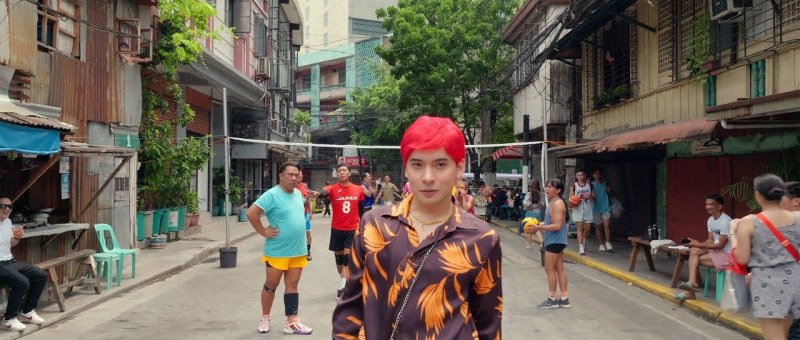

“What is the essence of being a real man?” The hero of Percival M. Intalan’s reverse coming out drama I Love You, Beksman (Mahal Kita, Beksman) finds himself questioning his own identity when confronted with the weight of social expectation and prejudice yet discovering that the question is meaningless when the key to happiness lies in self-acceptance and authenticity. Scripted by Fatrick Tabada (Chedeng and Apple), the film tears apart conventional notions of gender and sexuality in a hyper-masculine patriarchal culture while allowing its hero to gain the courage to define himself in order to chase his romantic destiny.
Everyone just assumes flamboyant hairdresser Dali (Christian Bables) is gay. He dyes his hair red, dresses in a less masculine fashion than other men his age, and has an effeminate manner. Yet Dali has a secret he doesn’t even really realise is one in that he is actually straight as he is forced to reveal after falling for beauty queen Angel (Iana Bernardez) at a pageant. The more he tries to explain to people that he isn’t gay and is serious about romantically pursuing Angel, the less they seem to understand him. It simply doesn’t make sense that someone so “obviously” gay could be attracted to women. They ask him if he’s sure or if it might be a phase or if he’s developed some kind of internalised homophobia but never really consider that it’s a possible for a man to be both effeminate and exclusively attracted to women.
Even Dali begins to subconsciously change himself in order to better conform to their expectations. Having lost her mother at a young age, Angel is surrounded by hyper-masculine men in her father and brothers who all rather hilariously have the same moustache and enjoy manly pursuits such as weightlifting and basketball. Dali, meanwhile, was surrounded by queerness all his life, raised in the salon by a father who now lives openly as a gay man in a platonic marriage with his mother. Despite having seemingly been very happy as a part of a big gay family who all just assumed him to be gay too, Dali begins to reject his father and his own femininity in believing that he must adopt a more stereotypical masculinity in order to convince Angel of his heterosexuality and eventually win her heart (along with those of her conservative father and brothers).
It might be true to say that Dali’s original presentation as a flamboyant hairstylist and fashion designer is also a kind of performance and an attempt to conform to parental expectation just as his rejection of it is an attempt to conform to the demands of a hyper-masculine society, but only by embracing both extremes can he learn to define himself outside of the images others project onto him. In adopting the traits of traditional masculinity, he becomes boorish and insensitive asking his father to hide his “gayness” to avoid embarrassing him in front of Angel’s dad while later becoming jealous and violent after seeing Angel hanging out with an ex. He can’t see that his adopted persona makes it even harder to form a genuine romantic connection with Angel, not just because he’s actively erasing the sides of himself she first became attracted to in his skill in makeup and fashion but because as she eventually tells him it’s difficult to trust someone who is being dishonest with themselves.
The realisation he comes to is that he has to be “himself” rather than being what other people expect him to be while those around him come to understand that outdated ideas of stereotypical gender presentation are harmful to everyone. A gentle tale of broadening horizons and mutual acceptance, Intalan’s ironic comedy neatly subverts the coming out trope while situating itself in a world of relative safety in which Dali is free to explore his own identity and means of self-expression encountering opposition only from those who fear he is not being true to himself. The reality may not be so kind as the classic rom-com conclusion may suggest but the film nevertheless neatly takes aim at the ridiculousness of conventional ideas of “masculinity” in a hyper-masculine and patriarchal culture in making a heartfelt advocation for the right to just be oneself.
I Love You, Beksman screens at the BFI Southbank on 18th April as the opening night gala of this year’s Queer East.
Original trailer (English subtitles)

 When you feel you’ve discharged all your social obligations, you might feel as if you’ve a right to live by your own desires. Whether the dreams you abandoned in youth will still be there waiting for you is, however, something of which you can be far less certain. Following the death of her husband, one Filipina grandma decides to find out, taking to the road with her best friend who is, incidentally, wanted for murder and carrying around the severed head of her late spouse in a Louis Vuitton handbag belonging to her vacuous step-daughter, in search of the one that got away.
 Windows on Worlds