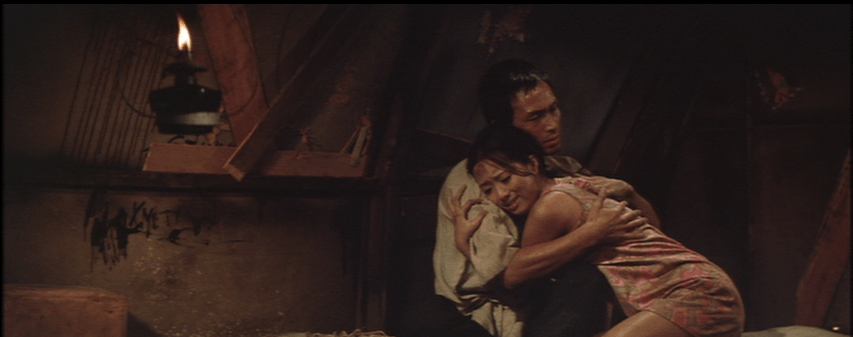
Genocide (昆虫大戦争, Kazui Nihonmatsu, 1968)

In the early 1960s, tokusatsu movies had begun to slide towards something which was much less serious than the early days of the genre, but as the decade went on others edged in the direction of the ‘70s paranoia thriller expressing a nihilistic view of contemporary Cold War geopoliticking. Given the rather provocative English title Genocide (昆虫大戦争, Konchu daisenso), as opposed to the more recognisably genre-inflected “great insect war”, Kazui Nihonmatsu’s wasp-themed disaster film is part anti-nuclear eco-treatise and part anti-US spy movie.

Then again, the film’s secondary hero, Joji (Yusuke Kawazu), a Japanese man obsessed with collecting rare insects he sends alternately to a researcher in Tokyo and a foreign woman living locally, cannot exactly claim the moral high ground. When he spots a US bomber falling out of the sky and runs to investigate the descending parachutes, he’s in the middle of tryst with Annabelle (Kathy Horan) while his wife waits for him patiently at home. Not only that, he picks up an expensive watch dropped by one of the airmen and attempts to sell it, he later claims to buy something nice for his wife, Yukari (Emi Shindo). Meanwhile, the voice of reason Dr. Nagumo (Keisuke Sonoi) is also seen conducting experiments on animals, injecting insect venom into a squirming guinea pig while explaining that the toxin affects the nervous system and causes madness and death. 

For all his own moralising, it’s this callous and selfish disregard for life which caused so many problems. The insects have apparently become fed up with human volatility and have decided that they don’t care what humans do to each other but they won’t go down with us in a nuclear war so the only solution is total eradication. The film’s true moral centre, the innocent Yukari, had tried to stop Joji capturing insects, reminding him that “insects have babies too,” while unbeknownst to him the insects he’d been capturing for Annabelle had been used for her sinister experiments to “breed vast numbers of insects that drive people mad and scatter them across the world.”

Annabelle’s quest is one of revenge, claiming that she doesn’t trust humans and likes insects because they don’t lie. She’s currently working with Communist spies supposedly researching deadly nerve toxins but with no loyalty to the regime, only the desire for the eradication of humanity in revenge for the murder of her parents in the holocaust. The Americans, meanwhile, only care about getting the H-bomb that the downed bomber had been carrying, eventually admitting that they’re considering simply detonating it to wipe out the insect threat in total indifference to the lives of those who live on the islands. When Nagumo challenges him, the American officer pulls a gun. One of the soldiers refuses the command to detonate, but is then killed. 

The Americans reject the idea that it was “insects” that brought the plane down, but tell on themselves on insisting that the airman onboard was hallucinating having become addicted to drugs to help him overcome his fear of combat situations. The insects do indeed cause him to hallucinate but with flashbacks back to his time in Vietnam, loudly exclaiming that he won’t go back there before asking for more drugs and being injected by a medic. The American officers claim they’re fighting for “freedom and independence,” but it rings somewhat hollow and is immediately challenged by Nagumo. “Sacrifices must be made in war,” they retort when he points out that detonating the bomb will not only kill everyone on the islands but irradiate the rest of Japan, wiping out the Japanese as if they too were merely insects. 

Even so, Nagumo too wants to wipe out the insects rather than consider the implications of their concern or find a way to live with them. Annabelle might have had a point when she said that human beings only knew hate despite her entirely twisted and exploitative plan to use the insects to complete her mission of eradicating humanity. In any case, in contrast to other similarly themed films, Nihonmatsu keeps things fairly realistic despite the outlandishness of the narrative, frequently cutting back to closeup footage of an insect biting into human flesh with its pincers before ending on an image of a nihilistic and internecine destruction that suggests there may be no real hope for us after all.


Espy (エスパイ, Jun Fukuda, 1974)

espy posterBy 1974 the Toho SFX movie was perhaps long past its heyday though Jun Fukuda’s Espy (エスパイ) was far from the last. Clearly influenced by popular spy franchises such as James Bond as well as more serious cold war spy dramas, Espy is a jet setting tale of superpowered assassins, international conspiracy, and love as an unexpected source of salvation, but as much as it embraces its hippyish message of total communication it also moves further into the realms of exploitation, skewing closer to Nikkatsu’s ’70s output than the more child friendly supernatural adventures of ages past.

The world is at breaking point. A small conflict in a tiny East European nation known as Baltonia threatens to spark a third world war. A UN delegation is currently en route to a conference in which they hope to settle the conflict in a peaceful way but all hope is lost when a sniper equipped with X-ray vision takes them all out with maximum precision.

Meanwhile, back in Japan, test driver Miki (Masao Kusakari) gets into trouble on the course when he swerves to avoid some pigeons. The car spins out of control but just at the last minute, Miki turns it around through his dormant psychic powers which brings him to the attention of the IPPG – the International Psychic Power Group. Following the assassination of the UN delegation, all eyes are on Japan where the prime minister of Baltonia is due to meet the US president in what is hoped will be a bold new development in international relations but the IPPG have reason to believe an attempt will be made on the prime minister’s life and only their ESP equipped team can stop it.

Espy takes the essential components of both the spy thriller in its international conspiracy set up, and the B-movie science fiction adventure in its presentation of the good and evil possibilities of advanced technologies or in this case innate superpowers. The Espy team are pitted against the Anti-Espy who have similar powers but are committed to using them to harm mankind. The leader of the Anti-Espy, Ulrov (Tomisaburo Wakayama), sees himself as a superior being to regular Earthlings and, believing that humans have overpopulated the planet which they continue to damage, is convinced the best solution is a mass cull. He plans to do this by helping the “lesser” humans destroy themselves by provoking a third world war or a hundred mini conflicts in which thousands will die.

Ulrov’s arguments tie in nicely with Toho’s trademark environmentalism and ambivalent attitude towards scientific development, but they go against the prevailing sense of humanism which is to be found in the studio’s genre output. In Ulrov’s fascistic view of the world, he and the other ESPers are a superior race whose existence is threatened by weaker humans and their reckless disregard for the planet as a whole. Due to a traumatic childhood incident, he believes that humans are cruel beasts who lust for blood and talk of peace with hearts filled with hate. He may have a point, but his message conflicts with the positive movement for peace which is advanced by the Baltonian PM who doesn’t want a world in which peace is brokered and balanced but one of true unity.

Espy is, however, of its time and fails to fully live out its peace and love ideals. Team member Maria (Kaoru Yumi) is kidnapped by Anti-Espy and taken to Ulrov’s lair where she is forced to dance lasciviously in front of fellow team member Tamura (Hiroshi Fujioka) with whom she shares an especially strong connection. Tamura’s arms and legs are cuffed as he communicates telepathically with Ulrov, semi-hypnotised by Maria’s strange dance. Maria is then approached by a large dark-skinned man wearing only a loincloth who proceeds to tear open her shirt at which point she snaps out of her trance, frees Tamura, and rips out the attacker’s tongue.

Meanwhile, new recruit Miki has failed in his mission and killed a man for the first time sending him into a kind of depression. Though Miki was introduced as the protagonist, he is in fact absent for most of the film though his journey is among the strangest as he reminisces about a foreign girl he was friends with as a child and enjoys an unusually strong bond with his intrepid dog, Caesar, who teaches the gang a few lessons about unconditional love. Maria is severely traumatised by her attack while Tamura reconsiders his sense of self worth having temporarily lost his powers, but eventually the team realise that their psychic abilities are nothing more than a manifestation of a great love. Ulrov later has the same epiphany but the team’s decision to consider him possessed by something “inhuman” is a worrying one. They don’t want to accept that it was humans who made him that way because it would be too sad, but not to do so is a failure to recognise humanity’s darkness as well as its light.

Espy bites off a little more than it can chew in failing to deal with some of the more interesting ideas it raises though it makes the most of its meagre budget to present an exciting spy thriller voyaging from Japan to Turkey and Switzerland. Skewing more towards Nikkatsu’s brand of exploitation action, Espy is definitely among the more adult orientated of Toho’s SFX adventures but its messages are broadly the same in its insistence on human interconnectedness as the ultimate superpower.