Masked Ward (仮面病棟, Hisashi Kimura, 2020)

“This hospital is…abnormal” according to locum doctor Hayami (Kentaro Sakaguchi) as he begins to discover dark goings on while trapped in a former psychiatric home after being taken hostage by a man in a clown mask. Based on the medical mystery novel by Mikito Chinen, Masked Ward (仮面病棟, Kamen Byoto) is partly a meditation on guilt and grief and partly an attack on backroom eugenics in an often judgemental and potentially corrupt society, if wrapped up in a wilfully silly B-movie crime thriller. 

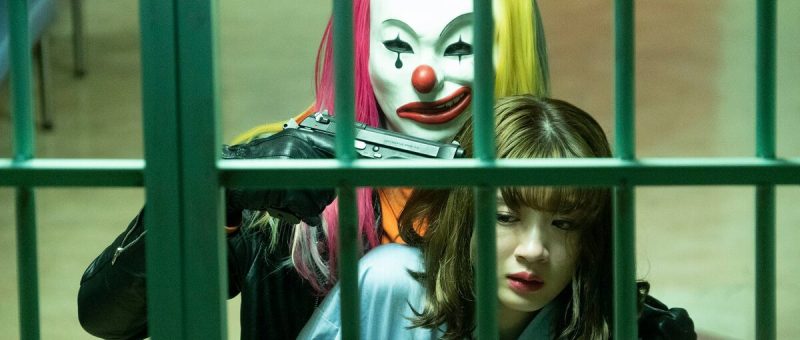
Still on a temporary sabbatical following a bereavement, Dr. Hayami is recruited by an old friend, Kosakai (Ryohei Ohtani), to cover a night shift at a long term care hospital mostly catering to patients living with dementia. It has to be said the hospital itself has an instantly creepy aura, the police who later arrive describing it as looking like a prison which is apt because no one ever thought to remove the bars from the interior intended to keep “dangerous” patients from escaping. Even so, Hayami is repeatedly assured that nothing ever happens here and most likely he won’t need to come out of his room. Unfortunately that proves to be bad advice because not long after he settles in, a man in a clown mask turns up with a young woman he apparently himself shot but now wants patched up thereafter taking everyone present hostage while hiding out from police who have instituted a manhunt after he robbed a convenience store at gunpoint. 

You’d have to admit it looks a bit suspicious that all of this happened the very night that Hayami is in charge, especially as it’s suggested he may bear a grudge towards head doctor Tadokoro (Masanobu Takashima) as he was the one who refused to admit Hayami’s late girlfriend Yoko (Izumi Fujimoto) who was killed in a car accident in which Hayami was driving. Then again, as Hayami says, what would be the point in that? Suffering frequent flashbacks he subconsciously links the young woman, Hitomi (Mei Nagano), with Yoko determined in a sense to save her instead while trying to figure out what exactly is going on in this very weird medical institution and what the clown is trying to achieve with his random siege. 

The creepiness of the hospital is already well established with its former psychiatric institution vibes, something only enhanced on the discovery of an apparently disused operating theatre which is no grimy basement filled with rusty equipment but appears to have been refurbished recently and is sparklingly clean. It doesn’t really take a genius to figure out what’s been going on in there or why evil head doctor Tadokoro doesn’t want to call the police, but it does call into question not just his own ethics but those of the wider medical profession as he advances a series of eugenicist justifications for his decisions insisting that some lives are not worth saving while those of the elite who “can’t bear to wait” obviously are. Many of those in their beds have no names, taking those only of the area in which they were found supposedly with no identification, and are receiving only basic care otherwise forgotten by an indifferent society while hypocritical politicians offer platitudes about equality, superficially insisting that every citizen should have the right to live, to be protected, and to have a future.  

Even so Kimura can’t quite decide how seriously he wants to treat the darkness at the film’s centre, embracing the outlandishness of the material through a series of B-movie cliches from eerie handheld photography in the creepiness of the of the empty hospital corridors to literal lightning effects and foreshadowing so heavy it almost feels ironic. Yet the tone is at the same time earnest and slightly naive, the police apparently minded to cover the whole thing up due to pressure from above while Hayami is otherwise free to blow the whistle by getting the media involved with a press conference beamed directly onto a big inner-city screen in the middle of a presidential campaign speech all of which seems faintly unlikely given how far they were prepared to go keep the conspiracy secret while one wonders if he’d really be able to get so much attention so quickly even having recovered the secret documents proving his claims are true. In any case, his speech is only really intended for an audience of one as he says pretty much the same thing as the duplicitous politician only he really means it while urging those who’ve been irreparably harmed to give up their hate and try to move on sharing feelings and hopes rather than anger and resentment which is a nice message but perhaps also not especially helpful in holding those who’ve misused their power to account. 


Masked Ward streams until 27th February in several territories as part of Japanese Film Festival Online 2022.

Original trailer (English sutbtitles)

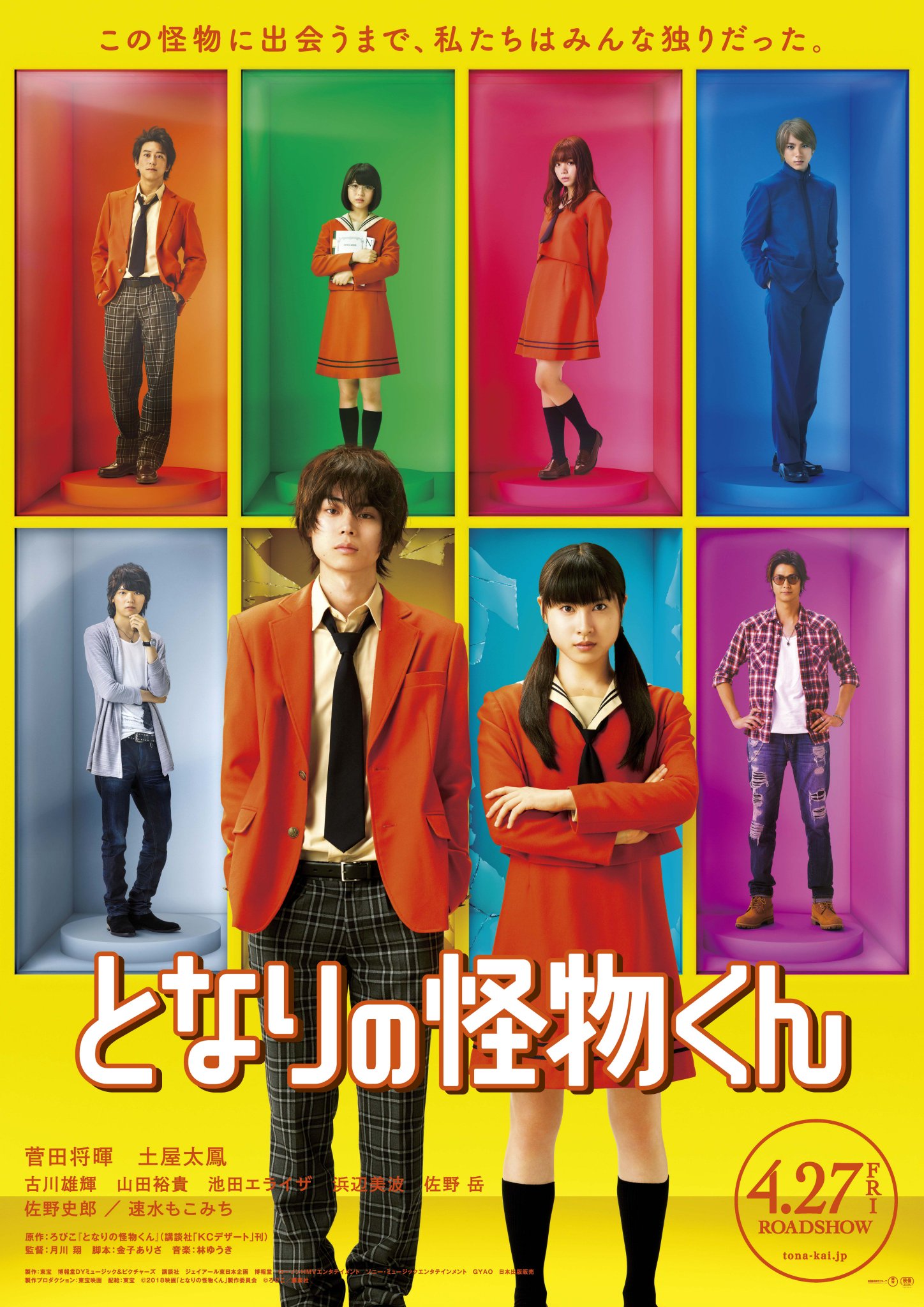
My Little Monster (となりの怪物くん, Sho Tsukikawa, 2018)

A wilfully self-contained high school girl falls for a big-hearted classmate, but struggles to understand that they are in essence fighting different battles in their parallel quests for acceptance. Adapted from the hit shojo manga by Robico, Sho Tsukikawa’s My Little Monster (となりの怪物くん, Tonari no Kaibutsu-kun) is in many ways a typical high school rom-com in which a repressed young woman begins to deal with her abandonment issues essentially by mothering a displaced young man whose “problematic” big-heartedness sees him regarded as a “monster” by a still conservative society. 

Opening with a flashback presumably set in the present day, an older Shizuku (Tao Tsuchiya) now wearing a lawyer’s pin listens wistfully to Kana Nishino’s 2010 hit Best Friend and reflects on a time when all she cared about was studying, rejecting all human connection. Until that is she met the titular “monster” Haru (Masaki Suda) and suddenly found herself surrounded by people. Haru, as we discover, got into a fight on the first day of school and never actually showed up for classes. Because Shizuku should have been his desk neighbour, the panicked teacher asks her to take the handouts etc to his home in the hope he’ll one day return. Shizuku has no interest in doing as the teacher has tasked her but fulfils her duty, only to unexpectedly encounter Haru who then decides they must be “friends” based on a primary school understanding that friends take each other notes and homework when one of them is sick. 

It turns out that Haru hasn’t been coming to school because it bothers him that everyone finds him scary because of his lack of impulse control. He desperately wants to make friends and thinks he has some in a trio of local boys but Shizuku can see right away that they are essentially bullying him for money and tries to explain that “real” friends don’t sponge off each other. Perhaps because of his innate kindness, Haru is completely guileless and sees the best in everyone unable to understand when he’s being taken advantage of. Despite herself, Shizuku begins to feel protective assuring Haru that he will one day be surrounded by people who understand him unwittingly echoing the words of his late aunt who was the only other person who’d ever rooted for him. Straightforward as ever, Haru immediately confesses his love and so their awkward high school romance begins. 

Shizuku, however, is still largely uninterested in love. She has devoted herself to studying and only cares about coming top in the school exams. As we discover this is less because of academic ambition than practical application. She studies hard and immediately sees results. It’s the sure thing, something which is completely within her own control, unlike other people’s feelings which are necessarily messy and unpredictable. There is however an uncomfortable conservatism in the centring of Shizuku’s trauma solely in the fact that her mother works outside the home and is therefore not present in her life in the way that mothers are expected to be in a patriarchal society while her family set up is regarded as unusual in that her father, having failed several times in business, is a househusband. 

Meanwhile, she remains fairly blinkered to Haru’s parallel familial disconnection in that he has apparently been disowned by his authoritarian father for his free-spirited ways. Taken to a birthday party held for Haru’s older brother Yuzan (Yuki Furukawa), Shizuku begins to realise there is a large class difference between them but reacts badly, confused that he is rejecting the very things she’s striving for in refusing to reconnect with his father, ignoring the fact that he has separated from him because he is essentially abusive. He refuses to let Haru be Haru, trying to straight-jacket him into conventionality by forcing him to clamp down on his noisy impulsivity, something which he seems unable to do even if he wanted to. Shizuku fails to realise the hurt she deals him in refusing to understand his reluctance, unable to see that it amounts to a rejection from the one person he assumed had completely accepted him. 

What she discovers is that you won’t always be forgiven for momentary thoughtlessness and in the end you have to let people be what they are, which throws into light the problematic “monster” of the title which is how Haru is often seen by others, a quality brought to vivid life in Suda’s manic performance. A rival suitor, Yamaken (Yuki Yamada), selling himself as the slow and steady candidate perhaps more suited to Shizuku in being more like herself, describes their relationship as a “make-believe friendship” rather than a real romance, something she has to accept may have a grain of truth in it in her inability to fully understand the person she claims to love, but nevertheless comes to the conclusion that while Yamaken may make her feel at ease in herself it’s the stressful stimulation with the intense yet passionate Haru that she truly craves. That aside, their romance is a fairly cool affair and its resolution too contrived to have any kind of impact which is perhaps why Tsukikawa resorts to anime-style imagery including a flying leap of love accompanied by bright sunshine flooding in from behind. Nevertheless, in true shojo fashion My Little Monster celebrates not only its heroine’s gradual path towards an embrace of the chaos of being alive, but also the power of friendship and acceptance as the gang find a place to belong in each other and with it a more concrete sense of self.


Singapore release trailer (English/Simplified Chinese subtitles)

Kana Nishino – Best Friend