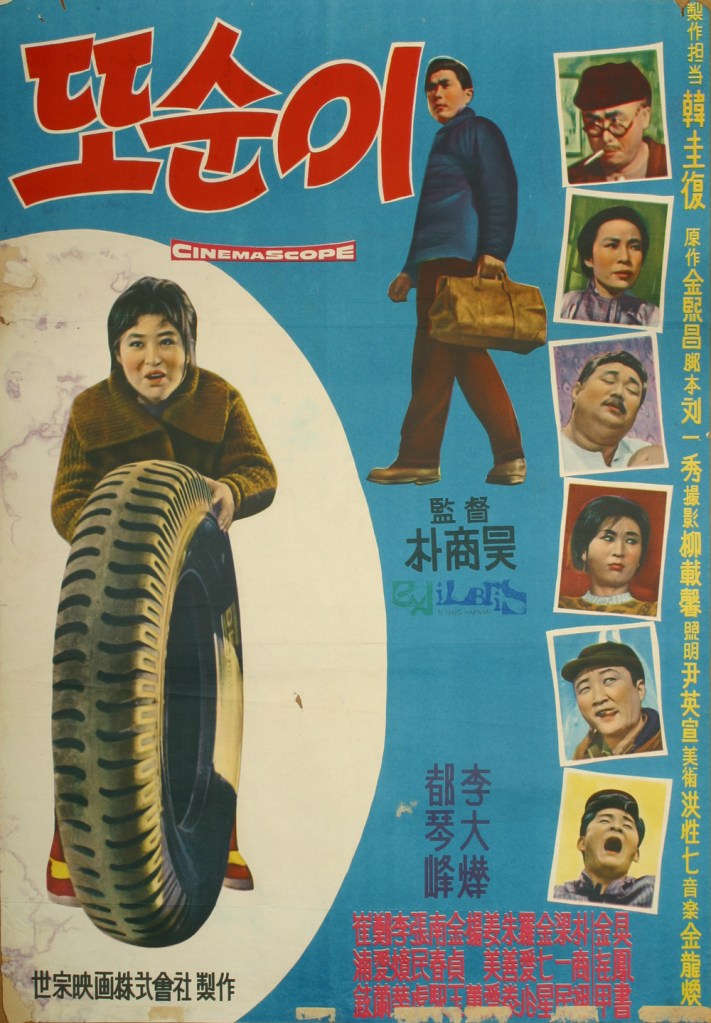
Tosuni: The Birth of Happiness (또순이, Park Sang-ho, 1963)

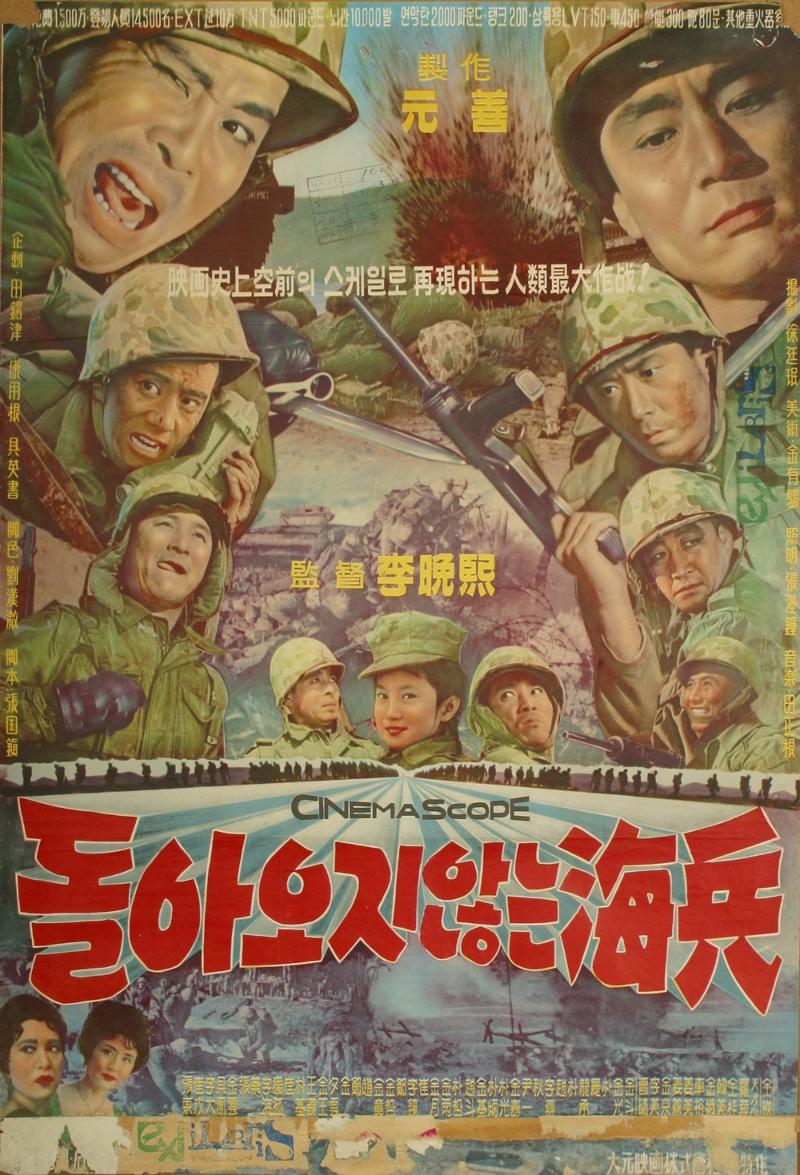
Korean Cinema had enjoyed a small window of freedom following the April Revolution that brought down the government of Rhee Syngman, but that window was closed all too soon by the Motion Picture Law brought in under Park Chung-hee which reformed the film industry and instituted an increasingly stringent censorship regime. Despite that, however, 1963 was something of a banner year which saw the release of such enduring classics as The Marines Who Never Returned, Bloodline, and Goryeojang. In comparison, Park Sang-ho’s Tosuni: The Birth of Happiness (또순이) seems like a much smaller film but was the fourth highest grossing that year, possibly because it was inspired by a hugely popular radio serial. Standing in direct contrast to contemporary melodrama, Tosuni puts a positive spin on go getting capitalistic individualism as its salt of the earth working class heroine defiantly makes her dream come true on her own despite the parade of useless men that attempt to drag her down. 

The cheerful Tosun (Do Kum-bong) is the daughter of Choi Jang-dae (Choi Nam-hyeon) who came from the North with nothing but the shirt on his back and now owns a bus company. A difficult, miserly old man, Jang-dae has a loathing for people who depend on others which is why he sends a young hopeful, Jae-gu (Lee Dae-yeop), packing when he turns up with a letter of recommendation and asks for a job as a temporary driver. Unbeknowst to Jang-dae, Tosun had already encountered Jae-gu on the bus where her father had sent her on an errand only to complain she’s not come back with as much money as he hoped. Tosun asks her father for a 50 won payment for her work but he refuses, leading to a blazing row during which Tosun points out that while both her parents were out working she was basically their housekeeper so he owes her around 15 years in back pay and is also in contravention of the child labour laws. Seeing as she was looking after them all these years, she feels she’s already well acquainted with the “independence” her father always seems so keen on. Eventually she storms out, vowing to become a success on her own. Jang-dae is annoyed to have lost the argument but also oddly proud, realising that he brought Tosun up right and impressed that she actually stood up to him and can obviously take care of herself. 

Tosun certainly is a very capable woman, working hard, taking every job going, and making money wherever she goes. Jae-gu, meanwhile, turns out to be something of a layabout, never really looking for a job but spending all his money drinking with the madam, Su-wol (Na Ae-sim), in a local cafe. Tosun carries on doing her own thing but also wants to help Jae-gu, not least because they pledged to try and achieve their dream of owning a modern motor car together. Jae-gu knows that Tosun is perfectly capable of getting the car on her own and is mildly put out by it, sore over wounded male pride despite her assurances that even if she’s the one who gets the money together he’s the one who’ll be driving. That’s perhaps why he’s so easily suckered by an obvious scam when he gets together with a friend who’s met a guy who needs to shift some tyres, but only after dark when there’s no one around. Tosun thinks it’s fishy, especially if they can’t take the tyres right away, but goes along with it to make Jae-gu feel better. 

Like Jae-gu, most of the other young men are also selfish and feckless, dependent on and exploitative of female labour to get them out of trouble. Tosun’s brother-in-law (Yang Il-min) is forever lying to his in-laws to get loans for spurious business opportunities which never work out, complaining that he can’t “slave away as a temporary driver forever” but taking no proactive steps to change his circumstances despite the responsibilities of being a husband and father. Jae-gu’s friend, meanwhile, takes the opportunity of his wife being in hospital waiting to give birth to their child to try it on with Tosun who manages to fend him off but has a major loss of confidence because of the shock of his betrayal. 

Tosun’s mother hadn’t wanted her to move out not only because that means she’s alone in the house with the difficult Jang-dae, but because being an “independent” woman was somewhat unheard of and she’s worried her daughter will lose her virtue, or at least be assumed to be a loose woman, after leaving home before marriage. Tosun might be a little naive and extremely good hearted, she keeps unwisely lending money to people who obviously aren’t going to pay her back, but as she keeps pointing out she didn’t move out for fun she wants her independence. That’s one reason she keeps Jae-gu at arms length even though she’s fallen in love with him despite her constant exasperation. 

Tosun is in many ways the embodiment of a capitalistic work ethic, proving that you really can make it if you just knuckle down. The car represents both independence itself and a sense of modernity, as demonstrated by the excited commotion among Tosun’s friends and neighbours when she finally gets one and arrives to take her parents for a drive. Even the brother-in-law suddenly realises he might be better off working for Jang-dae rather than living a feckless existence of constant and humiliating failures trying to get rich quick. That’s the problem with the younger men, apparently, they want everything right away, like Jae-gu and his tyre deal, and aren’t really prepared to work at it. Tosun sorted the tyre problem in her own cooly handled fashion, outwitting the unscrupulous vendor but doing it without malice and only showing him she won’t be had. Is the motor car and everything it represents the birth of happiness? Maybe not, but it doesn’t hurt, and Tosun unlike her father seems to have retained her good heart, setting off into an admittedly consumerist but hopefully comfortable future, a back seat driver but behind her own wheel. 


Tosuni: The Birth of Happiness is available on English subtitled DVD from the Korean Film Archive in a set which also includes a digital restoration before/after comparison and stills gallery plus a bilingual booklet featuring essays by Kim Jong-won (film critic & professor), and Park Yu-hee (film critic & research professor). It is also available stream online via the Korean Film Archive’s YouTube Channel.

The Body Confession (肉体의 告白 / 육체의 고백, Jo Keung-ha, 1964)

Body Confession posterThe Korea of 1964 was one beginning to look forwards towards a new global future rather than back towards the turbulent colonial past, but the rapid leap forward into a new society had perhaps left an entire generation behind as they prepared to watch their children reject everything they’d strived for in search of “modernity”. 1964’s The Body Confession (肉体의 告白 / 육체의 고백, Yukche-ui Gobak) is the story of one such woman. Widowed young, she turned to sex work in order to support her three daughters in the hope that sending them to university would win them wealthy husbands only for her daughters to encounter the very problems she worked so hard for them to avoid.

The heroine, a veteran sex worker known as The President (Hwang Jung-seun), has become a kind of community leader in the red light district largely catering to American servicemen in the post-war era. While she labours away in the brothels of Busan, her three daughters are living happily in Seoul believing that she runs a successful fashion store which is how she manages to send them their tuition money every month. The President goes to great lengths to protect them from the truth, even enlisting a fashion store owning friend when the girls visit unexpectedly. Nevertheless, she is becoming aware that her position is becoming ever more precarious – as an older woman with a prominent limp she can no longer command the same kind of custom as in her youth and is increasingly dependent on the support of her fellow sex workers who have immense respect for her and, ironically, view her as a maternal figure in the often dangerous underworld environment.

This central idea of female solidarity is the one which has underpinned The President’s life and allowed her to continue living despite the constant hardship she has faced. Yet she is terrified that her daughters may one day find out about her “shameful” occupation and blame her for it, or worse that it could frustrate her hopes for them that they marry well and avoid suffering a similar fate. Despite having, in a sense, achieved a successful career in the red light district, The President wants her daughters to become respectable wives and mothers rather than achieve success in their own rights or be independent. Thus her goal of sending them to university was not for their education but only to make them more attractive to professional grade husbands.

The daughters, however, are modern women and beginning to develop differing ideas to their mother’s vision of success. Oldest daughter Song-hui (Lee Kyoung-hee) has fallen in love with a lowly intellectual truck driver (Kim Jin-kyu) who has placed all his hopes on winning a literary competition. He is a war orphan and has no money or family connections. Meanwhile, second daughter Dong-hui (Kim Hye-jeong) has failed her exams twice and developed a reputation as a wild girl. Toying with a poor boy, she eventually drifts into a relationship with the wealthy son of a magnate (Lee Sang-sa) but fails to realise that he too is only toying with her and intends to honour his family’s wishes by going through with an arranged marriage. Only youngest daughter Yang-hui (Tae Hyun-sil) is living the dream by becoming a successful concert musician and planning to marry a diplomat’s son.

The three daughters have, in a sense, suffered because of their mother’s ideology which encourages them to place practical concerns above the emotional. Song-hui is conflicted in knowing that she will break her mother’s heart by marrying a man with no money or family but also knows that she will choose him all the same. Dong-hui, by contrast, enthusiastically chases Man-gyu for his money but naively fails to realise that he is selfish and duplicitous. In another evocation of the female solidarity that informs the film, Man-gyu’s fiancée Mi-ri eventually dumps him on witnessing the way he treats Dong-hui, roundly rejecting the idea of being shackled to a chauvinistic man who assumes it is his right to have his way with whomever he chooses and face no consequences. Like Song-hui, Mi-ri breaks with tradition in breaking off her engagement against her parents’ wishes and reserving her own right to determine her future.

Yang-hui, whose future eventually works out precisely because of the sacrifices made on her behalf by her mother, turns out to be her harshest critic, rejecting The President on learning the truth and attempting to sever their connection by repaying all the “ill-gotten” investment. Her wealthy husband, however, turns out to be unexpectedly sympathetic in pointing out that her mother has suffered all these long years only to buy her future happiness and that now is the time they both should be thanking her. Meanwhile, The President has become despondent in realising she is out of road. There is no longer much of a place for her in the red light district, and she has nowhere left to turn. Only the kindly Maggie, another sex worker who has been a daughter to her all this time, is prepared to stand by her and take care of her in her old age.

The gulf between the two generations is neatly symbolised by the surprising inclusion of stock footage from the April 19 rising against the corrupt regime of Rhee Syngman which led to a brief period of political freedom before the dictatorship of Park Chung-hee took power in 1961. The poor intellectual author whom The President dismissed, eventually becomes an internationally renowned literary figure after being published abroad while the wealthy magnate’s son turns out to be a louse. The President staked her life on the old feudal ways of ingratiating oneself with privilege by playing by its rules, but the world has moved on and it’s up to the young to forge their own destinies rather than blindly allowing those in power to do as they please. Sadly for The President, her sacrifices will be appreciated only when it’s too late and her desire for her daughters to escape the hardship she had faced misunderstood as greed and snobbishness. There is no longer any place for her old fashioned ideas in the modern era and her daughters will need to learn to get by on their own while accepting that their future was built on maternal sacrifice.


The Body Confession was screened as part of the 2019 Udine Far East Film Festival. It is also available to stream online via the Korean Film Archive’s YouTube Channel.
The Marines Who Never Returned (돌아오지 않는 해병, Lee Man-hee, 1963)

Marines Who Never ReturnedLee Man-hee was among the most prolific of Korean directors until his untimely death at the age of just 43 in 1975, but even among so many well regarded works The Marines Who Never Returned (돌아오지 않는 해병, 돌아오지 않는 해병, Doraoji Anneun Haebyong) has taken on an especial place in Korean film culture. Lee had himself served in the Korean War and brought his own ambivalent attitudes to the piece, expressing both an abject rejection of the senseless loss of life but also a warmth and nostalgia for the camaraderie born only out of such immediate danger. The film’s title, as melancholy as it is, points to this same ambivalence by signalling the eventually unhappy fates of these ordinary men but also according them a ghostly, unresolved future.

In the midst of the Korean War, a squad of South Korean soldiers is on patrol and taking fire from the Chinese in an urban environment. While they bide their time in a trench, a young girl and her pregnant mother run out of a nearby building. The girl runs clear but the mother is shot and killed in the crossfire. One of the soldiers is deeply struck by the scene and insists they at least make sure the little girl is safe. Pushing deeper into the building, the soldiers come upon a truly horrifying, hellish scene of men trussed up and hanging from the ceilings while bodies of the townspeople lie piled along the floor. The same soldier who wanted to save the little girl finds his own sister among the dead, just one face among so many.

From this point on the tale is narrated by the little girl, Young-hui (Jeon Young-sun), who is adopted by the troop of marines and smuggled around inside an old army kit bag so that the superiors do not find out about her presence. Young-hui proves a resilient little girl who obviously misses her parents but begins to care deeply for the soldiers who have taken her in. Giving each of her new uncles nicknames, Young-hui becomes the squad’s mascot and a symbol of everything it is they’re fighting for. Yet this makeshift family also has its share of difficulties. A problem arises when Young-hui recognises a new recruit, Choi (Choi Moo-ryong), as a man from her village. Choi is the brother of the man who joined the other side, took Young-hui’s father away and killed the sister of Private Goo, discovered so casually among the many dead in Young-hui’s village alone.

The conflict between Choi and Goo is emblematic of many ordinary families throughout Korea as fathers and sons, brothers and sisters, decided on different paths and found themselves on opposing sides of a war. Choi, as is pointed out, is not responsible for his brother’s actions – he clearly does not condone or agree with them, but still he feels responsible enough to understand Goo’s anger and resentment. Goo in turn realises his anger is pointless and misdirected but is powerless to change the way he feels. This situation is no one’s fault, but they’ll all pay the price anyway.

Lee spares no expense in recreating the hellish battles scenes more akin to the first war than the second with its outdated tanks, dugouts, and trenches. The easy, familial life of the camp soon gives way to action and danger as the squad meet their ends one by one. Away from the battlefield the men feel displaced within their own country – caught in the midst of a civil war yet also subjugated by foreign forces, barred from UN only bars and referred to as “tuppenny Koreans” by the “hostesses” in comparison to their big spending compatriots. Making his goodbye speech, the commanding officer instructs his comrade to return home and ask if anybody really needs to go to war, but rising from the trenches their thoughts are all for their fallen friends who will never see home again. These men remain “lost” on the battlefield, a lingering memory of loss and sacrifice which is impossible to resolve even so many years later.


The Marines Who Never Returned is the first in The Korean Film Archive’s Lee Man-hee box set which comes with English subtitles on all four films as well as a bilingual booklet but the film is also currently available to stream via the Korean Film Archive’s YouTube channel.