Feast (Apag, Brillante Mendoza, 2022)

A young man fuelled by an internalised class conflict struggles to come to terms with his guilt after running over a man and his daughter in Brilliante Mendoza’s social drama, Feast (Apag). With a strong religious sentiment, each of the four acts is preceded by a title card with a Biblical quotation, Mendoza seems to suggest that we are all one big family and that all divisions are healed when the feast is shared equally, except that equal it is not even when brokered by mutual compassion. 

The opening scenes also have their irony. Wealthy businessman Alfredo (Lito Lapid) and his diffident son Rafael (Coco Martin) shop for expensive fresh crabs at the market, while Matias and his young daughter haggled for much less extravagant fare before making their way home by scooter and sidecar. Distracted by a phone call, Rafael ends up colliding with Matias in his 4×4. Acting quickly, Alfredo jumps in the driving seat and speeds away insisting that he will take the responsibility for the accident, whatever that might mean. After a talk with their lawyer who tells them they’ve not a leg to stand on, Rafael goes to the hospital and pays the family’s bills but Matias dies soon afterwards. Alfredo insists on taking the blame, agreeing to go prison in his stead, but Rafael can’t get over his guilt and enters a depressive spell that prevents him from getting on with the rest of his life.

As we later discover, Rafael occupies a difficult position in terms of his social class. His mother Elisa is Alfredo’s second wife, once a waitress in the family home and disliked by the children of his previous spouse. He is separated from his daughter as his wife seems to have left him for unclear reasons and gone abroad where she has met another man. He wants to unburden himself by accepting the punishment for Matias’ death but is prevented by his father’s heroic act of sacrifice and must carry the guilt alone. The family determine to make amends by “supporting” Matias’ widow Nita (Jaclyn Jose) and their children, but are in essence wielding their privilege over her in assuming they can settle all of this with money and need accept no other responsibility. 

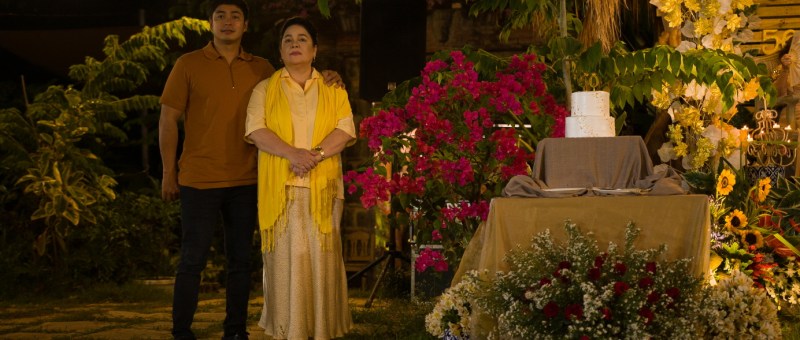
Nita is rightly insulted when Elisa turns up to offer her money to compensate for her husband’s death, but it’s also clear that the family is already poor and now presumably without their main breadwinner. In any case what she wants is justice, and both gets it and doesn’t when Alfredo is sent to prison in place of Rafael. In the final acts of the film, the family has taken in Nita and her children but ostensibly as servants even if ones treated like friends while she is forced to feel grateful to the family that killed her husband for gifting her financial security. The feast with which the film ends was cooked by Nita, but she is not invited to partake in it only stand by and watch while the rest of the family eat. Yet the scene is presented to suggest that a divide has been healed, that inviting them to attend the feast was enough in itself even if a class distinction is still clearly felt between those who serve and those who eat. 

Though Nita seems to have some latent resentment, it is largely washed away on learning the truth allowing her to forgive and symbolically releasing Rafael from his torment. While forgiveness maybe worthy, it also lets the privileged off the hook for their oppressive behaviour in suggesting that the wealthy need only show magnanimity while the poor are expected to simply accept it in good faith. Had this not happened, there is no way they would share their feast with a woman like Nita nor will they ever do so again. If they really meant to dissolve class barriers, they could open the doors to all but they do not. In any case, through coming to terms with his responsibility for Matias’ death, Rafael appears to quell his own inner class conflict to occupy his rightful place but perhaps still fails to fully consider that Matias’ death wasn’t really just an “accident” but a natural consequence of the way in which men like himself move through the world.


Feast screened as part of the 2022 Busan International Film Festival.

Original trailer (no subtitles)
Big Night! (Jun Robles Lana, 2021)

In the opening scenes of Jun Robles Lana’s darkly comic farce Big Night! a young man is shot in the head by another young man, this one wearing a motorcycle helmet with its visor down, who calmly walks away and gets back on the back of the bike he arrived on his friend then driving them both away. Of course people are shocked but then again not all that much, they barely pause despite the fact that his man, Ronron, was well known to them and no one really thought he had much to do with drugs. Beautician Dharna (Christian Bables) gossips about the killing with his friend Biba but gives it little thought before returning to his day, so normalised has death on the streets become in Duterte’s Philippines. 

Dharna may not have given much thought to extrajudicial killings, but then it’s different when it’s you who might be next in the firing line as he discovers when Biba gets an advance view of the following day’s “Watch List” from her law enforcement boyfriend. What ensues is a kafkaesque quest to clear his name though there’s no real “official” path towards getting off a watch list when you’re on one. His boyfriend Zeus who is due to perform in a “Big Night” pageant at a local gay bar that very night suggests simply fleeing to another district, but flight implies guilt and as Dharna points out he’ll lose all his customers if he has to move to another area and neither of them have the money to start all over again somewhere new. Like many of Dharna’s friends and acquaintances Zeus doesn’t seem to share his concern. “The police won’t bother you if you’re not doing anything illegal” he naively advises, sure it’s all just a random mistake that soon will blow over but otherwise so numbed to the idea of extrajudicial killing that he doesn’t really think too much of it and is mainly annoyed that Dharna has lost interest in helping finish his costume for the big show. 

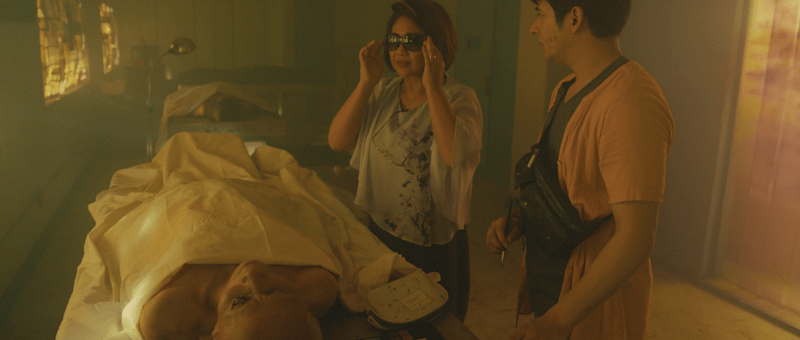
Neither of them can think of a reason why Dharna, under his full legal name, would have been placed on a list as he’s not a drug user and doesn’t know anyone who is. He does, however, have some useful connections including local law enforcement official Cynthia who isn’t terribly interested or helpful but manipulates his anxiety to force him to help her out by filling in for her regular mortician, Connie, who has mysteriously not shown up for work. The morgue is currently overflowing, Cynthia making a dark joke that undertaking is a growth industry while revealing that there are so many bodies in part because families have to pay a fee to get them back and most of those involved in extrajudicial killings are from the slums so they can’t afford it. Even so, she explains to Dharna that they get more donations when families can see the body which is why he’s supposed to make them up to look as good as they can despite many of them having sustained gunshot wounds to the head or face. 

Cynthia sends him on to local community leader Roja warning him that he’s “allergic to gays” while he too makes Dharna do his bidding pointlessly walking laps around a fountain in some sort of macho display of endurance while insisting that he’s so anti-drug that even if he gets a stomach upset he just powers through it with raw masculine energy. He too is a self-interested hypocrite spouting religious nonsense while hanging out in “massage parlours”, dangling the idea of salvation but unprepared to grant it. Dharna wonders if it might have been someone from the area where he grew up who reported him but discovers that unlicensed midwife Melba (Janice De Belen) makes a point of not putting any names forward at all and is herself willing to risk breaking the law to help women in need who are denied medical treatment because of their poverty.

It’s impossible to avoid the implication that this is happening to Dharna in part because he’s poor and powerless in an authoritarian and hierarchal society but he’s eventually forced to consider that someone may have put his name in a drop box anonymously, that perhaps they gave a random name when someone asked for one to save their own, because they had something against him, or sought to profit in some way from his absence. Like the witch trials of old, the war against drugs is another tool that can be manipulated for personal gain and so inured to violence has the society become that many are prepared to use it. Dharna finds himself at the centre of a random conspiracy in which he has no other option than to accept his complicity or die, discovering that as the radio report that opened the film had suggested the same officials in charge of prosecuting the war on drugs are in fact secretly using it to secure their stranglehold over the local drugs trade. 

Dharna finds himself compromised at every turn, beginning by offering free haircuts to help his case to progressing to covering up state crime, literally, by repairing the faces of the dead and graduating to faking a seizure in an ambulance to bypass a checkpoint. At the hospital he is confronted by the face of an old lady filled with despair one hand holding that of a little girl and the other a pair of bloody sandals before she simply collapses. Dharna tries to wash the sandals clean but there’s only so much you can do when the stain runs so deep. The irony of his big night taking place on All Souls Day is not lost though there’s precious little time for honouring the dead when your survival can no longer be assured. 


Big Night screens at UltraStar Cinemas Mission Valley, San Diego April 23/27 as part of this year’s SDAFF Spring Showcase.

Original trailer (English subtitles)