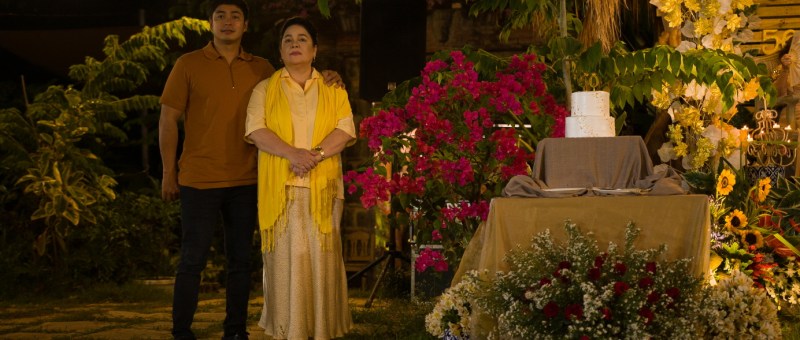
Feast (Apag, Brillante Mendoza, 2022)

A young man fuelled by an internalised class conflict struggles to come to terms with his guilt after running over a man and his daughter in Brilliante Mendoza’s social drama, Feast (Apag). With a strong religious sentiment, each of the four acts is preceded by a title card with a Biblical quotation, Mendoza seems to suggest that we are all one big family and that all divisions are healed when the feast is shared equally, except that equal it is not even when brokered by mutual compassion. 

The opening scenes also have their irony. Wealthy businessman Alfredo (Lito Lapid) and his diffident son Rafael (Coco Martin) shop for expensive fresh crabs at the market, while Matias and his young daughter haggled for much less extravagant fare before making their way home by scooter and sidecar. Distracted by a phone call, Rafael ends up colliding with Matias in his 4×4. Acting quickly, Alfredo jumps in the driving seat and speeds away insisting that he will take the responsibility for the accident, whatever that might mean. After a talk with their lawyer who tells them they’ve not a leg to stand on, Rafael goes to the hospital and pays the family’s bills but Matias dies soon afterwards. Alfredo insists on taking the blame, agreeing to go prison in his stead, but Rafael can’t get over his guilt and enters a depressive spell that prevents him from getting on with the rest of his life.

As we later discover, Rafael occupies a difficult position in terms of his social class. His mother Elisa is Alfredo’s second wife, once a waitress in the family home and disliked by the children of his previous spouse. He is separated from his daughter as his wife seems to have left him for unclear reasons and gone abroad where she has met another man. He wants to unburden himself by accepting the punishment for Matias’ death but is prevented by his father’s heroic act of sacrifice and must carry the guilt alone. The family determine to make amends by “supporting” Matias’ widow Nita (Jaclyn Jose) and their children, but are in essence wielding their privilege over her in assuming they can settle all of this with money and need accept no other responsibility. 

Nita is rightly insulted when Elisa turns up to offer her money to compensate for her husband’s death, but it’s also clear that the family is already poor and now presumably without their main breadwinner. In any case what she wants is justice, and both gets it and doesn’t when Alfredo is sent to prison in place of Rafael. In the final acts of the film, the family has taken in Nita and her children but ostensibly as servants even if ones treated like friends while she is forced to feel grateful to the family that killed her husband for gifting her financial security. The feast with which the film ends was cooked by Nita, but she is not invited to partake in it only stand by and watch while the rest of the family eat. Yet the scene is presented to suggest that a divide has been healed, that inviting them to attend the feast was enough in itself even if a class distinction is still clearly felt between those who serve and those who eat. 

Though Nita seems to have some latent resentment, it is largely washed away on learning the truth allowing her to forgive and symbolically releasing Rafael from his torment. While forgiveness maybe worthy, it also lets the privileged off the hook for their oppressive behaviour in suggesting that the wealthy need only show magnanimity while the poor are expected to simply accept it in good faith. Had this not happened, there is no way they would share their feast with a woman like Nita nor will they ever do so again. If they really meant to dissolve class barriers, they could open the doors to all but they do not. In any case, through coming to terms with his responsibility for Matias’ death, Rafael appears to quell his own inner class conflict to occupy his rightful place but perhaps still fails to fully consider that Matias’ death wasn’t really just an “accident” but a natural consequence of the way in which men like himself move through the world.


Feast screened as part of the 2022 Busan International Film Festival.

Original trailer (no subtitles)

Smaller and Smaller Circles (Raya Martin, 2017)

Smaller and Smaller circles poster“Time and forgetfulness are the allies of abusers” – a Catholic priest reminds his students as part of a history lesson regarding the supposedly bloodless revolution that led to the end of the Marcos regime. Festival favourite Raya Martin dials things back a little in adapting the award winning novel by F.H. Batacan, Smaller and Smaller Circles. Batacan’s novel is often described as the first real Philippine crime novel – something echoed in the ridiculous views of a lazy and self serving police officer who believes there are no serial killers in the Philippines, yet the Smaller and Smaller Circles of the title lay the blame for the heinous acts its centre not at the feet of an evil madman but at those of the society which so progressively damaged his soul as to render it irreparable.

Our hero is himself a priest. Father Gus Saenz (Nonie Buencamino) is a man of faith and compassion who, despite all the failings he can see in it, still believes the Church is the best way to help those in need. He is sickened and appalled by the institution’s intransigence when it comes to bad priests and is preoccupied by one in particular – Father Ramirez, whose inappropriate conduct with children he has doggedly reported for more than a decade only for him to continually escape punishment. In addition to the priesthood, Father Gus is also a teacher of philosophy and a forensic scientist who works as an occasional consultant to the local police. It is in this capacity that he comes to discover a series of murders involving young boys whose bodies were discarded on a local rubbish dump deprived of their hearts, genitals, and faces. With the assistance of his junior priest, Father Jerome (Sid Lucero), and a reporter (Carla Humphries) who was once his student, Gus attempts to solve the mystery behind this horrific series of murders before the killer strikes again.

Martin breaks with genre norms by giving us an immediate insight into the killer’s psychology as we witness the prelude to the killings while listening to his own explanations of why they must occur. The picture he paints of his childhood quickly frames his crimes as a murder of the self as the killer indulges in a compulsion to kill the weak, targeting teenage boys and stealing from them not only the breath of life but the spirit of it too. The first of our circles is the Church – the bad priests whose abuses are sanctioned by their organisation and mitigated by the “good” they leave behind. Father Ramirez was shuffled on and now works for a children’s charity but Father Gus’ attempts to warn the charity’s director fall on deaf ears and then cost him his funding. Only when Father Ramirez’ financial improprieties are discovered is his position finally questioned.

The second ring is poverty. All of these boys were poor and many of them were not identified right away because aside from their parents (if they had them) nobody was going to miss them. The film opens with a scene of children running over a rubbish dump and as the father of the first victim explains, his son was one of many who supported their struggling families by combing over the left overs of the better off looking for anything which might still be useful. Our third ring is bureaucracy – when Fathers Gus and Jerome meet the local councillor, they are surprised to find that she is efficient and committed, keen to do whatever it takes to look after her constituents even if it means going up against the Church or the wider government. However, she knew nothing of the murders and though she is quick to grant Father Gus all the access he needs, it is partly her own efforts to provide essential services to the poor which have enabled the crimes as those who claim to want to help others are really only helping themselves and wilfully turning those same mechanisms back on the people who need them most.

As a man of faith Father Gus does his best, refusing to give up on the killer, trying to ease his burden whilst in grave physical danger. Set in the Philippines of the late 90s, Smaller and Smaller Circles is filled with those still trying to come to terms with the traumatic past but finding its unpleasantness echoing in unexpected places. As such it finds unexpected resonance in the world of 2017 in which life is once again cheap and compassion thin on the ground.


Smaller and Smaller Circles is screening as part of the seventh season of Chicago’s Asian Pop-Up Cinema on 19th September at 7pm, AMC River East 21, plus introduction and Q&A with director Raya Martin.

Original trailer (English subtitles)