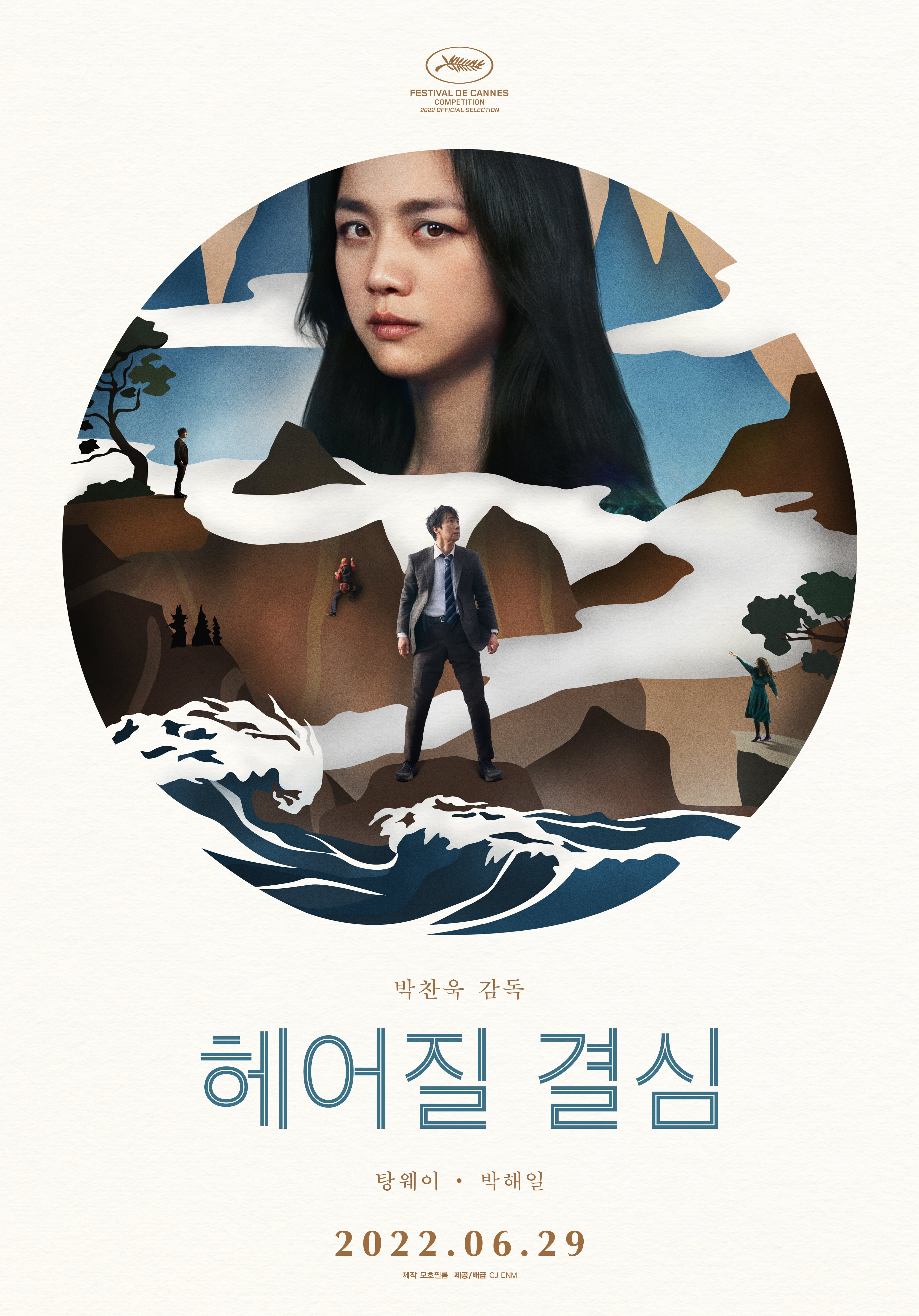
Decision to Leave (헤어질 결심, Park Chan-wook, 2022)

“I went through hell for you but without you my life would be empty” a fugitive murderer asks an insomniac detective to tell the woman he loves, making his own Decision to Leave (헤어질 결심, Heojil kyolshim) which will in fact be one of many in Park Chan-wook’s achingly romantic noir. Tinged with fatalism, the pursuit of love is also one of death and leads inevitably to a kind of haunting from which there is no real escape though you wouldn’t really want one anyway. 

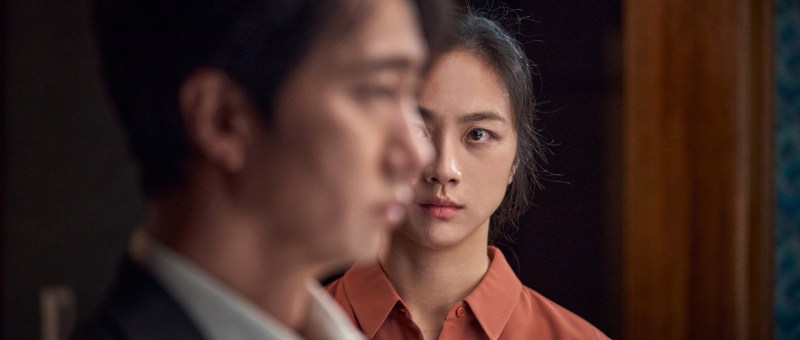
In any case, the detective Park Hae-joon’s (Park Hae-il) sense of reality is already fracturing under the strain of his incurable insomnia. As he tells his partner, it’s not that he can’t sleep because of his obsessive stakeouts, it’s that he goes on stakeouts because he cannot sleep. Unfortunately for him, there have been relatively few murders lately. He wonders if it’s because of the nice weather, as if homicidal rage were being held in check by the gentle art of picnicking which it has to be said has a strange logic to it. Living apart from his wife who is a nuclear engineer in provincial Ipo, Hae-joon prides himself on being a good policeman and is preoccupied by his failure to catch two suspects currently on the run for a vicious murder. When he’s called to the scene of a dead body lying below a cliff, most are ready to rule it a tragic accident or perhaps a suicide but Hae-joon isn’t so sure especially given the unusual behaviour of the man’s much younger widow, Seo-rae (Tang Wei), who appears almost indifferent to her husband’s death and giggles to herself during an interrogation a habit she later claims is born of nervousness and a lack of confidence in her ability to speak Korean having migrated from China. 

Seo-rae’s Korean is perhaps a little better than she makes out, but still we see her repeating lines from romantic dramas on television, lines she later repeats to Hae-joon, while he wonders if her taste for historical romance has lent her Korean its archaic quality. They are each in a way out of time, she remarking that he strikes her as “dignified” to a degree she didn’t expect in a “modern” man while he ironically tells her that he was drawn to her because like him she liked to look at things directly. Yet there’s nothing at all direct about the mysterious Seo-rae whom he suspects of murdering her husband, and though there might be something unspoken directly understood between them their attempts at communication are always frustrated. Not only is there an ever shifting language barrier, but a mediation through text message and voice note or else through the act of being observed at a distance. As they grow closer, Hae-joon allows Seo-rae to listen to his surveillance tapes recorded as he voyeuristically watched her apartment from the rooftop opposite. She immediately deletes them but later does something similar herself, and is finally undone by her inability to delete a potentially incriminating recording because it has come to mean too much to her. 

The pair are in a sense perfectly matched. Hae-joon’s melancholy wife finally exclaims that he needs murder and violence in order to be happy, while Seo-rae admits that she ends up with terrible men like husband because it would take something extreme such as a murder for a good man like Hae-joon to take notice of her. As the couple dance around each other, Park colours their non-romance with shades of the gothic in the repeated motif of the crow feathers each of them find as they work their way towards the apotheosis of their love. As they say every love story is a ghost story and what is love if not an unsolvable mystery? Hae-joon’s sense of reality is forever in flux, Park playfully dressing Hae-joon’s new team and his old team in similar outfits as he segues between fantasy, reality, and memory while trying to parse out an objective truth. Hae-joon’s tragedy may be that he discovers more than he ought to know but not enough to solve the mystery, destined to be haunted by his unresolved cases and the elusive silhouette of lost love lingering silently in the mists of memory. 


Decision to Leave screened as part of this year’s BFI London Film Festival and is now on general release in US & UK cinemas courtesy of MUBI.

International trailer (English subtitles)

Angae (Mist) by Jung Hoon-hee (1967) which is also the title song for Kim Soo-yong’s 1967 film of the same name.

The Battle: Roar to Victory (봉오동 전투, Won Shin-yeon, 2019)

The Battle roar to voctory poster 1Besides seeing the birth of Korean cinema, 1919 was something of a flashpoint in the nation’s 20th century history. Japan had annexed Korea in 1910, thereafter instituting an increasingly brutal colonialist regime. On March 1, 1919 the people rose up in an act of mass protest inspired by the provision for “Self-Determination” included in US president Woodrow Wilson’s 14 Points speech outlining a path towards enduring peace. Though the protest was peaceful, it was quickly suppressed by Japanese troops resulting in thousands of deaths and mass incarcerations.

The Battle: Roar to Victory (봉오동 전투, Bongodong Jeontoo) situates itself a year after the protest as the Independence Movement began to intensify, and is inspired by real life events apparently often absent from the textbooks in which several factions eventually came together to wipe out an “elite’ squad of Japanese troops which had been put together to take down guerrilla Resistance fighters. Our heroes have been charged with collecting money from a fundraiser and conveying it to the Independence Movement in exile in Shanghai but are drawn into a wider battle against Japanese brutality on their way.

The Japanese colonial forces are indeed brutal, if often cowardly. When we first meet crazed commander Yasukawa (Kazuki Kitamura), he’s butchering a tiger in some kind of symbolic act of intense barbarity. To smoke out the Resistance fundraiser, the Japanese military begin razing villages, killing the men and raping the women, even going so far as to shoot small children for sport. When veteran Resistance fighter Hae-cheol (Yoo Hae-jin) raids a command post, he makes a point of taking a hostage who himself seems to be a teenage recruit. Hae-cheol lets the boy live not only out of a sense of compassion, but also because he wants him to take what he’s seen back to Japan, including the aftermath of a Japanese assault on an ordinary Korean village.

Yukio (Kotaro Daigo), as the boy later gives his name, is, unlike his fellow officers, conflicted and confused. Apparently a member of the elite himself, the son of a prominent military figure, Yukio gave up a bright academic future to join the army and find out what it is that Japan does with its advanced weaponry. Asked what he thinks now that he’s seen for himself, he says that he’s ashamed, that his worst fears have been confirmed. According to Yukio, his nation is suffering from an intense inferiority complex which is leading it to commit acts of extreme barbarity in order convince itself it is equal to any other imperial power.

The Japanese officers veer from the crazed, bloodthirsty Yasukawa who views his mission as some kind of hunting expedition, to the merely weak and cowardly. The Independence fighters, however, come from all over Korea speaking many dialects (some less mutually intelligible than others) and with many different motivations but all with the desire to free their country from Japanese oppression. Ace captain Jang-ha (Ryu Jun-yeol) is a born soldier, but those who support him are largely street fighters and “bandits” not always welcomed into the movement by the so-called intellectual “nobles” running the show from a position of social superiority. Then again, as Hae-cheol puts it, no one can be sure how many guerrilla soldiers there are because any farmer is a potential sleeper agent.

In any case, the Resistance fighters pursue their mission selflessly, manipulating the complacent Japanese troops to lure them into a mass ambush while trying to ensure the money still makes its way to Shanghai to preserve the movement. Despite the “Roar to Victory” subtitle, it’s important to note that the Independence Movement was still in a nascent state and would continue opposing Japanese oppression until Korea’s liberation at the end of the war. Covering the legendary battle of Battle of Fengwudong, the film ends with forward motion as the Resistance commander (a late and great cameo from a giant of Korean cinema) points ahead towards the next target, the well known Battle of Cheongsanri, in which the Japanese military reportedly suffered over 1200 casualties at the hands of Independence forces. Overly gory and lacking in subtlety, The Battle: Roar to Victory is unabashedly patriotic but does its best to suggest the costs and compromises of guerrilla warfare as its selfless heroes put aside their differences to fight for a better Korea.


The Battle: Roar to Victory was screened as part of the 2019 London East Asia Film Festival.

Original trailer (English subtitles)

https://www.youtube.com/watch?v=3j__4TEyzxI

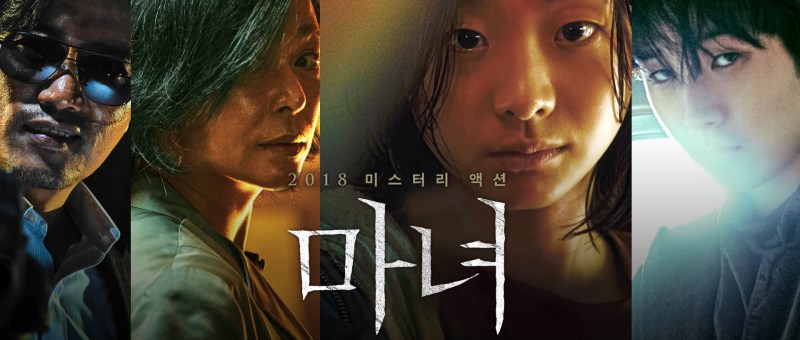
The Witch: Part 1. The Subversion (마녀, Park Hoon-jung, 2018)

There’s probably something quite profound to be said about the folkloric tradition of the foundling child and untold destiny, that exiled nobility can salvage the best qualities of the place they escaped in a rural paradise before returning to make their restoration. Superheroes do indeed seem to find frequent refuge in the wholesome plains of farm country where the salt of the Earth raises them into upstanding people with the right kind of values to couple with their “unnatural” powers to enable them to “save the world” in ways both literal and metaphorical. Perhaps there is darkness in that idea too, that we need such people to save us rather learning to save ourselves or that we secretly long to believe in our latent specialness and hidden destiny, and of course those rightful values may also be inherently conservative in that they aim to preserve a particular vision of “goodness”. In any case, the heroine of Park Hoon-jung’s The Witch: Part. 1. The Subversion (마녀, Manyeo) is not so much out to save the world as engaged in a war to save herself and that particular vision of goodness she’s been gifted by good people (or, then again, perhaps not).

Park begins with blood as a little girl manages to escape a massacre at some kind of shady facility before passing out in front of an idyllic farmstead where she is eventually taken in and nursed back to health by a kindly older couple, the Koos. 10 years pass. The little girl is now the teenage Koo Ja-yoon (Kim Da-mi) and an archetypal farm girl albeit an extraordinarily pretty one with straight A grades and fierce love for her now struggling adoptive parents. With the farming industry in crisis and Mrs. Koo suffering with Alzheimer’s, Ja-yoon finds herself bullied into taking part in a televised singing competition by her boisterous best friend Myung-hee (Go Min-si), which is not the best idea if you’re trying to hide from shady government forces. Sure enough, the past begins to resurface leaving Ja-yoon with a series of difficult choices.

Like many other recent Korean action dramas with female leads, The Witch steps back into the familiar territory of “good” mothers and “bad” while uncomfortably asking if childhood corruption can be cured by love alone. Living as Ja-yoon, the unnamed little girl has been reset. Given a “normal” childhood, she seems to have become a “normal”, perhaps ideal, young woman who does well at school, is confident and self possessed, and dearly loves her family and friends. When we finally meet the woman responsible for her corruption, Professor Baek (Jo Min-su) who presents herself again as a maternal figure and Ja-yoon’s “creator”, we learn that Ja-yoon is a creature born of icy violence, raised without compassion or love for no greater purpose than destruction.

Mr. Koo (Choi Jung-woo), perhaps understanding Ja-yoon a little better than she understands herself, often tells her not to go out “like that” which seems like slightly archaic paternal sexism but is also an attempt to soften those “male” instincts towards violence which are so much a part of her early life and of her essential nature. Frightened by her “unnatural” cruelty, Mr. Koo wasn’t sure if they should keep Ja-yoon with them but his wife (Oh Mi-hee) disagreed, believing they could heal her by raising her in love. The choice Ja-yoon faces is whether to embrace her persona as Koo Ja-yoon as raised by her adoptive parents, or the psychopathic killer which lies underneath.

Park leaves the dilemma very much in the air with “Ja-yoon” a vacillating cypher whose internal divisions seem to become ever more stark as she begins to wall off her various personas. “The Witch”, as the title implies, may itself have its misogynistic overtones in pointing directly at Ja-yoon’s transgressive femininity, both innocent farm girl and unstoppable killing machine, but as the subtitle hints Ja-yoon is also attempting to subvert herself in service of a greater mission which (for the moment) remains unclear. Park opens the door to a sequel in which subversion might not be the aim, sending Ja-yoon further along the path of dark self exploration which promises still more violence and mayhem before her bloody work is done.


The Witch: Part 1. The Subversion is released on Digital HD in the UK on April 22nd courtesy of Signature Entertainment.

UK release trailer (English subtitles)