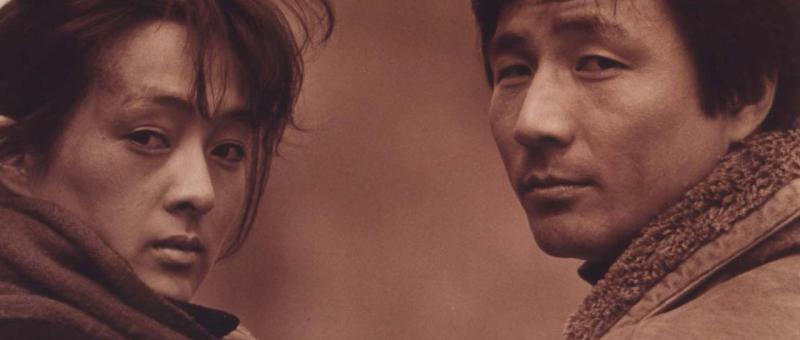
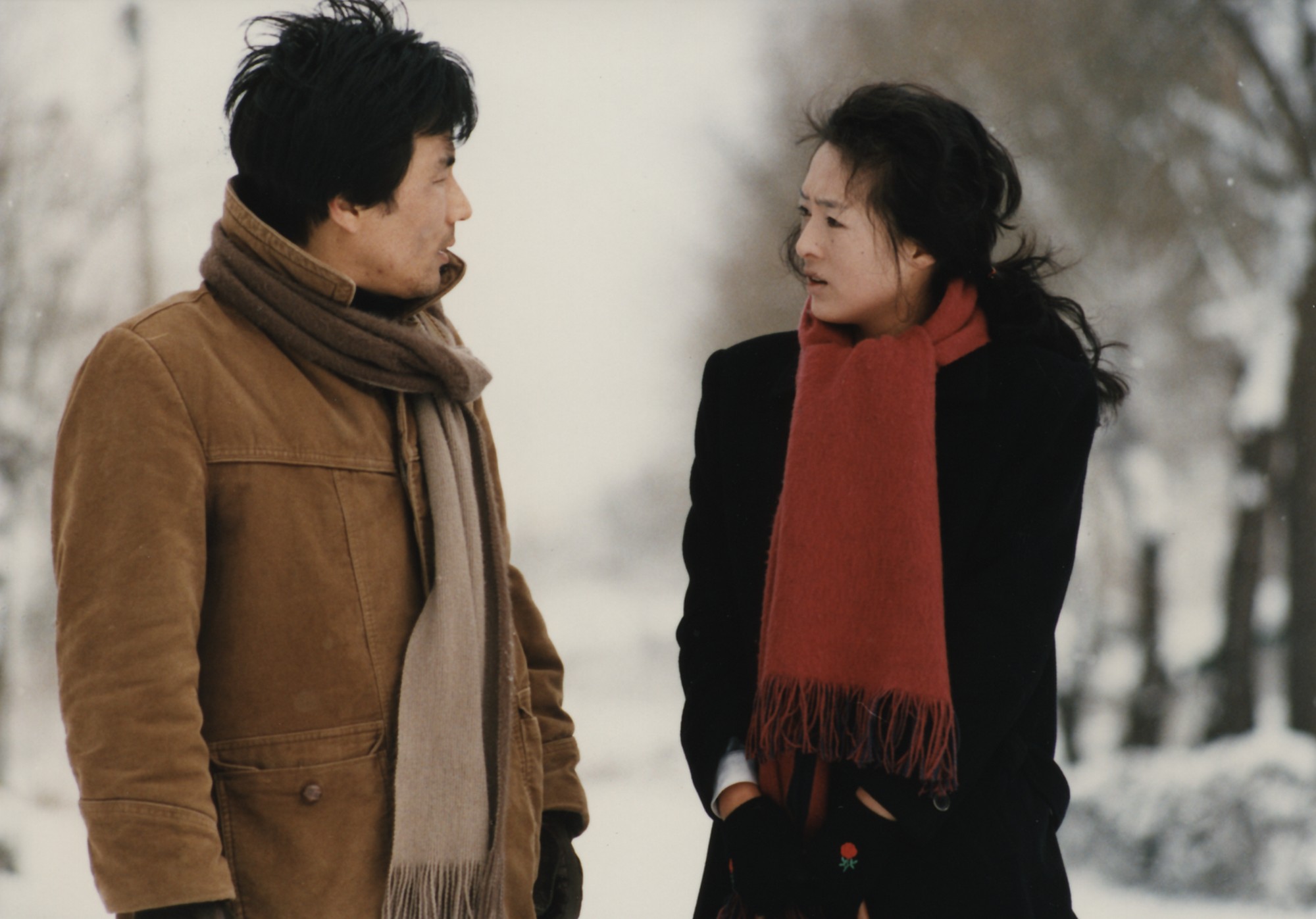
“What a piteous soul who wanders around with sorrow.” The echoes of a funeral song haunt the melancholy hero of Lee Jang-ho’s Division Film, The Man With Three Coffins (나그네는 길에서도 쉬지 않는다, Nageuneneun kileseodo swiji anhneunda). Adapting a novel by Lee Je-ha, Lee Jang-ho positions the divided nation as a more literal kind of limbo filled with wandering ghosts and souls who no longer have a home to return to in which the echoes of shamanism ring with fatalistic intensity.
In Lee’s elliptical screenplay, moments replay and reverberate in a stream of memory that echoes the protagonist’s fractured state of being. What eventually becomes apparent is that he is on a quest to return his wife’s ashes to her hometown, the problem is that she was one of many displaced by the Korean War. She became separated from her parents and no longer knew where her hometown was except somewhere in the North. The man who is being discussed in the opening sequence, Mr Kim, is also on a quest to return to his hometown but like that of Sun-seok’s wife (Lee Bo-hee) it lies in the North and it is unlikely he can reach it. The old man tightly grips a photograph of his family before the war, finally releasing it only when some henchman working for his son who only sees the South as his home come to retrieve him and destroy his hopes of dying in the place where he was born.
During his journey, Sun-seok (Kim Myung-gon) passes a sign which reads “Road to Reunification” but the bridge alongside it has been removed with only the supports remaining like thorns embedded in the landscape. Another sign reads “Restricted Area” marking the line beyond which Sun-seok cannot pass, like the man in the funeral song unable to pass through mountain or water. As he nears his destination, Sun-seok’s paths are blocked by snow preventing him from moving on or from returning to his ordinary life in Seoul. He is in more ways than one a purgatorial figure, a man already dead but trapped in the mortal realm even as the shamans attempt to guide him towards his rightful direction, a direction which Sun-seok may finally realise only on witnessing a woman with whom he may have fallen in love join in with the shamanistic dance though she two had been as soulless as he was and it may be impossible to say which of them is bound for the land of the dead.
Mrs. Choi (Lee Bo-hee), the only woman given a name, remarks that a shaman had told her that at 30 she would meet a man by a river who was carrying three coffins and that this man was her husband in a previous life. This might explain why all of Sun-seok’s women are played by the same actress, as if they are all echoes of the same soul though equally it could reflect Sun-seok’s myopic view in which there is only ever really one woman. In any case, their connection seems both fated and frustrated because in this divided world there are only ever partings. Unable to reach his destination, Sun-seok scatters his wife’s ashes in the closest town to the DMZ, the same town where Mrs Choi and Mr Kim are also prevented from moving forward though in this case pulled back towards the soulless capitalism of the contemporary South as symbolised by Mr Kim’s son and his political ambitions.
The implication is that is the division itself which caused the death of Sun-seok’s wife, ultimately unable to reconcile the division within herself and eventually consumed by it. Her death is echoed in that of a sex worker who dies gripping her throat and foaming at the mouth shortly after an encounter with Sun-seok, while a sex worker he meets in another town suffers a similar fate as if he were somehow spreading death along his way bringing him to his three coffins, which are in a way one and also four including perhaps his own. The washed out red of Lee’s distinctive colour palate lends the dusty land a hellish glow while the unusual camera techniques, a copulating couple superimposed on Sun-seok’s playing cards and a giant hand suddenly appearing in the sky for example, add a sense of ominous dread enhanced by the constant intrusions of shamanic ritual. It seems that as the song says, a funeral lament for a boy who disappeared feared drowned but also for Sun-seok himself, he really can’t go anywhere and is condemned to wander, a lost soul in a divided land who cannot any longer return to his home.
 Windows on Worlds