Legend of Gatotkaca (Satria Dewa: Gatotkaca, Hanung Bramantyo, 2022)

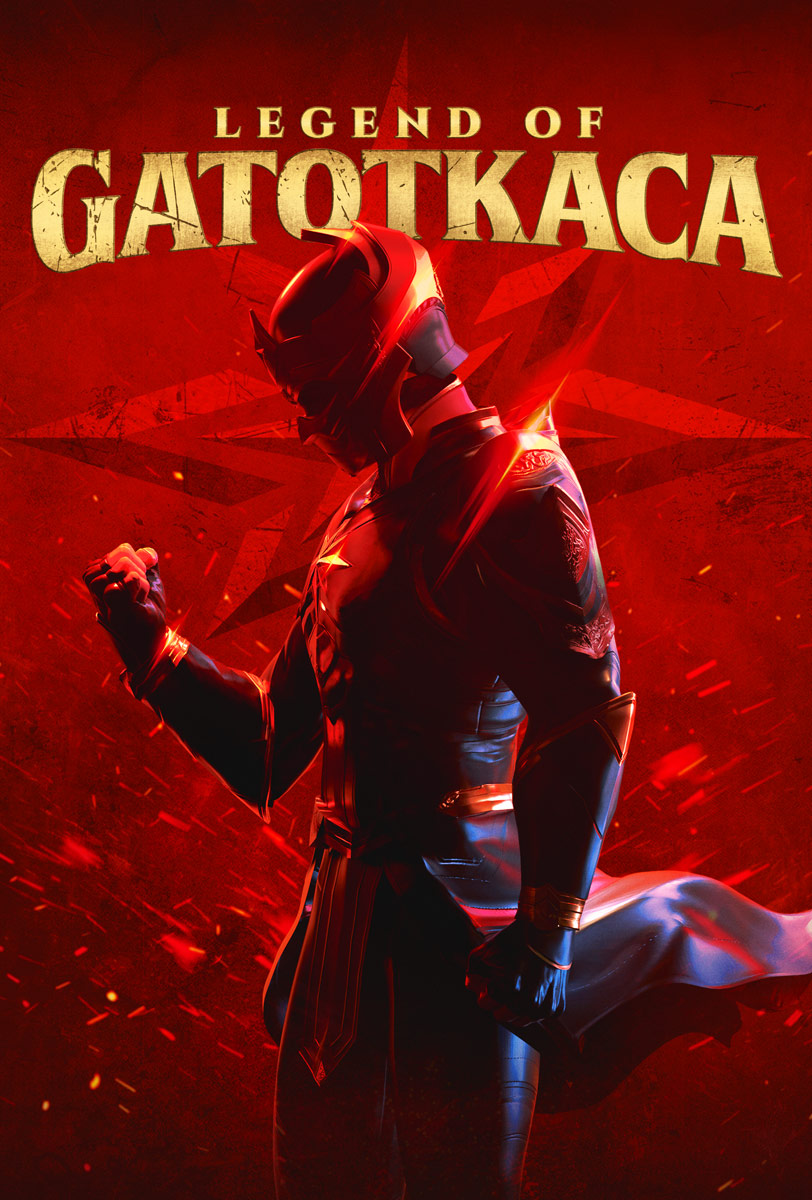
Indonesia has quietly been building its very own superhero cinematic universes over the past few years with Joko Anwar’s Gundala almost certainly the best known internationally. The Legend of Gatotkaca (Satria Dewa: Gatotkaca) is similarly intended to be the first in a new franchise, Satria Dewa, which draws influence from Indian mythology and is set in a dualistic world centuries after a battle between good and evil was ended by the gods to stop evil winning. 

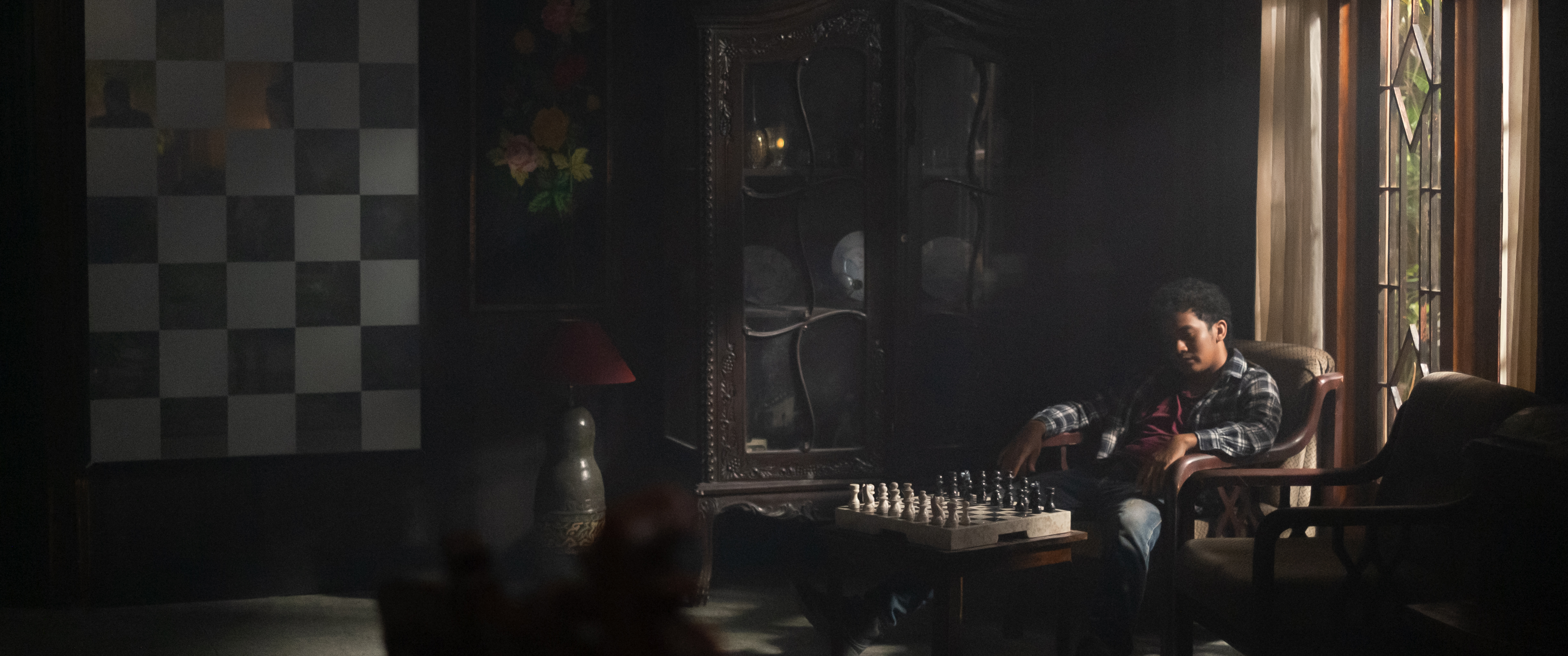
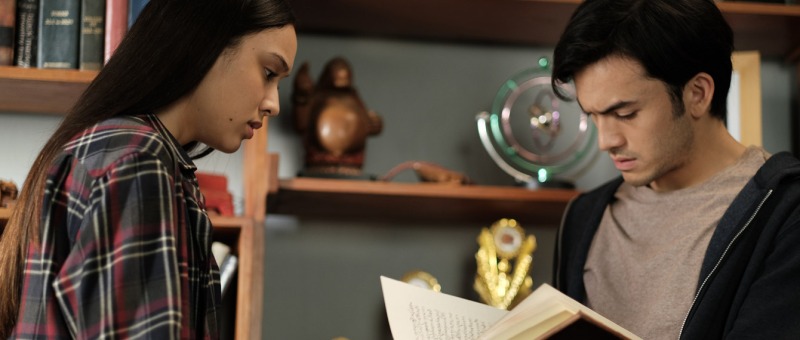
Essentially an origin story for the titular hero Gatotkaca, the film follows down on his luck photographer Yuda (Rizky Nazar) who had to drop out of university because he is poor and also responsible for taking care of his mother who is suffering with memory loss and mental illness following an incident 15 years previously in which the pair were attacked by a mysterious figure in black who could shoot lasers from his fingers. Yuda assumes his memories from back then must have been a dream and that his mother’s mental distress has more to do with his father, Pande (Cecep Arif Rahman), abandoning the family. Nevertheless, he is soon dragged into intrigue when his best friend Erlangga (Jerome Kurnia) is murdered in the same way his mother was attacked during his university graduation ceremony. Determined to figure out the truth, Yuda and professor’s daughter Agni (Yasmin Napper) find their way to a secret organisation Erlangga had been a part of which aims to save the world from destructive forces carrying the Kaurava gene. 

In the film’s dualistic world view, there was once a civil war between those carrying the Pandava gene which encourages good, humanistic qualities and the Kaurava whose impulses are dark and destructive. But then as Professor Arya (Edward Akbar) who studies such things points out, Pandava can also be destructive while Kaurava are capable of using their “destructive” qualities for good. Even so, most of the bad things that have happened in the world particularly in the last 15 years since a mysterious meteorite fell to earth, can be attributed to the rising Kaurava influence from political corruption to illegal logging and even the COVID-19 pandemic. Someone is bumping off Pandava in an effort to release evil Kaurava general Aswatama (Fedi Nuril) from his imprisonment within a giant gemstone which explains the “mysterious” deaths of talented people like Olympic sportmsmen and a doctor who discovered a COVID-19 vaccine. 

Of course, Yuda turns out to be a chosen one and must pursue his destiny as the defender of the Pandava before assuming his rightful role as Gatotkaca. Only by confronting his immediate family history can he make himself whole and gain the strength to defeat Aswatama, saving the world from chaos. Meanwhile he has to contend with a romantic subplot in which Agni is aggressively courted by the odious and entitled Nathan (Axel Matthew Thomas) and his father who have at least strong Kaurava energy aside from being embodiments of oppressive elitism looking down on Yuda simply because he is poor. The underground cell Yuda eventually comes into contact with are also in their way a resistance to this same elitism, though unusually well equipped in their incredibly expensive-looking lair filled with the latest technology and looked after by a kindly Indian granny who is herself a Karauna but uses her powers, and at one point a good old-fashioned shot gun, for good.

It’s this duality to which the film eventually returns as Yuda declares they must be the light in the darkness and the darkness in the light as they secretly wage a war against an ancient evil apparently already well established in the contemporary social order. This being the first instalment in what seems to be cued up as a burgeoning franchise, there is undoubtedly a lot to take in from the talk of heirlooms and amulets to holy water and ancient weapons though the film does boast some excellent production design even if the centralisation of genetics as an indicator of good and evil is equally uncomfortable. Nevertheless, it’s a promising start to the cycle with a series of exciting action set pieces showcasing the art of silat along with some impressive CGI in the Star Wars-esque laser warfare even if it’s clear Gatotkaca’s toughest battles are yet to come.


Legend of Gatotkaca streams in the US via Hi-YAH! from 17th February and will be released on Digital, blu-ray, and DVD on March 21 courtesy of Well Go USA.

International trailer (English subtitles)
Autobiography (Makbul Mubarak, 2022)

“It’s 2017. Forget about hierarchies. We are friends” a former general disingenuously reassures from the other side of the bars in Makbul Mubarak’s pointed exploration of the mediation of power in contemporary Indonesia, Autobiography. A young man with few prospects for the future is drawn towards authoritarianism by a charismatic father figure but is soon confronted by the realities of his quasi-fascist posturing only to discover that there may be no real escape from the violent world of toxic masculinity that he has unwittingly entered. 

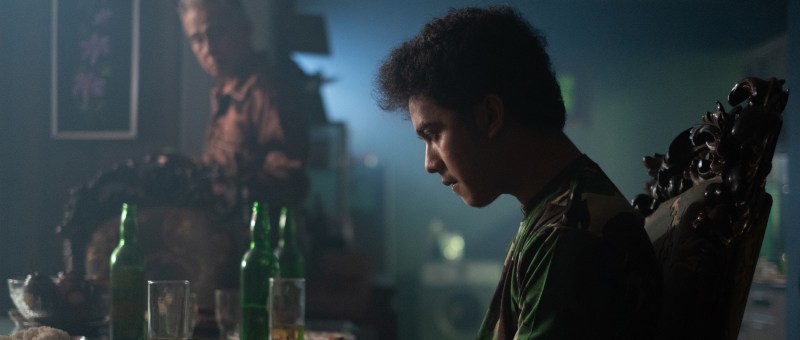
19-year-old Kib (Kevin Ardilova) lives alone in a vast mansion, the country home of a former general, Parna (Arswendy Bening Swara), who soon arrives unexpectedly with the intention of beginning his political career. Kib is quite obviously awestruck by the figure of the General, gazing at him like some long lost saviour drunk on the sense of power he exudes from every pore. On silently collecting the old man’s laundry, he stops to stare at a large portrait of him in uniform on the bedroom wall as if somehow thinking he too could one day be a fine general wielding such infinite power for himself. 

Such a thought might in a sense be transgressive. Kib is a servant in this house and as his father Amir, currently in prison for standing up to developers who were trying to steal his land, points out, their ancestors have always served the ancestors of Purna. Purna may tell him that no one cares about class anymore, but it obviously isn’t true or these two men wouldn’t be on opposite sides of the bars, or perhaps they would but their positions might be reversed. “Be careful who you trust” Amir tries to warn his son, but it’s already too late. Kib is ambitious. There’s something that bristles in him when Purna asks after his brother and wonders how well he can be doing as a migrant worker in Singapore with thinly concealed disdain in his voice. When Purna gives Kib an army shirt and says he looks just like him when he was young, a resemblance soon noticed by others, it flatters him to think he may be the General’s son rather than that of a mere servant turned convict. 

The more time he spends with Purna the more like him becomes, walking around with a swagger, exuding power and intimidation as if he really were a soldier not just a boy in a green shirt. Tragically he doesn’t even quite understand how this power mechanism works or what it’s implications are. When he accidentally bumps into a mosque while attempting a tight three point turn, local men surround the car demanding compensation. Purna gets out and puts on a show of authority. On realising what they’re dealing with the men instantly back down. Purna has a sheepish Kib apologise, and the men apologise to him, before explaining that sorry is a powerful word that can turn rage into blessing. What Kib fails to realise is that Purna is talking not about humility but intimidation, a mistake he learns to his cost in bringing a boy only a little younger than himself to Purna to “apologise” for disrespecting him expecting the General to pull the same trick again but shocked when events take a much darker turn than he’d anticipated. 

The boy he brought in, Argus, was the son of a woman whose coffee plantation would have to go if Purna got his hydroelectric plant approved. Purna sells the plant as a way of dealing with the problems caused by inefficient infrastructure but hides the corruption at its centre, forcing families off their land for the developers’ benefit through violence and intimidation. Argus is just as angry Kib, only he’s not falling for Purna’s sales patter. Kib watches the General shift the blame onto the developers, whom he backs and back him, while claiming to be a man of the people and giving a glib speech at the funeral of a boy he killed in nothing other than pettiness. 

Yet Purna is ageing and his grip on power may not be as firm as it once was while his seeming sentimentality in his attachment to Kib as a surrogate son is also a weakness. Kib may be deciding that being a migrant worker’s not as bad as becoming the heir of a man like Purna, but once you’re in it’s hard to get out as the ambivalent closing scene implies catching him dumbstruck once again only now like a general overseeing his troops and in one way or another a prisoner of his father’s house, a servant inheriting the mansion whether he wants it or not. In many ways a tale of seduction, Autobiography paints a fairly bleak picture of the contemporary society ruled by violent masculinity and fragile authority figures who quite literally visit their sins on their sons. 


Autobiography screens 15th/16th October as part of this year’s BFI London Film Festival.

Original trailer (English subtitles)