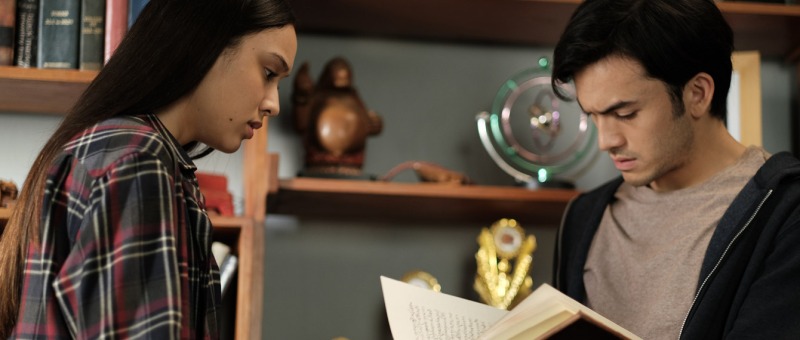

Four emerging female filmmakers explore the experiences of women in contemporary Indonesia in anthology film The Period of Her. Though in different styles and approaching the issues from different angles, each of the segments highlights the ways in which women suffer disproportionately due to double standards in a fiercely patriarchal culture, from being prevented from following their dreams to being trapped at home by an abusive partner expecting total obedience from his wife.
Perhaps the clearest indication of this is that the women are expected to scrub their sanitary pads to remove “dirty” blood even though they are disposable and will just be thrown away. Women are often seen trying to wash blood stains out of their clothes and towels as if expected to hide the evidence of their womanhood. Nisa gets her period during swimming training and is immediately forced to reckon with her sudden entrance into adulthood. Though she enjoyed swimming and was good at it, now that she is a woman it is no longer permitted. They tell her that she’s polluting the water, while it’s now improper for her to wear “revealing” swimming costumes. At first, she tried to keep it a secret from her school friends, but once they find out she has to dress differently, marking her out as an “adult”, though she is clearly still a child no different from the other girls. Though her male teammate doesn’t agree with the way she’s being treated and just wants to swim with her again, he is eventually picked to represent the school while Nisa is forced to retire. She takes a used, unscrubbed, sanitary towel and smears blood over the display cabinet featuring all her trophies and certificates for which the school has taken all the credit.
Nisa’s mother had also wanted to pursue her dream of swimming, but was pulled into an early marriage meaning she had to give it up which isn’t what she wants for Nisa. But motherhood is it seems the only role for a woman. Wati also turns down her husband’s sexual advances because of her menstrual cramps, but he too becomes angry and is apparently fed up with her inability to conceive a child after five years of marriage. He says this is the reason that he married her, but, at the same time, refuses to be examined by a doctor unwilling to consider that the issue may lie with him. His family have called her a failure as a wife, while Watik complains that she’s struggled for five years trying to prove her husband’s manhood. When she comes across an abandoned baby, it seems like all her problems are solved, though her husband is unhappy complaining that he wanted her to have his child, not raise someone else’s, and then bizarrely taking them both to a brothel in search of help.
Rendi, a cheating boyfriend, similarly says he can do what he likes and smirks that his girlfriend, Shela, wasn’t a virgin anyway so he doesn’t owe her anything even if they slept together. The girl she caught him with, Desi, tells her that Rendi said he was bored with her, though he’s evidently made no attempt to end the relationship or treat Shela as anything other than object. She can’t really challenge him, but becomes so enraged during the traditional dance she’s performing that the MC has to stop it for her safety. Nevertheless, she pretends to be possessed by a spirit to call Rendi out, seeing as he’s at the festival in the guise of a “virgin shaman”. Despite the animosity that might exist between them, the episode ends on a note of female solidarity as Shela and Desi share a drink on the way home, laughing together as they ride away on their motorbikes.
An inversion of this female solidarity can be seen in the final segment, Not Dead Enough, in which an overbearing husband drops dead of a heart attack after picking up a machete to attack his previously meek wife who has been pushed to breaking point by his uselessness. On waking up, he discovers himself in a world in which gender roles have been completely reversed. He is now bullied by his domineering wife and a host of female debt collectors, not to mention casually sexually harassed even though he’s not really allowed to go out of his house. He has only the solidarity of the other husbands who try to help and take care of him. In place of hijabs, they wear bicycle helmets on their heads, and are expected to serve their wives with absolute obedience. Experiencing period pain for the first time along with the threat of violence from his wife and other women, Kempas gets a taste of his own medicine and realises what it’s like to live as a woman in this society, though he never really gets the opportunity to put what he’s learned into practice and be a better man and husband. Each of the women is, in their own way, trapped by the patriarchal order and struggling to find a way to live while looked down on and dismissed by men who think it’s their birthright to be served and take each refusal as an assault on their manhood.
The Period of Her screens in Amsterdam 9th/10th April as part of this year’s CinemAsia Film Festival.
Trailer (English subtitles)