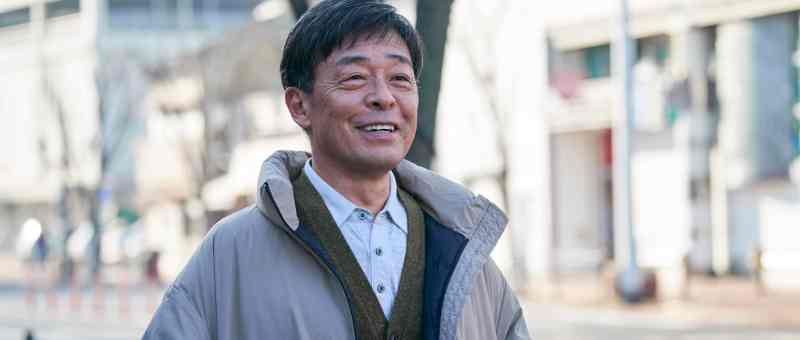
Dreaming in Between (逃げきれた夢, Ryutaro Ninomiya, 2023)

Everyone keeps asking Suenaga (Ken Mitsuishi) is if he’s okay. He has these tiny moments in which it looks like he’s on pause, sudden instances of stillness in which he stares vacantly into space. We start to wonder if he’s experiencing some kind of mental distress, having a stroke or developing dementia as those around him seem perplexed about his his behaviour which to us seems cheerful and pleasant. In fact, it seems confusing and unfair that he’s held in such contempt by his wife and daughter not to mention the pupils at his school and sullen young woman at the cafe he often frequents. 

A man of a certain age with a once overbearing father now mute and living with dementia in a retirement home, Suenaga is indeed undergoing a crisis of life. A year away from retirement, he begins to wonder what it was all for and how his relationship with his family became what it is today. He asks his wife Akiko (Maki Sakai) if they somehow gradually became estranged from each other in an impassioned speech in which he begs for love that neither she or his daughter are very minded to give him. Perhaps we can infer from the surprised reactions to his cheerfulness and attempt to take an interest in his daughter’s life that he hasn’t always been this way, though he too seems confused and perhaps not so much trying to make a mends but only to be his real self at what he fears may be the close of his life. 

When he surprises the waitress at a local cafe he goes to frequently by sitting in a different seat and then neglecting to pay the bill, it’s not really clear whether he actually forgot or did so deliberately as an attempt to assert himself. Likewise when he makes a clumsy attempt to embrace his now emotionally estranged wife or calls in sick to work it seems like more examples of his strange behaviour, yet Suenaga claims he’s becoming more of himself and on looking back over his life so far feels dejected and unfilled.

This  sense of mid life crisis is exposed in his conversation with Minami (Miyu Yoshimoto), the waitress at the cafe and an former pupil. He reveals that he wanted to become a head master but didn’t make it, and thinks he was only appointed deputy head because of picking up so many cigarette butts dropped by his rebellious charges, Minami is in many ways his opposite number, young and grumpy yet also grateful to him in another way restoring meaning to his life when she tells him that his words once saved her when he told her that she was fine the way she was. Even so she goads him a little, joking and maybe not really that he should give her his retirement money so she can have a better life. Echoing the opening conversation with his father, Minami hints she may soon quit the cafe to become a bar hostess or sex worker to save up before eventually emigrating Greece.

For all his teacherlyness, Suenaga seems to be a man who wants to be more understanding. He takes an interest in his pupils though they assume he doesn’t and again tells Minami that people should live the way they choose. In the rawness of their final parting, he tells her not to do anything she’ll regret but then adds that maybe she should, as if a life with no regrets is not really lived or perhaps reflecting that despite his own unhappy circumstances he does not really regret the life he’s lived. 

Filming in 4:3, Ninomiya makes great use of closeups, not least of Mitsuishl’s cheerful expression which somehow carries with it a great sorrow amid his own disappointments and yearnings. False or otherwise, there is something touching the connection of these dejected souls, the ageing teacher and the former pupil looking for permission to move on with her life but also teaching something to Suenaga in her sullen defiance and the eventual drive to keep going. Quiet and gentle if suffused with melancholy, Ninomiya’s poignant drama does indeed seem to argue that people in general are alright as they are but false acts jollity are as likely to confuse as console.


Dreaming in Between screens 1st June as part of this year’s Nippon Connection

Original trailer (English subtitles)

Angry Rice Wives (大コメ騒動, Katsuhide Motoki, 2021)

“Even if women try to do something, nothing will change” a condescending husband insists cautioning his wife not to take part in any more protests lest he lose his protected status and the family its source of income. Set in the middle of the Taisho era, Angry Rice Wives (大コメ騒動, Dai Kome Soudo) dramatises a small moment of revolution in which the resistance movement organised by a community of women towards the spiralling cost of rice sent shock waves through a changing society and in its own way provoked a change of course in an increasingly capitalistic society. 

Beginning in April 1918, the small fishing village of Toyama sees an exodus of its young men who must spend the off-season when the catch is low working other jobs in order to make ends meet, This necessarily means their wives and families are left behind and must make do with what they themselves can earn in doing menial jobs such as transporting rice and the little their husbands might be able to send before their return. A farmer’s daughter who married into the fishing community, Ito (Mao Inoue) is one of the few literate women in the village and looked to as a kind of oracle reporting the contents of the morning paper to the other wives who are keenly interested in the continually fluctuating price rice which seems set to rise still more with news that Japan plans to send troops to Siberia. 

As the voiceover relates, with the catch so low rice is the only form of sustenance available but prices have already exceeded what most of the women can earn in a day leaving them unable to feed their feed their families and giving rise to increasing discontent with the inequalities of the contemporary social order. Taking drastic action and led by eccentric old woman Kiyonsa (Shigeru Muroi), they stage a rebellion by intercepting their locally grown rice in order to stop it being sent to Hokkaido which is reported in the newspapers as an “uprising”. The term is indeed a little grand for what actually took place, but it does at least seem to spark a spirit of rebellion echoing around the country even if nothing much as changes in Toyama. Buoyed by a sense of wider support, the women continue their protests merely asking for the rice merchants to sell at a more reasonable rate (which they are perfectly capable of doing) while decrying the immorality of the obvious profiteering by corrupt authorities including local bigwig Kuroiwa (Renji Ishibashi) who are deliberately stockpiling rice to push the price up while planning to sell it to the government for a hefty price to feed their troops. 

Kuroiwa is entirely unsympathetic to the women’s predicament while the local police chief Kumazawa (Junichi Uchiura) believes himself indebted to him and is therefore entirely under his thumb. Neither of them think the women are much of a threat, Kumazawa randomly arresting a middle-aged man close to several of the women the rationale being as the husband of one puts it that women can never achieve anything no matter how hard they try but a man’s involvement in such rebellious activity would be cause for concern. Similarly, Ito is often told that her education is of no use, partly because the other women feel inferior for not having any, but struggles to find the self-confidence to standup to the corruptions of lingering feudalism owing to her liminal status as a non-native villager despite having given birth to three children there. Even so she is often looked to as a local problem solver and potential successor to Kiyonasa as leader of the village women if only she could learn to embrace the courage of her convictions. 

The children, by contrast have no such qualms, Ito’s young son Soichiro directly telling the profiteering proprietress of the rice store Mrs Washida (Tokie Hidari) that it’s her own fault another child stole food because if she hadn’t insisted in pricing her customers out to the point that they were starving she would never have needed to steal. “What exactly has capitalism done for us?” an opportunistic visitor from the workers party asks but receives short shrift from the cynical Kiyonsa who agrees they should rebel but is non-plussed by the flummoxed canvasser’s admission that he has no real plan for what do afterwards. Washida plays divide and conquer, pitting the women against each other and tempting even Ito with offers of under the table rice deals to feed their starving families if only they back down but though the solidarity of the women is temporarily ruptured it is never truly broken as they stand together to fight for fairness in the face of the Kuroiwas and Washidas of the increasingly capitalistic society. Their resistance eventually forces the government to backdown, realising they can’t simply ignore the plight of society’s poor or take their complicity for granted while attempting to starve them into submission. 


International trailer (English subtitles)

Insomniacs After School (君は放課後インソムニア, Chihiro Ikeda, 2023) [Fantasia 2023]

Two teens begin to overcome their fears and anxieties after bonding over their shared insomnia in Chihiro Ikeda’s adaptation of the Makoto Ojiro manga, Insomniacs After School (君は放課後インソムニア, Kimi wa Hokago Insomnia). It may seem strange in some ways that the pair find their inability to sleep so embarrassing that they keep it a secret from those around them, but then it’s difficult to tell people you’re having trouble sleeping without explaining why which is admittedly to enter the place of emotional vulnerability that each of them is otherwise avoiding. 

Namiki (Daiken Okudaira) describes himself as being overwhelmed by negative thoughts while his days are filled with despair. Unable to sleep at home he struggles to keep his eyes open at school and is otherwise reserved, rejected by many of his peers for being gloomy and aloof with only one real friend to whom he has disclosed his persistent insomnia. When he ventures into a part of the school others avoid thinking it is haunted, he discovers another “ghost” in classmate Isaki (Nana Mori) who also suffers from insomnia and had carved out this small corner of the disused astronomy club as a private lunchtime nap space. Luckily for him, Isaki, who is cheerful and outgoing, is willing to share and soon they become firm friends who decide that their empty nights of dark despair could otherwise be filled with fun and adventure. 

Neither of them really discuss why they aren’t able to sleep until their friendship is more deeply established and the facts emerge somewhat naturally but instead draw strength from their new connection while laying claim to their “sanctuary” in the school’s disused observatory as a place where they can find peace. Discovered by a teacher they have to keep up the pretence of restarting the astronomy club which means deciding on some sort of goal activity as proof that they have a right to the space all of which leads them down a secondary path that distracts them from their sleeplessness as they determine to put on stargazing events and enter a photography competition which requires a short sojourn in the country as well as making entreaties to their classmates for additional help and support. 

Then again, that might be contrary to their original wishes given that what they wanted from the observatory was a private place to sleep free from the stresses of their home lives which are in themselves fairly wholesome problems running from health anxiety to abandonment issues. Parallel scenes remind us that their struggles are largely the same, each has come to blame themselves for things which weren’t their fault and has developed a need to be seen as “good” which has led to chronic people pleasing and low self-esteem. But what their stargazing mission begins to teach them is that some things in life are beyond your control so there’s no point worrying about them, while the sense of eternity they discover watching the movement in the skies helps them overcome an adolescent fear of mortality in realising that “human existence doesn’t disappear so easily” and those who are gone still live on in the hearts of minds of others in the great confluence of humanity. 

Where night had been something to endure, they now find new ways to appreciate their lives in a world that seems more full of possibility than fear. Ikeda’s adaptation revels in its wholesomeness with even its slow-burn romantic subplot relatively innocent in its earnestness as the pair monologue over a voice notes app and quite literally lean on each other for support even if it’s not clear whether their insomnia actually improves or they just find better ways of living with it thanks to the new community they’ve found in the re-formed astronomy club which like most clubs is more about just hanging out than it is about serious study of the stars. Making the most of its picturesque small-town setting, the film discovers a quiet sense of serenity in the beauty of the landscape along with its ever expanding vistas in which the teens learn to overcome their mutual anxieties and embrace the infinite possibilities of life thanks to a true friendship founded on empathy and compassion.


Insomniacs After School screened as part of this year’s Fantasia International Film Festival.

Original trailer (English subtitles)

461 Days of Bento: A Promise Between Father and Son (461個のおべんとう, Atsushi Kaneshige, 2020)

“This is a story about my lunch every day. Nothing more, nothing less” the hero of Atsushi Kaneshige’s slice of comfort cinema, 461 Days of Bento: A Promise Between Father and Son (461個のおべんとう, 461ko no Obento), claims though it is of course something more than that. Based on an essay by musician Toshimi Watanabe who himself starred in Dad’s Lunch Box, Kaneshige’s gentle drama is another in the recent series inspired by the “papaben” phenomenon of fathers suddenly taking an interest in domestic matters by preparing tasty, nutritious and elegantly prepared packed lunches for their school-aged children. 

Obviously inspired by Watanabe’s real life, 461 Bento opens with cheerful home video footage of the early years of hero Kouki (Shunsuke Michieda) before shifting darker as the relationship between his parents begins to sour eventually ending in divorce. Kouki is given a choice whether to live with mum or dad, remaining behind in the family home with musician Kazuki (Yoshihiko Inohara) while his mum Shuko (Emi Kurara) moves out taking the tree they planted together with her. With the stress of the divorce, young Kouki ends up failing his high school entrance exams and is set back a year, eventually getting in the following spring. Hoping to encourage him, Kazuki offers to make a bento lunch every day for the next three years on the condition that Kouki pledges to not to skip school. 

In true papaben tradition, Kazuki ends up getting far too into the art of bento filling the kitchen with new gadgets while sometimes coming into conflict with his bandmates through investing all of his creative energies in innovative lunch recipes. Yet Kouki isn’t quite convinced by his father’s newfound passion, assuming it’s merely a new hobby he’ll soon get tired of rather than something he’s actively doing out of love for his son. Consequently, he’s originally a little embarrassed when his classmates appear unduly impressed by the quality of his dad’s work though it later helps him make a few friends which had otherwise been a little difficult seeing as he is a year older than everyone else. 

Being a year older continually weighs on Kouki’s mind, adding to the already onerous pressures of high school life his sense of anxiety intensifying as graduation nears. He complains he feels creepy hanging out with younger kids, and insists he can’t afford to fail and risk being held back again even older than everyone else at the beginning of college. Meanwhile he’s lowkey resentful towards his father blaming him for the end of his parents’ marriage while also seemingly ambivalent towards his mother for giving him the choice of where to live unfairly blaming her for leaving him even though it was his own choice to stay with his father. He rebels passive aggressively against his parents’ gentle support as they refuse to pressure him insisting he be free to do and be what he wants, while floundering in confusion over the next steps in his life. 

Kazuki is fond of telling him that everything will work out in the end, life’s not a race after all, only for Kouki to fire back that everything always works out for him because he just does whatever he wants and forces everyone else to go along with it which is why his mum left. Harsh words, but not without truth as new girlfriend Maka (Junko Abe) expresses something similar confessing that being with Kazuki makes her feel lonely and as he lives so defiantly in the moment it’s difficult to believe in the future of their relationship. Kouki cruelly tells Shuko he can choose a father for himself suggesting he might move in with his mother and her new boyfriend, but contrary to expectation Kazuki is serious about fatherhood giving his son the space for his adolescent angst while trying to be quietly supportive through his bento endeavours. 

The papaben phenomenon may be in itself a little sexist in exoticising a perfectly ordinary task just because it’s being done by a man thereby ironically reinforcing the idea that children’s lunches are a woman’s responsibility, but it does undoubtedly broker a reconciliation between father and son as the young Kouki begins to come to an understanding of his father’s love for him, overcoming the trauma of his parents’ divorce and gaining the courage to step forward into an independent future. A heartwarming coming-of-age tale, 461 Bento is about more than a boy’s lunch but also of the quiet power of unconditional love as mediated through the most ordinary act of care.


461 Days of Bento: A Promise Between Father and Son screened as part of this year’s Camera Japan

Original trailer (no subtitles)