Moonlight Whispers (月光の囁き, Akihiko Shiota, 1999)

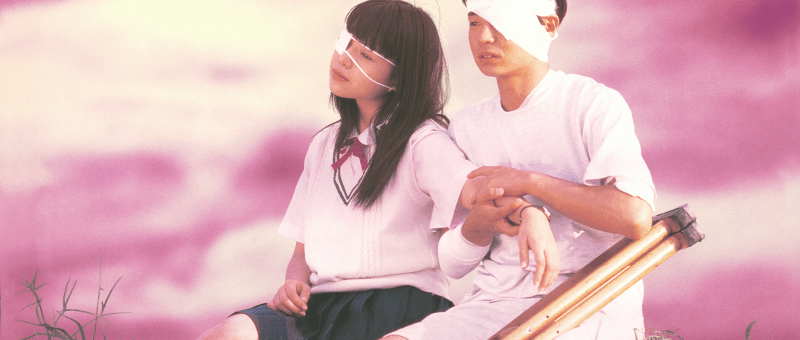
Well established in Japanese cinema, the teenage romance comes with its own series of genre tropes, the barriers standing between the young lovers usually leaning towards the constraints of a conformist society, class differences, or familial disapproval if not introducing a note of inevitable tragedy in serious illness or physical threat. What the youngsters typically do not do or are actively at times prevented from doing is to begin to accept themselves for all they know that to do so may in a sense result in their exile from mainstream society. Yet this is exactly the conclusion with which Akihito Shiota’s debut feature Moonlight Whispers (月光の囁き, Gekko no Sasayaki), adapted from the manga by Masahiko Kikuni, eventually presents us as the teens come to embrace their unconventional relationship while accepting that others may never truly understand. 

Beginning in conventionality, Shiota opens with the sweet and innocent friendship between kendo enthusiasts Takuya (Kenji Mizuhashi) and Satsuki (Tsugumi). Many seem to think they are a couple, but Takuya is quick to correct his friend telling him that they are merely “sparring partners” even going so far as to hand over a love letter, which he knows to be exactly the same as the letter his friend writes to all the other girls, on his behalf. As expected, Satsuki finds his behaviour insensitive, suspecting that Takuya himself has a crush on her but finally confessing her own feelings while he wheedles that he never said anything because of his sense of inadequacy explaining that just to be near her was always enough for him. Following this brief moment of connection, the couple embark on a “normal” teen romance, Satsuki taking the initiative with Takuya in bed with a cold to consummate their relationship. It does not go particularly well, in part because Takuya has a secret. He’s been secretly stalking Satsuki for ages, likes to break into her locker to smell her gym kit, and has a collection of keepsakes he’s stolen from her in addition to a series of illicit photographs and a tape of her using his family bathroom. The tape proves the last straw for Satsuki who then storms out calling him a freak and starts dating her handsome kendo club senior Uematsu (Kota Kusano) instead. 

What Satsuki hasn’t figured out is that Takuya quite likes it when she’s mean to him, which is why he continues stalking her even after she starts dating the very “normal” Uematsu. Unexpectedly, she begins to discover that she quite likes, if not quite the process of hurting him, then watching him suffer which is why she makes him sit silently in a tiny cupboard while she has “normal” sex with Uematsu on a sofa directly opposite. The relationship between them is one of push and pull, Takuya initially embarrassed and ashamed of his masochistic desires explaining that “god made me wrong” while ironically driving Satsuki towards an awareness of her sadism. On the other hand, the relationship had always been unconventional in its reversal of gender roles, Satsuki quite literally leading while Takuya trails behind. She is the first to openly state her feelings and the first to initiate sex, while Takuya is somewhat feminised in his deference and timidity.

Nevertheless, Satsuki struggles to accept her capacity for sadism refusing to tell Uematsu why she broke up with Takuya but explaining that she wants a “normal” relationship in with someone with whom she would be able to discuss anything and everything honestly the irony being that she might have had that with Takuya but cannot with Uematsu because she is filled with internalised shame about the “perverted” pleasure she gains on witnessing Takuya wilfully degrade himself on her behalf. They are already in an accidental sado-masochistic relationship though they of course do not quite have the words to describe how they feel or what it is that exists between them. Their love inevitably heads to quite a dark place but even so leads to a kind of rebirth in which each fully accepts themselves for who they are along with their designated role within the relationship even if also knowing that others may not be quite so understanding. 

For all of its provocative qualities, there is an underlying sweetness in Shiota’s unconventional romance even as he carefully inverts accepted genre norms the conventional indie background score perhaps ironically undercutting any sense that the relationship is actually as “perverse” as the teens sometimes feel it is even as they each struggle with their respective feelings and desires. Nevertheless he ends on a note of anxious ambivalence as the physically and emotionally wounded lovers remove themselves from mainstream society in order to embrace their authentic selves.


Original trailer (English subtitles)

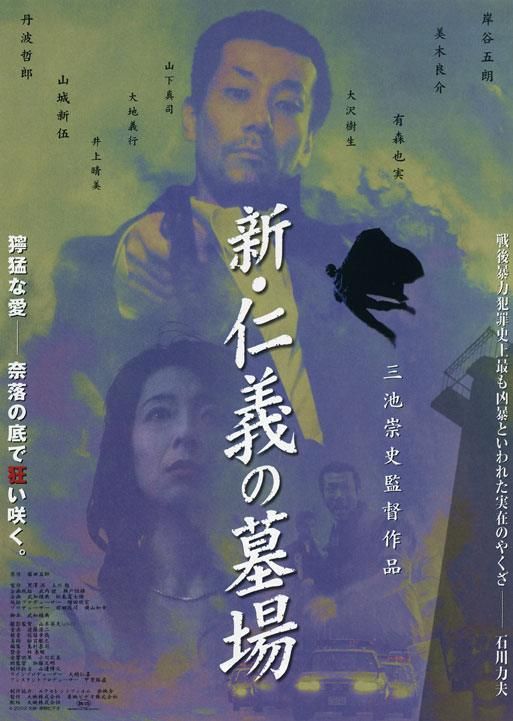
Graveyard of Honor (新・仁義の墓場, Takashi Miike, 2002)

In Kinji Fukasaku’s 1975 jitsuroku eiga Graveyard of Honor, a collection of voices open the film musing on whether the hero was corrupted by the times in which he lived or merely born crazy. Like most jitsuroku or true account gangster movies of the ‘70s, Fukasaku’s Graveyard of Honor is a post-war story about a man who failed to adapt himself to the rules of his society which was of course in constant flux though the rules of the yakuza are perhaps as fixed and timeless as any. Inspired by the same source material Takashi Miike’s comparatively subdued, contemplative Graveyard of Honor (新・仁義の墓場, Shin Jingi no Hakaba) maintains the moody, noirish feel of the ‘70s gangster drama complete with melancholy jazz score but updates the legend of Rikio Ishikawa to late 20th century Japan which again finds itself in crisis, floundering for direction and filled with despair. The bubble has burst in more ways than one as the young in particular awaken to the fact they have been deceived by the false promise that the good times of the Bubble years were cost free and would last forever leaving them abandoned in a world they no longer recognise as their own. 

Unlike Rikio Ishikawa who, we are told, always wanted to be a gangster, Rikuo Ishimatsu (Goro Kishitani) falls into the gokudo world by chance, his life thereafter one long fall until the bloody suicide with which the film opens. A bleach blonde dishwasher at a Chinese restaurant, he gets an offer he can’t refuse when he calmly defuses a would be assassin by hitting him on the head with a chair, earning the eternal gratitude of boss Sawada (Shingo Yamashiro) who takes him on and makes him his protege. This meteoric rise in the yakuza ranks, however, is not without its drawbacks especially in that it destabilises the internal politics of the Sawada gang with old retainers instantly resentful that this young upstart has leap frogged them to sit at the boss’ side while they’ve patiently put the work in only to be sidelined. 

A stretch in prison for avenging the boss’ honour brings him into contact with Imamura (Ryosuke Miki), later his sworn brother but also his opposing number, possibly the last honourable yakuza. “A yakuza without honour isn’t worth shit” Imamura’s boss later remarks, instructing him that Rikuo is a liability he’ll have to take responsibility for, but in this graveyard of honour that kind of responsibility is the one that will get you killed. Honourable yakuza can no longer survive in the world of corporatised thuggery that is the modern gokudo existence. Later we realise that the tale is being narrated by Rikuo’s former underling, Kikkawa, who reminds us that “even yakuza are human beings” existing within a social structure with clearly defined rules which must be followed, yet the rules themselves are largely superficial and Kikkawa survives because he subverts them, abandoning the reckless Rikuo for the certainty of Sawada and setting himself on the traditional gokudo path of sucking up to the boss in the constant hope of advancement. 

Kikkawa is, in a sense, the grovelling salaryman to Rikuo’s frenzied maverick, one as much they symptom of the age as another. Rikuo’s rise occurs against the economic boomtown of Japan in the ‘80s which is as much a paradise for gangsters as for anyone else but also a kind of twilight, the yakuza as an institution relegated to the Showa era and the post-war past. Gangsters forced out of their families like the desperate ronin of the feudal era further destabilise an already chaotic environment which, like that of the post-war years, is filled with despair and disillusionment only to be further disrupted by the advent of natural disaster and economic collapse. 

Like the yakuza of the jitsuroku, those of Miike’s Graveyard of Honor struggle to reorient themselves in a changing society, no more equipped to deal with economic stagnation than their forbears were for the end of occupation and the increasing irrelevance of gangsterdom in a world of economic prosperity. Increasingly paranoid and anxious, Rikuo sees betrayal in all quarters and remains essentially powerless, eventually imprisoned in what appears to have been previously used as a child’s bedroom. He seeks escape in drugs which he finds by chance, and then in romance with an equally powerless woman who bizarrely seems to have fallen in love with him after he brutally raped her though their strange, drug-fuelled quasi-wedding ceremony is the tenderest, most vulnerable we ever see them. Yet as the opening scene implied, all there is is futility. Knowing what he knows, Kikkawa meditates on his memories of happier days when he was just a minion at Rikuo’s side. In this graveyard of honour only the slippery survive and the only way to be free is to fall, and fall hard. 


Original trailer (English subtitles)