A Family (ヤクザと家族 The Family, Michihito Fujii, 2020)

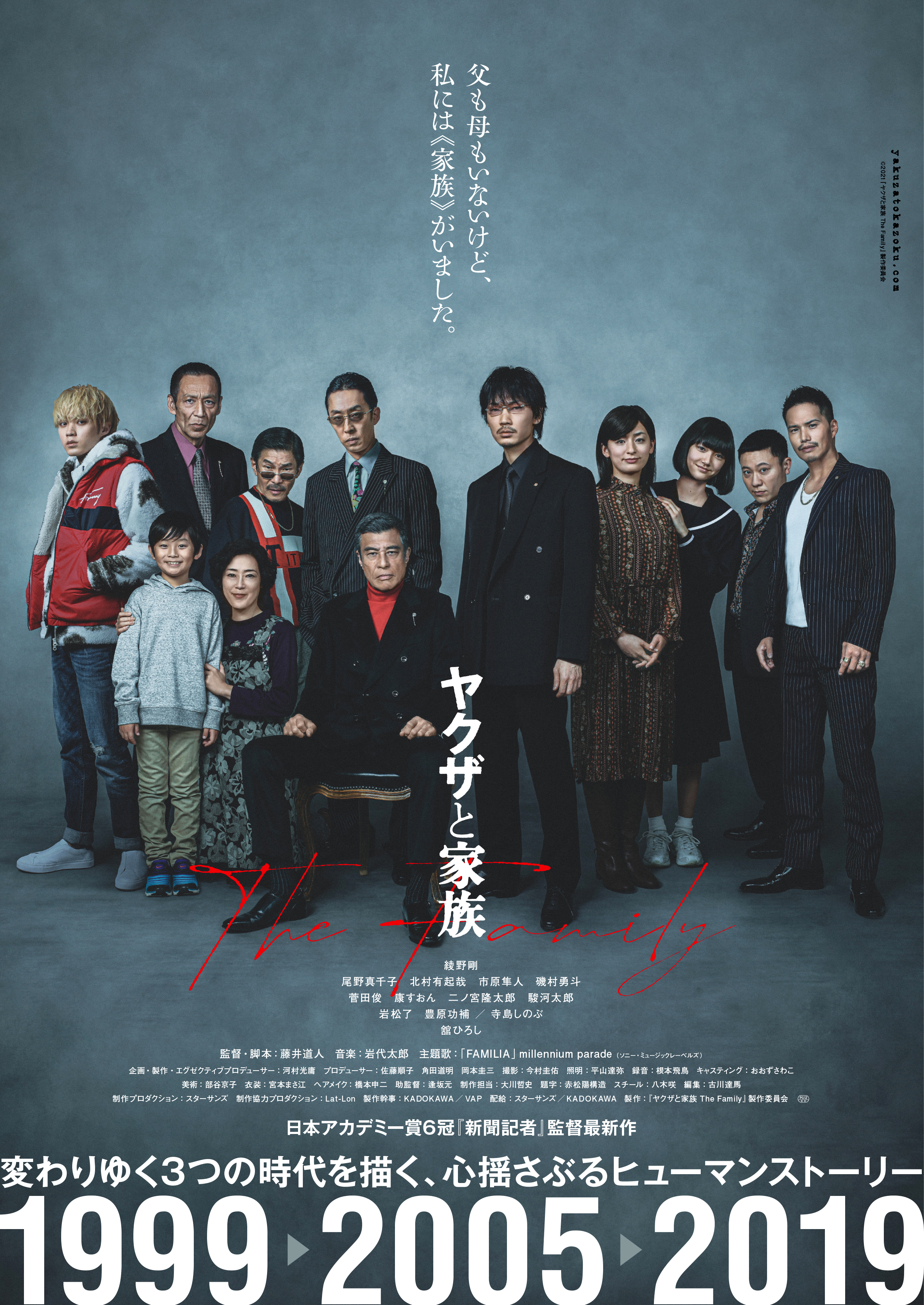
“No one can survive as a yakuza in this world” according to another orphaned son playing the long game of a crime adjacent existence in Michihito Fujii’s melancholy gangster drama, A Family (ヤクザと家族 The Family, Yakuza to Kazoku The Family). The yakuza, or at least yakuza in the movies, has long been a relic of the Showa era rendered increasingly irrelevant in a society no longer in need of its dubious claims of protection. In truth, it’s hard to mourn the passing of organised crime, but Fujii at least finds a kind of pathos and infinite sympathy for these men for whom the gangster brotherhood took the place of a family even if one with a self-destructive legacy. 

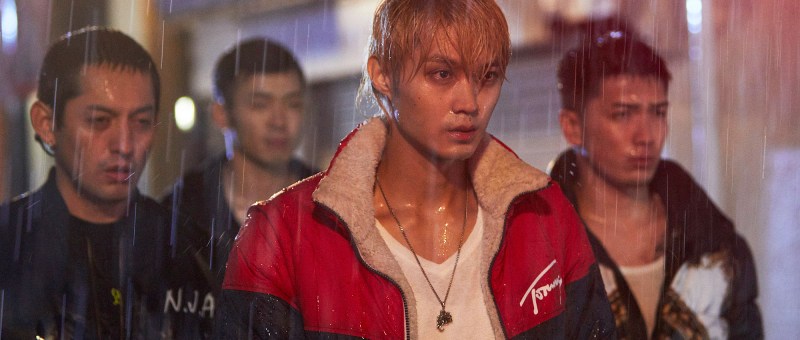
To begin with, petty street punk “Li’l Ken” (Go Ayano) wants nothing to do with the yakuza, seemingly the only guest at the funeral of the drug dealer father he resented other than a corrupt cop from the organised crime squad, Osako (Ryo Iwamatsu), who expresses regret that had he simply arrested him perhaps Ken’s father would be still be alive. Visiting another “familial” environment, a Korean barbecue run by the maternal Aiko (Shinobu Terajima) herself the widow of a gangster currently with a baby on her back, Ken gets himself noticed by local mobster Shibasaki (Hiroshi Tachi) by taking on some punks who stormed into the restaurant and attacked his guys. Explaining that his guys don’t associate with drugs, Shibasaki offers him a job which he refuses but having his card in his pocket literally saves his life when he’s pickup by rival gang leader Kato (Kosuke Toyohara) after having stolen and then destroyed some of their stash after stumbling across a drug deal. The course of Ken’s life is set, he joins the Shibasaki gang along with his two delinquent friends and accepts Shibasaki as his “oyabun” or “father”. 

In Shibasaki, Ken finds a father figure more palatable than the one he lost. As in many a yakuza movie, the Shibasaki clan is positioned as “good yakuza” of the old school kind who believe in things like duty and honour and are apparently pursuing the path towards becoming “true men”. The rival Kyoyo, by contrast, are “bad” new yakuza who no longer play by the old rules and make their money through destructive vices such as drugs. The expected turf war does exactly materialise though the uneasy truce between the rival gangs becomes increasingly strained as the economic situation of millennial Japan begins to shift, the local town council apparently set on demolishing the red light district as part of their plans for redeveloping the city. Kyoyo would rather take over its entirety, pushing Shibasaki to retreat in exchange for a small amount of monetary compensation while shady cop Osako tries to play the situation to his own advantage. 

Yet it’s also clear that the yakuza as an institution is on its way out. After a 14-year prison term, Ken emerges into a very different world in which organised crime has been hounded further into the margins thanks to effective, though the film would also argue inherently vindictive, legislation. No one can make any money anymore, and the slightest slip up can lead to arrest. The Shibasaki gang is now a handful of old men, most of the guys having moved on only moving on from the yakuza life is not easy as Ken’s old friend Hosono (Hayato Ichihara) explains. In order to rejoin regular society, a former yakuza must endure five years in the wilderness unable to open a bank account or get a regular job leaving them with few possibilities for basic survival that enable them to leave a life of crime. Now with a young daughter and job in waste disposal, Hosono is nervous and reticent, reluctant to be seen in public with Ken lest he be tarred with the criminal brush and lose access to the new life he’s managed to build for himself as a responsible husband and father. 

Urged by Shibasaki, Ken eventually leaves one family for another in reuniting with a woman he loved before prison who has since made a respectable life for herself as a low level civil servant but once his life of crime is exposed by a thoughtless colleague at his new job in deconstruction, he discovers that there is no place for a “reformed” yakuza in the contemporary society because in a sense there can be no such thing. Once gangster always a gangster, there is no path forward. Complaining that Osako has stolen his right to life, Ken is told only that the yakuza lost human rights long ago. 

“They’re my family. No reasons are needed” Ken replied when asked why he became a yakuza, but he continues to find himself torn between the various concepts of family and the inheritances of his two very different father figures. “Your time is over old man”, Aiko’s fatherless son Tsubasa (Hayato Isomura) tells an unrepentant Kato attempting to hang on to his territory in the face of a younger generation operating on an entirely different level, rejecting the codification of gangsterdom but seemingly embracing its romance. Tsubasa too is later sucked in by the hyper masculine revenge drama of the yakuza way, seeking vengeance for the death of his father and apparently prepared to ruin his life in order to gain it. It’s for this surrogate son, now a kind of father figure himself, that Ken will eventually make a sacrifice. A sad tale of dubious paternal legacies, frustrated fatherhood, life’s persistent unfairness, and a perhaps uncomfortable lament for a bygone Japan defined by giri/ninjo conflict ruled by manly men, the ironically titled A Family has only sympathy for those trapped by an inescapable spiral of manly violence but also reserves its respect for those who know their time has passed and elect to end the cycle in order to set their “sons” free. 


Original trailer (no subtitles)

All About Lily Chou-Chou (リリイ・シュシュのすべて, Shunji Iwai, 2001)

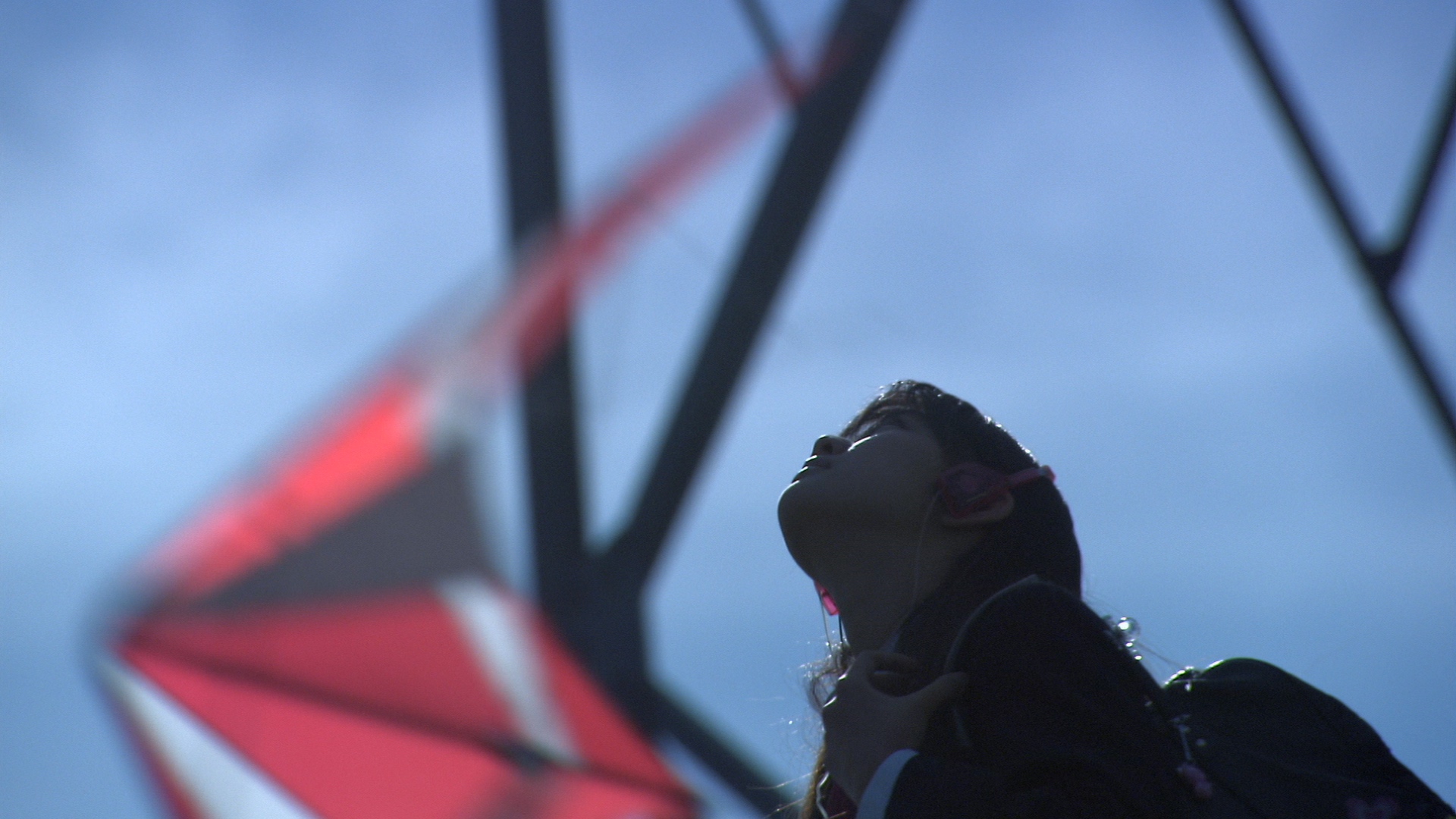
“For us the natural world is a playground. But for the things that live in it, it might be hell on earth.” a middle-aged stranger explains to a confused teenage boy elaborating on a metaphor about a strangler tree that wraps itself around its brethren and suffocates them to death. The contemporary society is indeed a hell on earth to the alienated turn of the century teens in Shunji Iwai’s plaintive youth drama All About Lily Chou-Chou (リリイ・シュシュのすべて, Lily Chou-Chou no Subete) who have found solace in “The Ether”, “a place of eternal peace” as discovered in the music of a zeitgeisty pop singer inspired by the ethereality of Mandopop star Faye Wong. 

Filled with millennial anxiety, The Ether as mediated through message board chat is the only place the teens can be their authentic selves. “For me only the Ether is proof that I’m alive” one messenger types using an otherwise anonymous online handle unconnected with their real life identity. Iwai often cuts to the teens standing alone listening to music on their Discmans while surrounded by verdant green and wide open space with a bluer than blue sky above, but also at times finding that same space barren and discoloured, drained of life in, as Yuichi (Hayato Ichihara) puts it, an age of grey much like a field in winter. For Yuichi the world ended on the first day of school in September 1999 when his torment began at the hands of a previously bullied boy who decided to turn the tables after, of all things, getting hit in the head by a flying fish in Okinawa and almost drowning.  

Purchased with money stolen from some other bullies who had just stolen it from a well-off middle-aged man they were harassing in a carpark, the trip to Okinawa captured in grainy ‘90s holiday video style later subverted by the same use of contemporary technology to film a gang rape of a fellow student, is the event that finally reduces Yuichi’s world to ashes. Like the other teens he is also carrying a sense of alienation as his mother prepares to remarry while carrying his soon-to-be stepfather’s child which also dictates that Yuichi will have to change his surname lending a further degree of instability to his already shaky sense of identity. For Hoshino (Shugo Oshinari), his sometime friend, the instability seems to run a little deeper. “Nobody understands me” he tells Yuichi with broody intensity, irritated by the image others have of him as a top swat chosen to give a speech at the school’s opening ceremony and widely believed to have placed first in the exams. In truth he only placed seventh and is most annoyed that whoever really did come top probably thinks he pathetically lied about it for clout. 

We can see that Hoshino’s family appears to be wealthy, at least much more than Yuichi’s, though as we also discover they once owned a factory which has since gone bust amid the economic malaise of the ‘90s leading to the disintegration of his family unit. Like Yuichi he feels himself adrift, evidently bullied in middle school for being studious and introverted while rejected by the girls in his class who again attack him because of his model student image. Hoshino seems to have a crush on a girl who is herself bullied, Kuno (Ayumi Ito), apparently resented by the popular set for being popular with boys. “It’s amazing how women can ostracise someone like that” band leader Sasaki (Takahito Hosoyamada) reflects, one of the few willing to call her treatment what it is but finding no support from their indifferent teacher Miss Osanai (Mayuko Yoshioka), while entirely oblivious to the fact that the boys are just the same in Hoshino’s eventual reign of terror as a nihilistic bully drunk on his own illusionary power. 

Shiori (Yu Aoi), blackmailed into having sex with middle-aged men for money, questions why she and Yuichi essentially allow themselves to be manipulated by Hoshino and are unable to stand up to him even when they know they are being asked to do things that they find morally repugnant such as Yuichi’s complicity when tasked with setting Kuno up for gang rape by Hoshino’s minions with a view to videoing it for blackmail purposes. Whether or not he did in fact have a romantic crush on her, Hoshino’s orchestration of the rape signals his total transformation, forever killing the last vestiges of his humanity and innocence but for Yuichi, who can only stand by and cry, it signals the failure of his resistance that if he went along with this there is no line beyond which he will not go if Hoshino asks it. Yuichi asks Shiori why she didn’t agree to date the kindhearted Sasaki who would have been able to shield her from Hoshino but she knows it’s too late for that while suggesting Yuichi is in a sense protecting her though his inability to do so only further erodes his wounded sense of masculinity. 

Only online can the teens find the elusive Ether they dream of, ironically connected via a message board that Yuichi runs under the name Philia where the only rule is that you have to love Lily yet unknown to each other thanks to the alienating effect of their online handles. Someone has a point when they suggest all this talk of polluting the Ether sounds a bit like a cult, but does at least give the teens their safe space where they can share their pain free of judgement and find solidarity in adolescent angst. In any case all of this shame, repression, and loneliness is later channeled into nihilistic violence and cruelty provoked by millennial despair. The only way Yuichi can free himself is by killing the part of himself that hurts in an effort to quell the “noise” in his head. Broken by title cards accompanied by the reverberating sound of typing in emptiness, Iwai’s characteristic soft focus lends a trace of nostalgic melancholy to this often harrowing tale but also neatly encapsulates turn of the century teenage angst with the infinite sympathies of age. 


All About Lily Chou-Chou screens at Japan Society New York on Dec. 10 as part of Love Letters: Four Films by Shunji Iwai

Original trailer (English subtitles)

Blade of the Immortal (無限の住人, Takashi Miike, 2017)

blade of the immortal posterGenerally speaking, revenge tends not to go very well in Japanese cinema. It has the tendency to backfire. When you’re immortal, however, perhaps revenge is risk worth taking – then again, it’s not your life your weighing. Takashi Miike is no stranger to the jidaigeki world, though in adapting Hiroaki Samura’s manga Blade of the Immortal (無限の住人, Mugen no Junin) he harks back to the angry, arty samurai films of the late 1960s from Gosha’s Sword of the Beast with which the manga features some minor narrative similarities, to Kobayashi’s melancholy consideration of corrupted honour, and the frantic intensity of Okamoto’s Sword of Doom.

The film opens in black and white as a disgraced samurai, Manji (Takuya Kimura), tries to protect his younger sister, Machi (Hana Sugisaki), who has gone mad through grief only to see her murdered by a bounty hunter. Manji enters a state of furious, mindless killing which leaves the bounty hunter’s vast crowd of henchmen lying dead and Manji mortally wounded. Consumed by guilt and having lost the sister who was his sole reason for living, Manji longs for death but a mysterious old woman who calls herself Yaobikuni (Yoko Yamamoto) has other ideas and curses Manji to a life of eternal suffering by means of sacred bloodworms which give him the power of infinite, near instant healing.

Fifty years later, the land is at peace under the Tokugawa Shogunate but peaceful times are dull for warriors. The Itto-ryu school of swordsmanship has a mission – to take over all of the nation’s martial arts facilities and restore power to the sword. They have no honour or ideology save that of kill or be killed and are content to use any and all weapons which come to hand. A young girl, Rin (Yoko Yamamoto), is a daughter of one of these schools and has her eyes set on becoming a top swordswoman herself but when the Itto-ryu show up at her door, Rin’s father’s training proves worthless as he’s cut down with one blow while the gang kidnap Rin’s mother. The Itto-ryu’s sole concession to morality is in letting Rin alone, seeing as it’s “vulgar” to toy with children.

Rin vows revenge on the Itto-ryu’s leader, Anotsu (Sota Fukushi), at which point she runs into Yaobikuni who recommends she track down Manji and hire him as a bodyguard. Fifty years of immortality have turned Manji into an isolated, embittered wastrel with rusty swordskills but Rin’s uncanny resemblance to Machi eventually begins to move his heart. Despite generating a master/pupil, big brother/little sister relationship, Manji fails to teach Rin very much of consequence that might assist her in her plan to avenge her family, leaving her a vulnerable young woman beset by enemies and random thugs, and eventually caught up in a government conspiracy. The irony of Manji’s life is that he’s just not very good at the art of protection and all of his attempts to do something good usually provoke an even bigger crisis, in this case leaving his new little sister open to exactly the same fate as the one he failed to save for much the same reasons. Apparently, Manji has learned little during his extended lifetime except how to brood and glare resentfully at the world.

It turns out being immortal is kind of a drag. Manji wants to die because he can’t cope with the burden of his guilt, but another similarly cursed man he meets has lived much longer and lost far more, becoming tired of the business of of living. Manji’s existence has lost all meaning, but as he puts it to another world weary warrior who shares his brotherly grief, he’s not the only hero of a sad story. Rin’s need for vengeance gives him a purpose again – not just in the literal revenge, but in being the protector (though one could argue this is less positive than it sounds and might explain why he fails to teach Rin anything very useful, even if it doesn’t explain why she also forgets all her father’s teachings).

Rin remains conflicted over her mission of revenge, confessing to a similarly conflicted assassin that she agrees killing is wrong but that right and wrong no longer matter when it comes to people you love. A dangerous and dubious assertion, but it does bear out the more positive message that love, or at least learning to live for others, can be a transformative force for good as Manji allows himself to resume his role as the big brother despite his past failings. Violent and visceral, if also humorous, Blade of the Immortal is, oddly enough, a story of love but also of cyclical paths of violence and revenge, and of the general muddiness of assigning the moral high ground to those engaged in a quest for retribution.


Blade of the Immortal was screened as part of the BFI London Film Festival 2017 and will be released in UK cinemas courtesy of Arrow Entertainment on 8th December.

International trailer (English subtitles/captions)

700 Days of Battle: Us vs. the Police (ぼくたちと駐在さんの700日戦争, Renpei Tsukamoto, 2008)

700days-of-battleThose golden last few summers of high school have provided ample material for countless nostalgia filled Japanese comedies and 700 Days of Battle: Us vs. the Police (ぼくたちと駐在さんの700日戦争, Bokutachi to Chuzai-san no 700 Nichi Senso) is no exception. Set in a small rural town in 1979, this is an innocent story of bored teenagers letting off steam in an age before mass communications ruined everyone’s fun.
In the summer of 1979, a group of teenage high school students get their kicks pulling pranks around the neighbourhood. They finally meet their match when a new policeman, Chuzai (Kuranosuke Sasaki), arrives in town intent on actually enforcing the law. When one of the boys is fined for speeding after coming down a steep hill on his bicycle, the guys decide to make Chuzai their new enemy, virtually daring him to arrest them with their constant trolling.

However, things take a turn when the boys move their prank planning meetings to a local cafe and discover the beautiful waitress working there, Kanako (Kumiko Aso). Instantly smitten the boys step up their romance game (donning some fancy outfits in the process) and semi-forget about their mission. Unfortunately Kanako is a married woman and worse than that she’s married to Chuzai! This whole thing just got real.

Chuzai, for all his uptight authoritarianism is onto the boys and their generally innocent mischief. Finding it all very irritating rather than actually dangerous, Chuzai gradually starts playing them at their own game by attempting to prank them back such as in one notable incident where he makes them attend a public behaviour seminar but gives the entire lecture through a ventriloquist’s dummy called Taru-kun. As a slightly older man, Chuzai can see the boys are just hopelessly bored in their backwater town. Breaking with his hitherto austere persona, Chuzai drops the authoritarian line to offer some fatherly advice to the effect that these summers are precious times,  soon the boys’ high school lives will be over and they’ll most likely leave their pleasant small town for the bustling metropolis of Tokyo so they’d better make the most of these aimless days while they can.

Idyllic as it is, the nature of the boys’ mission changes in the second half as the war against Chuzai takes on a slightly more affectionate quality. At this point they decide to use their pranking powers for good to help a little girl who’s stuck in the hospital finally enjoy the summer fireworks she’s been longing for even though the doctors won’t let her out to go to the festival. With the fireworks heist hovering in the background the guys get into various romanctic difficulties while enjoying archetypal teenage summer adventures.

Infused with period detail, 700 Days of Battle: Us vs. the Police has an authentically ‘70s soundtrack with some of the biggest hits of the era running in the background. Frequent cultural references such as a brief appearance from Ultraman add to the atmosphere which has a kind of retro, nostalgic innocence behind it as these kids live in a golden era of friendship and bike riding when the sun is always shining and graduation is still a long way off.

Director Tsukamoto keeps things simple though the production values are high and visual gags are spot on. Somewhat episodic in nature, the tale is split up into various chapters by means of title cards which helps to break up the seemingly endless summer as the boys attempt to fill their otherwise empty days. Apparently this was only the beginning of the “war” against the police, occupying only 108 days of a “conflict” which would finally run to 700. Presumably the guys have finished up their high school days by that point but at least they’ve succeeded in making some amusing memories of their elaborate and sometimes fiendishly clever schemes to take revenge on the surprisingly patient Chuzai-san. Filled with innocent, witty and whimsical comedy 700 Days of Battle: Us vs. the Police offers no great leap forward even within the realm of quirky teen comedies but still manages to provide some old fashioned, wholesome summer themed fun.


Original trailer (English subtitles)

Yakuza Apocalypse (極道大戦争, Takashi Miike, 2015)

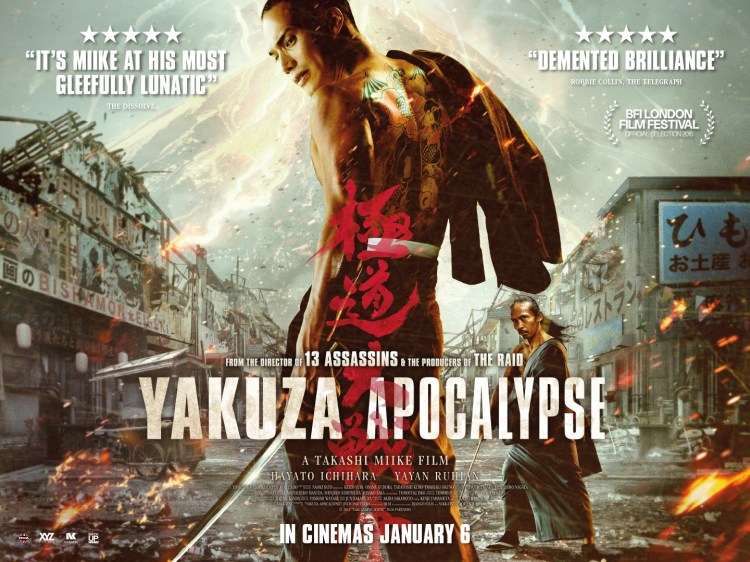
Yakuza-Apocalypse-Quad-HalfSize-NEWBelated review from the 2015 London Film Festival – Yakuza Apocalypse is released in UK cinemas for one day only on 6th January 2016 courtesy of Manga who will also be releasing on home video at a later date.


Takashi Miike shuffles back towards the yakuza plains in the western inspired horror comedy Yakuza Apocalypse (極道大戦争, Gokudo Daisenso) trailing ever more zany humour behind him. Yakuza gungslingers, bloodsucking, high school girls running away from things and, finally, a guy with a magic belly button wearing a frog suit who just happens to be “The World’s Toughest Terrorist”.

We open in media res as vampire yakuza boss Kamiura (Lily Franky) cuts up a storm in settling some local disputes. There’s a handy voice over from our soon to be protagonist, Kageyama (Hayato Ichihara), lamenting the old yakuza world of tough guys and honour codes but things don’t really take off until a very geeky looking guy and a Van Helsing type in 17th century attire suddenly turn up hoping to re-recruit the boss to “The Syndicate”. When he refuses, they fight and the geek twists Kamiura’s head right off. Using his last ounce of strength and in a touch right out of Hausu, Kamiura clamps onto Kageyama’s neck turning him into a vampire. However, in his just turned state, the honourable Kageyama turns a few more vampires of his own – and not only vampires, the bite also transmits yakuzaism too. This increase in bloodsucking gangsters is a bit of a problem for the regular guys as it does mean their pool of victims is being steadily depleted…

Not making much sense is not generally much of a problem in a Miike film. In fact, it’s a pretty much a given at this stage of the prolific director’s career. However, in the case of Yakuza Apocalypse it’s even more pointless than usual to pay any attention at all to any kind of narrative. Looking over Kageyama’s shoulder, we move from set to piece to set piece as, first of all, the non-vampire yakuza guys struggle for power between themselves and then with the vampire variety before the giant frog turns up to ruin everything.

There are some rules, Miike takes a while explaining to us how this yakuza business works with Kamiura as the “good” kind of yakuza committed to protecting his townspeople above all else – essentially, he’s the sherriff around these parts. He’s a vampire, yes, but he only feeds on yakuza who he’s “reforming” by means of an underground knitting circle held prisoner in his basement. Apparently yakuza blood tastes bad and isn’t very good for you but eating civilians is dishonourable and anyway, limited in supply, because when you turn someone they also become a foul mouthed yakuza fighting machine.

The world building is shaky at best, none of this really hangs together making for a fairly disappointing series of one note jokes. There is an attempt at a bit of more sophisticated satire with the regular gangsters suddenly lamenting that there will be no one left for them to prey on if everyone turns yakuza vampire but otherwise it’s crazy piled on crazy. Not a bad thing in itself but somewhat lacking in substance.

Despite that, the film offers some quality performances notably from its lead, Kageyama, played by Hayato Ichihara, as the yakuza who’s so sensitive his delicate skin won’t allow him to get a proper yakuza tattoo. That is, until he becomes a brooding, conflicted vampire mourning the loss of his boss and of those long held tough guy ideals. Lily Franky also offers a high impact though short lived appearance as the honourable vampire boss with a hinted at backstory, though the much publicised cameo of The Raid’s Yayan Ruhian feels a little wasted as he’s just generally hanging around for a handful of fight scenes. That said, the action scenes themselves are extremely impressive, both exciting and often funny too.

Yakuza Apocalypse is not one of Miike’s most well thought out efforts. Its collection of crazy ideas feels thrown together and there’s disappointingly little depth to its world building. Even its media res conclusion looks more like running out of ideas than a deliberate decision. However, that’s not to say it isn’t heaps of fun, which it often is. A crazy frog riding a bicycle who somehow wakes up the giant king of the crazy frog people after some kind of emergency plaster is ripped off his belly button – really, what could be more fun than that? That really is all there is though and those who prefer their absurdist action thrills with a little more substance had best look elsewhere.


Yakuza Apocalypse is in released in UK cinemas for one night only on 6th January 2016. Luckily the film is playing across the UK even if it’s only the one night and you can see if it’s on anywhere near you by checking out this handy link! If it’s not, don’t despair! It’ll also be available in all the normal ways from Manga later in the year.

Reviewed at the 2015 BFI London Film Festival.